Hospital and clinic software built around clinicians
Patient intake and booking, clinical documentation, bed boards, billing and claims, rostering, radiology workflow and discharge follow-up, connected to the systems hospitals already run.
What hospitals and clinics software has to get right
Clinical software fails when it adds clicks to someone who is already short of time. The systems that work fit the way a ward, a front desk or a radiology team already moves, and connect to the record system instead of asking staff to type things twice.
Health data also carries the strictest rules most teams will meet: who may see a record, what must be logged, and what happens when something goes wrong. These are designed in from the first screen.
Problems we are asked to fix
The problems teams bring to us, the system that fixes each one and the builds that did it.
Patient intake and online booking
Front desks spend hours on phone scheduling and paper intake forms.
Online booking and digital intake forms, with risk answers routed to a clinician before the visit.
AI clinical scribe and specialty EHR
Clinicians spend evenings on notes.
A scribe that drafts the note for the clinician to edit and sign, and charting built for the specialty's own workflow.
Bed and capacity management
Hospitals cannot see bed availability in real time.
A live bed board fed by admission, discharge and transfer messages, with patient flow across sites.
Hospital billing and claims
Claims are denied for coding and eligibility errors.
Coding and eligibility checks before a claim is sent, so errors are fixed while the patient is still in the building.
Staff rostering
Nurse and doctor rosters are built in spreadsheets.
Rosters and call-outs with the union and labour rules built in, so a valid roster is the easy one to make.
Radiology information system
Radiology worklists are unbalanced and reports are slow.
One flow from order to signed report, with balanced worklists and HL7 and DICOM connections.
Discharge follow-up
Patients are readmitted because follow-up after discharge is missed.
Scheduled follow-ups after discharge, nurse triage of the answers and a handover to community care.
HL7 and FHIR integration
New systems must talk to the hospital record system through HL7 v2 feeds.
Interfaces that read HL7 v2 messages and FHIR APIs, with monitoring for failed messages.
12 kinds of hospitals and clinics system we have built
Each one links the product build behind it, counted from our case studies.
- Atalaya - Radiology workflow
- Baken - Lab results portal
- Berth - Bed & capacity management
- Clinica - Clinic operations platform
- Loupe - Specialty EHR
- Lyrebird - Patient intake & scheduling
- Mizani - Pharmacy management
- Quillon - AI clinical scribe
- Recado - Patient feedback
- Singil - Medical billing
- Varde - Discharge follow-up
- Watchbill - Staff rostering
Hospitals and clinics products we built
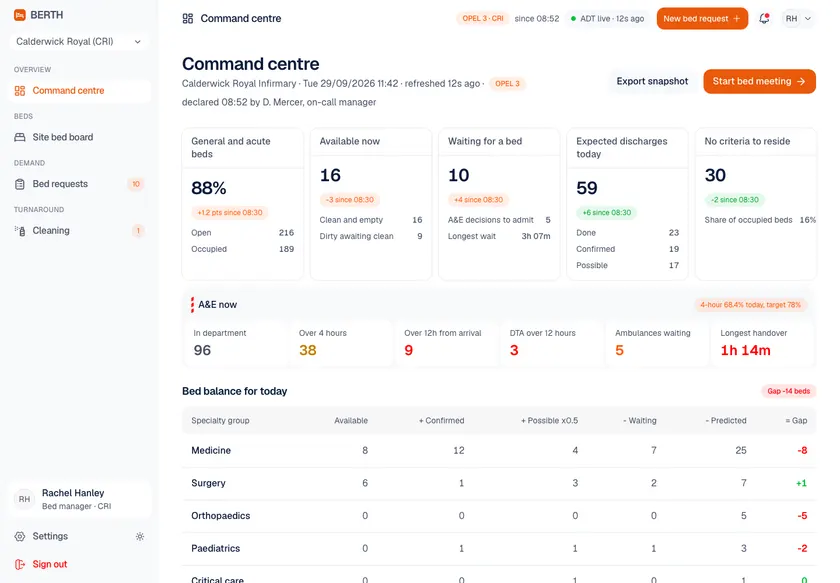
Berth - Live Bed Board and Patient Flow for a Two-Site NHS Hospital Trust
Designed and built a clickable bed and capacity management system for a two-site NHS acute trust: a command centre with the day's bed balance, a live bed board for every ward and bay, a bed request queue that suggests safe beds with reasons, and a cleaning board that turns dirty beds around for the patients waiting on them.
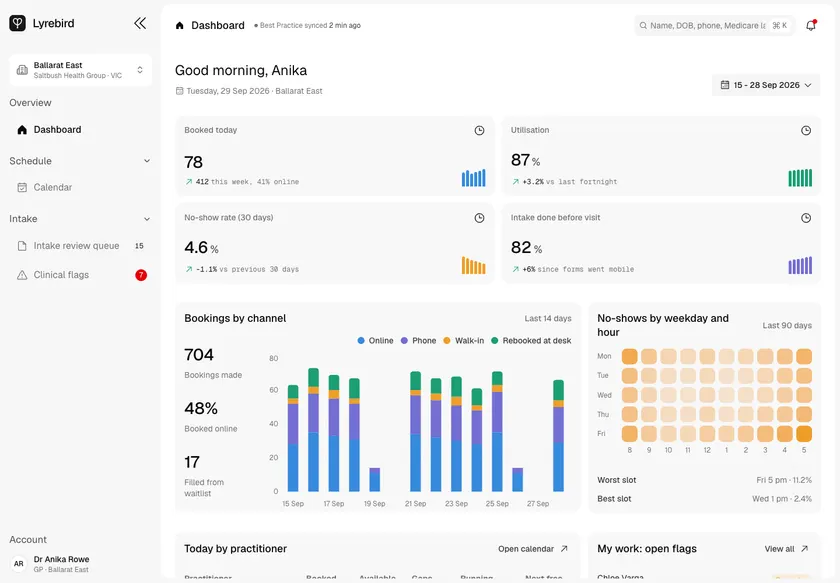
Lyrebird - Patient Booking and Intake Platform with Clinician-Routed Risk Flags
Designed and built a clickable booking and intake platform for a group of GP, physiotherapy and psychology clinics in regional Victoria and southern NSW: a day calendar by practitioner or room, pre-visit forms reviewed before the visit, and a clinician-only queue that puts every risk answer in front of a clinician against a response target.
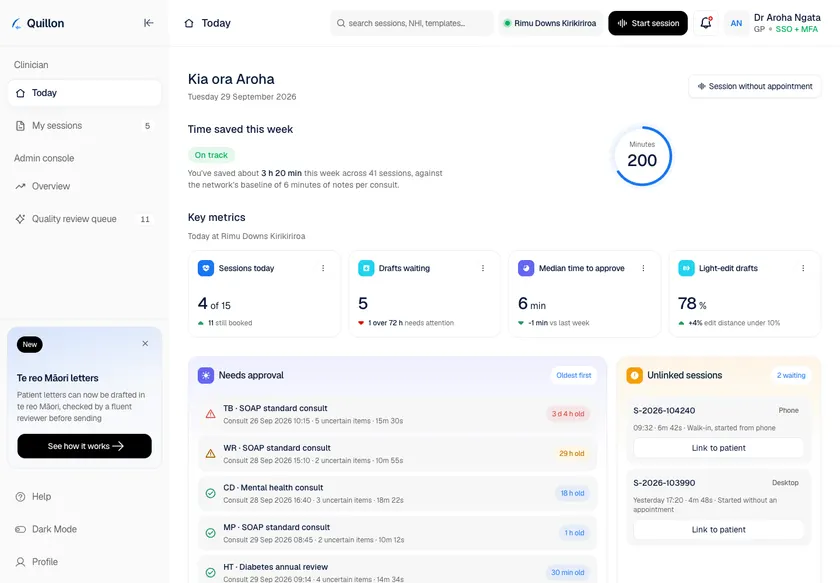
Quillon - AI Clinical Scribe That Drafts the Note and Leaves the Clinician in Charge
Designed and built a clickable ambient AI scribe for a network of 14 New Zealand general practices: consent before recording, a structured draft note with every uncertain item flagged, SNOMED CT code and follow-up suggestions, approve and push to the practice management system, and an admin console for safety, retention and quality review.
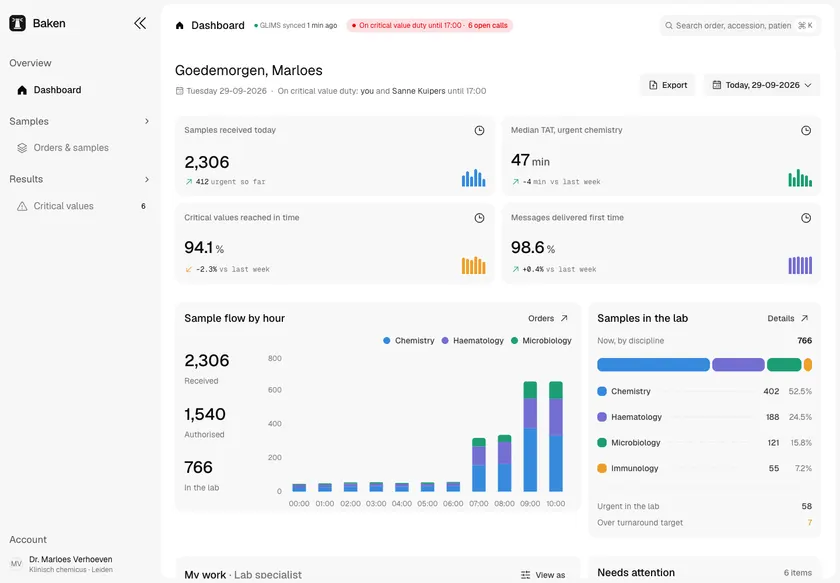
Baken - Lab Results Portal with Critical Value Calls and Read-Back
Designed and built a clickable lab console for an ISO 15189 accredited laboratory in Zuid-Holland: follow every order and sample from collection to storage, read validated results with flags, EUCAST susceptibility and release state, and phone critical values against a deadline with a logged call chain and a read-back check.
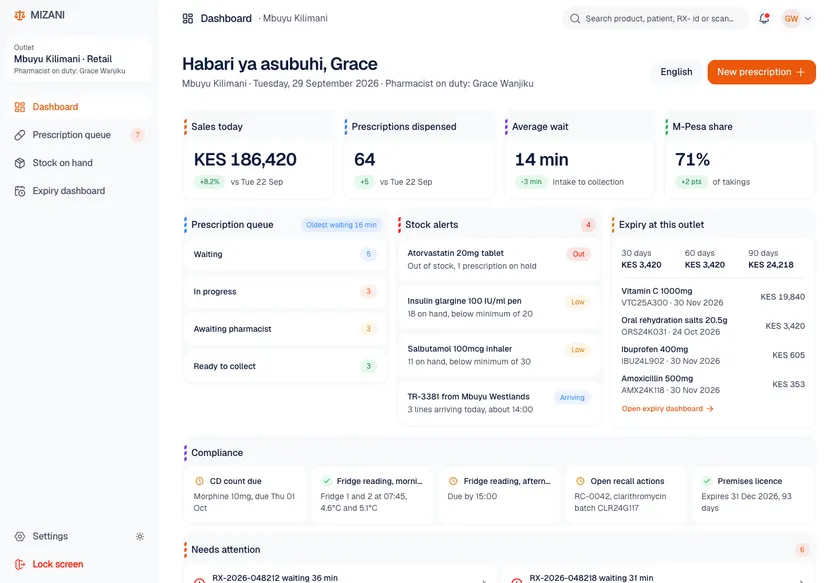
Mizani - Pharmacy Chain Management with Batch-Level Stock and Safe Dispensing
Designed and built a clickable pharmacy management platform for a Kenyan chain of 40 retail and hospital outpatient pharmacies: a prescription queue, a dispensing workspace with batch picking by expiry, safety checks, bilingual labels and the controlled drugs register, batch-level stock, and an expiry dashboard that suggests what to do with every batch at risk.
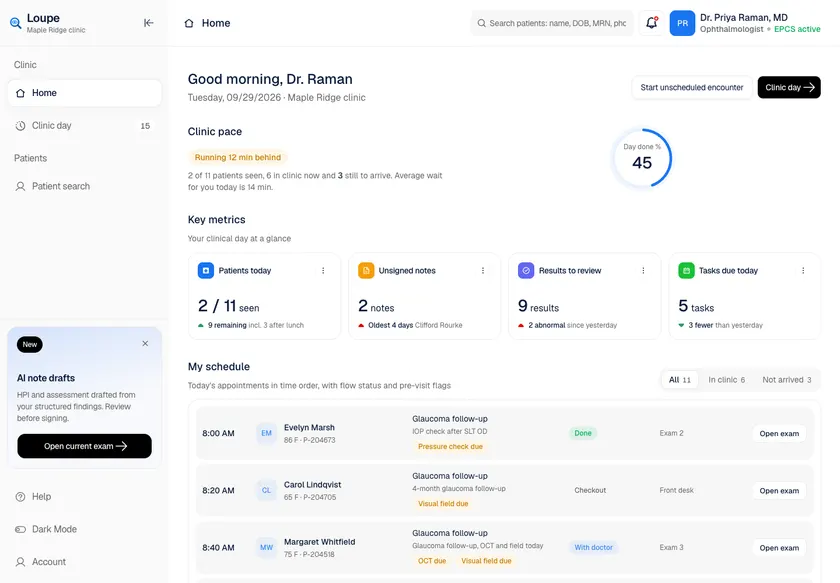
Loupe - Ophthalmology EHR with Per-Eye Charting and Laterality-Aware Coding
Designed and built a clickable ophthalmology EHR for a US eye care group with seven clinics: a clinician's day at a glance, a live patient flow board with dilation timers, patient search with break-the-glass access, a chart summary with right-eye and left-eye findings side by side, and a structured exam workspace per eye.
The rules involved
The rules this kind of software usually has to follow. Guidance, not legal advice.
- 01
Health privacy
HIPAA in the US, and the GDPR plus national health data laws in Europe and elsewhere, set who may see a record and what must be logged.
- 02
Medical device rules
Software that diagnoses or guides treatment can be a medical device under the EU MDR or FDA rules. AI in such devices is high-risk under the EU AI Act.
- 03
Interoperability
HL7 v2, FHIR and DICOM are how hospital systems talk. In the US, the 21st Century Cures Act also bans information blocking.
- 04
Clinical safety
Some health systems require clinical risk management for software, such as DCB0129 and DCB0160 in England.
- 05
Accessibility
Patient-facing apps and portals often must meet WCAG 2.1 AA or similar standards.
Framework guides
Rules our hospitals and clinics builds cite most
- HL7 v2 ADT2
- WCAG 2.1 AA2
- 21st Century Cures Act1
- CMS MIPS1
- CNO registration1
- COFEPRIS health advertising1
- CSG Patient Safety Essential Actions1
- Data Privacy Act (RA 10173)1
- Data Protection Act 20181
Two ways to work with OceanLab
Project build
We design and build the system as one project. It starts with a clickable prototype your team tries before any production code is written. Pay per milestone (outcome-based) or hourly at $30-50/hr, depending on role and seniority.
Embedded engineers
Our engineers join your team on a flexible monthly retainer. Part-time is fine and it runs month to month, with hours that overlap the US, UK and Europe, the Middle East, and Australia and Asia. Outcome-based or $30-50/hr.
Guides and tools
Hospitals and clinics software questions
Can you connect to our hospital's record system?
Yes, through the interfaces it offers: HL7 v2 feeds, FHIR APIs or DICOM for imaging. Some of the builds on this page read admission, discharge and transfer messages from the hospital system.
Do you build AI for clinical work?
Yes, with the clinician in charge. Our AI scribe drafts the note and the clinician edits and signs it. Nothing clinical is sent without a person's review.
Which health rules do you design for?
The ones that apply where the product runs. Our clinic builds cite rules from many countries, such as HIPAA in the US, NHS standards in England and national health data laws in Europe.
