Quillon - AI Clinical Scribe That Drafts the Note and Leaves the Clinician in Charge
Ambient AI Scribe for a New Zealand Primary Care Network
Designed and built a clickable ambient AI scribe for a network of 14 New Zealand general practices: consent before recording, a structured draft note with every uncertain item flagged, SNOMED CT code and follow-up suggestions, approve and push to the practice management system, and an admin console for safety, retention and quality review.
Most of our work is under NDA. Per agreement, we can share the work but not the company details - all names and identifying information shown here have been changed.
Impact
Today, My sessions, Draft review, the admin overview and the quality review queue, with the consent, link session, approve and push, and discard modals working on local state.
Low audio confidence, not clearly stated, medicine name uncertain, dose not stated, possible speaker mix-up and number unclear. Approve and push stays disabled until each one is confirmed, edited or deleted.
Audio is deleted when the note is approved, or after 7 days if a session is abandoned. Transcripts go after 30 days, and sessions past that window show "Transcript deleted".
22 sessions, 15 of today's appointments, 3 full drafts with transcripts (diabetes review, SOAP and mental health), 22 quality reviews and 3 model versions across Medtech Evolution, Indici and MyPractice.
The Problem
Rimu Downs GPs run 15-minute appointments and, by the network's own time-and-motion survey, were spending 90 to 120 minutes a day on notes, referrals and letters, much of it after hours. Notes were typed with eyes on the screen, and some clinicians had started using consumer AI note tools on their own phones with no consent step, no idea where the audio went and no way for the network to check the output.
Our Solution
Quillon records the consult only after the patient's consent is logged, drafts a structured note in the clinician's chosen template, flags anything it is unsure of and suggests codes and follow-up actions. The clinician checks, edits and approves the note, which is then pushed into the practice management system. An admin console shows usage, safety incidents, retention health and a quality review queue that samples real sessions.
The Challenge: An AI Draft the Clinician Can Trust and Sign
A scribe saves time only if clinicians can check its draft quickly, and the network can approve it only if consent, privacy and accuracy are handled in a way that New Zealand health law and professional guidance accept.
Notes Eating the Day
Fifteen-minute consults left no room to write a full note, so documentation spilled into evenings. Typing during the consult pulled the GP's attention away from the patient, which patients noticed and disliked.
Shadow AI Without Consent
Clinicians trying consumer AI tools on their phones meant audio of consultations going to unknown places. The Code of Health and Disability Services Consumers' Rights requires informed consent, and declining must not affect care.
Drafts That Can Be Wrong
A model can omit details, mishear a medicine name or dose, swap a speaker or turn "no chest pain" into "chest pain". The Medical Council's guidance keeps the doctor responsible for the record, so every error has to be easy to spot before signing.
Privacy and Data Sovereignty
The Health Information Privacy Code 2020 limits what is collected and how long it is kept, and Te Mana Raraunga's Māori Data Sovereignty principles shape the network's approach. Data had to stay onshore where possible, never train vendor models, and get NZ medicine names and Māori names right.
Our Approach: From Clinical Governance Rules to a Clickable Scribe
Spec and Rules Research
Mapped 10 roles from GP, nurse and supervised registrar to reception, quality reviewer, clinical safety lead, privacy officer, network admin and the patient. Specified 30 screens across the clinician desktop app, a mobile companion, the admin console and public patient pages, plus the data model for sessions, consent, drafts, suggestions, letters, quality reviews, incidents and model versions. Wrote down the rules the design follows: the Privacy Act 2020 and HIPC, the Code of Rights, Health NZ and Medical Council guidance on AI, the retention regulations, HISO 10029, NHI handling and SNOMED CT.
Clickable Demo on a Production UI Kit
Built 5 key screens on a production dashboard kit: Today with drafts awaiting approval aged at 24 and 72 hours and the day's appointments with opt-out chips, My sessions with filters and retry push, Draft review with uncertain items, source evidence, SNOMED CT codes, suggested actions and pushed or push-failed states, the admin overview with KPIs, safety strip, retention health and a 12-week usage chart, and the quality review queue with its sampling rule. All actions run on local state.
What a Production Build Adds
Integration with Medtech Evolution (via the ALEX API), Indici and MyPractice for appointments, patient context and note write-back, speech-to-text and a drafting model in New Zealand or approved Australian regions, SNOMED CT NZ Edition and the NZ Universal List of Medicines, Microsoft Entra ID single sign-on with MFA, and an append-only audit log. Plus the remaining screens: live session, patient letters in English and te reo Māori, dictation, the mobile companion, templates, vocabulary, consent and retention settings, incidents, models and the public patient pages.
Why It Works: The Clinician Signs, Quillon Only Drafts
Uncertainty Is Shown, Never Hidden
Uncertain sentences are highlighted amber with the reason, and a section where nothing was said reads "Not discussed" instead of an inferred finding. Clicking any sentence opens the transcript lines it came from, with timestamps and speaker labels.
Suggestions, Not Actions
SNOMED CT codes and follow-ups such as a podiatry referral or HbA1c in 3 months each need accept or reject, and actions are labelled "Suggestion only - action in the PMS". Checks before approval list medicines not on the PMS list and any allergy conflicts.
Consent and Privacy by Default
Recording cannot start until consent is recorded, using a script in English or te reo Māori with fields for a representative when the patient is under 16, and a standing opt-out blocks the session. NHI numbers stay masked until Reveal is clicked, and the admin overview tracks audio held past policy, which should be zero.
Accuracy Measured Before Rollout
The quality review queue samples 5% of sessions per clinician per month, every session linked to an incident, all sessions in a clinician's first 14 days and an extra 10% on pilot models. The overview shows error rates by type, from omission to negation errors, and which model version each practice runs.
Related case studies
View all: Hospitals & clinics
Clinica - Multi-Department Clinic Operations Console with AI Assistant
Built a multi-department clinic operations console with appointment management, department load tracking, staff performance, resource utilisation and an AI assistant for staff queries - shipped from clickable AI prototype to production in 14 weeks.
Loupe - Ophthalmology EHR with Per-Eye Charting and Laterality-Aware Coding
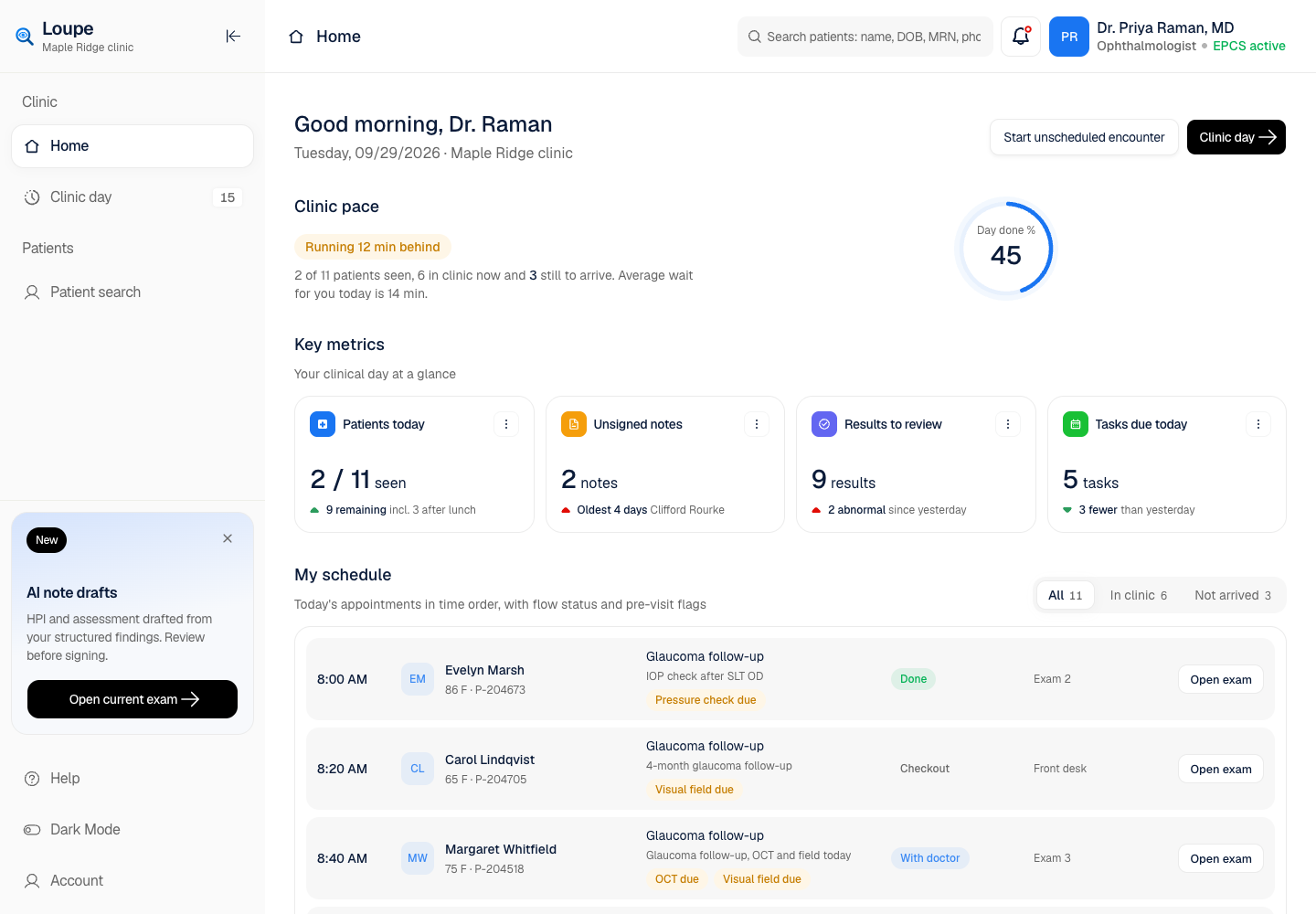
Designed and built a clickable ophthalmology EHR for a US eye care group with seven clinics: a clinician's day at a glance, a live patient flow board with dilation timers, patient search with break-the-glass access, a chart summary with right-eye and left-eye findings side by side, and a structured exam workspace per eye.
Enterprise Software Engineering - Human + AI
Contact Us
© 2026 - Copyright. All Rights reserved Oceanlab
Location
Global Headquarters
21 Merchant Road, 3rd Floor, Singapore 058267
Main corporate office and leadership operations
North America Office
548 Market Street, PMB 12345, San Francisco, CA 94104
Client operations and business development
India Office
402 Shivalik Shilp II, SG Highway, Ahmedabad 380015
Engineering and delivery center

Enterprise Software Engineering - Human + AI
Contact Us
Locations
Global Headquarters
21 Merchant Road, 3rd Floor, Singapore 058267
Main corporate office and leadership operations
North America Office
548 Market Street, PMB 12345, San Francisco, CA 94104
Client operations and business development
India Office
402 Shivalik Shilp II, SG Highway, Ahmedabad 380015
Engineering and delivery center
© 2026 - Copyright. All Rights reserved Oceanlab