Loupe - Ophthalmology EHR with Per-Eye Charting and Laterality-Aware Coding
Specialty EHR for a US Eye Care Group
Designed and built a clickable ophthalmology EHR for a US eye care group with seven clinics: a clinician's day at a glance, a live patient flow board with dilation timers, patient search with break-the-glass access, a chart summary with right-eye and left-eye findings side by side, and a structured exam workspace per eye.
Most of our work is under NDA. Per agreement, we can share the work but not the company details - all names and identifying information shown here have been changed.
Impact
Home, clinic day board, patient search, chart summary and exam workspace. Each of the 22 demo patients opens their own chart, and each of the 21 encounters opens its own exam.
Eye summary cards, slit lamp and fundus rows, IOP and visual acuity trends sit right and left side by side, and problem codes carry the matching laterality character, such as H40.1122 for moderate glaucoma in the left eye.
Minutes in status turn amber after 20 and red after 40, the client's policy, and the dilation timer marks a patient ready 25 minutes after drops. Every move on the board goes to a session log.
Glaucoma, cataract, macular degeneration, diabetic retinopathy and post-op profiles, with 21 encounters, 9 staff users, 9 rooms, 7 clinics and 4 surgeries booked this week.
The Problem
Cedar Hollow used a general-purpose ambulatory EHR built around primary care. Every finding was typed twice, once per eye, into free-text boxes with no place for pressure with its tonometry method, a cup-to-disc ratio or a retina drawing. Technicians re-keyed device readings, imaging arrived as scanned PDFs with no trend, and missing or wrong eye codes were the group's most common billing rejection.
Our Solution
Loupe charts the eye clinic's day in eye-care terms. Technicians and doctors record findings for the right and left eye side by side, the chart shows pressure and vision trends per eye against the target, the flow board tracks every patient and dilation timer, and diagnoses carry laterality that must match the eye they describe.
The Challenge: Two Eyes, One Record
Eye care runs on paired findings, device data and tight coding rules. Seven clinics, 22 ophthalmologists and optometrists and about 60 technicians needed one record that understood all three.
Every Finding Comes in Pairs
Visual acuity, pressure, lens grading, cup-to-disc ratio and fundus findings differ by eye. A primary care template forced each one into free text twice, and glaucoma patients' pressure history sat across three screens.
Laterality Lives in the Code
In the ICD-10-CM eye chapter a character position carries the eye: 1 right, 2 left, 3 bilateral, 9 unspecified, and glaucoma codes add a 7th character for stage. When laterality sat only in the note, the wrong eye was coded and claims were denied.
A Clinic Day With Many Hands
Technicians work up, patients dilate, scribes enter findings and doctors sign. Without a shared view of who was in which room and for how long, clinics ran 40 minutes behind by lunchtime and doctors finished notes at night.
Health Records Under Federal Rules
HIPAA requires access controls and audit trails, the 21st Century Cures Act limits holding notes and results back from patients, controlled substances need DEA-compliant EPCS, and the FTC Eyeglass and Contact Lens Rules govern releasing prescriptions.
Our Approach: From Eye Care Rules to a Clickable EHR
Spec and Rules Research
Mapped 12 user roles, 38 screens across staff, co-management portal and patient views, and the data model for per-eye findings, problems, encounters, imaging, orders, prescriptions and surgery cases. Wrote down the rules the design follows: HIPAA, information blocking, certified health IT with FHIR R4, e-prescribing and EPCS, ICD-10-CM and CPT eye coding, the FTC optical prescription rules, MIPS eye measures and DICOM device data.
Clickable Demo on a Production UI Kit
Built 5 key screens on a production dashboard kit: the clinician home with schedule, surgery readiness and overdue follow-ups, the clinic day board with dilation timers and provider lanes, patient search with break-the-glass for restricted charts, the chart summary with eye cards, coded problems and IOP and acuity trends, and the exam workspace with slit lamp, gonioscopy, fundus and imaging interpretation per eye. All actions run on local state.
What a Production Build Adds
The technician workup, assessment and plan with the coding panel, note signing with the AI draft panel, imaging viewer, orders, e-prescribing, optical prescriptions, surgery board, referrals, letters, reports and the co-management portal. Integrations with Surescripts and EPCS signing, PDMP checks, Zeiss FORUM, Heidelberg HEYEX and Topcon Harmony imaging, refraction devices, HL7 labs, Direct messaging and the AAO IRIS Registry, plus role-based access, automatic logoff and a full audit log.
Why It Works: Charting the Way Eye Doctors Think
Right and Left, Side by Side
Each exam row has an OD and an OS column with quick picks from favorites, copy to the other eye and set normal for OD, OS or both. The chart opens with an eye card per side: best-corrected acuity, pressure with method and date, target pressure, lens status and last dilated exam.
Trends Against the Target
Pressure is charted per eye with the target line and markers for treatment events such as starting latanoprost or SLT, and visual acuity is shown in Snellen with logMAR behind the scale, so a glaucoma patient's history reads on one screen.
Nothing Carried Forward Unseen
Findings copied from the last visit show a carried-forward tag until the doctor confirms or edits them, scribe entries are marked for co-sign, and pre-plan checks list uninterpreted tests before the exam moves on. One person edits a section at a time, with lock and unlock.
Access That Is Logged and Justified
Every chart opened from search is logged. A restricted chart outside the care team asks for a break-the-glass reason first, and choosing Other requires details, so the privacy officer can review why access was taken.
Related case studies
View all: Hospitals & clinics
Clinica - Multi-Department Clinic Operations Console with AI Assistant
Built a multi-department clinic operations console with appointment management, department load tracking, staff performance, resource utilisation and an AI assistant for staff queries - shipped from clickable AI prototype to production in 14 weeks.
Quillon - AI Clinical Scribe That Drafts the Note and Leaves the Clinician in Charge
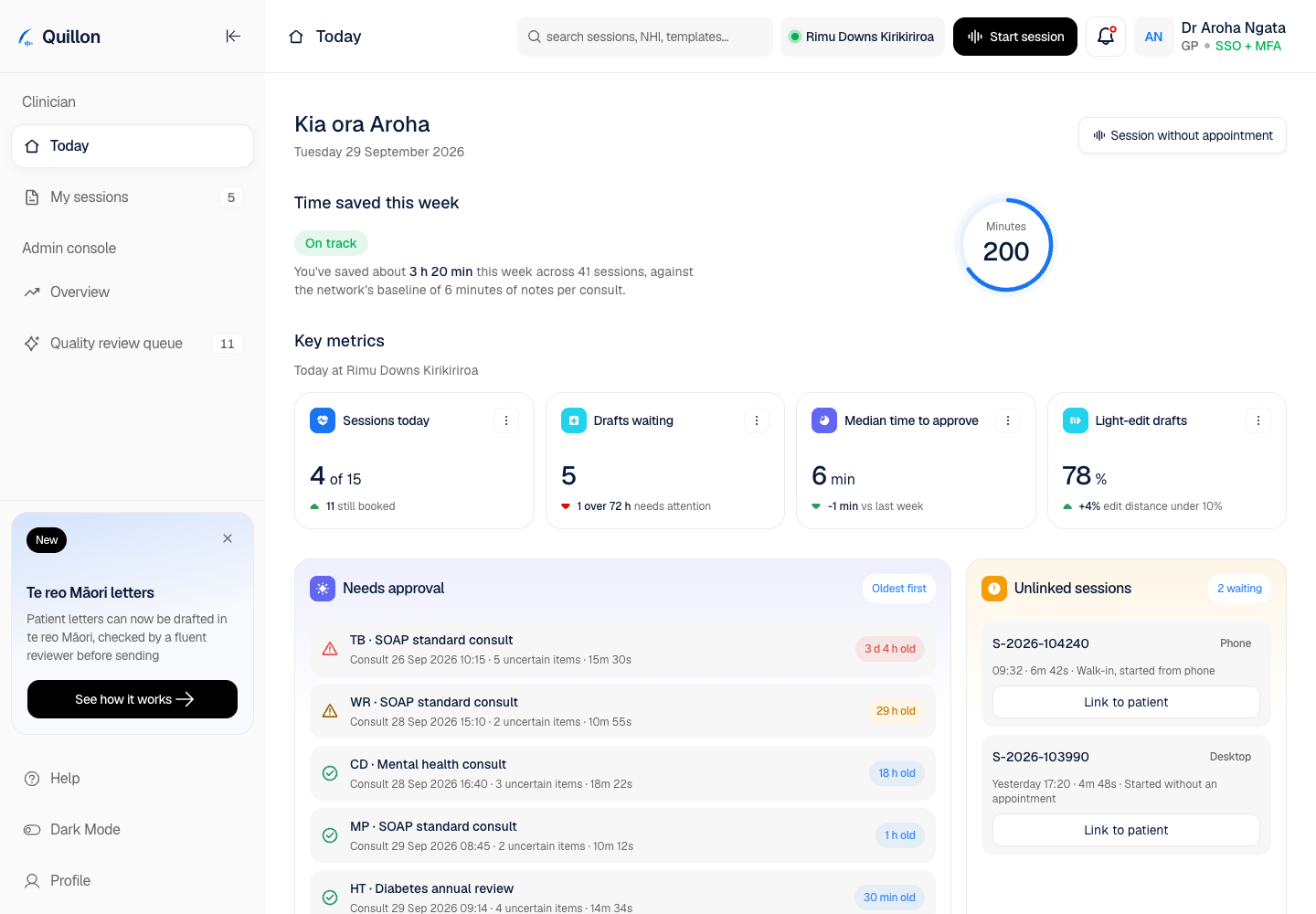
Designed and built a clickable ambient AI scribe for a network of 14 New Zealand general practices: consent before recording, a structured draft note with every uncertain item flagged, SNOMED CT code and follow-up suggestions, approve and push to the practice management system, and an admin console for safety, retention and quality review.
Enterprise Software Engineering - Human + AI
Contact Us
© 2026 - Copyright. All Rights reserved Oceanlab
Location
Global Headquarters
21 Merchant Road, 3rd Floor, Singapore 058267
Main corporate office and leadership operations
North America Office
548 Market Street, PMB 12345, San Francisco, CA 94104
Client operations and business development
India Office
402 Shivalik Shilp II, SG Highway, Ahmedabad 380015
Engineering and delivery center

Enterprise Software Engineering - Human + AI
Contact Us
Locations
Global Headquarters
21 Merchant Road, 3rd Floor, Singapore 058267
Main corporate office and leadership operations
North America Office
548 Market Street, PMB 12345, San Francisco, CA 94104
Client operations and business development
India Office
402 Shivalik Shilp II, SG Highway, Ahmedabad 380015
Engineering and delivery center
© 2026 - Copyright. All Rights reserved Oceanlab