Pharma and life sciences software built for inspection
Clinical trial management, recruitment and eConsent, pharmacovigilance safety databases, GMP lab systems and compliant medical rep CRM. Built with audit trails, electronic signatures and validation evidence from the start.
What pharma and life sciences software has to get right
Life sciences software is judged by an inspector as much as by its users. Every record that a regulation requires must be attributable, time-stamped and unchangeable without a trace, and every signature must mean something.
The builds below treat those rules as the data model, not an add-on: append-only audit trails, signing steps bound to record versions, workflows that block steps out of order, and validation evidence produced with every release.
Problems we are asked to fix
The problems teams bring to us, the system that fixes each one and the builds that did it.
Part 11 ready records and signatures
Systems handling GxP records must meet 21 CFR Part 11.
Audit trails, electronic signatures and access checks built into the data model, with validation evidence for each release.
Pharmacovigilance safety database
Adverse event reports are processed by hand.
Case intake, coding and assessment with the regulator's reporting clocks shown on every case.
Clinical trial management system
Trial sites and monitors coordinate by email and spreadsheets.
Sites, visits, milestones and documents in one system, with the trial master file structure built in.
Recruitment and eConsent platform
Trial recruitment and consent are paper-heavy.
Screening and electronic consent with version control, signatures and re-consent when the protocol changes.
GMP laboratory system
Lab inventory and samples are tracked in spreadsheets.
Samples, chain of custody and release testing tracked with audit trails and reviewer sign-off.
Medical rep CRM
Medical reps lack compliant CRM for visits and samples.
Doctor visits and sample handouts recorded against the marketing code's limits, with safety reports routed to pharmacovigilance.
5 kinds of pharma and life sciences system we have built
Each one links the product build behind it, counted from our case studies.
Pharma and life sciences products we built
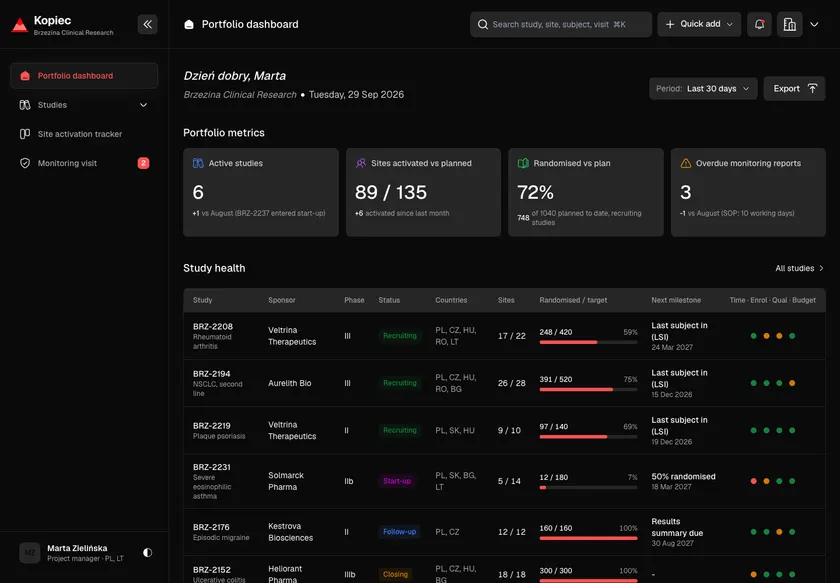
Kopiec - Clinical Trial Management System for Sites, Visits and Milestones
Designed and built a clickable clinical trial management system for a Warsaw contract research organisation running phase II and III trials in seven countries: a portfolio dashboard with CTIS notification deadlines, study timelines planned against actual, an 11-step site activation tracker and monitoring visit reports signed with a stated meaning.
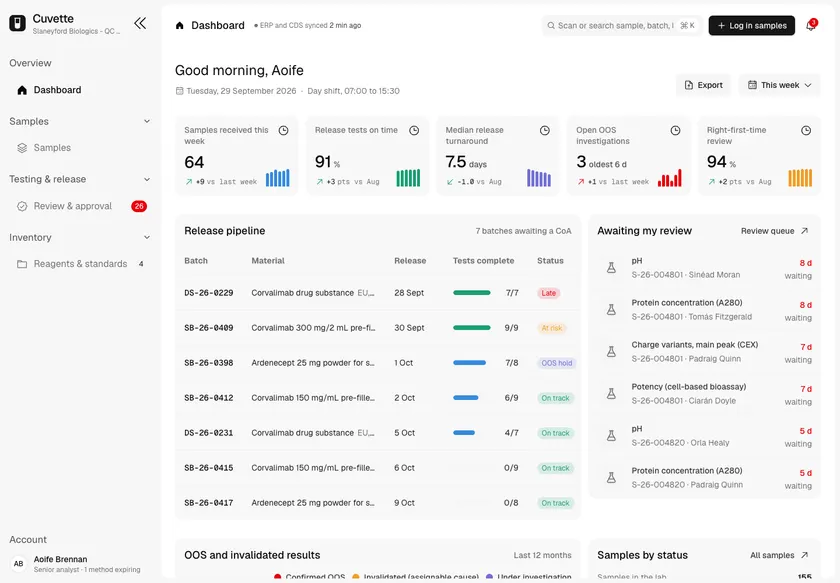
Cuvette - GMP Laboratory System for Samples, Chain of Custody and Release Testing
Designed and built a clickable laboratory information management system for the quality control lab of an Irish biopharma manufacturing site: every sample from login to disposal with an unbroken chain of custody, second person review with electronic signatures, and the lab's own reagent and reference standard inventory, so no result is signed against an expired lot or an overdue instrument.
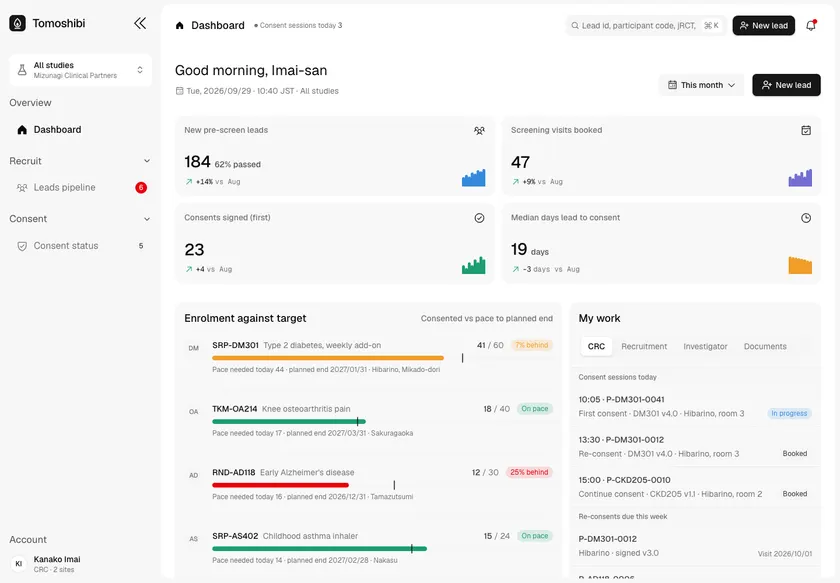
Tomoshibi - Trial Recruitment and eConsent Platform for a Japanese SMO
Designed and built a clickable recruitment and eConsent platform for a Japanese site management organisation: a pre-screen leads pipeline with contact SLAs, a consent status view against the current IRB-approved version, and a participant consent record with every signature, quiz result and question a monitor needs to see.
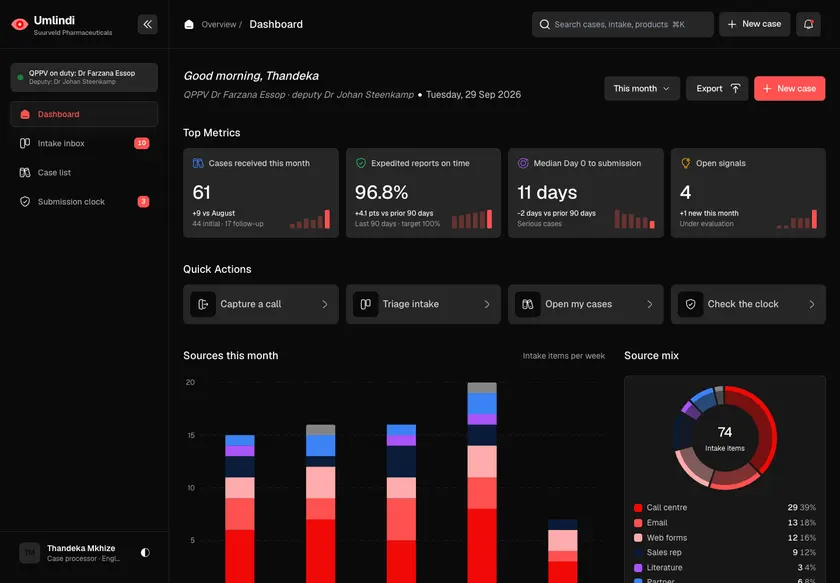
Umlindi - Pharmacovigilance Safety Database with Regulator Clocks
Designed and built a clickable safety database for a South African generic medicines company: one intake inbox for calls, emails, web forms, rep and partner reports, case processing with MedDRA coding and WHO-UMC causality, medical review sign-off, and a submission clock that counts every SAHPRA and partner deadline from Day 0.
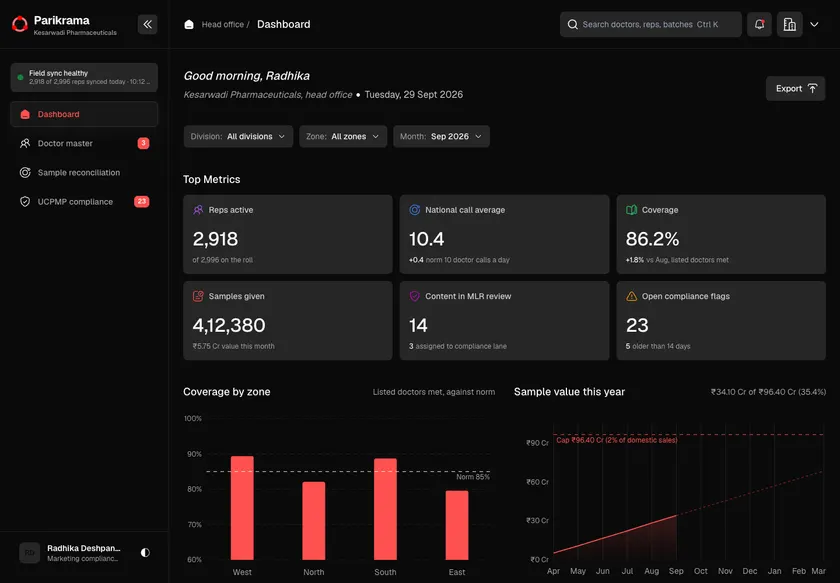
Parikrama - Medical Rep CRM for Doctor Visits, Samples and UCPMP Compliance
Designed and built a clickable head office console for the field CRM of an Indian pharmaceutical company with about 3,000 medical reps: a verified doctor master, sample caps tracked per doctor across every rep, a monthly sample reconciliation per rep and a UCPMP 2024 compliance dashboard that builds the annual self-declaration pack.
The rules involved
The rules this kind of software usually has to follow. Guidance, not legal advice.
- 01
Electronic records and signatures
21 CFR Part 11 in the US and Annex 11 of the EU GMP guidelines for computerised systems.
- 02
Good practice (GxP)
Good clinical practice for trials, good manufacturing practice for production and labs, and good pharmacovigilance practice for safety.
- 03
Clinical trial rules
The EU Clinical Trials Regulation and national trial laws, which set consent, reporting and record-keeping duties.
- 04
Safety reporting
National medicines laws and ICH guidelines set how fast adverse events must be reported and in what format.
- 05
Personal data
Trial participants' and patients' data is health data under the GDPR and similar laws.
Framework guides
Rules our pharma and life sciences builds cite most
- 21 CFR Part 113
- EU GMP Annex 112
- 21 CFR Part 2111
- Act on Electronic Signatures1
- ALCOA+ data integrity1
- APPI1
- DIA TMF Reference Model1
- DPDP Act 20231
- Drugs and Cosmetics Rules 19451
Two ways to work with OceanLab
Project build
We design and build the system as one project. It starts with a clickable prototype your team tries before any production code is written. Pay per milestone (outcome-based) or hourly at $30-50/hr, depending on role and seniority.
Embedded engineers
Our engineers join your team on a flexible monthly retainer. Part-time is fine and it runs month to month, with hours that overlap the US, UK and Europe, the Middle East, and Australia and Asia. Outcome-based or $30-50/hr.
Guides and tools
Pharma and life sciences software questions
Can you deliver validated software?
We build the controls and produce validation evidence with each release: requirements, risk assessment, traceability and test results. Your quality team keeps the final say on validation for your intended use.
Do you build for both FDA and EU rules?
Yes. Part 11 and EU Annex 11 cover the same ground, so we design one set of controls and document how it meets both.
Can AI help with safety case processing?
It can pull details from reports and suggest coding, with a safety specialist reviewing every case. The regulator's clock and the human decision stay at the centre.
