Cuvette - GMP Laboratory System for Samples, Chain of Custody and Release Testing
QC Lab LIMS for an Irish Biopharma Site
Designed and built a clickable laboratory information management system for the quality control lab of an Irish biopharma manufacturing site: every sample from login to disposal with an unbroken chain of custody, second person review with electronic signatures, and the lab's own reagent and reference standard inventory, so no result is signed against an expired lot or an overdue instrument.
Most of our work is under NDA. Per agreement, we can share the work but not the company details - all names and identifying information shown here have been changed.
Impact
Dashboard with the release pipeline, samples list, sample detail with tests, chain of custody, aliquots, documents and audit trail, the review and approval workspace, and reagents and standards. Each of the 24 demo samples opens its own record.
Method version, materials in date and qualified, instrument in calibration, system suitability, calculations, manual entries justified and audit trail reviewed. The Review button stays disabled until all 7 are ticked.
The analyst who performed a test cannot review or approve it, and the approver cannot be the reviewer. Each signature records its meaning, printed name and user id, and asks for the password again.
24 samples across 7 sample types, 7 batches in the release pipeline, 21 reagent, standard, column and consumable lots, 11 instruments and 12 lab staff across 8 roles.
The Problem
Slaneyford's QC lab ran on paper logbooks, a 15-year-old sample tracking database and around 60 spreadsheets. Reviewers checked worksheets by hand against the specification and the instrument printout, reagent expiry lived on the bottle label and freezer contents in a binder. The last HPRA inspection raised observations on uncontrolled spreadsheets, audit trails that were never reviewed and an OOS result retested before an investigation was opened, and batch release testing took a median of 11 working days.
Our Solution
Cuvette follows every sample from the moment manufacturing creates it to disposal: barcode, storage location, current holder and every custody hand-over, the tests its specification assigns, and second person review with Part 11 electronic signatures. Alongside the samples it runs the lab's reagents, reference standards, columns and consumables, with use-by dates, qualification status and stock levels in one place.
The Challenge: Every Result Has to Stand Up to an Inspector
A QC lab releasing biologics to the EU and US answers to EU GMP, the HPRA and the FDA at once. Every result must be attributable, traceable to the sample, reagent and instrument used that day, and reviewed by a second person before a batch can be certified.
Custody Gaps Nobody Could See
Samples move from manufacturing to the sample hatch, fridges, freezers and analysts' benches. On paper a hand-over that sat unaccepted for hours, or a seal broken on arrival, left no visible trace on the sample's record.
Review That Missed the Audit Trail
EU GMP Annex 11, 21 CFR Part 11 and the ALCOA+ data integrity guidance expect audit trails to be reviewed as part of every result review. Reprocessed chromatography, manual integration and manual entries had to be found by hand, if at all.
OOS Results and Separation of Duties
An out-of-specification result must be investigated before any retest, and no result may be invalidated without an assignable cause. The same person must never sign as analyst and reviewer on one test.
Reagents and Standards Out of Sight
Reagents expire, opened bottles get a shorter use-by, and secondary standards must be qualified against a primary standard before use. Controlled substances and drug precursors such as acetic anhydride need their own register under Irish and EU rules.
Our Approach: From GMP Rules to a Clickable LIMS
Spec and Rules Research
Mapped 10 user roles from sample coordinator to inspector, 43 staff screens, 5 slide-over panels and about 20 modals, and the data model for samples, append-only custody events, tests, results, signatures, investigations, stability studies, inventory lots and instruments. Wrote down the rules the design follows: EU GMP Chapters 4 and 6 and Annex 11, 21 CFR Parts 211 and 11, ALCOA+, the FDA OOS guidance, ICH Q1A(R2), instrument qualification and retention periods.
Clickable Demo on a Production UI Kit
Built 5 key screens on a production dashboard kit: the dashboard with 5 KPIs, release pipeline and reviewer queue, the samples list with status filters and a bulk-action bar, sample detail with a custody timeline that breaks in red on a gap, the review workspace with checklist, audit trail excerpt and electronic signature, and reagents and standards with lot panels. Holds, transfers, aliquots, signatures and lot changes run on local state.
What a Production Build Adds
Integration with SAP S/4HANA Quality Management, the MES, the Empower or Chromeleon chromatography data system, LabX balances, Veeva Vault QMS, training and controlled documents, BarTender labels on Zebra printers, viewLinc temperature monitoring and Microsoft Entra ID sign-on with re-authentication at signing. Worklists, test execution, investigations, certificates of analysis, stability, instruments, a tamper-evident audit log, retention rules and the client's own computer system validation.
Why It Works: Data Integrity Built Into Every Screen
Custody Breaks Show in Red
The chain of custody tab lists every event with who, when, from, to, seal number and condition on arrival. A transfer accepted hours after hand-over breaks the timeline in red with a note to the team lead, and the dashboard flags transfers not accepted within 2 hours.
The Audit Trail Sits Inside the Review
The review workspace shows the result against its specification limits next to an audit trail excerpt, with reprocessing, manual integration, manual entries and modified values highlighted with their reasons. Raw data opens from the same screen.
Signatures That Meet Part 11
Every signature names the record, its meaning (Reviewed or Approved), the signer's printed name and user id, and asks for the password again. Bulk approval still applies one signature per result, and a reviewer's own tests stay in the queue for someone else.
Lots Flag Themselves Before They Fail
Reagents and standards show use-by after opening, days to expiry, reorder levels and qualification status. Expired, quarantined and unqualified lots are counted at the top, secondary standards show the primary they were qualified against, and precursors are marked as controlled.
Related case studies
View all: Pharma & life sciences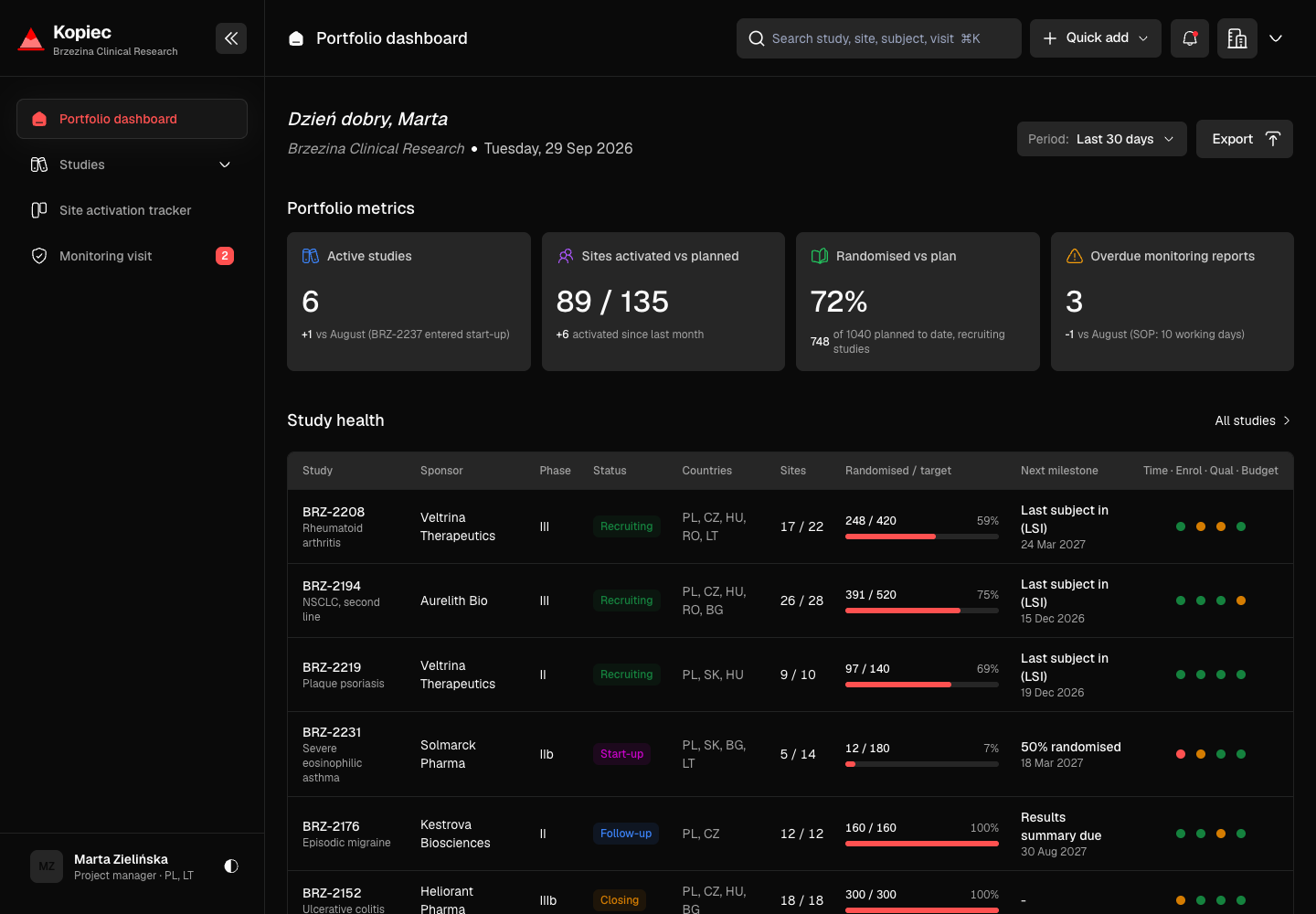
Kopiec - Clinical Trial Management System for Sites, Visits and Milestones
Designed and built a clickable clinical trial management system for a Warsaw contract research organisation running phase II and III trials in seven countries: a portfolio dashboard with CTIS notification deadlines, study timelines planned against actual, an 11-step site activation tracker and monitoring visit reports signed with a stated meaning.
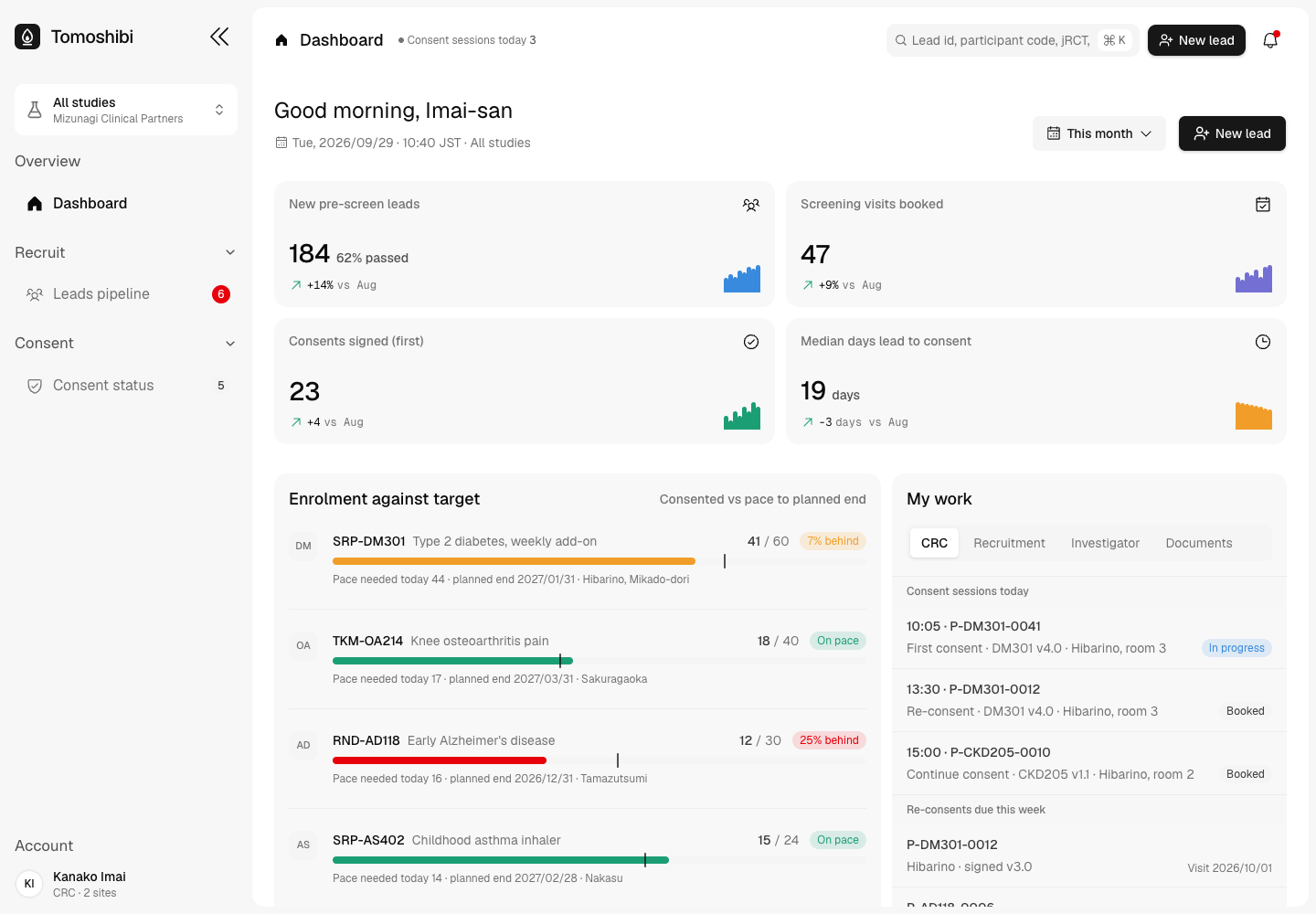
Tomoshibi - Trial Recruitment and eConsent Platform for a Japanese SMO
Designed and built a clickable recruitment and eConsent platform for a Japanese site management organisation: a pre-screen leads pipeline with contact SLAs, a consent status view against the current IRB-approved version, and a participant consent record with every signature, quiz result and question a monitor needs to see.
Enterprise Software Engineering - Human + AI
Contact Us
© 2026 - Copyright. All Rights reserved Oceanlab
Location
Global Headquarters
21 Merchant Road, 3rd Floor, Singapore 058267
Main corporate office and leadership operations
North America Office
548 Market Street, PMB 12345, San Francisco, CA 94104
Client operations and business development
India Office
402 Shivalik Shilp II, SG Highway, Ahmedabad 380015
Engineering and delivery center

Enterprise Software Engineering - Human + AI
Contact Us
Locations
Global Headquarters
21 Merchant Road, 3rd Floor, Singapore 058267
Main corporate office and leadership operations
North America Office
548 Market Street, PMB 12345, San Francisco, CA 94104
Client operations and business development
India Office
402 Shivalik Shilp II, SG Highway, Ahmedabad 380015
Engineering and delivery center
© 2026 - Copyright. All Rights reserved Oceanlab