Kopiec - Clinical Trial Management System for Sites, Visits and Milestones
CTMS for a Warsaw CRO Running Trials Across Central and Eastern Europe
Designed and built a clickable clinical trial management system for a Warsaw contract research organisation running phase II and III trials in seven countries: a portfolio dashboard with CTIS notification deadlines, study timelines planned against actual, an 11-step site activation tracker and monitoring visit reports signed with a stated meaning.
Most of our work is under NDA. Per agreement, we can share the work but not the company details - all names and identifying information shown here have been changed.
Impact
Portfolio dashboard, studies list, study home, site activation tracker and monitoring visit. All 8 demo studies open their own study home and activation tracker, and all 16 monitoring visits open their own report.
From confidentiality agreement to site initiation visit, including Part II outcome, site added in CTIS and IP release. Activate site stays disabled until every step is done and needs the project manager's e-signature.
Each monitoring visit counts working days since the visit ended against the client's 10-day target. The CRA submits with the meaning "Author", the lead CRA approves as "Reviewer approval" or returns it with comments.
6 sponsors, 7 countries, 135 planned sites, 16 monitoring visits and 15 staff users, all fictional. Subjects appear only as pseudonymised subject numbers with visit dates.
The Problem
Brzezina ran 14 studies on spreadsheets, a legacy CTMS that could not model the EU Clinical Trials Regulation, and email. Site activation lived in one tracker per country, CTIS submissions in a separate workbook, and monitoring reports were Word files signed by scanning a printout. Enrolment reached sponsors two to three weeks late, and the move of every ongoing trial into CTIS by January 2025 made the gap impossible to manage by spreadsheet.
Our Solution
Kopiec follows a study from protocol to close-out in one place. The portfolio dashboard shows every study's health and the CTIS notifications due per member state, the study home tracks milestones planned against actual, the activation tracker shows what is blocking each site, and monitoring reports move from author to reviewer with e-signatures and a working-day clock.
The Challenge: Running Trials Under the EU Clinical Trials Regulation
A CRO running trials in Poland, Czechia, Slovakia, Hungary, Romania, Bulgaria and Lithuania works under one EU regulation, seven national authorities and its own SOPs, while sponsors, sites and auditors each expect a different view of the same study.
Regulatory Clocks Per Member State
Under Regulation (EU) No 536/2014 applications go through CTIS, with Part I assessed jointly and Part II nationally. The sponsor generally has to notify the start of the trial, the first visit of the first subject and the end of recruitment per member state within 15 days, and these dates were followed in a separate workbook.
Site Activation Across Seven Countries
Each site passes contracts, budgets, the country's ethics and Part II outcome, CTIS registration, essential documents, training, IP release and system access before it can enrol. In Poland the 2023 Act moved ethics review to a Supreme Bioethics Committee. Status sat in one tracker per country.
Monitoring Reports That Hold Up in an Audit
EU GMP Annex 11 and 21 CFR Part 11 generally require a time-stamped audit trail and electronic signatures that show signer, date, time and meaning. ICH E6(R3) adds risk-based, proportionate monitoring. Scanned signatures on Word files met none of this cleanly.
Numbers Sponsors and Sites Wait For
Enrolment figures reached sponsors weeks late, investigator fees were worked out by hand from EDC exports in EUR, PLN and other currencies, and before every sponsor audit the team spent a week reconciling the eTMF against what the trackers claimed.
Our Approach: From Trial Rules to a Clickable CTMS
Spec and Rules Research
Mapped 13 user roles, from head of clinical operations, CRAs and start-up specialists to site and sponsor portal users, and 41 screens. Defined the data model for studies, countries, milestones, sites and activation steps, pseudonymised subjects, monitoring visits, deviations, payment runs, TMF artifacts and append-only signatures. Wrote down the rules the design follows: the EU Clinical Trials Regulation and CTIS, the Polish 2023 Act, ICH E6(R3), Annex 11 and Part 11, GDPR and the DIA TMF Reference Model.
Clickable Demo on a Production UI Kit
Built 5 key screens on a production dashboard kit: the portfolio dashboard with KPIs, a study health table with RAG status, My work by role and the regulatory clock; the studies list with status counts and filters; the study home with a milestone timeline, 6 KPI cards, the enrolment curve against plan and the country table with CTIS Part II status; the site activation tracker; and the monitoring visit report with checklist, findings, review and signatures. Actions run on local state.
What a Production Build Adds
EDC and IRT sync (such as Medidata Rave, Veeva Vault EDC or Castor, and Suvoda), Veeva Vault eTMF, DocuSign for site contracts, NBP and ECB exchange rates, bank file export for site payments and KSeF invoices in Poland. CTIS statuses are recorded by hand with their reference unless a structured export exists. Staff sign-in through Microsoft Entra ID with MFA, the site and sponsor portals, and a validation package for Annex 11 and Part 11 agreed with QA.
Why It Works: The Study's Status Is the Evidence
A Site Cannot Skip a Step
The activation matrix shows each step as done with its date, in progress, blocked with the reason or not started. A bar of sites by step filters the matrix, the median days from selection to activation sits next to the 90-day target, and a site is activated only once every step is done.
Regulatory Dates Are Milestones
The study timeline puts plan against actual for every key milestone, from CTA submitted to results summary due, with the variance in days. The regulatory clock lists CTIS notifications due per member state with days left, and the country table shows each Part II status.
Every Signature Says What It Means
Monitoring reports are submitted as Author and approved as Reviewer approval, each signature shown with name and date. Findings carry a severity and become an action item or a deviation, and the report shows how many times it was returned.
Each Role Starts With Its Own Work
My work changes with the role: reports to review for the lead CRA, blocked sites for start-up, milestones and deviations for the project manager, payment runs for finance. Needs attention gathers KRI breaches, reports over the SOP target and SAEs reported late.
Related case studies
View all: Pharma & life sciences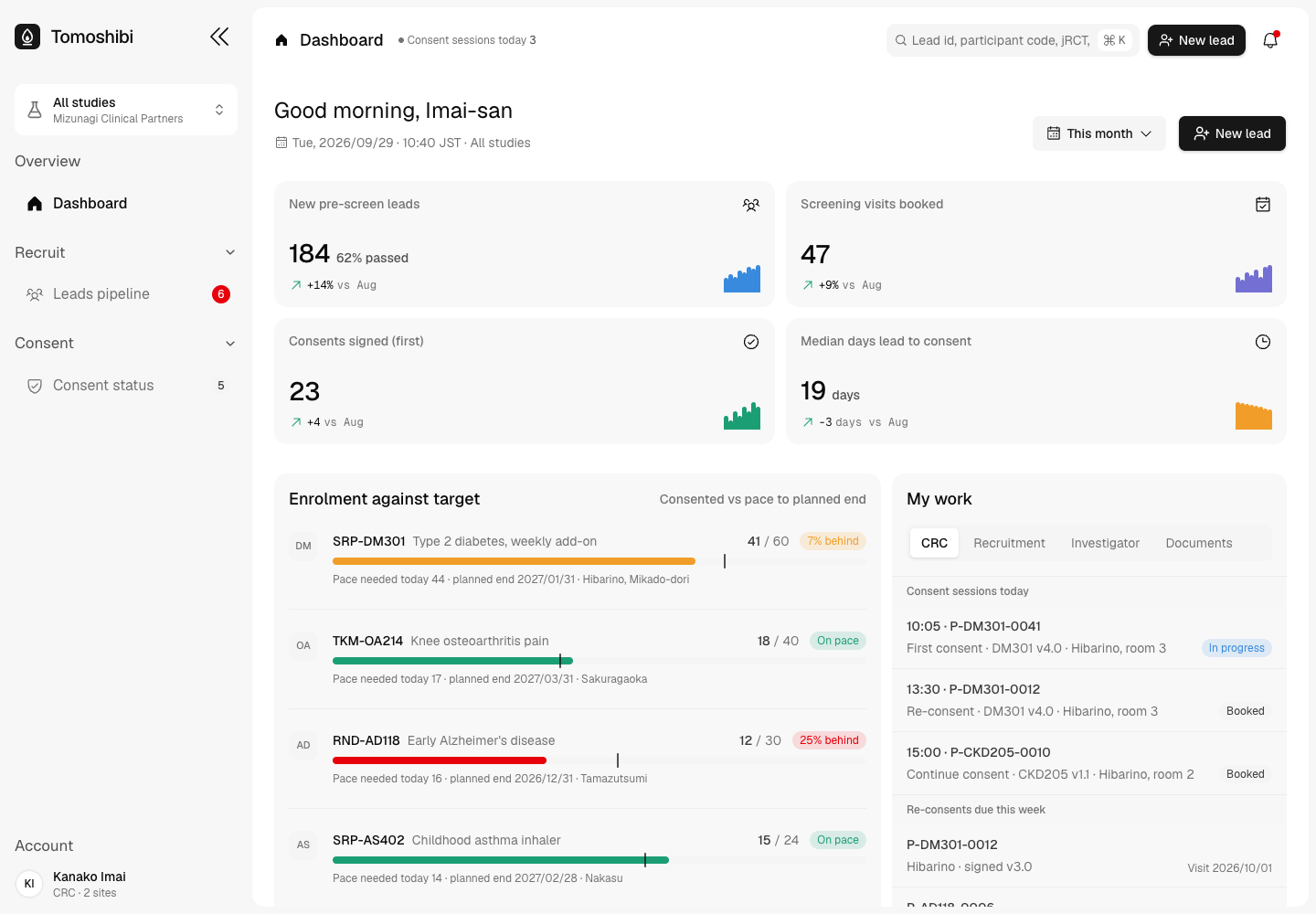
Tomoshibi - Trial Recruitment and eConsent Platform for a Japanese SMO
Designed and built a clickable recruitment and eConsent platform for a Japanese site management organisation: a pre-screen leads pipeline with contact SLAs, a consent status view against the current IRB-approved version, and a participant consent record with every signature, quiz result and question a monitor needs to see.
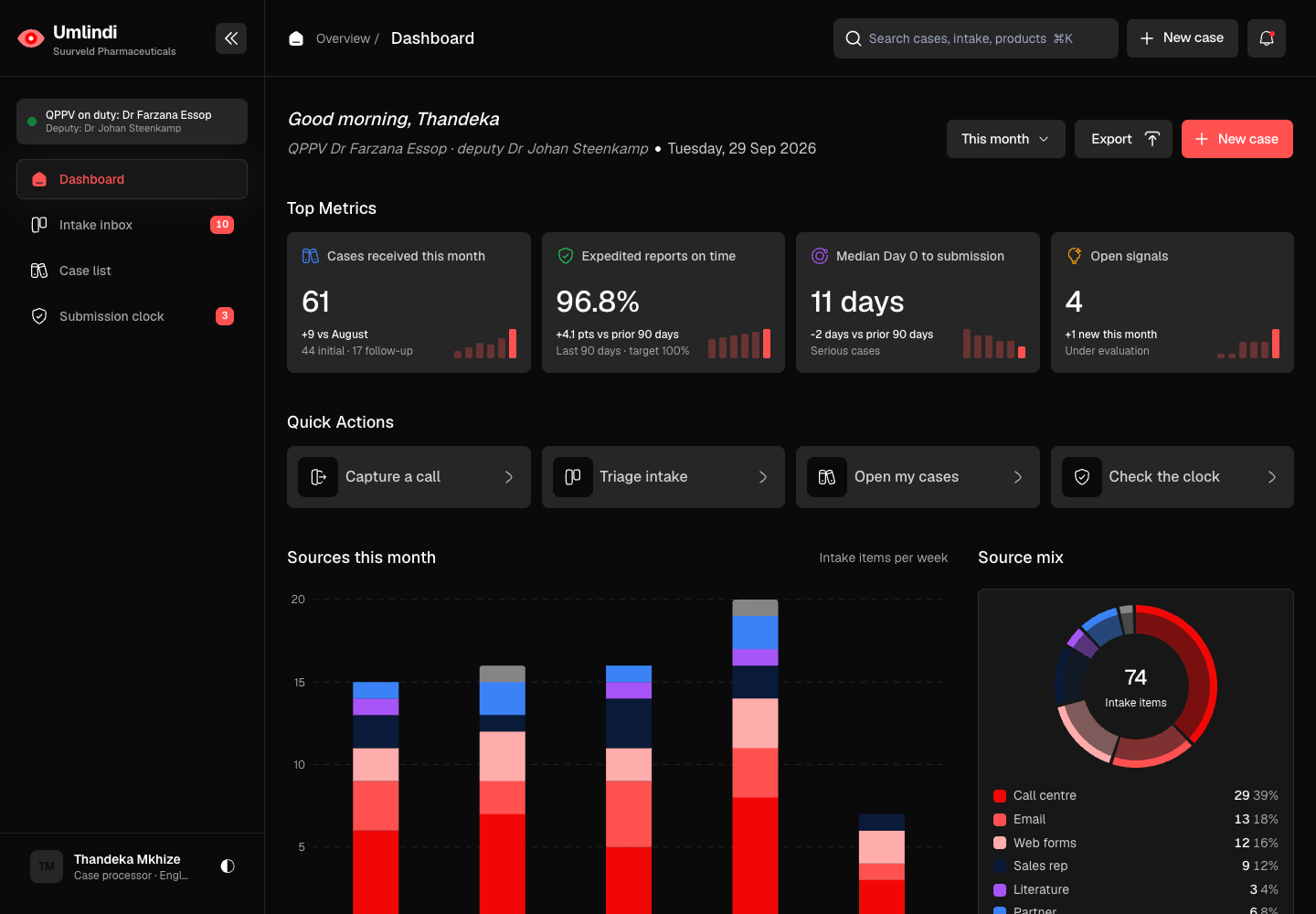
Umlindi - Pharmacovigilance Safety Database with Regulator Clocks
Designed and built a clickable safety database for a South African generic medicines company: one intake inbox for calls, emails, web forms, rep and partner reports, case processing with MedDRA coding and WHO-UMC causality, medical review sign-off, and a submission clock that counts every SAHPRA and partner deadline from Day 0.
Enterprise Software Engineering - Human + AI
Contact Us
© 2026 - Copyright. All Rights reserved Oceanlab
Location
Global Headquarters
21 Merchant Road, 3rd Floor, Singapore 058267
Main corporate office and leadership operations
North America Office
548 Market Street, PMB 12345, San Francisco, CA 94104
Client operations and business development
India Office
402 Shivalik Shilp II, SG Highway, Ahmedabad 380015
Engineering and delivery center

Enterprise Software Engineering - Human + AI
Contact Us
Locations
Global Headquarters
21 Merchant Road, 3rd Floor, Singapore 058267
Main corporate office and leadership operations
North America Office
548 Market Street, PMB 12345, San Francisco, CA 94104
Client operations and business development
India Office
402 Shivalik Shilp II, SG Highway, Ahmedabad 380015
Engineering and delivery center
© 2026 - Copyright. All Rights reserved Oceanlab