AI agent and automation software that reaches production
Knowledge assistants, document processing, back-office agents, voice agents, ticket triage, code review and evaluation. Built with review steps and logs, so a person stays in charge of the decisions that matter.
What AI agents and automation software has to get right
Most AI projects stall between a demo and a system people rely on. The model is rarely the hard part. The hard parts are the data it reads, the checks around what it outputs, the permission rules it must respect, and the way a person reviews and corrects it.
The AI builds on this page treat those as the product. Answers cite their sources, agents work behind approval gates, and every model or prompt change is scored before it ships.
Problems we are asked to fix
The problems teams bring to us, the system that fixes each one and the builds that did it.
RAG knowledge assistant
Answers from internal documents are wrong or uncited.
Search over your own documents that answers with citations and respects each user's document permissions.
Intelligent document processing
Invoices and forms are retyped by hand.
Extraction from documents into structured fields, with confidence scores and a review queue for anything uncertain.
Back-office agent
Back-office tasks are repetitive and rule-heavy.
An agent that does the routine steps and stops at approval gates, with an operator console to see and correct what it did.
LLM evaluation and release gates
Teams cannot tell if a prompt or model change made things worse.
Fixed test sets scored on every change, traces from production, and a release blocked when quality drops.
AI voice agent
Phone calls need to be answered at scale.
A voice agent that handles routine calls and hands off to a person, with a console to review calls.
Ticket triage
Support tickets are routed by hand.
Classification and routing of incoming tickets, with high-risk reports flagged for a person straight away.
Code review agent
Pull requests wait for review.
An agent that comments on pull requests and never merges, so engineers keep the final say.
Production AI workflow
AI pilots never reach production.
Approval gates, evaluation and operator tooling from the first release, so the pilot is already shaped like the real system.
12 kinds of AI agents and automation system we have built
Each one links the product build behind it, counted from our case studies.
- Anvesha - Research agent
- Baqueano - Sales call analyser
- Kaganek - RAG knowledge assistant
- Kaito - Meeting notes to CRM
- Lektor - Code review agent
- Pitline - Voice agent
- Riffle - Support ticket triage
- Sanbuk - Back-office agent
- Sonde - AI evaluation dashboard
- Sotdae - Claims processing agent
- Tallyman - Document processing (IDP)
- Tekmė - Workflow automation builder
AI agents and automation products we built
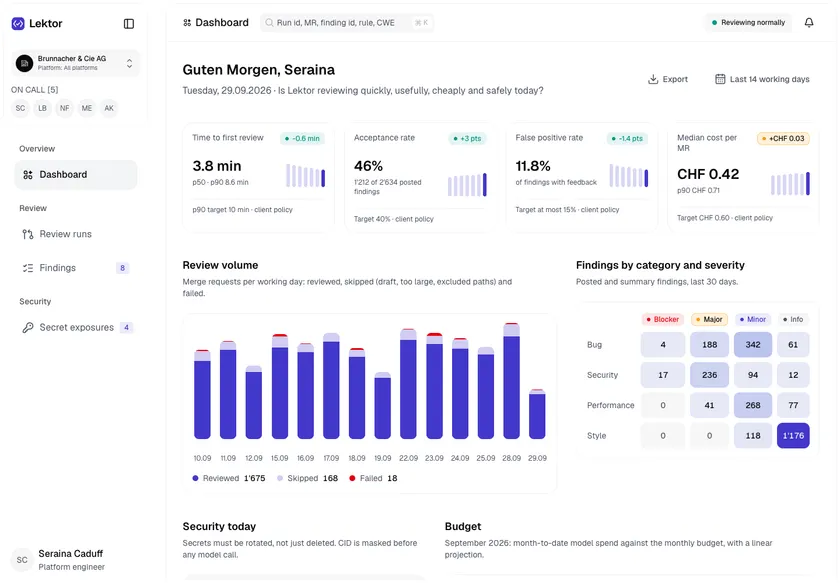
Lektor - AI Code Review Agent That Comments but Never Merges, Hosted Inside a Private Bank
Designed and built a clickable AI code review agent for the engineering team of a Zurich private bank: it reviews every merge request on GitLab and GitHub Enterprise with models hosted in the bank's own tenancy, masks client data and secrets before any model sees the diff, posts inline findings with rule, CWE and suggested patch, and never approves or merges.
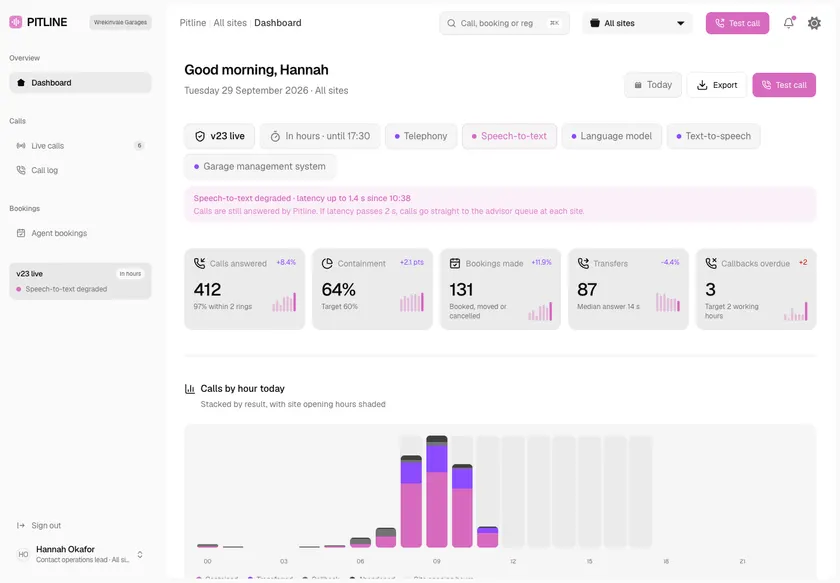
Pitline - AI Voice Agent and Call Review Console for a Garage Chain
Designed and built a clickable staff console for an AI phone agent that books, moves and cancels car servicing and MOTs, reads out job status and answers common questions for a chain of 14 Midlands garages - with every call reviewable turn by turn, every tool call on the record and a warm transfer to a person whenever the agent should not decide.
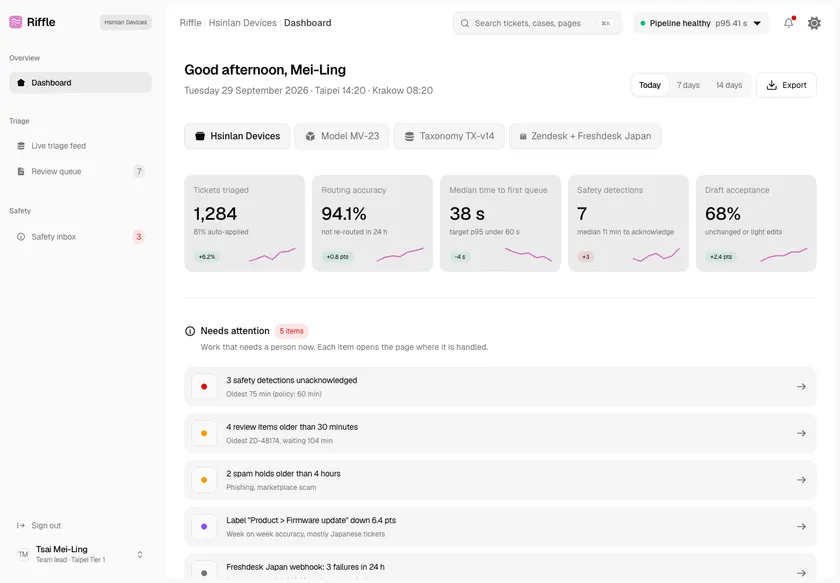
Riffle - AI Ticket Triage Layer That Catches Product Safety Reports
Designed and built a clickable AI triage layer for a Taipei consumer electronics brand: it classifies every new Zendesk and Freshdesk ticket, masks personal data, routes it to the right queue, sends low-confidence tickets to a review queue and pushes possible battery, heat and fire reports to an on-call product safety team.
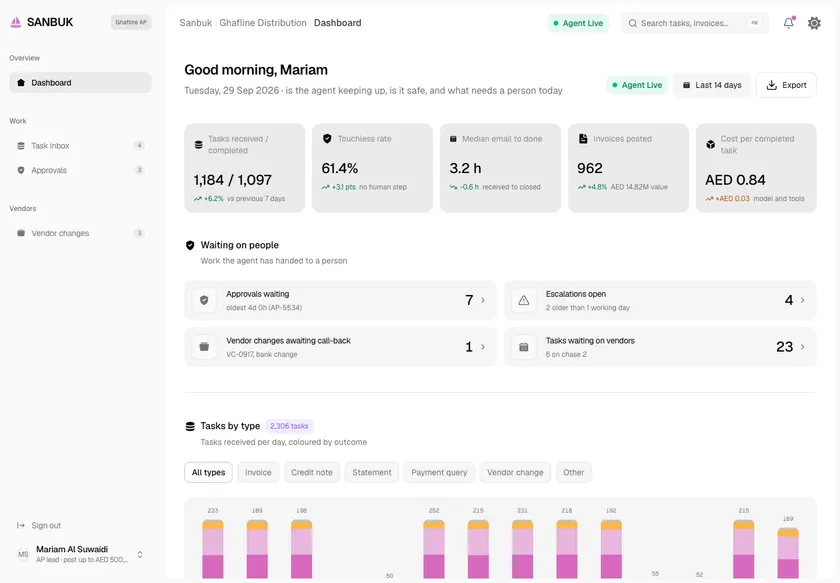
Sanbuk - Accounts Payable Agent with an Operator Console and Approval Gates
Designed and built a clickable back-office agent for a Dubai mainland distributor: it reads the AP and vendor mailboxes, matches invoices to POs and goods receipts, checks UAE tax invoice fields, drafts replies and posts to the ERP, while people approve by amount, see every tool call and handle every bank detail change themselves.
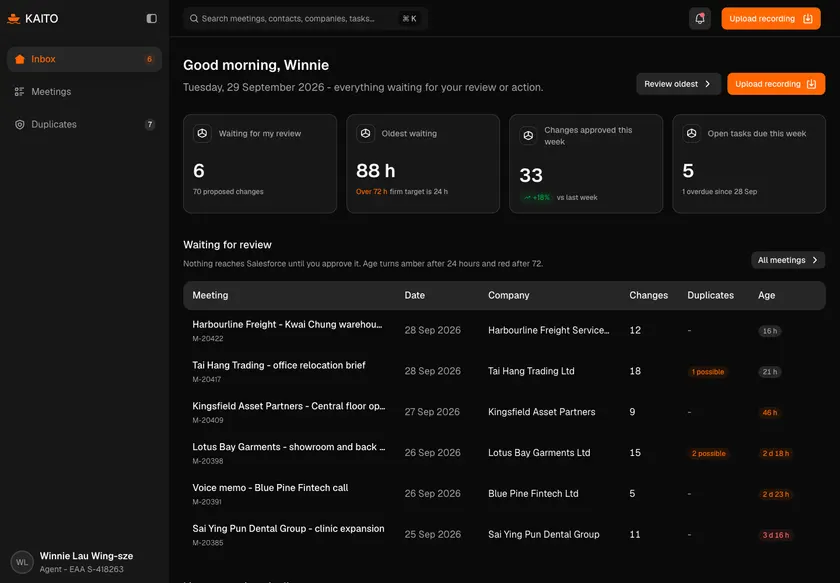
Kaito - Meeting Notes to CRM Assistant with Field-Level Review
Designed and built a clickable meeting assistant for a Hong Kong commercial property brokerage: it transcribes brokers' meetings and calls in Cantonese, English and Mandarin, proposes CRM changes as a field-level diff with evidence from the transcript, flags likely duplicate contacts, and writes nothing to Salesforce until the agent approves.
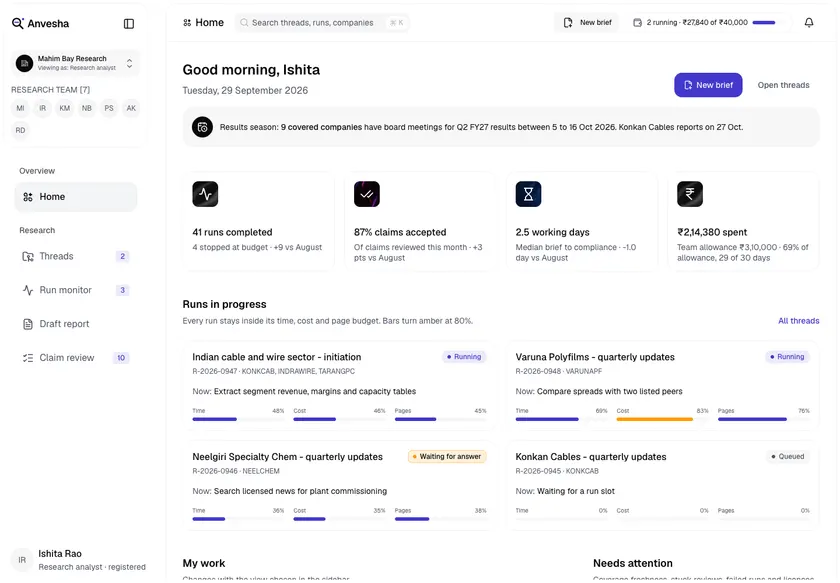
Anvesha - Deep-Research Agent for Cited Equity Research
Designed and built a clickable deep-research agent for a SEBI-registered Mumbai research boutique: analysts brief the agent, watch each run stay inside its time, cost and page budget, and get a draft report in which every factual sentence links to a quoted source passage they must accept before it can leave the team.
The rules involved
The rules this kind of software usually has to follow. Guidance, not legal advice.
- 01
EU AI Act
Risk tiers, transparency for chatbots and generated content, and heavy duties for high-risk uses such as hiring and credit.
- 02
Data protection
The GDPR and similar laws cover personal data used to train or run a model, and give people rights around automated decisions.
- 03
Rules of the industry using the AI
A claims agent follows insurance rules, a research agent follows securities rules. The AI inherits the rules of the work it does.
- 04
LLM application security
The OWASP Top 10 for LLM Applications covers prompt injection, data leaks through outputs and unsafe tool use.
- 05
AI management standards
ISO/IEC 42001 sets out a management system for AI, the way ISO 27001 does for security.
Framework guides
Rules our AI agents and automation builds cite most
- EU AI Act5
- GDPR5
- ISO/IEC 420012
- OWASP Top 10 for LLM Applications2
- ACPR AI governance1
- AI Basic Act1
- AMLO (Cap. 615)1
- Argentina Law 25.3261
- ArGV 3 Art. 261
Two ways to work with OceanLab
Project build
We design and build the system as one project. It starts with a clickable prototype your team tries before any production code is written. Pay per milestone (outcome-based) or hourly at $30-50/hr, depending on role and seniority.
Embedded engineers
Our engineers join your team on a flexible monthly retainer. Part-time is fine and it runs month to month, with hours that overlap the US, UK and Europe, the Middle East, and Australia and Asia. Outcome-based or $30-50/hr.
Guides and tools
AI agents and automation software questions
How do you keep AI agents from making bad decisions?
By design, they do not make the final call where it matters. Our agents work behind approval gates or a human review step, show the reasons for their output and log what they did, so a person can review, change or stop it.
Which models do you use?
It depends on the task, the data rules and the cost. We pick per workflow and keep the model swappable, with an evaluation set to compare options on your own data.
Is our AI feature high-risk under the EU AI Act?
It depends on what it is used for, not on the model. Uses such as hiring, credit scoring and some insurance pricing are high-risk. Use the EU AI Act risk checker for a first answer, then confirm with your advisor.
