Anvesha - Deep-Research Agent for Cited Equity Research
Research Agent for an Indian Equity Research Boutique
Designed and built a clickable deep-research agent for a SEBI-registered Mumbai research boutique: analysts brief the agent, watch each run stay inside its time, cost and page budget, and get a draft report in which every factual sentence links to a quoted source passage they must accept before it can leave the team.
Most of our work is under NDA. Per agreement, we can share the work but not the company details - all names and identifying information shown here have been changed.
Impact
Home, research threads, run monitor, draft report and claim review. 12 demo runs open their own monitor, from queued and running to waiting for an answer, stopped at budget, failed and cancelled.
The hero report cites every claim to the exact words and page in its source. The numeric check against source catches one figure that does not match: ₹131 crore of capex spent in the claim, ₹113 crore in the investor presentation.
Time, cost and pages, amber at 80% and a hard stop at 100%. Firm defaults are 45 minutes, ₹1,500 and 400 pages for an update, and 120 minutes, ₹5,000 and 1,200 pages for an initiation.
14 covered companies with NSE symbols, BSE scrip codes and ISINs, 9 staff users across 5 roles, 10 source documents in 4 tiers and 5 new exchange filings.
The Problem
Mahim Bay's seven analysts spent most of each results season collecting rather than thinking: pulling results filings, investor presentations and call transcripts from the exchanges, checking figures against a data terminal and pasting numbers into a Word template by hand. Associates had started summarising filings with general-purpose chatbots, which gave fluent paragraphs with no sources and the occasional invented number, and compliance could not tell which parts of a report came from an AI tool.
Our Solution
Anvesha turns a research brief into an editable plan, runs it across exchange filings, licensed data, licensed news and the open web inside a fixed budget, and drafts the report in the firm's template with a citation on every factual sentence. The analyst accepts or rejects each claim against its source passage, and nothing goes for sign-off until every claim used is accepted.
The Challenge: AI Research a Regulator Can Trace
Mahim Bay is registered with SEBI as a research analyst and covers around 140 listed Indian mid- and small-cap companies for institutional clients. Every statement in a published note has to be traceable to its basis, and the analyst who signs it is answerable for it, however it was drafted.
The Analyst Owns the AI Output
SEBI's December 2024 amendments to the research analyst regulations are generally read as making an analyst who uses AI tools solely responsible for the output and requiring disclosure of AI use to clients. The regulations also expect the basis for research to be kept, generally for at least five years.
No Unpublished Price Sensitive Information
The SEBI insider trading regulations prohibit using UPSI. Uploaded meeting notes need a declaration that they hold none, suspected UPSI must be held away from every run, and companies on the firm's restricted list cannot be researched without clearance.
Sources With Rules of Their Own
Exchange websites restrict automated scraping, so filings come through a licensed feed. Vendor data and news are protected by the Copyright Act and licence terms, and every site has robots.txt rules. The agent must never get around a paywall or login.
Sources That Disagree
A news report can quote a different margin from the company's own filing, a wire story can appear on six sites, and a blog can sound as confident as an annual report. The agent has to rank by tier, merge duplicates and surface contradictions instead of picking one silently.
Our Approach: From Research Rules to a Clickable Agent
Spec and Rules Research
Mapped 6 roles (analyst, associate, head of research, compliance officer, data and licence manager, admin), 30 screens with 4 slide-over panels and about 16 modals, and the data model for threads, briefs, versioned plans, runs, run events, sources, licences, passages, claims, contradictions, reports and quarantine items. Wrote down the rules the design follows: the SEBI research analyst, insider trading and listing regulations, the Copyright Act 1957, the robots exclusion protocol (RFC 9309) and the DPDP Act 2023.
Clickable Demo on a Production UI Kit
Built 5 key screens on a production dashboard kit: Home with KPIs, runs in progress and a My work list that changes by role, research threads with pins and filters, the run monitor with budget bars, plan progress, step log, live activity, skipped pages and agent questions, the draft report with citation markers and an evidence panel, and claim review with keyboard shortcuts. All actions run on local state.
What a Production Build Adds
Integration with NSE and BSE data products or a licensed filings feed, a fundamentals vendor (such as CMIE Prowess or ACE Equity), Factiva, a web search API, a fetcher that follows robots.txt, PDF and table extraction, Claude through Amazon Bedrock in an Indian region, pgvector search, Word export to SharePoint and Entra ID sign-in. Plus a write-once records archive in the Mumbai region and the remaining 25 screens: new brief, plan editor, sources, export, coverage, compliance, analytics and settings.
Why It Works: Every Sentence Earns Its Place
Nothing Uncited Leaves the Team
Each factual sentence carries citation markers that show the source and quoted passage on hover. A sentence with no claim behind it is marked red and blocks export, a rejected claim strikes its sentence through, and Submit for sign-off stays disabled until both are fixed.
The Analyst Decides, Claim by Claim
Claim review puts key figures first, shows the sentence each claim feeds, highlights the passage with its page number and checks numeric claims against the source. Accept, reject with a reason or edit and accept, with A, R, E and N on the keyboard.
Runs Show Their Work and Their Limits
The run monitor projects time, cost and pages to the finish, logs every query, fetch and model call per step, and lists each page not read with its reason: robots.txt, deny list, paywall without licence, login, licence forbids AI processing, duplicate, out of time frame or too large.
Judgement Stays With People
The rating, target price, investment view and disclosures sit in analyst-only sections the agent cannot write. When a source falls outside the allow list, a stop and ask me rule pauses the run and asks the analyst, and contradictions come with the agent's suggestion, not a silent choice.
Related case studies
View all: AI agents & automation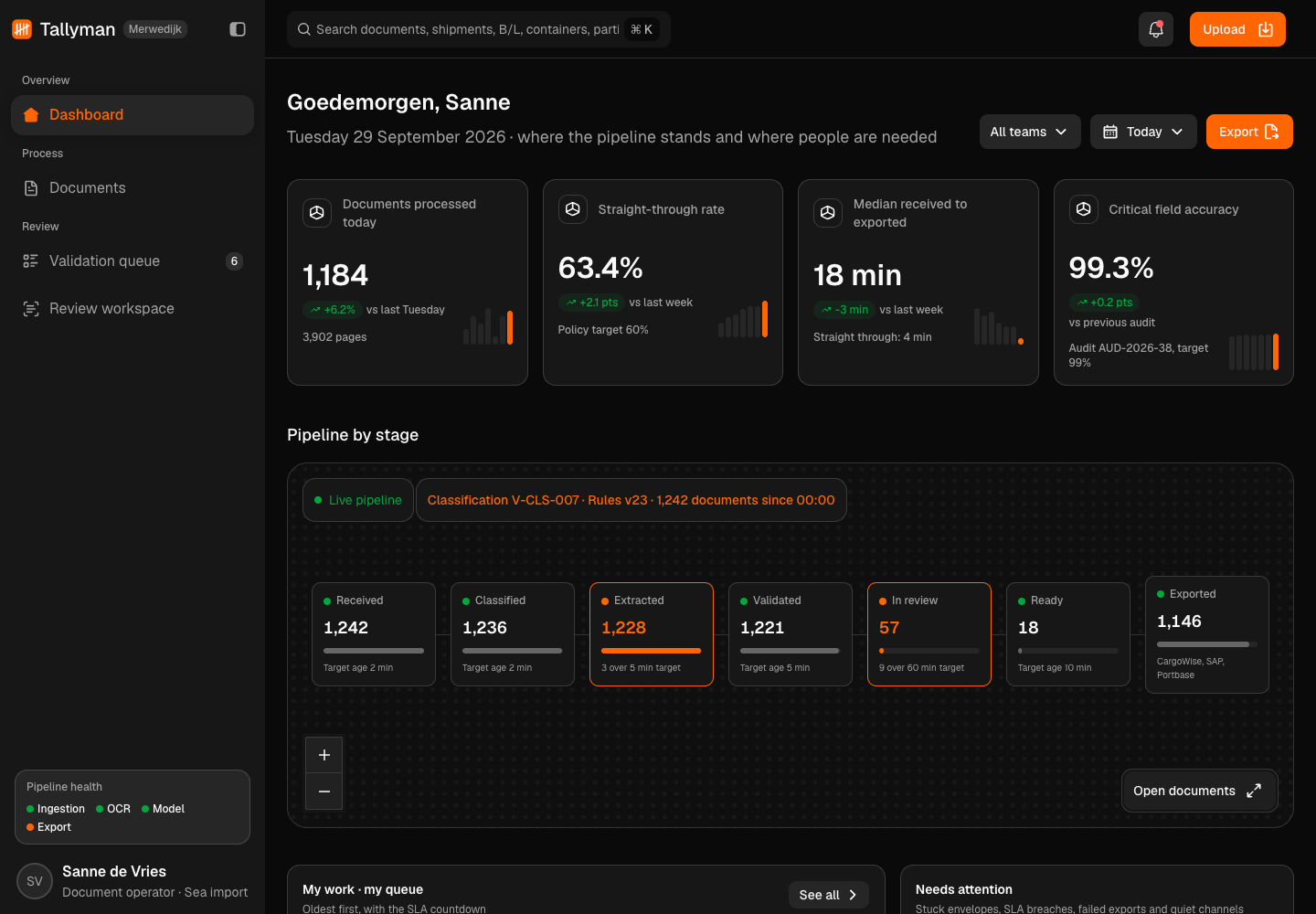
Tallyman - Intelligent Document Processing for Trade and Customs Documents
Designed and built a clickable document processing platform for a Rotterdam freight forwarder and customs representative: it classifies commercial invoices, packing lists, bills of lading, air waybills and certificates of origin, extracts each field with a confidence score, checks it against business rules and sends only the uncertain fields to a person in a side-by-side review workspace.
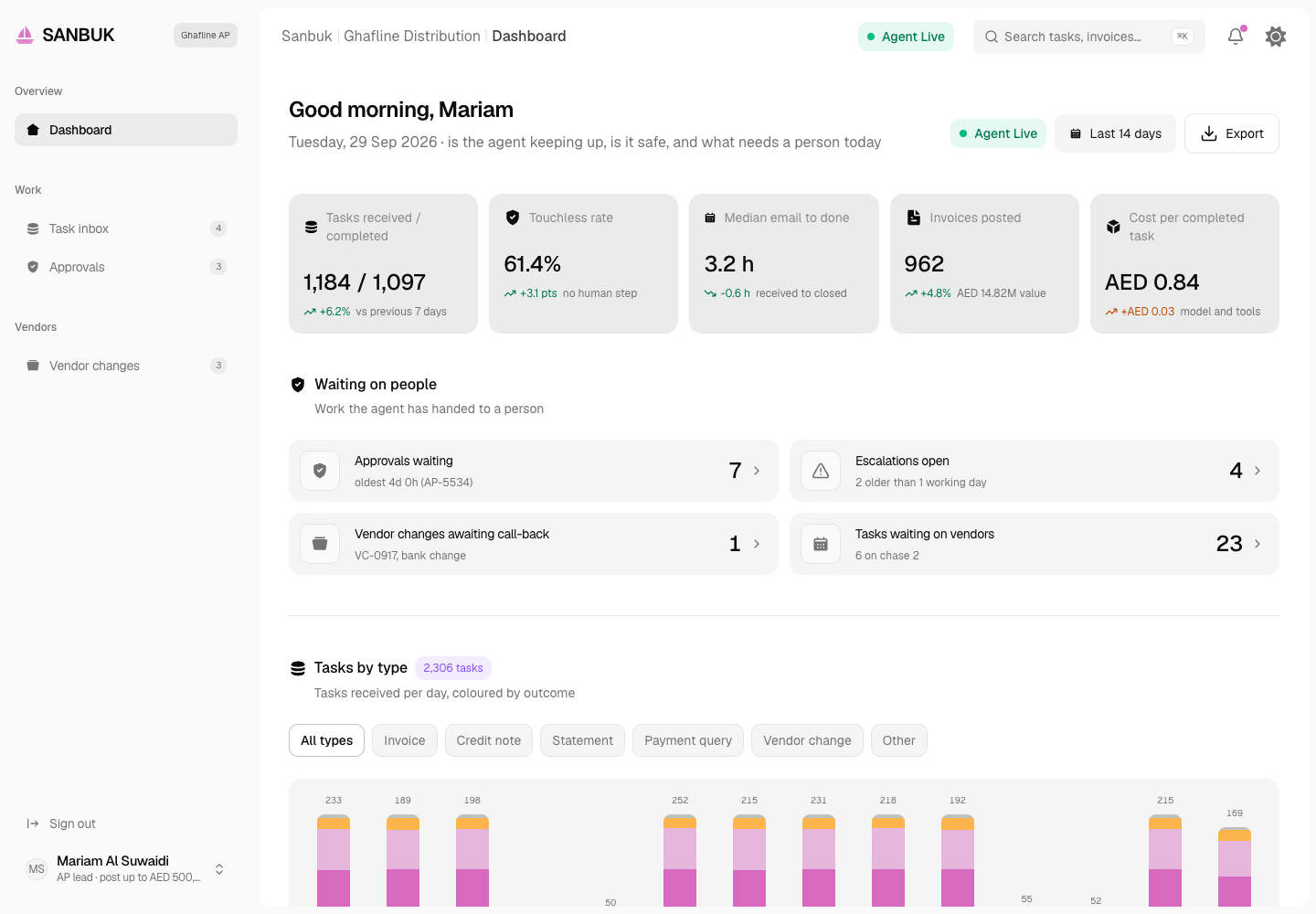
Sanbuk - Accounts Payable Agent with an Operator Console and Approval Gates
Designed and built a clickable back-office agent for a Dubai mainland distributor: it reads the AP and vendor mailboxes, matches invoices to POs and goods receipts, checks UAE tax invoice fields, drafts replies and posts to the ERP, while people approve by amount, see every tool call and handle every bank detail change themselves.
Enterprise Software Engineering - Human + AI
Contact Us
© 2026 - Copyright. All Rights reserved Oceanlab
Location
Global Headquarters
21 Merchant Road, 3rd Floor, Singapore 058267
Main corporate office and leadership operations
North America Office
548 Market Street, PMB 12345, San Francisco, CA 94104
Client operations and business development
India Office
402 Shivalik Shilp II, SG Highway, Ahmedabad 380015
Engineering and delivery center

Enterprise Software Engineering - Human + AI
Contact Us
Locations
Global Headquarters
21 Merchant Road, 3rd Floor, Singapore 058267
Main corporate office and leadership operations
North America Office
548 Market Street, PMB 12345, San Francisco, CA 94104
Client operations and business development
India Office
402 Shivalik Shilp II, SG Highway, Ahmedabad 380015
Engineering and delivery center
© 2026 - Copyright. All Rights reserved Oceanlab