Baqueano - Sales Call Analyser with Consent Rules Built In
Conversation Intelligence for a Multilingual Sales Team
Designed and built a clickable sales call analyser for a Buenos Aires SaaS company selling in Spanish, Portuguese and English: one call library across Zoom, Teams, Meet and the dialer, recording rules checked per participant before analysis, AI summaries, talk metrics and MEDDICC or BANT scorecards with evidence, and deals seen through what was said on calls.
Most of our work is under NDA. Per agreement, we can share the work but not the company details - all names and identifying information shown here have been changed.
Impact
Home, call library, call detail with 7 analysis tabs, deals and deal detail. Every one of the 24 demo calls and 14 deals opens its own page, including held, processing, stopped and media-expired calls.
California, Florida, Illinois, Maryland, Massachusetts, Montana, New Hampshire, Pennsylvania and Washington trigger the all-party rule, and so does any participant whose location is unknown. A held call shows the location evidence, consent events and a 72-hour discard clock.
7 MEDDICC and 4 BANT fields, each with the extracted value, a confidence chip, the evidence in the transcript and a suggested, confirmed, edited or not discussed status before anything syncs to the CRM.
14 deals worth $695,300 across 14 accounts in 7 countries, 19 contacts, 5 recording sources, 4 tracked competitors and 6 topics, with calls in Spanish, Portuguese, English and mixed Spanish and English.
The Problem
Quebracho Cloud grew from one Buenos Aires team to four hubs in three years. Managers could join only a handful of live calls a week, recordings sat in personal Zoom and Drive folders nobody searched, deal reviews relied on what the rep remembered, and CRM qualification fields were filled in the night before forecast calls. Reps were also recording prospects in California, Illinois and Germany without a consistent notice.
Our Solution
Baqueano puts every eligible call in one library, decides the recording rule for each participant before any transcription or analysis, and gives managers the evidence behind every summary, score, risk and coaching comment: the exact moment in the call. Only confirmed notes and qualification fields go to the CRM.
The Challenge: Coaching From Evidence, Across Borders
A team of about 70 people in Buenos Aires, São Paulo, Mexico City and Miami sells in three languages to prospects across Latin America, the United States and Europe, so every call carries different recording rules, and the analysis has to be trusted by both managers and the reps it describes.
Recording Rules Change Per Participant
Most US states allow one-party consent, but a group including California and Illinois generally require every party to agree. Argentina's Law 25.326, Brazil's LGPD and the GDPR each require notice and a lawful basis. One call can mix all of these, and a participant's location is often unknown.
Three Languages on One Call
Calls run in Spanish, Portuguese or English and often switch between Spanish and English mid-call. Transcripts, trackers, objections and summaries have to work in the original language, with any translation clearly labelled as machine translated.
Scores Reps Can Trust
The EU AI Act restricts emotion recognition at work and places obligations on systems that evaluate workers. Reps are data subjects too, so scores have to describe observable behaviour, show their evidence, and never feed pay or promotion decisions automatically.
CRM Fields Nobody Confirmed
Qualification fields were typed from memory before forecast calls. AI can extract MEDDICC and BANT answers from the transcript, but a wrong value in the CRM is worse than a blank one, so each field needs a person to confirm it against the quote.
Our Approach: From Recording Rules to a Clickable Analyser
Spec and Rules Research
Mapped 8 staff roles, from reps and managers to revenue operations and the privacy lead, plus prospects who never log in. Specified 31 screens and the data model for calls, participants, jurisdiction rules, consent determinations and events, transcripts, trackers, objections, scorecards, risk signals and CRM sync. Wrote down the rules the design follows: Argentina's Law 25.326, the LGPD, US one-party and all-party consent, Illinois BIPA, the GDPR and the EU AI Act.
Clickable Demo on a Production UI Kit
Built 5 key screens on a production dashboard kit: the home view with team KPIs, to-dos, deals at risk and competitor mentions, the call library with saved views and filters, call detail with a speaker-lane player, transcript and tabs for summary, metrics, trackers, objections, scorecard, coaching and participants, the deals table and deal detail with a qualification board and risk signals. Held calls show the consent hold detail, and Upload recording refuses an all-party upload without a consent declaration.
What a Production Build Adds
Recording intake from the Zoom, Microsoft Teams and Google Meet APIs, a meeting bot such as Recall.ai and a dialer such as Aircall, transcription with speaker separation (such as Deepgram or AssemblyAI), a language model for summaries and extraction, and Salesforce or HubSpot sync. SSO and SCIM provisioning, retention and deletion jobs, an audit log of every consent decision, playback and export, and the remaining screens: coaching, playlists, insights, governance, settings and the public notice and privacy request pages.
Why It Works: Rules Before Recording, Evidence Behind Every Score
The Strictest Rule Wins
Each participant shows the location used for consent and where it came from: CRM, calendar domain, phone country code or the rep. If any location is unknown, the call is treated as all-party and held before analysis, and it can only be released with a reason once the rule is satisfied.
Every Claim Links to the Moment
Summaries, trackers, objections and scorecard fields all point back to the utterance they came from, and the timeline marks trackers, objections and coaching comments so a manager can jump straight to them.
Behaviour, Not Judgement
Metrics are talk ratio against the team's 40% to 55% target band, longest monologue, questions asked, interactivity and patience, each beside the team benchmark. Nothing infers emotion or sentiment about a rep.
People Confirm Before the CRM Sees It
The scorecard separates suggested from confirmed fields, a sync preview shows exactly what will be written, and only the summary, next steps and confirmed fields go to the CRM. Full transcripts stay in Baqueano, where retention applies.
Related case studies
View all: AI agents & automation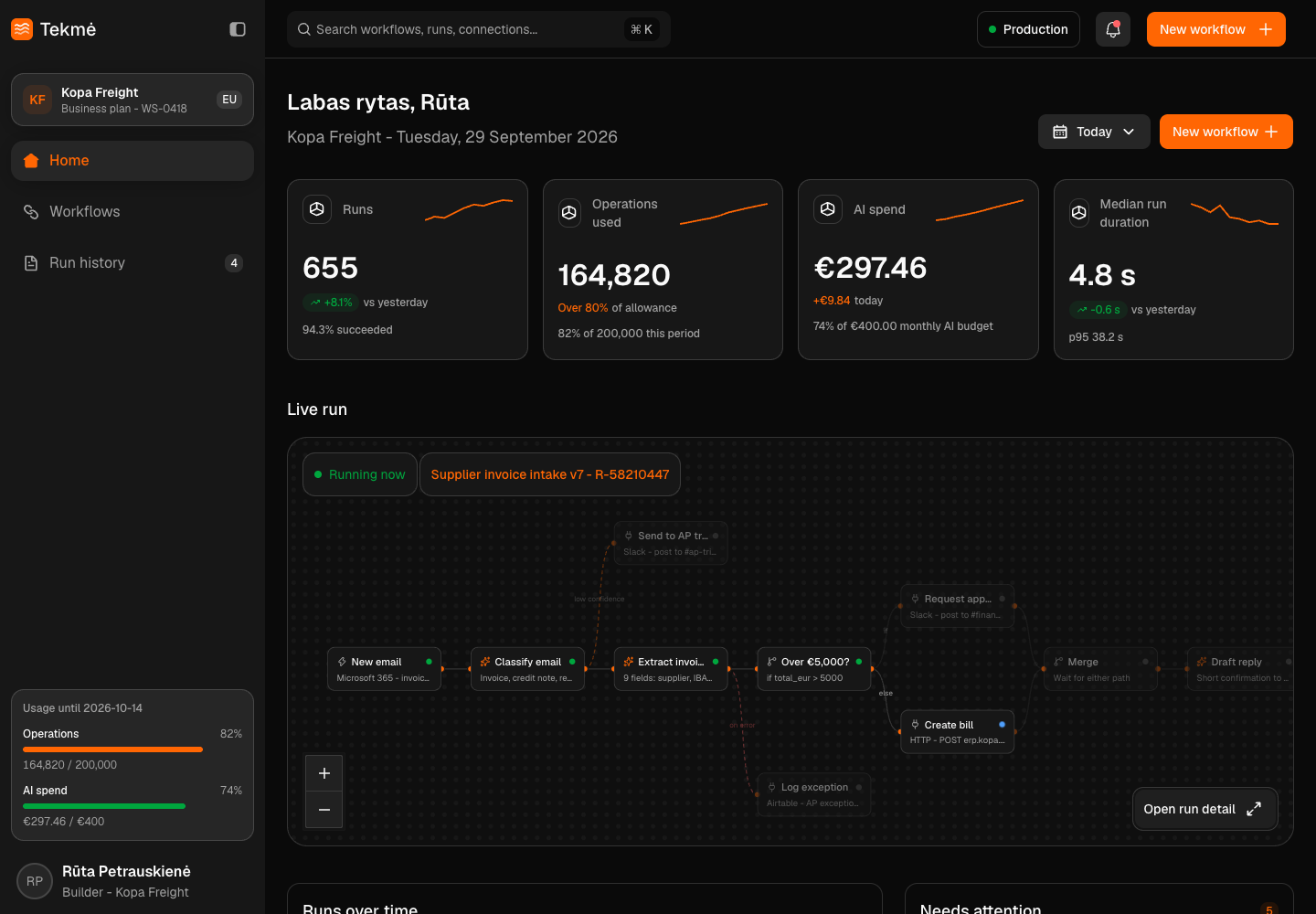
Tekmė - No-Code Workflow Automation Builder with AI Steps
Designed and built a clickable no-code automation builder for a Vilnius SaaS startup selling to EU operations teams: a node canvas with branches, error paths and AI steps that classify, extract, summarise or act as an agent, a cost estimate per run, and a run history where every step is recorded with personal data masked.
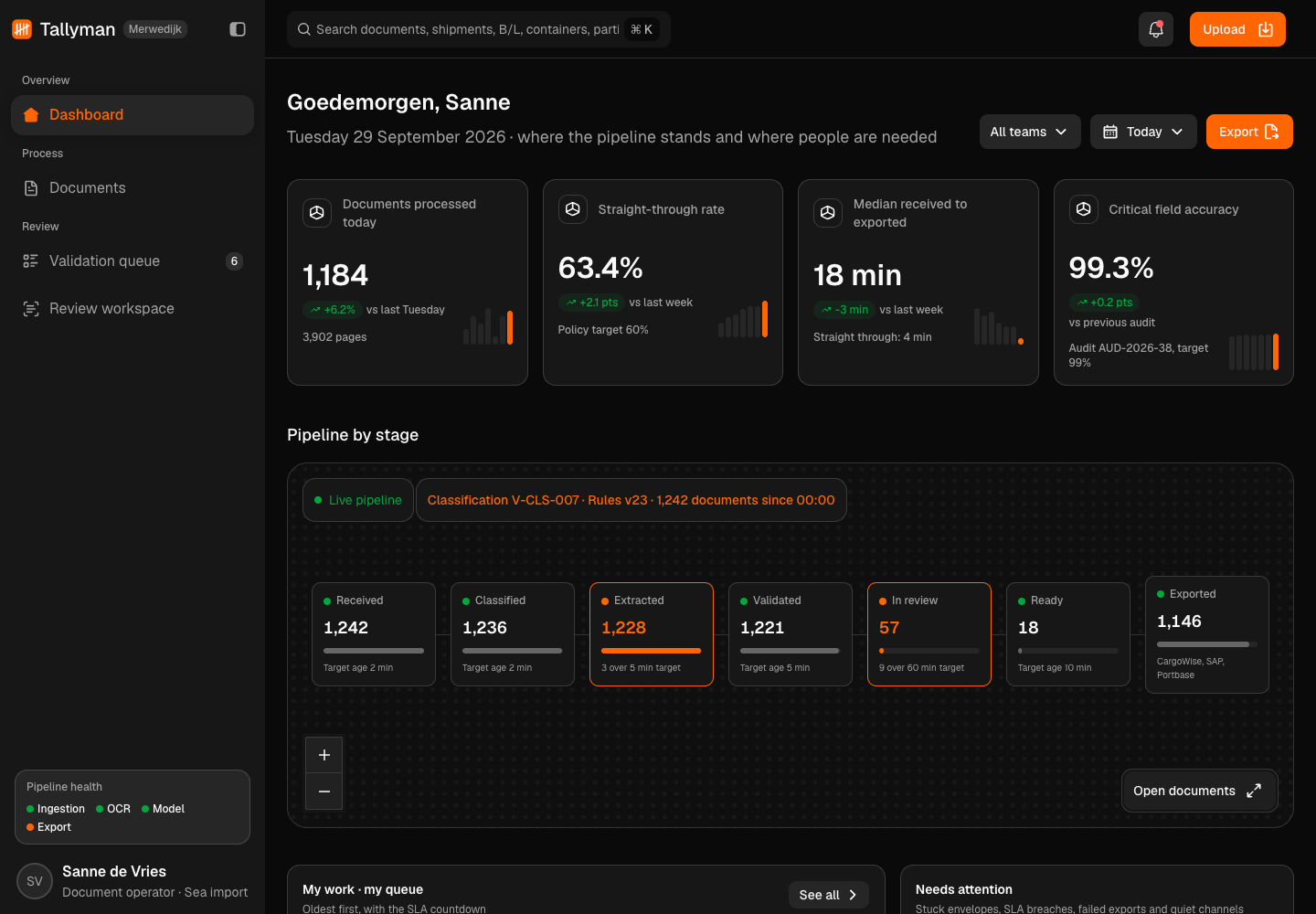
Tallyman - Intelligent Document Processing for Trade and Customs Documents
Designed and built a clickable document processing platform for a Rotterdam freight forwarder and customs representative: it classifies commercial invoices, packing lists, bills of lading, air waybills and certificates of origin, extracts each field with a confidence score, checks it against business rules and sends only the uncertain fields to a person in a side-by-side review workspace.
Enterprise Software Engineering - Human + AI
Contact Us
© 2026 - Copyright. All Rights reserved Oceanlab
Location
Global Headquarters
21 Merchant Road, 3rd Floor, Singapore 058267
Main corporate office and leadership operations
North America Office
548 Market Street, PMB 12345, San Francisco, CA 94104
Client operations and business development
India Office
402 Shivalik Shilp II, SG Highway, Ahmedabad 380015
Engineering and delivery center

Enterprise Software Engineering - Human + AI
Contact Us
Locations
Global Headquarters
21 Merchant Road, 3rd Floor, Singapore 058267
Main corporate office and leadership operations
North America Office
548 Market Street, PMB 12345, San Francisco, CA 94104
Client operations and business development
India Office
402 Shivalik Shilp II, SG Highway, Ahmedabad 380015
Engineering and delivery center
© 2026 - Copyright. All Rights reserved Oceanlab