Sotdae - Travel Insurance Claims Agent with Human Decisions and Cited Clauses
Supervised Claims Agent for a Seoul Travel Insurance Agency
Designed and built a clickable claims processing agent for a Seoul travel insurance agency: it takes claims in by chat or email, reads receipts and medical reports, checks cover against the policy wording in force on the travel date and writes a recommended decision with the clauses it relied on, while adjusters approve every payment and only people with decline authority can decline.
Most of our work is under NDA. Per agreement, we can share the work but not the company details - all names and identifying information shown here have been changed.
Impact
Dashboard, claims queue, claim detail, decision workbench and payment approvals. Every one of the 27 demo claims opens its own detail page with 8 tabs and its own decision workbench.
The agent's tool set has no decline or payment release tool. Recommended declines and partial declines route to a person with decline authority, who picks a reason from a fixed list and cites the clauses.
Only full payments at or under the limit, on an eligible benefit, with no open fraud indicator, no low-confidence field and a matching payee check. Approval has a 5-second undo, and nobody approves a claim they entered.
Across 6 benefits, with documents, coverage tests, agent runs with step timelines and guardrail checks, communications, 14 wording clauses, 15 past decisions and 8 staff users.
The Problem
Byeolbit's claims team of nine handled about 6,000 claims a month by hand. Claimants emailed photos of receipts and hospital bills in Thai, Japanese, Vietnamese and English, and a handler typed them in, looked up the policy, opened the wording PDF and worked out which benefit applied. After the summer and Lunar New Year peaks the queue ran to three weeks, and the insurer's 2025 oversight review found inconsistent decisions on the same benefit and two declines with no clause cited in the letter.
Our Solution
Sotdae collects the documents a claim needs, extracts the data, checks cover against the exact wording version, looks for fraud indicators and writes a recommended decision with its reasoning and cited clauses. Adjusters work a claims queue, see every agent step and tool call, approve small payments in one click and review everything else in a decision workbench. The agent cannot decline, reduce an amount for an exclusion or release a payment.
The Challenge: Faster Than People, Decided by People
Byeolbit wanted automation that was faster and more consistent than its team, but one where every decision against a claimant is still made, and signed, by a person, and where the insurer can see all of it.
Every Claim Took the Same Effort
A four-hour flight delay claim worth KRW 100,000 took the same handling as a medical claim. Documents arrived in four languages and foreign currencies, and claimants chased by phone and KakaoTalk while a growing share of complaints were about silence rather than outcomes.
The Insurer Keeps Responsibility
Under the Insurance Business Act the insurer stays responsible for claims decisions and payment even when an agency does the work, and loss adjustment is a regulated activity. Every decision has to be recorded against Seorak Fire & Marine's delegated authority, with a named person as the decision maker.
Decisions Have to Explain Themselves
The Financial Consumer Protection Act calls for clear explanations and proper complaint handling. Each decision must rest on the wording version in force on the trip start date, and every decline letter must give the reasons, cite the clauses and tell the claimant how to complain and how to reach the FSS.
Health Data and Automated Decisions
Under PIPA, health information needs separate consent, and sharing with the insurer, a hospital or an airline needs its own. The 2024 PIPA amendments give a right to refuse or ask for an explanation of fully automated decisions, and the AI Basic Act adds duties to tell people they are dealing with AI.
Our Approach: From Claims Rules to a Clickable Agent Console
Spec and Rules Research
Mapped 10 user roles from claims handler and senior adjuster to fraud analyst, complaints officer, agent operator, insurer oversight and claimant, 39 screens across staff, insurer partner and claimant pages, and the data model for claims, documents, coverage checks, fraud indicators, recommendations, decisions, payments, agent runs, guardrail events, complaints and versioned wordings. Wrote down the rules the design follows: the Insurance Business Act, the Financial Consumer Protection Act, PIPA, the AI Basic Act, insurance fraud reporting and the OWASP Top 10 for LLM Applications.
Clickable Demo on a Production UI Kit
Built 5 key screens on a production dashboard kit: the dashboard with 5 KPIs, queue by status, needs attention and how people acted on recommendations, the claims queue with 5 tabs, 7 filters, a quick view drawer and a new claim form, the claim detail with status rail, 8 tabs, clause panel, document viewer and run timeline, the decision workbench with a switch to view it as a claims handler, and payment approvals. All actions run on local state.
What a Production Build Adds
Anthropic Claude through Amazon Bedrock in the Seoul region, OCR such as NAVER CLOVA OCR or Upstage Document Parse, Seorak's policy API and wording versions, Cirium or FlightAware flight data, exchange rates, PASS identity checks through NICE or KCB, firm banking payouts with an account holder check, Kakao AlimTalk and Microsoft 365 email. Staff auth by role, an audit log of every agent step with model and prompt version, the remaining screens for complaints, privacy requests, the insurer partner view and claimant mobile pages, and compliance review of every rule.
Why It Works: The Agent Recommends, a Person Decides
Declines Are Blocked in the Tool Set
The limit is enforced by which tools exist, not by a prompt. Partial declines and declines go to decline review, and the workbench authority check shows whether the signed-in person may approve the amount and outcome, so a handler without decline authority sees the block before acting.
Every Reasoning Step Has a Source
The agent's reasoning is shown as numbered steps, each linked to the flight record, document field or clause it used, and an unsupported step is marked No source in red. Cited clauses open their full text with a plain summary, and up to five similar decided claims sit beside the decision.
Amounts Built Up Line by Line
Each claimed item shows its original currency, the rate, the KRW value and whether it is eligible under a clause, then the sub-limit, deductible and total. The letter preview explains the result in the claimant's language and plain words before anything is sent.
Documents Are Data, Not Instructions
Text in a receipt or chat cannot change the agent's tools, thresholds or rules: an instruction found in a document is ignored and flagged on the run. A fraud indicator never lowers a recommendation by itself; it routes the claim to a fraud analyst instead.
Related case studies
View all: AI agents & automation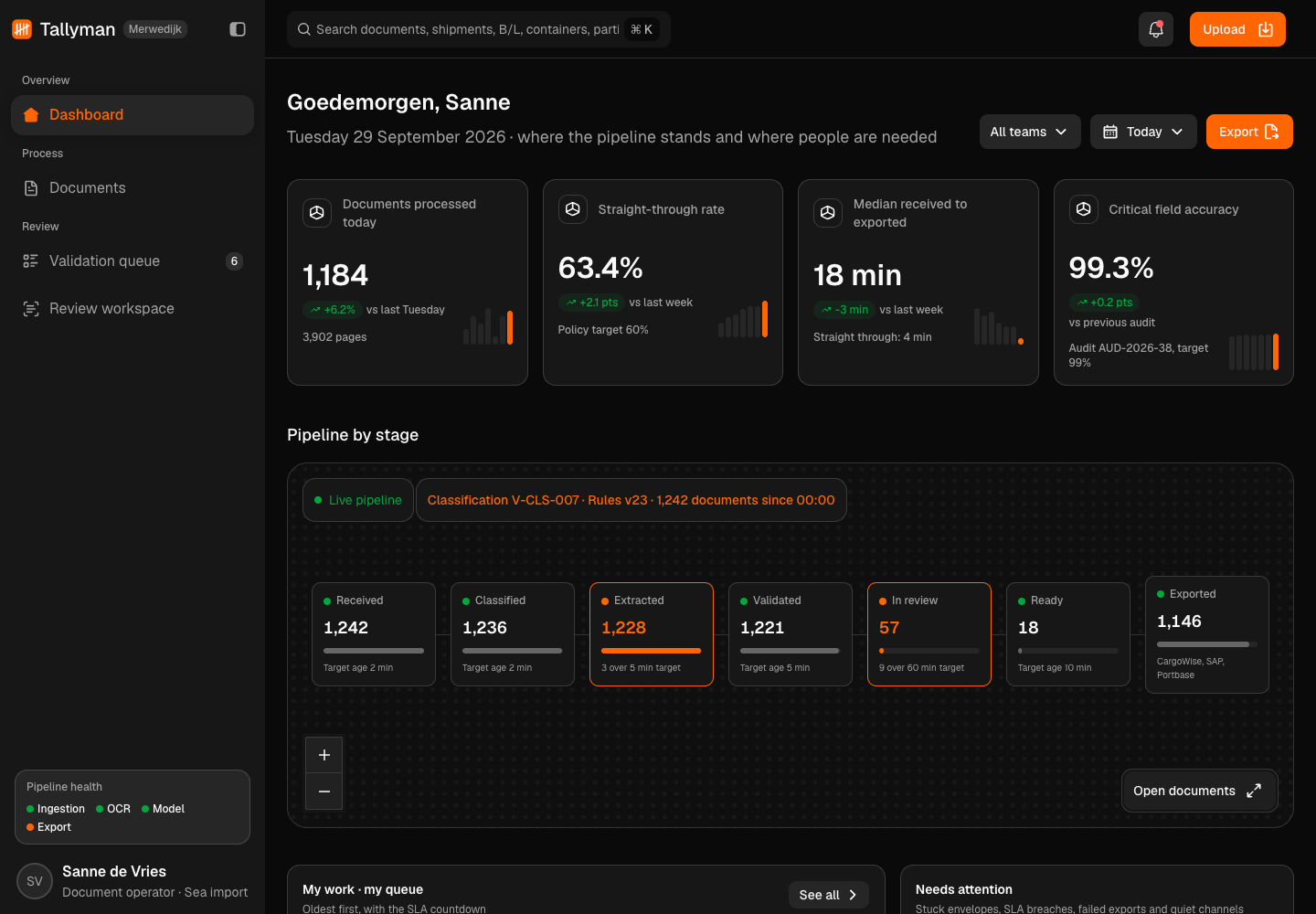
Tallyman - Intelligent Document Processing for Trade and Customs Documents
Designed and built a clickable document processing platform for a Rotterdam freight forwarder and customs representative: it classifies commercial invoices, packing lists, bills of lading, air waybills and certificates of origin, extracts each field with a confidence score, checks it against business rules and sends only the uncertain fields to a person in a side-by-side review workspace.
Sanbuk - Accounts Payable Agent with an Operator Console and Approval Gates
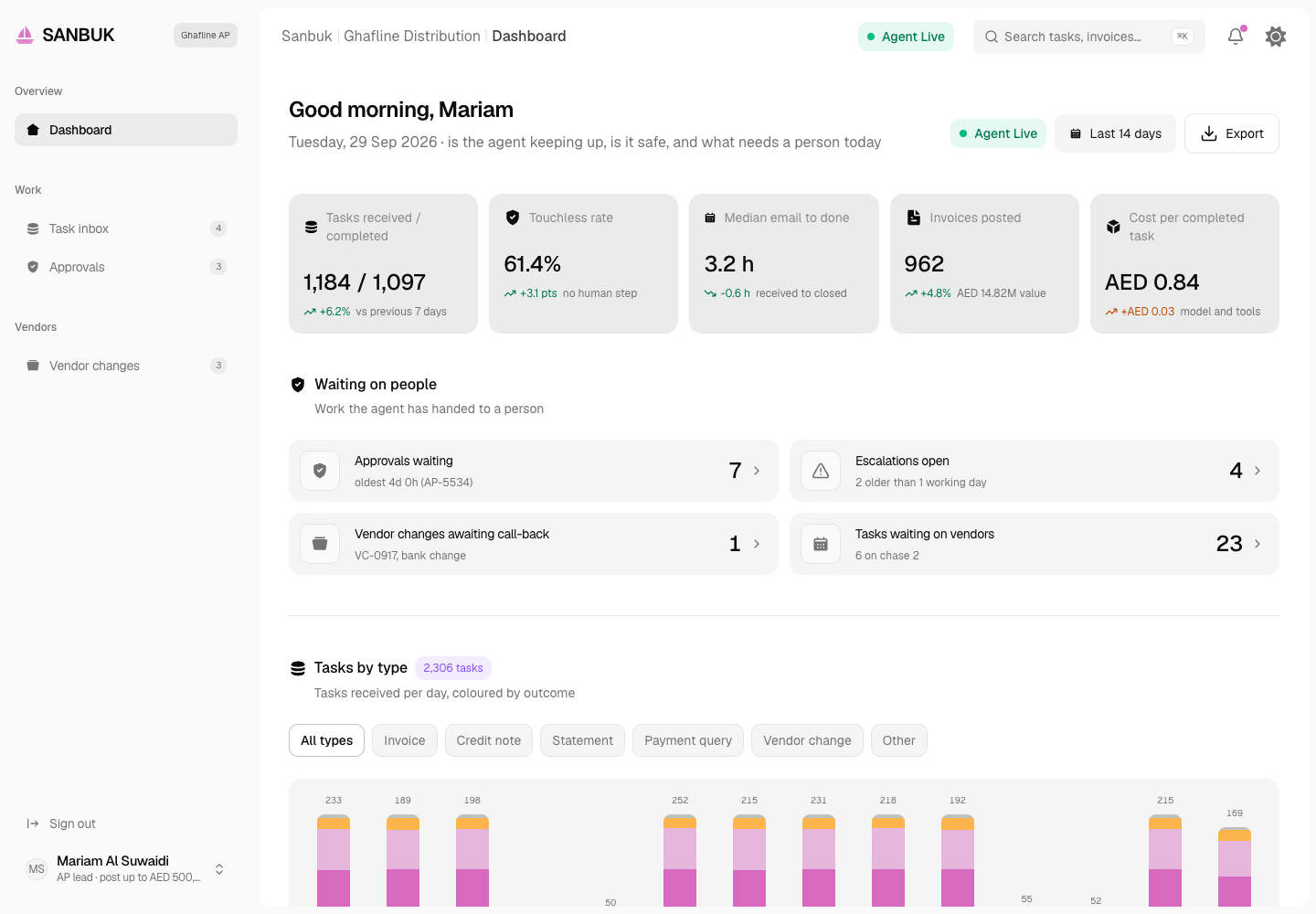
Designed and built a clickable back-office agent for a Dubai mainland distributor: it reads the AP and vendor mailboxes, matches invoices to POs and goods receipts, checks UAE tax invoice fields, drafts replies and posts to the ERP, while people approve by amount, see every tool call and handle every bank detail change themselves.
Enterprise Software Engineering - Human + AI
Contact Us
© 2026 - Copyright. All Rights reserved Oceanlab
Location
Global Headquarters
21 Merchant Road, 3rd Floor, Singapore 058267
Main corporate office and leadership operations
North America Office
548 Market Street, PMB 12345, San Francisco, CA 94104
Client operations and business development
India Office
402 Shivalik Shilp II, SG Highway, Ahmedabad 380015
Engineering and delivery center

Enterprise Software Engineering - Human + AI
Contact Us
Locations
Global Headquarters
21 Merchant Road, 3rd Floor, Singapore 058267
Main corporate office and leadership operations
North America Office
548 Market Street, PMB 12345, San Francisco, CA 94104
Client operations and business development
India Office
402 Shivalik Shilp II, SG Highway, Ahmedabad 380015
Engineering and delivery center
© 2026 - Copyright. All Rights reserved Oceanlab