Singil - Hospital Billing and Claims Platform for PhilHealth and HMOs
Billing and Claims Platform for a Philippine Hospital Group
Designed and built a clickable billing and claims platform for a private hospital group in Quezon City, Cebu and Davao: patient accounts from first charge to zero balance, a bill that applies PhilHealth, senior and PWD discounts and HMO coverage in the right order, a discharge clearance board, and PhilHealth claims tracked against the filing deadline.
Most of our work is under NDA. Per agreement, we can share the work but not the company details - all names and identifying information shown here have been changed.
Impact
Dashboard, patient accounts, account detail with 6 tabs, discharge clearance board and PhilHealth claims. Every one of the 28 demo accounts opens its own account page.
PhilHealth HCI and PF portions, No Balance Billing, senior or PWD VAT exemption and 20% discount, HMO up to the LOA limit, corporate guarantee and deposits. Each line names the rule version that produced it.
Five stages from discharge order to cleared. Wait time turns amber after 1 hour and red after 2, each card names what is blocking it, and only unblocked patients can be cleared.
3 facilities, 9 physicians, 11 diagnoses with ICD-10 and RVS codes, 3 HMOs with LOAs, 11 clearance cards and 22 PhilHealth claims across 8 statuses.
The Problem
Balangay's billing offices worked from the hospital information system's charge printouts, a separate eClaims tool, HMO portals and a spreadsheet per payer for remittances. Coders chased doctors for missing diagnoses by phone, clerks computed senior citizen discounts and PhilHealth deductions by hand, patients waited three to five hours for discharge clearance, about one PhilHealth claim in six came back as a return to hospital, and days in accounts receivable sat above 110.
Our Solution
Singil takes a patient account from the first charge to a zero balance. Charges arrive grouped by department, codes map to a PhilHealth case rate, the bill applies every deduction in the order the payer rule sets, a clearance board shows what is holding each discharge, and every PhilHealth claim carries its filing deadline from the day of discharge.
The Challenge: Many Payers on One Hospital Bill
A Philippine hospital bill is rarely paid by one party. PhilHealth pays first, senior citizens and persons with disability get a discount set by law, an HMO covers what its letter of authorization allows, and the patient pays the rest, each with its own rules, forms and deadlines.
Deductions in the Right Order
Senior citizens (RA 9994) and persons with disability (RA 10754) generally get a 20% discount and VAT exemption on hospital services, medicines and attending doctors' fees. Whether PhilHealth or the discount comes first changes the patient's share, and hospitals differ, so the order has to be a versioned rule rather than a clerk's habit.
Codes That Decide Payment
PhilHealth generally pays a fixed case rate keyed on the ICD-10 diagnosis or RVS procedure code, split into a hospital (HCI) portion and a professional fee portion paid only for accredited physicians. A second case rate is generally paid at 50%, and a planned move to DRG payment means the benefit engine must be able to switch.
Claims Against the Clock
Claims are filed through PhilHealth eClaims with a set of forms (CF1 to CF4) that varies by claim type, generally within 60 days of discharge. Returns to hospital and denials each carry their own refiling or appeal period, and Balangay could not see which claims were close to missing theirs.
Discharges Held by Billing
A patient with a discharge order still needs coded diagnoses, encoded doctors' fees, pharmacy returns and an HMO approval before the bill is final. Each blocker sat with a different team, and patients waited three to five hours for clearance with nobody able to say why.
Our Approach: From Billing Rules to a Clickable Platform
Spec and Rules Research
Mapped 12 user roles from coder and billing clerk to the data protection officer, physicians and patients, 39 screens across staff, physician portal and patient pages, and the data model for accounts, charges, professional fees, code assignments, case rates, payer rules, bill computations, LOAs, claims, denials and remittances. Wrote down the rules the design follows: the UHC Act, PhilHealth case rates and eClaims, No Balance Billing, senior and PWD discounts, HMO letters of authorization and the Data Privacy Act.
Clickable Demo on a Production UI Kit
Built 5 key screens on a production dashboard kit: the dashboard with KPIs, work waiting by stage, AR by payer and ageing bucket and collections against target, patient accounts with status pills and a quick view panel, the account page with charges, codes and case rate, the bill computation and its finalise and reopen actions, the discharge clearance board, and PhilHealth claims with filing deadlines and transmittal. All actions run on local state.
What a Production Build Adds
PhilHealth eligibility, eClaims transmission and status through an accredited eClaims-compliant system, the EHR feed over HL7 v2 or FHIR, HMO portals for Maxicare, Intellicare and MediCard, GCash, Maya and card payments through PayMongo or Xendit, bank statement imports, SMS and email statements and SAP Business One. Staff auth by role and facility, an audit log of every view of a patient record, the coding, claims, payments and settings screens, the physician portal and the patient pay-by-link pages, with the deduction order confirmed by counsel and every PhilHealth rule checked against current circulars.
Why It Works: Every Peso Explained
Each Deduction Shows Its Rule
The bill lists gross charges and fees, then every deduction in the order the payer rule applies them, each with its basis and rule version, such as the PhilHealth rules or the senior and PWD rule in force. Finalise locks the computation, and in the spec only the billing manager can reopen it, with a reason.
The Board Says What Is Blocking
Each discharge card shows room, physician, payers, patient share and time since the discharge order, with the blocker in plain words: PF not yet encoded, pharmacy returns pending, LOA limit exceeded or senior citizen ID copy not verified. Issue clearance is enabled only when nothing is blocking.
Deadlines Counted From Discharge
Every PhilHealth claim shows its filing deadline at discharge plus 60 days and the days left, and a callout lists claims within 10 days of it that are not yet transmitted. Ready claims can be selected and added to a transmittal in one step.
Sensitive Data Kept Back
Health information is sensitive personal information under the Data Privacy Act, so PhilHealth PINs are masked except the last four digits in every list and record, senior and PWD flags show that the ID was verified, and the spec logs every view of a patient account.
Related case studies
View all: Hospitals & clinics
Clinica - Multi-Department Clinic Operations Console with AI Assistant
Built a multi-department clinic operations console with appointment management, department load tracking, staff performance, resource utilisation and an AI assistant for staff queries - shipped from clickable AI prototype to production in 14 weeks.
Lyrebird - Patient Booking and Intake Platform with Clinician-Routed Risk Flags
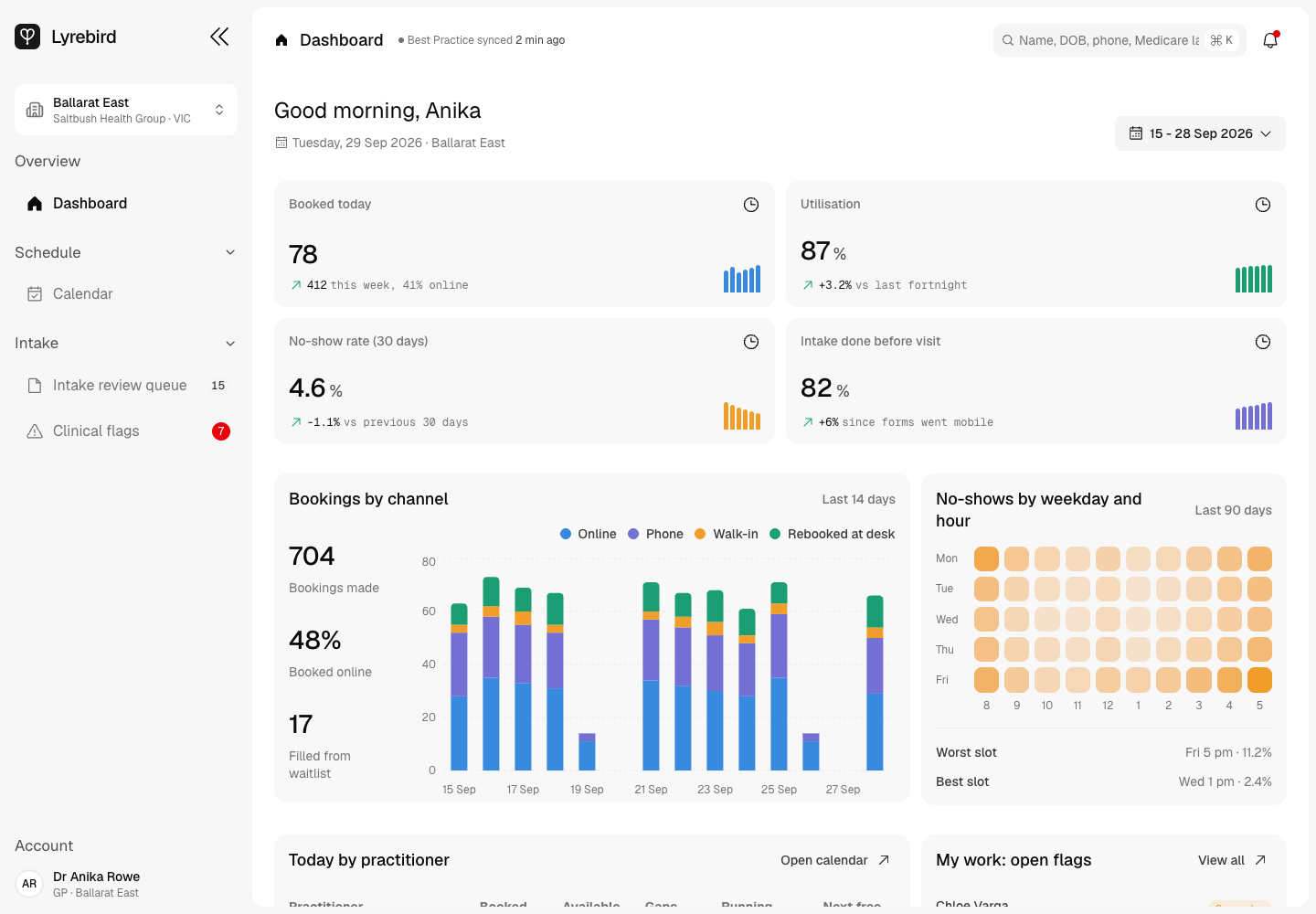
Designed and built a clickable booking and intake platform for a group of GP, physiotherapy and psychology clinics in regional Victoria and southern NSW: a day calendar by practitioner or room, pre-visit forms reviewed before the visit, and a clinician-only queue that puts every risk answer in front of a clinician against a response target.
Enterprise Software Engineering - Human + AI
Contact Us
© 2026 - Copyright. All Rights reserved Oceanlab
Location
Global Headquarters
21 Merchant Road, 3rd Floor, Singapore 058267
Main corporate office and leadership operations
North America Office
548 Market Street, PMB 12345, San Francisco, CA 94104
Client operations and business development
India Office
402 Shivalik Shilp II, SG Highway, Ahmedabad 380015
Engineering and delivery center

Enterprise Software Engineering - Human + AI
Contact Us
Locations
Global Headquarters
21 Merchant Road, 3rd Floor, Singapore 058267
Main corporate office and leadership operations
North America Office
548 Market Street, PMB 12345, San Francisco, CA 94104
Client operations and business development
India Office
402 Shivalik Shilp II, SG Highway, Ahmedabad 380015
Engineering and delivery center
© 2026 - Copyright. All Rights reserved Oceanlab