Lyrebird - Patient Booking and Intake Platform with Clinician-Routed Risk Flags
Patient Intake and Scheduling for an Australian GP and Allied Health Group
Designed and built a clickable booking and intake platform for a group of GP, physiotherapy and psychology clinics in regional Victoria and southern NSW: a day calendar by practitioner or room, pre-visit forms reviewed before the visit, and a clinician-only queue that puts every risk answer in front of a clinician against a response target.
Most of our work is under NDA. Per agreement, we can share the work but not the company details - all names and identifying information shown here have been changed.
Impact
Dashboard, day calendar with appointment quick view, intake review queue, intake submission and clinical flags with the flag panel. Each of the 21 submitted forms opens its own submission.
Urgent flags must be answered within 30 minutes and same-day flags within 2 business hours. Time to target counts down on every flag, turns red when overdue, and resolving an urgent flag needs a note.
Bulk billed, private fee or mixed by eligibility, with duration and fee on each of the 10 appointment types. Calendar cards carry a BB, Private or DVA chip so the front desk sees the billing before the patient arrives.
Booked today at one clinic across 7 practitioners and 7 rooms, with 80 patients, 25 intake forms, 12 clinical flags, waitlist matches and the day's cancellations.
The Problem
Saltbush grew by buying independent practices, and each kept its own habits. Two used a third-party booking site, the rest booked by phone, and the allied health clinics ran a different practice management system from the GPs. New patients filled in a clipboard form that reception re-typed, reminders were sent by hand, no-shows ran at about 8% of booked appointments, and a psychology intake questionnaire once sat unread for four days with a concerning answer on it.
Our Solution
Lyrebird gives the group one way to book and one way to take intake. The front desk runs the day from a calendar by practitioner or room, pre-visit forms arrive as structured answers with admin changes ready to accept into the record, and risk answers go to a clinician-only flag queue with a response target, never only to reception.
The Challenge: Safe Intake Across 14 Practices
Saltbush runs 9 general practices and 5 allied health clinics with about 140 practitioners. Each practice books, bills and takes intake its own way, and the rules for what a patient pays and what must be reviewed change with every appointment.
Three Ways of Booking
Some practices took online bookings through a third-party site, most took every booking by phone, and allied health ran on a different practice management system. Reminders were sent by hand from a phone and the waitlist lived on sticky notes.
Clipboards Re-Typed at the Desk
New patients filled in a paper form in the waiting room and reception typed it into the system. Medicare details were often wrong until the claim bounced, and nobody could see which answers had changed since the last visit.
Risk Answers With No Owner
A concerning answer on a mental health questionnaire could wait days for someone to read it. The clinical governance committee asked for a safer way: risk answers routed to a clinician, with a clear owner and a time to respond.
Billing and Eligibility Per Appointment
An appointment type can be bulk billed, privately billed or mixed by eligibility. Allied health generally attracts a Medicare rebate only with a valid GP referral and plan, and most Medicare GP telehealth needs an eligible telehealth practitioner for the patient.
Our Approach: From Clinic Rules to a Clickable Platform
Spec and Rules Research
Mapped 10 user roles from receptionist and clinical lead to patient and carer, 40 screens (28 staff and 12 patient-facing), and the data model for appointments, versioned appointment types and booking rules, form submissions, clinical flags, waitlist offers and the audit log. Wrote down the rules the design follows: the Privacy Act 1988 and APPs, notifiable data breaches, the Spam Act 2003 for reminders versus marketing, Medicare billing modes and referrals, telehealth eligibility, practitioner advertising rules and crisis contacts on every patient screen.
Clickable Demo on a Production UI Kit
Built 5 key staff screens on a production dashboard kit: the dashboard with bookings by channel, a no-show heatmap and today by practitioner, the calendar in 5-minute steps with check in, cancel and did not attend, the intake review queue with bulk review for admin-only forms, the intake submission with a scored K10 block and flagged answers, and the clinical flags queue with assign, record contact, escalate and resolve. All actions run on local demo data.
What a Production Build Adds
Integration with Best Practice or MedicalDirector and with Cliniko or Nookal as the appointment book, SMS reminders through MessageMedia or Twilio, email through Postmark or Amazon SES, deposits through Stripe or Tyro, video links, TIS National interpreter tasks and staff sign-in with Microsoft Entra ID. The 12 mobile-first patient screens to WCAG 2.1 AA, the remaining staff screens, an append-only audit log, Australian data hosting and licence checks for every scored questionnaire.
Why It Works: Every Answer Has an Owner
Risk Answers Go to a Clinician
Flag rules run on the questionnaire, so an answer such as PHQ-9 item 9 above 0 or chest pain now raises a flag with its severity. The flag queue is clinician-only, the clinician of the day owns it, and clinician-only answers are hidden from reception roles.
The Deadline Is On Screen
Each flag shows time left to target, with overdue flags in red and the sidebar badge red when any flag is past target. Flags raised out of hours say when they will first be seen, and patients who give a risk answer see Lifeline (13 11 14), 000 and the clinic number straight away.
Admin Changes Accepted, Not Re-Typed
A new Medicare card, address or concession card arrives as a proposed update that reception accepts into the record or rejects. Answers changed since the last visit are highlighted, and every view of a submission is recorded in the audit log.
One Card Tells the Front Desk Everything
Each calendar card shows the appointment type colour, billing chip, new patient badge, telehealth and interpreter icons, intake status and confirmation state. The day switches between practitioners and rooms, can show only free slots, and lists waitlist matches for cancelled slots.
Related case studies
View all: Hospitals & clinics
Clinica - Multi-Department Clinic Operations Console with AI Assistant
Built a multi-department clinic operations console with appointment management, department load tracking, staff performance, resource utilisation and an AI assistant for staff queries - shipped from clickable AI prototype to production in 14 weeks.
Loupe - Ophthalmology EHR with Per-Eye Charting and Laterality-Aware Coding
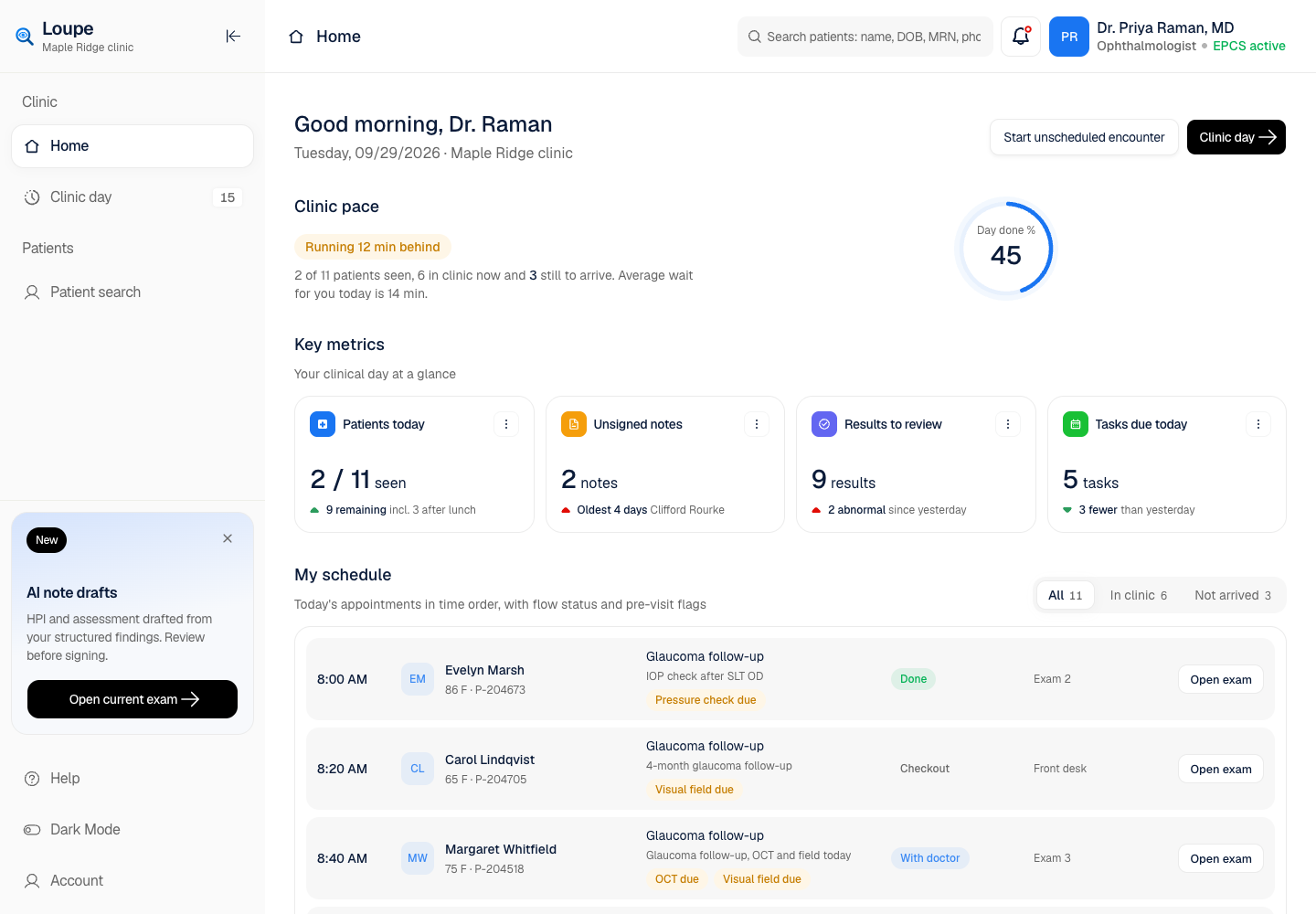
Designed and built a clickable ophthalmology EHR for a US eye care group with seven clinics: a clinician's day at a glance, a live patient flow board with dilation timers, patient search with break-the-glass access, a chart summary with right-eye and left-eye findings side by side, and a structured exam workspace per eye.
Enterprise Software Engineering - Human + AI
Contact Us
© 2026 - Copyright. All Rights reserved Oceanlab
Location
Global Headquarters
21 Merchant Road, 3rd Floor, Singapore 058267
Main corporate office and leadership operations
North America Office
548 Market Street, PMB 12345, San Francisco, CA 94104
Client operations and business development
India Office
402 Shivalik Shilp II, SG Highway, Ahmedabad 380015
Engineering and delivery center

Enterprise Software Engineering - Human + AI
Contact Us
Locations
Global Headquarters
21 Merchant Road, 3rd Floor, Singapore 058267
Main corporate office and leadership operations
North America Office
548 Market Street, PMB 12345, San Francisco, CA 94104
Client operations and business development
India Office
402 Shivalik Shilp II, SG Highway, Ahmedabad 380015
Engineering and delivery center
© 2026 - Copyright. All Rights reserved Oceanlab