Atalaya - Radiology Information System from Order to Signed Report
Radiology Workflow for a Spanish Imaging Group
Designed and built a clickable radiology information system for a private imaging group with nine centres in Andalucía, Madrid and Cataluña: radiologists protocol orders against safety rules, read from one worklist ranked by urgency and time to SLA, sign structured reports behind a pre-sign checklist, and prove every critical finding reached a clinician.
Most of our work is under NDA. Per agreement, we can share the work but not the company details - all names and identifying information shown here have been changed.
Impact
Dashboard, protocolling queue, reading worklist, reporting workspace and critical findings. Every one of the 22 demo studies opens its own reporting workspace.
Laterality in the impression matches the exam, every AI finding has a response, any critical finding is logged and the template's required fields are complete. Sign and Sign and next stay disabled until all four pass.
Orange findings get 12 hours and yellow 7 days, counted down from signature. A phone call only counts as acknowledged when read-back is confirmed.
Across 9 centres and 15 exam types, with 12 orders to protocol, 11 critical findings, 7 payers including 3 regional conciertos, and flags from 5 labelled AI models.
The Problem
Albariza grew by buying independent imaging centres, and each one kept its own RIS. A radiologist in Sevilla reading a Málaga CT logged into a second system over remote desktop, orders arrived by fax and as photos on a messaging app, and technologists chose protocols when no radiologist was free. Urgent studies sat in the same first-in-first-out list as routine knee MRIs, critical findings were phoned through with no record of who took the call, and nobody could say which concierto was about to miss its contractual turnaround.
Our Solution
Atalaya puts every centre on one worklist, one reporting workspace and one audit trail. Radiologists protocol orders with safety warnings and a justification for every ionising exam, read studies ranked by priority and time left to SLA, respond to clearly labelled AI flags, sign structured Spanish reports only when the pre-sign checks pass, and log every critical finding until a clinician acknowledges it.
The Challenge: One Department Across Nine Centres
Diagnostic imaging in Spain answers to data protection law, patient rights law, radiation protection rules for medical exposures, EU rules on AI as a medical device and the turnaround terms of every insurer and public health concierto, all at once and for every study.
Nine Centres, Nine Systems
Each acquired centre kept its own RIS, so reading for another site meant a second login, and orders came in by fax, messaging app and partner hospital feeds. There was no single list of what was waiting, where, or for whom.
Protocols Chosen by Whoever Was Free
Real Decreto 601/2019 requires every medical exposure to be justified by a practitioner and optimised against diagnostic reference levels. Protocols picked at the scanner missed contrast allergies, low eGFR before gadolinium, possible pregnancy and repeat CTs of the same region.
Urgency Lost in the Queue
STAT studies waited behind routine ones, and conciertos with regional health services set contractual report turnarounds nobody tracked. AI triage tools could help, but they are medical devices under the EU MDR and likely high-risk under the AI Act, so their output must stay decision support.
Critical Findings Without Proof
Urgent results were phoned through with no record of who was reached or whether they repeated it back. Health data is a special category under the GDPR and the LOPDGDD, so every signature, call and view of a report also has to be traceable.
Our Approach: From Imaging Rules to a Clickable RIS
Spec and Rules Research
Mapped 11 user roles, 39 screens across the staff app, a referrer portal and a patient portal, and the data model for orders, protocols, exams, consents, dose records, studies, AI results, reports, critical findings, peer review, distribution and coding. Wrote down the rules the design follows: GDPR and the LOPDGDD, Ley 41/2002 on patient access and consent, RD 601/2019 transposing Directive 2013/59/Euratom, the Esquema Nacional de Seguridad, the EU MDR and AI Act, BI-RADS and Lung-RADS templates, and HL7, DICOM and IHE workflow standards.
Clickable Demo on a Production UI Kit
Built 5 key screens on a production dashboard kit: the dashboard with turnaround KPIs, throughput against the same weekday last month and SLA risk by payer, the protocolling queue with rule-suggested protocols and safety warnings, the reading worklist with six tabs and a Next study button, the three-column reporting workspace with dictation, structured fields and a locked dose statement, and the critical findings log. Every action runs on local state.
What a Production Build Adds
Integration with the PACS (such as Sectra or Agfa HealthCare), a zero-footprint viewer, Spanish voice dictation (such as Nuance PowerScribe or Dragon Medical One), AI vendors such as Aidoc, Lunit and Qure.ai, dose monitoring from DICOM RDSR, an HL7 and FHIR integration engine, the DICOM modality worklist, e-signature for consent and SMS and email notices. Staff auth by role and site, a tamper-evident audit log of every view, and the remaining screens: order intake, scheduling hand-off, the technologist's exam workspace, peer review, distribution, teleradiology, coding, dose, reports, settings and both portals.
Why It Works: The Right Study, a Safe Report, a Proven Call
The Worklist Ranks Itself
Studies sort by priority, then by the share of SLA time left, with a countdown that turns amber under 25% and red when past. A study opened is locked to its reader, and Next study opens the top unlocked study the radiologist may read.
AI Is Labelled, Never Trusted Blindly
Every AI flag carries a purple chip with the product and version and the note "Decision support. Not a diagnosis. Review the images." A study whose priority an AI raised says so and shows the original priority, and each finding needs Agree, Disagree or Not assessed before signing.
Safety Checked Before the Exam Is Booked
The protocol picker pre-selects the protocol suggested by rule, shows slot length, contrast, preparation and dose band, and warns on contrast allergy, low eGFR, possible pregnancy, a repeat CT within 90 days or an implant. Ionising exams cannot be approved without a justification.
Critical Findings Are Chased to the End
Each finding shows its category, deadline and the clinician to reach. Every phone call, secure message or portal notice is logged with who was reached and whether read-back was confirmed, and a finding nobody acknowledges can be escalated to the on-call clinician.
Related case studies
View all: Hospitals & clinics
Clinica - Multi-Department Clinic Operations Console with AI Assistant
Built a multi-department clinic operations console with appointment management, department load tracking, staff performance, resource utilisation and an AI assistant for staff queries - shipped from clickable AI prototype to production in 14 weeks.
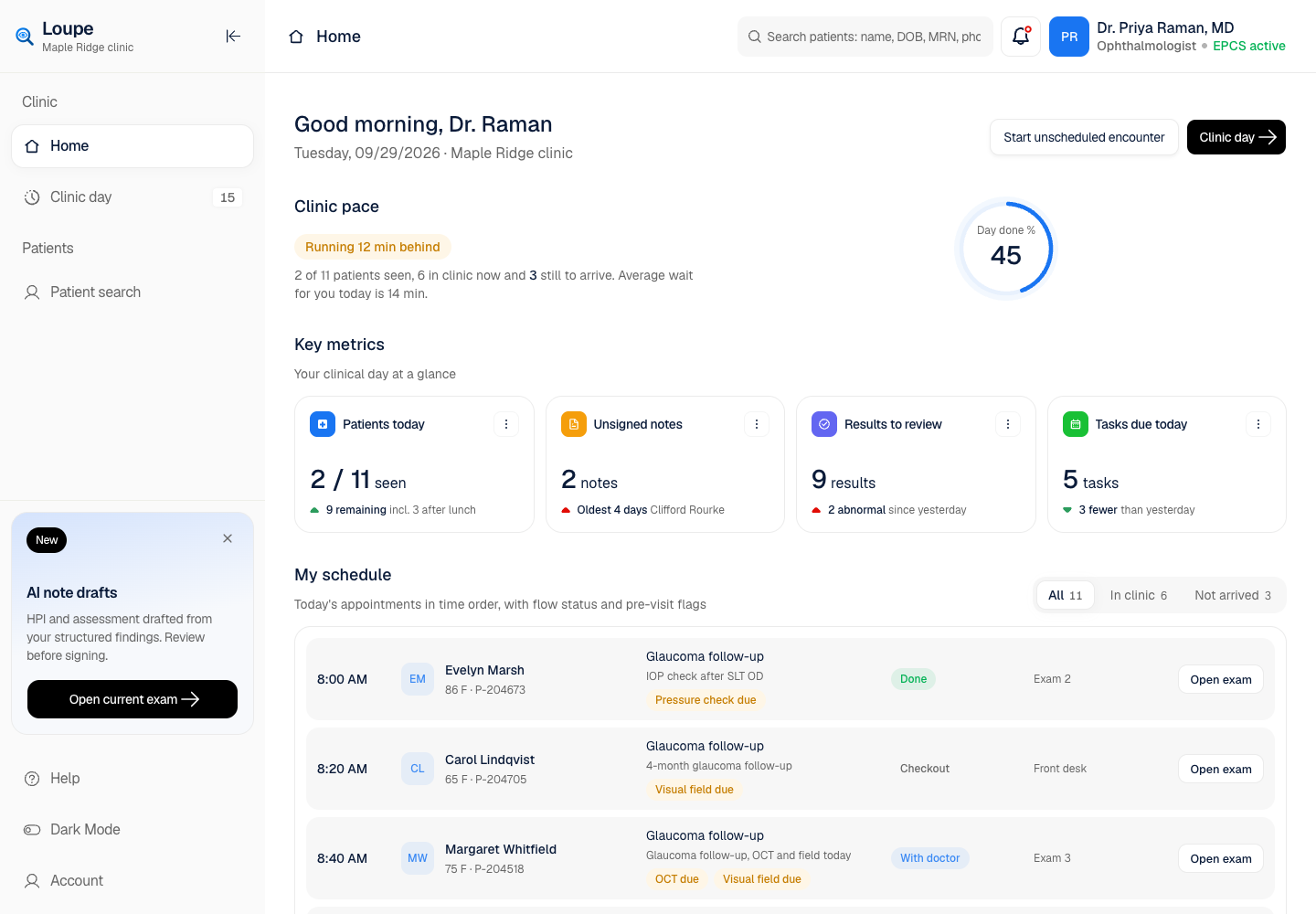
Loupe - Ophthalmology EHR with Per-Eye Charting and Laterality-Aware Coding
Designed and built a clickable ophthalmology EHR for a US eye care group with seven clinics: a clinician's day at a glance, a live patient flow board with dilation timers, patient search with break-the-glass access, a chart summary with right-eye and left-eye findings side by side, and a structured exam workspace per eye.
Enterprise Software Engineering - Human + AI
Contact Us
© 2026 - Copyright. All Rights reserved Oceanlab
Location
Global Headquarters
21 Merchant Road, 3rd Floor, Singapore 058267
Main corporate office and leadership operations
North America Office
548 Market Street, PMB 12345, San Francisco, CA 94104
Client operations and business development
India Office
402 Shivalik Shilp II, SG Highway, Ahmedabad 380015
Engineering and delivery center

Enterprise Software Engineering - Human + AI
Contact Us
Locations
Global Headquarters
21 Merchant Road, 3rd Floor, Singapore 058267
Main corporate office and leadership operations
North America Office
548 Market Street, PMB 12345, San Francisco, CA 94104
Client operations and business development
India Office
402 Shivalik Shilp II, SG Highway, Ahmedabad 380015
Engineering and delivery center
© 2026 - Copyright. All Rights reserved Oceanlab