Recado - Patient Feedback Platform with Real-Time Alerts and Service Recovery
Patient Feedback Platform for a Mexican Private Hospital Network
Designed and built a clickable patient feedback platform for a private hospital network in Mexico: survey results by programme, an alerts inbox that puts safety concerns and unhappy patients in front of a person within a set deadline, recovery cases that end with the patient being called back, and Spanish text analytics that show what patients talk about.
Most of our work is under NDA. Per agreement, we can share the work but not the company details - all names and identifying information shown here have been changed.
Impact
Dashboard, alerts inbox, recovery cases in table and board views, case detail and the themes view. Each of the 15 demo cases opens its own case detail.
Safety 2 hours to first review, in-house 30 minutes, detractor and call-back 24 hours to first contact. Safety alerts cannot be dismissed; a patient safety officer must review them.
Acknowledge, contact the patient, agree what will be done, do it, confirm with the patient. A case can move to could not reach after 3 failed attempts, and gestures above the coordinator's MXN 500 limit need approval.
26 Spanish patient responses across 4 survey programmes, 16 alerts, 15 recovery cases, 12 themes in 5 categories and 11 staff users.
The Problem
Encinal measured satisfaction with paper forms at the nurses' station and a quarterly email survey run by an outside agency. Response rates were under 4%, results arrived six weeks late, and a patient who wrote that they had been given the wrong medication could wait a month before anyone read it. Each hospital kept its own complaints spreadsheet, doctors were compared on five or six responses, and unhappy patients went to PROFECO or social media because nobody had called them first.
Our Solution
Recado turns every survey answer into either a number on a fair dashboard or a task for a named person. Low scores, call-back requests and safety terms raise alerts with a deadline, coordinators run each one as a recovery case until the patient is told what changed, and Spanish comments are grouped into themes so departments can see what to fix.
The Challenge: Listening Without Losing a Patient
Patient feedback in a Mexican private hospital touches sensitive health data, the hospital's safety and complaints processes, and messaging rules, and it only helps if someone acts on it while the patient still cares.
Safety Concerns Hidden in Comments
A comment like "me dieron el medicamento equivocado" is a possible adverse event, and hospitals certified by the Consejo de Salubridad General are expected to report and analyse those. Such comments must reach a patient safety officer quickly and can never be closed without review.
Health Data Is Sensitive Data
Under Mexico's 2025 personal data law, health data needs express consent for purposes beyond care. Consent to be surveyed is held per channel, a message never names the department or diagnosis, and survey answers stay out of the clinical record governed by NOM-004-SSA3-2012.
Recovery Versus Formal Complaints
Most unhappy patients want a call and a fix, but some want a formal complaint, or mention PROFECO, CONAMED or legal action. Those cases have to leave service recovery and go to the complaints team with the full record.
Fair Numbers From Small Samples
Doctors had been compared on five or six responses. The client's policy needs 30 responses per quarter for a doctor and 50 for a department before any ranking, and shows smaller samples as not enough responses.
Our Approach: From Feedback Rules to a Clickable Platform
Spec and Rules Research
Mapped 11 user roles, from the patient experience director to the patient safety, complaints and privacy officers, and 36 screens across staff, doctor and patient pages. Modelled programmes, survey sends, responses, themes, safety terms, alerts, recovery cases and gestures, and wrote down the rules the design follows: the LFPDPPP, NOM-004-SSA3-2012, the patient safety essential actions, PROFECO and CONAMED hand-offs, COFEPRIS limits on testimonials and WhatsApp template and opt-out rules.
Clickable Demo on a Production UI Kit
Built 5 key screens on a production dashboard kit: the dashboard with NPS, CSAT, response rate, open alerts, SLA performance and the recovery funnel; the alerts inbox with SLA countdowns, a response viewer and safety review; recovery cases in table and board views; case detail with masked patient contact, consents per channel, the recovery checklist, contact log and gestures; and the themes view with Spanish phrases. The hospital switcher filters every screen, and actions run on local state.
What a Production Build Adds
HL7 v2 ADT or FHIR encounter, discharge and death events through an interface engine, WhatsApp, SMS and email sending, click-to-call through Twilio Voice or Aircall, Spanish sentiment and theme detection with a custom safety term classifier, Google Business Profile reviews, the hospital's complaints system and Microsoft Entra ID sign-in. Plus the survey builder, the 4 patient pages, the doctor view, the settings pages and an audit log of every identity reveal and export.
Why It Works: Every Response Has an Owner
The Inbox Is Ordered by Risk
Alerts are split into safety, detractor, call-back and in-house tabs. Each card shows its reason chips, such as the safety term matched, the score and a visit request, and counts down to its SLA. Safety alerts have no dismiss button and go to patient safety for a decision.
Recovery Ends With the Patient
A case is not done when it is resolved. The checklist records who did each step and when, the contact log keeps every attempt and outcome, and closing the loop records what the patient was told had changed.
Identity Shown Only When Needed
Patients appear as initials with a masked phone number, and revealing the details is a deliberate, audited action. The encounter card shows the department, dates and doctor but never a diagnosis.
Themes in the Patients' Own Words
Spanish comments are grouped into people, process, place, money and clinical themes, with mentions, sentiment, change on the previous period and the NPS of patients who raised the theme against those who did not. Sample comments highlight the matched words, so a department head can see why.
Related case studies
View all: Hospitals & clinics
Clinica - Multi-Department Clinic Operations Console with AI Assistant
Built a multi-department clinic operations console with appointment management, department load tracking, staff performance, resource utilisation and an AI assistant for staff queries - shipped from clickable AI prototype to production in 14 weeks.
Loupe - Ophthalmology EHR with Per-Eye Charting and Laterality-Aware Coding
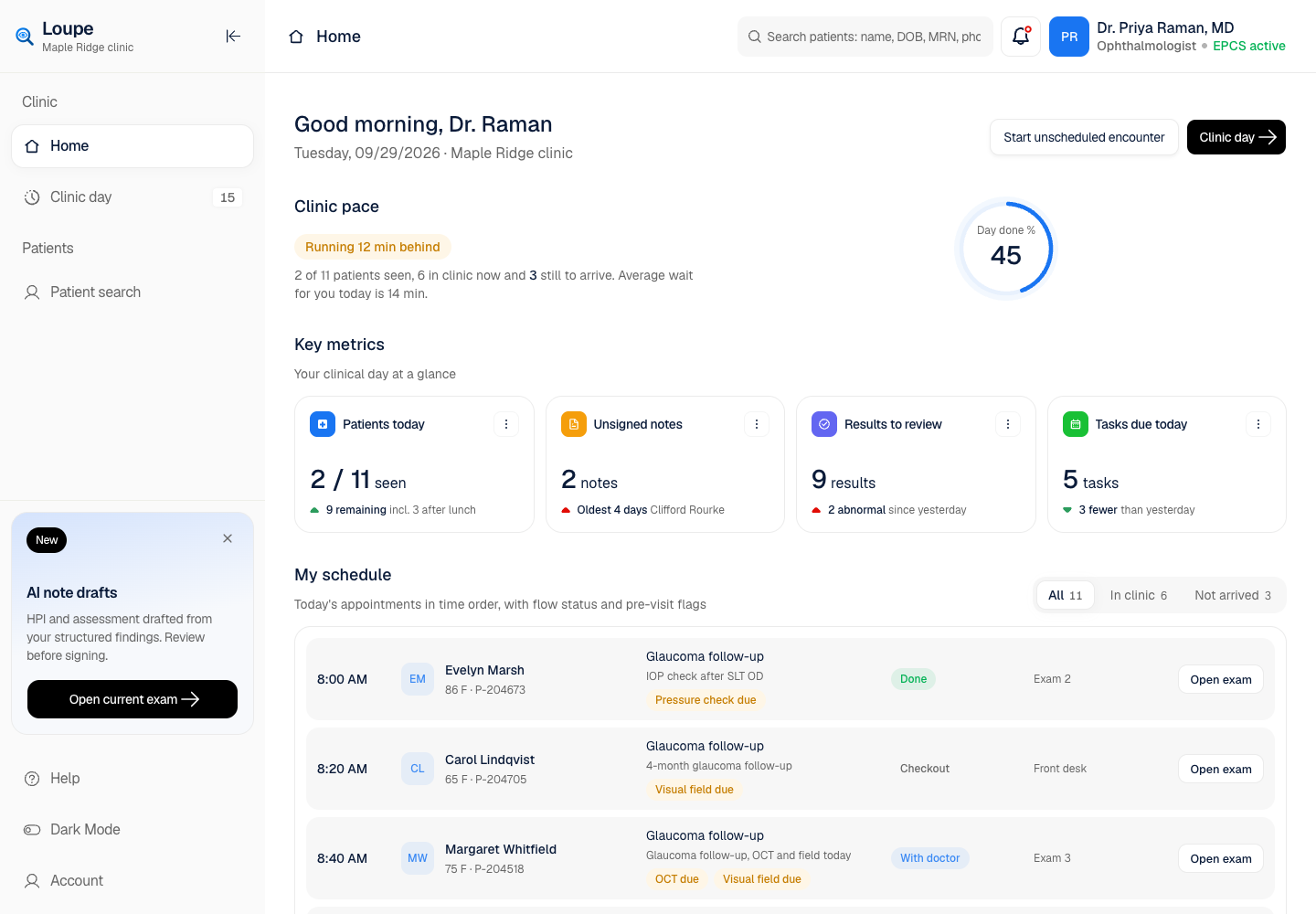
Designed and built a clickable ophthalmology EHR for a US eye care group with seven clinics: a clinician's day at a glance, a live patient flow board with dilation timers, patient search with break-the-glass access, a chart summary with right-eye and left-eye findings side by side, and a structured exam workspace per eye.
Enterprise Software Engineering - Human + AI
Contact Us
© 2026 - Copyright. All Rights reserved Oceanlab
Location
Global Headquarters
21 Merchant Road, 3rd Floor, Singapore 058267
Main corporate office and leadership operations
North America Office
548 Market Street, PMB 12345, San Francisco, CA 94104
Client operations and business development
India Office
402 Shivalik Shilp II, SG Highway, Ahmedabad 380015
Engineering and delivery center

Enterprise Software Engineering - Human + AI
Contact Us
Locations
Global Headquarters
21 Merchant Road, 3rd Floor, Singapore 058267
Main corporate office and leadership operations
North America Office
548 Market Street, PMB 12345, San Francisco, CA 94104
Client operations and business development
India Office
402 Shivalik Shilp II, SG Highway, Ahmedabad 380015
Engineering and delivery center
© 2026 - Copyright. All Rights reserved Oceanlab