How to build a telehealth platform
The parts of a telehealth platform, from booking and video to prescribing and follow-up, the rules that apply to remote care, and an order to build it in.
What a telehealth platform does
A telehealth platform lets patients see a clinician remotely: they book, answer intake questions, join a video or chat consult, get a prescription or referral, and receive follow-up. The clinician gets a queue, the patient's history and a place to write notes.
The video is the easy part. The work is in intake and triage, in knowing who may treat whom and where, in prescribing safely at a distance, and in getting the record back to the patient's usual care.
The modules you need
Most teams need all of these in the end. The phased plan below sets the order.
Booking and queues
Scheduled and on-demand consults, matched to clinicians licensed where the patient is.
Intake and triage
Questions before the consult, with red flags that route the patient to urgent care instead.
Video and chat consults
Secure video with fallbacks for poor connections, and asynchronous chat where it fits.
Clinical notes
Structured notes with history, findings and plan, signed by the clinician.
Prescribing
Electronic prescriptions with checks on what may be prescribed remotely.
Referrals and follow-up
Referrals, test orders and follow-up tasks, with summaries sent to the patient's usual doctor.
Payments and coverage
Self-pay, insurance or employer cover, with eligibility checks.
Clinical governance
Review of consults, outcomes and incidents by a clinical lead.
How the parts fit together
- 01
Consult as the central record
Booking, intake, the call, notes, prescriptions and follow-up all hang off one consult.
- 02
Video provider behind an adapter
A managed video service behind one interface, so it can be changed without touching the clinical flow.
- 03
Rules for licensing and prescribing
Which clinician may see which patient, and what may be prescribed remotely, kept as configuration.
- 04
Triage engine
Clinically owned rules on intake answers, with every routing decision logged.
- 05
Integration layer
Connections to EHRs, pharmacies and labs, so the consult record does not end in a silo.
Data model sketch
- 01
Patient and coverage
Identity, location, history and how the consult is paid for.
- 02
Clinician and licence
Each clinician's registrations, specialties and where they may practise.
- 03
Consult
Type, status, times, participants and the recording policy.
- 04
Intake answers and triage result
What the patient said and where the rules sent them.
- 05
Note, prescription and referral
Signed clinical outputs of the consult.
Systems it has to talk to
- 01
Video service
A managed video provider with an agreement that covers health data.
- 02
E-prescribing
National e-prescription services or pharmacy networks.
- 03
EHRs and health records
History in, summaries out, over FHIR or national networks.
- 04
Insurers and employers
Eligibility checks and claims or invoices.
- 05
Identity verification
ID checks for patients and registration checks for clinicians.
Rules to design for
Which rules apply depends on your market and product.
- 01
Telemedicine rules
Each country, and in the US each state, sets who may treat remotely, for what, and how consent is taken.
- 02
Prescribing at a distance
Limits on which medicines can be prescribed after a remote consult, with tighter rules for controlled drugs.
- 03
Health data protection
HIPAA, the GDPR and national laws, including agreements with the video provider.
- 04
Medical device rules
Triage or symptom-checking software that guides decisions can be a medical device.
- 05
Accessibility
Patients join from any device, in any condition, so accessibility is part of safety.
From prototype to production
Build in this order so something real is in users' hands early.
- 01
Clickable prototype
Booking, intake and the clinician's consult screen, tried by patients and clinicians.
- 02
First service live
One consult type with booking, video, notes and the audit log, in one market.
- 03
Prescribing and follow-up
E-prescriptions, referrals and summaries to the patient's usual doctor.
- 04
Scale
More specialties, markets and payers, with clinical governance reporting.
What drives the cost
These decide most of the budget. For a number based on your own scope, use the cost tool. OceanLab bills $30-50/hr or per milestone.
- 01
Markets and licensing
Each country or state adds rules, clinicians and testing.
- 02
Prescribing integrations
E-prescription services differ by country and take time to certify against.
- 03
Triage logic
Clinically safe triage needs clinical input, testing and maybe device work.
- 04
Payers
Each insurer or employer scheme has its own eligibility and billing.
- 05
Native apps
Mobile apps with reliable video on poor connections.
Product builds that match this guide
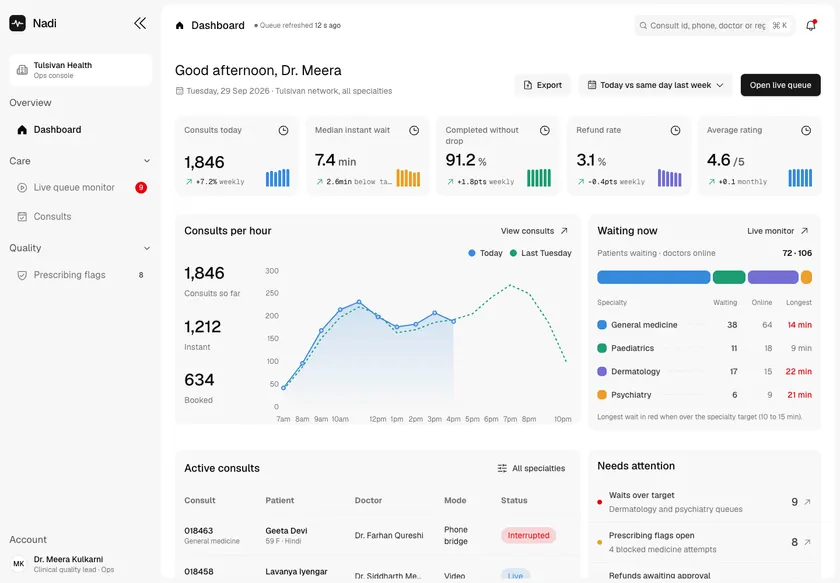
Nadi - Video Consult Platform with Guideline-Aware Prescribing
Designed and built a clickable ops console for an Indian telemedicine provider's video consult platform: a live queue across four specialties, every consult with its guideline evidence and signed e-prescription, refunds within role limits, and prescribing flags raised when a doctor tries a medicine the Telemedicine Practice Guidelines do not allow.
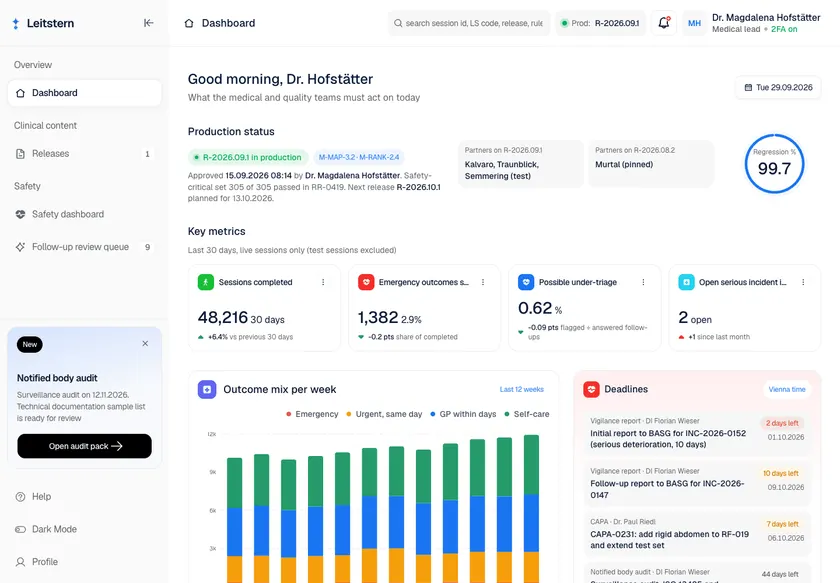
Leitstern - AI Symptom Checker with a Clinical Governance Console
Designed and built the clinical governance console for a CE-marked symptom checker that tells people in Austria how urgently to seek care: releases of clinical content, red-flag rules and locked models approved by e-signature against a passing regression run, real-world under-triage tracked from follow-ups, and vigilance deadlines kept in view.
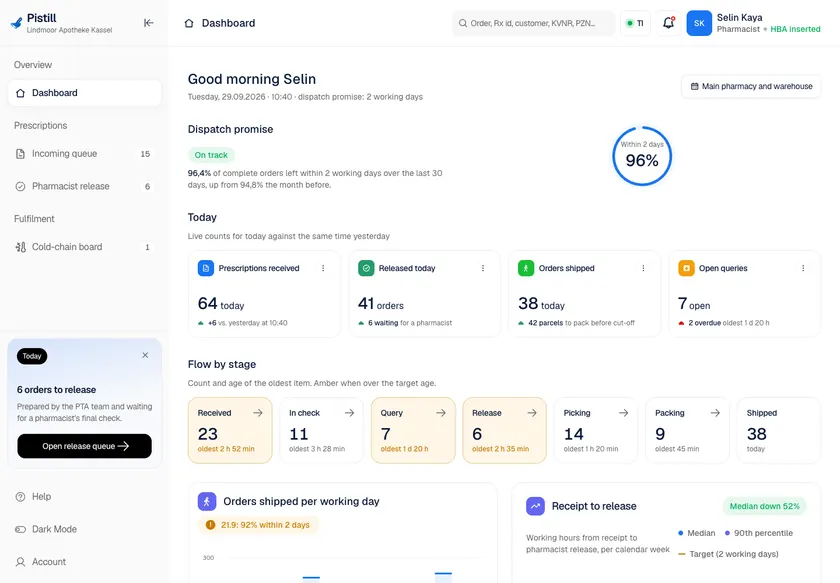
Pistill - E-Rezept Redemption, Pharmacist Release and Home Delivery Console
Designed and built a clickable pharmacy operations console for a pharmacist-owned group in northern Hesse with a mail-order permit: one queue for E-Rezepte from every channel, a validation workbench with substitution and co-payment rules, a pharmacist release step, and a cold-chain board for fridge medicines.
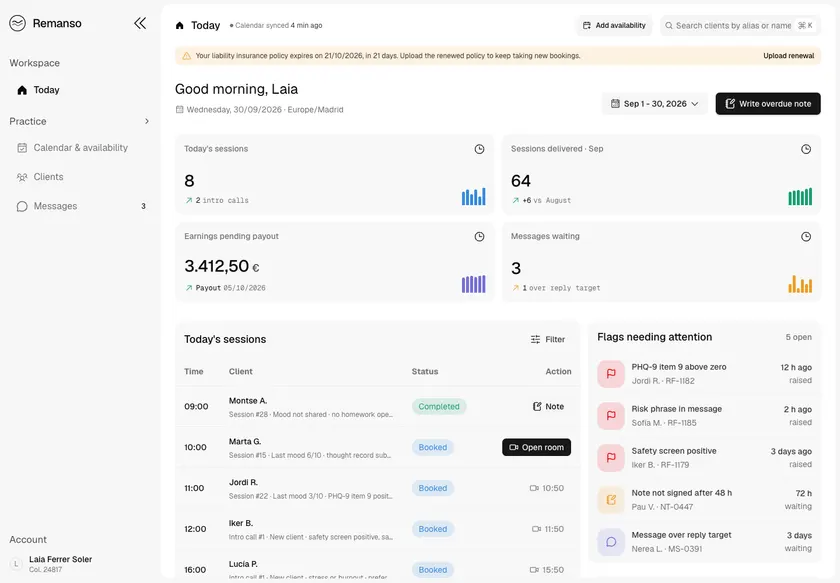
Remanso - Online Therapy Platform with Crisis Rules Built In
Designed and built a clickable psychologist workspace for a Spanish online therapy platform that matches clients with licensed psychologists: today's sessions with a pre-session summary, availability and bookings, a private clinical record per client, and a message inbox that flags risk phrases and replies waiting too long.
Two ways to work with OceanLab
Project build
We design and build the system as one project. It starts with a clickable prototype your team tries before any production code is written. Pay per milestone (outcome-based) or hourly at $30-50/hr, depending on role and seniority.
Embedded engineers
Our engineers join your team on a flexible monthly retainer. Part-time is fine and it runs month to month, with hours that overlap the US, UK and Europe, the Middle East, and Australia and Asia. Outcome-based or $30-50/hr.
Questions
Should we build our own video?
Rarely. A managed video service under a health data agreement is safer and cheaper. We put it behind an adapter so the clinical flow does not depend on one vendor.
How do you handle clinicians licensed in different places?
We store each clinician's registrations and match them to the patient's location at booking, so a patient only sees clinicians who may treat them.
Is our triage questionnaire a medical device?
It can be, if it guides diagnosis or treatment for individual patients. We review it with your regulatory lead before building the rules.
