Leitstern - AI Symptom Checker with a Clinical Governance Console
CE-Marked Symptom Checker for an Austrian Digital Health Company
Designed and built the clinical governance console for a CE-marked symptom checker that tells people in Austria how urgently to seek care: releases of clinical content, red-flag rules and locked models approved by e-signature against a passing regression run, real-world under-triage tracked from follow-ups, and vigilance deadlines kept in view.
Most of our work is under NDA. Per agreement, we can share the work but not the company details - all names and identifying information shown here have been changed.
Impact
Dashboard, releases, release detail, safety dashboard and follow-up review queue. Every one of the 12 demo releases, from draft to rolled back, opens its own approval record.
Approve is blocked while any safety-critical test case fails or a significant change lacks its notified body record. In the demo, R-2026.11.1 is held by 1 failure out of 312 safety-critical cases.
Confirmed under-triage is charted weekly against the PMS plan limit, and metrics outside their limits surface on the dashboard, such as abdominal pain in people 65 and over at 0.71%.
12 releases with regression runs of up to 1,204 test cases, 14 follow-up cases (9 to review, 5 classified), 8 red-flag rules with 30-day stats, 4 partners and 9 staff users across 8 roles.
The Problem
Donauhain's first product was a symptom questionnaire kept in a spreadsheet and published by developers. Clinical changes went live without a recorded sign-off, nobody could say which version of the logic a person had seen when they complained, and regression testing was a doctor clicking through twenty scenarios before each release. Its telehealth partner found about one booked video consult in five should have gone to 144 or needed no doctor at all, and two insurers would not embed a tool whose safety they could not see.
Our Solution
Leitstern gives people one of four triage levels with next steps such as 144, the 1450 health hotline or a telehealth consult, and gives Donauhain's medical and quality teams a governance console behind it. Every clinical change ships in a versioned release with an MDR change assessment, a regression run and three electronic sign-offs, and follow-ups show how often the checker under-triaged in real life.
The Challenge: Triage Software Under the MDR
A symptom checker that recommends how urgently to seek care is a medical device. Donauhain is its legal manufacturer, so every question, rule and model change has to be traceable, tested and approved, and every serious incident reported on time.
Software as a Medical Device
Under MDR Rule 11, Donauhain classifies Leitstern as class IIa, so a notified body audits its quality system and technical documentation. Changes to the clinical logic may need notified body assessment before release, so every release has to be marked significant or not, with a rationale.
No Trace From Complaint to Logic
Content lived in a spreadsheet and went live without sign-off. When a person complained, nobody could reconstruct which questions, rules and model version they had seen, and twenty manual scenarios were the whole test suite.
Under-Triage Is Only Seen Later
A self-care answer that was wrong only shows up when the person ends up in hospital. Measuring it needs follow-ups after the check, clinician review of every flagged case and control limits set in the post-market surveillance plan.
Reporting Clocks and AI Rules
Serious incidents go to the BASG generally within 15 days of awareness, 10 for a death or unanticipated serious deterioration and 2 for a serious public health threat. Symptoms are special category data under GDPR Article 9, and the EU AI Act generally treats the product as a high-risk AI system.
Our Approach: From Device Rules to a Clickable Console
Spec and Rules Research
Mapped 11 roles, from the person checking symptoms to the medical lead and the PRRC, and 44 screens: 10 for the mobile patient flow, 6 for the partner console and 28 for clinical governance. Modelled content items, red-flag rules, locked model packages, releases, test cases, regression runs, sessions, follow-ups, incidents and vigilance reports. Wrote down the rules the design follows: the EU MDR, ISO 13485, ISO 14971, IEC 62304, IEC 62366-1, the EU AI Act, GDPR and the Austrian DSG, and the 144, 112 and 1450 escalation paths.
Clickable Demo on a Production UI Kit
Built 5 key screens of the governance console on a production health dashboard kit: the dashboard with production status, KPIs, vigilance and audit deadlines, outcome mix per week and safety signals; releases with the approval queue; the release detail with changes, MDR change assessment, verification, sign-offs and rollout; the safety dashboard with under- and over-triage against the control limit; and the follow-up review queue with its classification form. Approve, reject, promote, roll back and classify run on local state.
What a Production Build Adds
The patient flow and partner console, plus the remaining governance screens: content library, red-flag rules, model packages, test cases, regression runs, session viewer, incidents, vigilance and PSUR. Hosting in Austrian data centres, a locked free-text mapping model behind a mapping layer, SNOMED CT and ICD-10 codes, HL7 FHIR hand-off to partner booking flows, a QMS such as Greenlight Guru or Qualio for CAPA, BASG vigilance forms and EUDAMED, and staff sign-in with a second factor and a full audit log.
Why It Works: Every Change Has an Approval Record
Releases Carry Their Own Evidence
Each release freezes exact content and rule versions with the model packages, its MDR change assessment, hazards affected and the latest regression run. The clinical reviewer, the PRRC and the medical lead sign in turn, each with the meaning of their signature.
Approval Blocks Itself
Approve stays disabled while a safety-critical case fails, a translation is missing or a significant change lacks its notified body record, and the approval panel says which. Roll back names a target release and asks for a reason.
Follow-Ups Feed the Test Library
Cases are flagged automatically, for example a self-care or GP outcome followed by a hospital admission. A clinician classifies each one with severity and a note, and can add it to the test library or raise an incident in the same step.
Safety and Deadlines Up Front
The dashboard shows vigilance reports to the BASG with days left, red under 3, next to the PSUR and notified body audit dates. Safety breakdowns suppress counts under 10, and red-flag rules show how often people said they answered wrongly.
Related case studies
View all: Telehealth & patient apps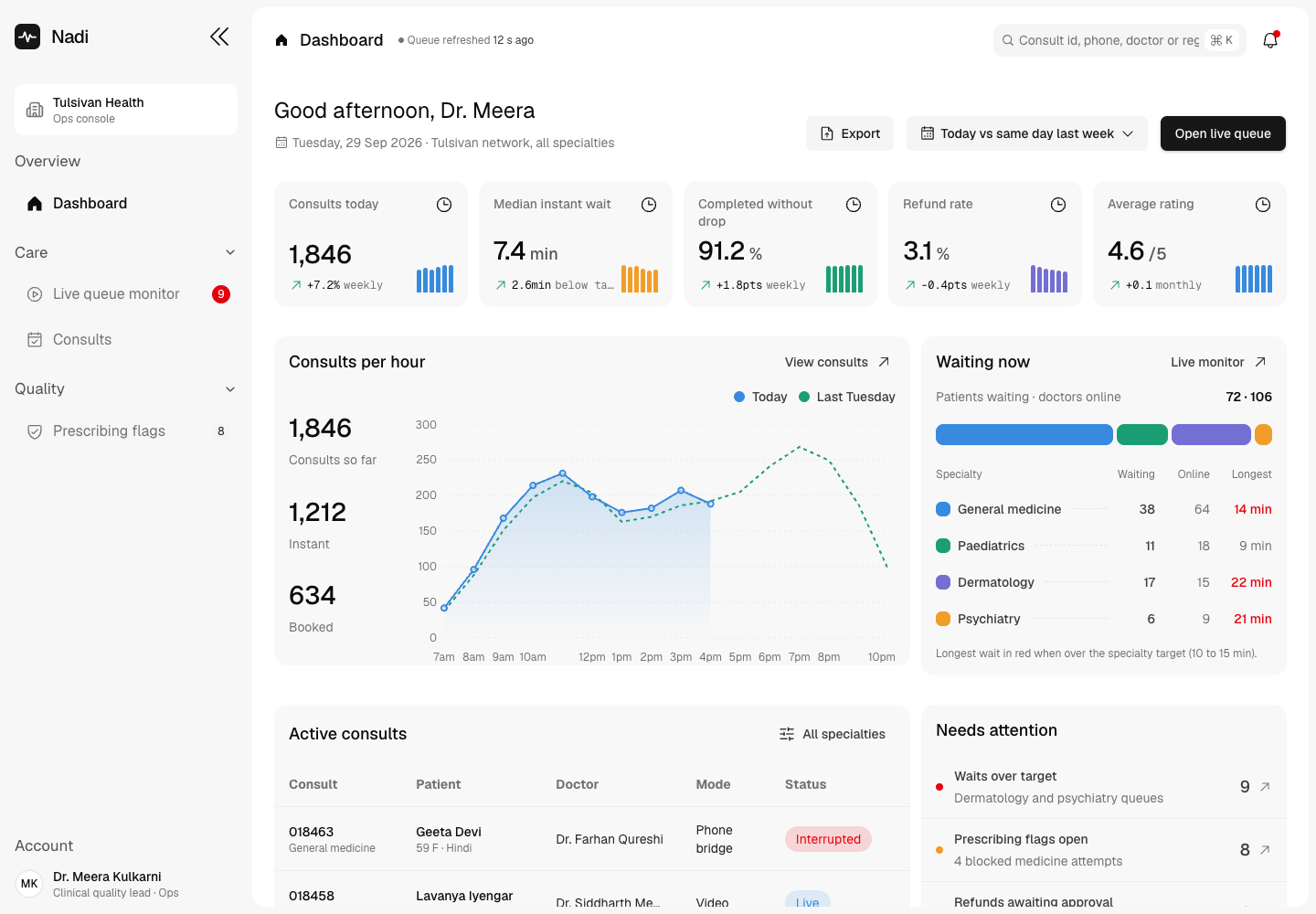
Nadi - Video Consult Platform with Guideline-Aware Prescribing
Designed and built a clickable ops console for an Indian telemedicine provider's video consult platform: a live queue across four specialties, every consult with its guideline evidence and signed e-prescription, refunds within role limits, and prescribing flags raised when a doctor tries a medicine the Telemedicine Practice Guidelines do not allow.
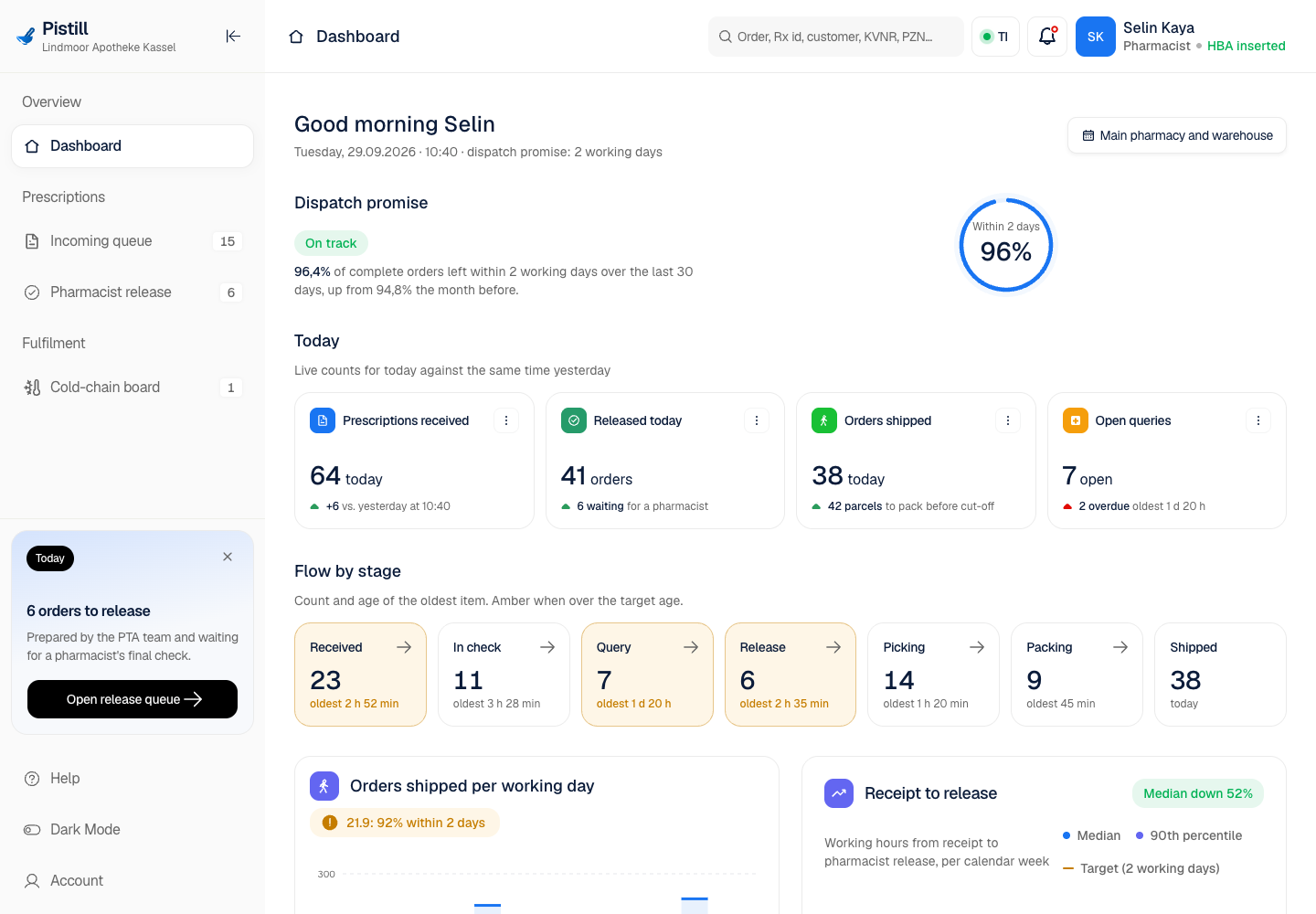
Pistill - E-Rezept Redemption, Pharmacist Release and Home Delivery Console
Designed and built a clickable pharmacy operations console for a pharmacist-owned group in northern Hesse with a mail-order permit: one queue for E-Rezepte from every channel, a validation workbench with substitution and co-payment rules, a pharmacist release step, and a cold-chain board for fridge medicines.
Enterprise Software Engineering - Human + AI
Contact Us
© 2026 - Copyright. All Rights reserved Oceanlab
Location
Global Headquarters
21 Merchant Road, 3rd Floor, Singapore 058267
Main corporate office and leadership operations
North America Office
548 Market Street, PMB 12345, San Francisco, CA 94104
Client operations and business development
India Office
402 Shivalik Shilp II, SG Highway, Ahmedabad 380015
Engineering and delivery center

Enterprise Software Engineering - Human + AI
Contact Us
Locations
Global Headquarters
21 Merchant Road, 3rd Floor, Singapore 058267
Main corporate office and leadership operations
North America Office
548 Market Street, PMB 12345, San Francisco, CA 94104
Client operations and business development
India Office
402 Shivalik Shilp II, SG Highway, Ahmedabad 380015
Engineering and delivery center
© 2026 - Copyright. All Rights reserved Oceanlab