EU MDR software classifier
Check whether your software may be a medical device in the EU and which class Rule 11 would likely give it.
Free, runs in your browser, no sign-up. Updated 2026-10-25.
Guidance, not legal advice. This is a first-pass classification; your regulatory lead or notified body decides.
Result
Likely result under EU MDR Rule 11: Class IIa. A medical purpose from Article 2(1) is intended, so the software can be a medical device. Rule 11 sets its class. It provides information used for diagnosis or therapy decisions: class IIa. Not legal advice.
Why
- A medical purpose from Article 2(1) is intended, so the software can be a medical device. Rule 11 sets its class.
- It provides information used for diagnosis or therapy decisions: class IIa.
- Other Annex VIII rules can also apply to software. When several rules apply, the strictest class wins.
- Software for in vitro diagnostic purposes falls under Regulation (EU) 2017/746 (IVDR), not the MDR. MDCG 2019-11 covers both.
Annex VIII, Rule 11 (full text)
Software intended to provide information which is used to take decisions with diagnosis or therapeutic purposes is classified as class IIa, except if such decisions have an impact that may cause: death or an irreversible deterioration of a person's state of health, in which case it is in class III; or a serious deterioration of a person's state of health or a surgical intervention, in which case it is classified as class IIb. Software intended to monitor physiological processes is classified as class IIa, except if it is intended for monitoring of vital physiological parameters, where the nature of variations of those parameters is such that it could result in immediate danger to the patient, in which case it is classified as class IIb. All other software is classified as class I.
Send this result to OceanLab
Opens an email to OceanLab with this result and a link to your inputs. Nothing is sent until you press send, and there is no sign-up.
How this is calculated
First, Article 2(1) of Regulation (EU) 2017/745: software is a medical device only if the manufacturer intends it for a medical purpose, such as diagnosis, monitoring or treatment of disease.
Then Annex VIII, Rule 11, quoted in full on the page: decision support is class IIa, IIb for serious harm or surgery, III for death or irreversible harm. Monitoring is IIa, or IIb for vital parameters with immediate danger. All other software is class I.
When both decision support and monitoring apply, the stricter class wins. Other Annex VIII rules can also apply and are not checked here.
MDCG 2019-11 rev.1 (June 2025) is the Commission-endorsed guidance with worked examples. Read it before relying on a result.
Sources
- Regulation (EU) 2017/745 (MDR), Official Journal text · checked 2026-10-25
- MDCG 2019-11 rev.1: qualification and classification of software (June 2025) · checked 2026-10-25
Questions about this tool
Is a wellness app a medical device?
Not if it has no medical purpose under Article 2(1). The intended purpose in your labelling, store listing and marketing decides it, so check what you claim.
Why is most decision-support software class IIa or higher?
Rule 11 starts any software that informs diagnosis or therapy decisions at class IIa, and raises it with the harm a wrong decision could cause.
What about in vitro diagnostic software?
Software for in vitro diagnostic purposes falls under Regulation (EU) 2017/746 (IVDR). MDCG 2019-11 covers both regulations.
Is this legal advice?
No. It is a first-pass check to plan engineering and regulatory work. Your regulatory lead or notified body decides.
Other free tools
OceanLab product builds like this
Products OceanLab designed and built. Each case study covers the screens, the scope and the rules it was built for.
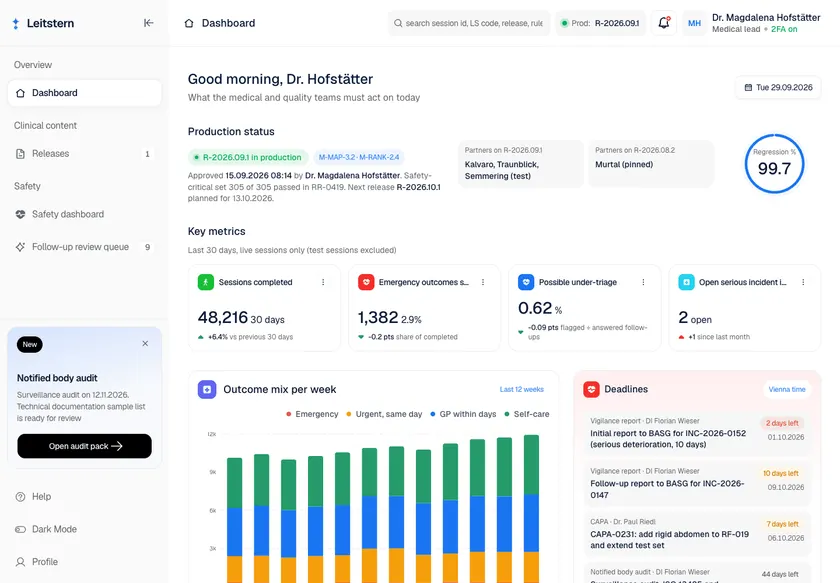
Leitstern - AI Symptom Checker with a Clinical Governance Console
Designed and built the clinical governance console for a CE-marked symptom checker that tells people in Austria how urgently to seek care: releases of clinical content, red-flag rules and locked models approved by e-signature against a passing regression run, real-world under-triage tracked from follow-ups, and vigilance deadlines kept in view.
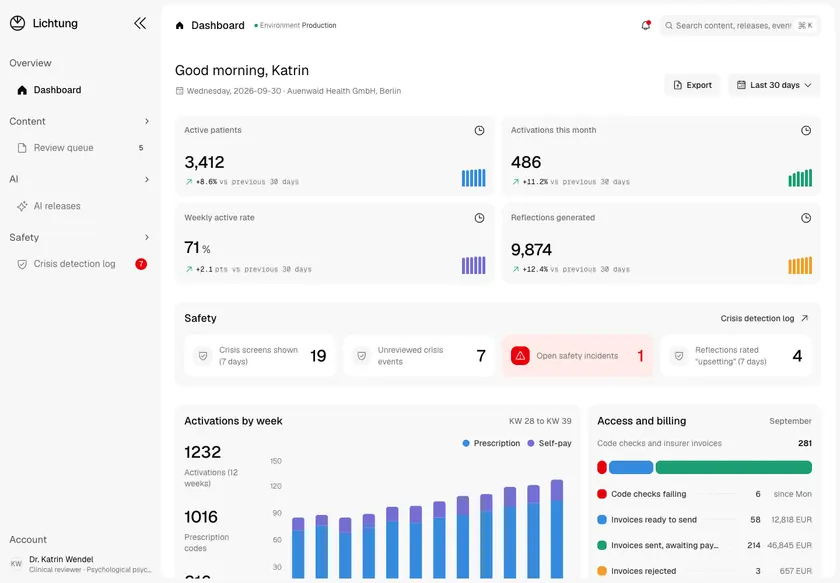
Lichtung - Prescribable AI Journaling App with a Clinical Safety Console
Designed and built a clickable clinical console for a prescribable CBT journaling app on the German DiGA pathway: clinical review of every patient-facing text, an AI release register with safety gates and sign-offs, and a crisis detection log that staff review without ever reading a journal entry.
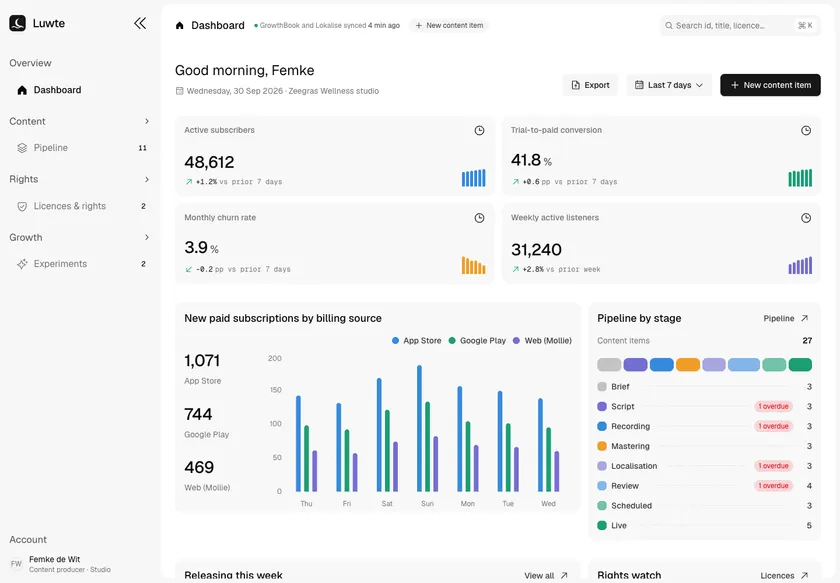
Luwte - Meditation and Sleep App with a Content Studio and Ethical Growth Guardrails
Designed and built a clickable content studio console for a Dutch meditation and sleep subscription in four languages: a pipeline that takes every session from brief to release, mastering checks against the house loudness standard, a rights register that warns before licences run out, and growth experiments that cannot start without an ethics review.
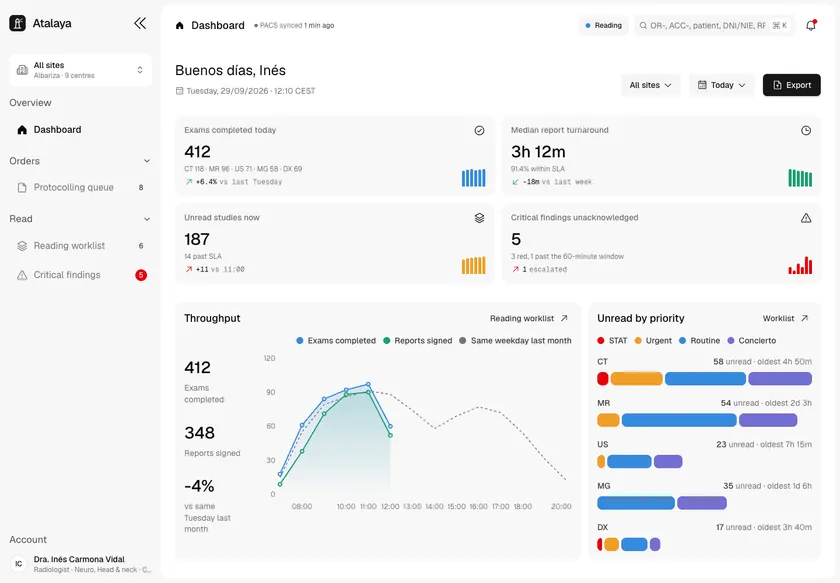
Atalaya - Radiology Information System from Order to Signed Report
Designed and built a clickable radiology information system for a private imaging group with nine centres in Andalucía, Madrid and Cataluña: radiologists protocol orders against safety rules, read from one worklist ranked by urgency and time to SLA, sign structured reports behind a pre-sign checklist, and prove every critical finding reached a clinician.
