Fintech app cost calculator
Pick the money features and platforms and get a cost and timeline range, with what cutting each feature would save.
Free, runs in your browser, no sign-up. Updated 2026-10-25.
Result
Estimated cost $51,800 – $128,100 (USD), 9–22 weeks with a team of 4. Platform: iOS + Android (one cross-platform codebase). Design: Custom design. Features: Sign-up, login, password reset; User profiles and settings; KYC onboarding through an identity vendor; Strong customer authentication (MFA, device binding); Bank account linking (open banking or aggregator API); Double-entry ledger and balances; Transaction history, statements and search; Fraud and limit rules with a review queue; Email and push notifications; Admin panel; Audit log.
- Timeline
- 9–22 weeks
- Total hours
- 1,126–2,782
- Engineering hours
- 776–1,919
- Team
- 4 people
| Role | Hours | Cost |
|---|---|---|
| Engineering | 776–1,919 | $38,800 – $95,900 |
| Product design | 116–288 | $5,200 – $13,000 |
| QA / testing | 155–384 | $4,700 – $11,500 |
| Project management | 78–192 | $3,100 – $7,700 |
| Feature | Hours | Cost |
|---|---|---|
| Sign-up, login, password reset | 37–75 | $2,500 – $5,000 |
| User profiles and settings | 25–50 | $1,700 – $3,300 |
| KYC onboarding through an identity vendor | 93–217 | $6,200 – $14,500 |
| Strong customer authentication (MFA, device binding) | 62–155 | $4,100 – $10,400 |
| Bank account linking (open banking or aggregator API) | 93–248 | $6,200 – $16,600 |
| Double-entry ledger and balances | 186–466 | $12,400 – $31,100 |
| Transaction history, statements and search | 62–155 | $4,100 – $10,400 |
| Fraud and limit rules with a review queue | 93–248 | $6,200 – $16,600 |
| Email and push notifications | 37–87 | $2,500 – $5,800 |
| Admin panel | 62–155 | $4,100 – $10,400 |
| Audit log | 25–62 | $1,700 – $4,100 |
What cutting a feature would save
Each row re-runs the estimate without that feature, including its share of design, QA and project management. Biggest saving first.
| Drop this feature | Saves | Weeks saved |
|---|---|---|
| Double-entry ledger and balances | $12,400 – $31,100 | 2–5 |
| Fraud and limit rules with a review queue | $6,200 – $16,600 | 1–3 |
| Bank account linking (open banking or aggregator API) | $6,200 – $16,600 | 1–3 |
| KYC onboarding through an identity vendor | $6,200 – $14,500 | 1–2 |
| Strong customer authentication (MFA, device binding) | $4,100 – $10,400 | 0–2 |
| Transaction history, statements and search | $4,100 – $10,400 | 0–2 |
Assumptions
Every number the result depends on, and where it comes from. Change any value and the result updates.
| Assumption | Value | Source |
|---|---|---|
| Engineering rate | USD/hour | OceanLab's rates are $30–50/hr depending on role and seniority. Other teams' rates vary several-fold by country and seniority; replace them with the rates you are quoted.Reviewed 2026-10-25 |
| Product design rate | USD/hour | OceanLab's rates are $30–50/hr depending on role and seniority. Other teams' rates vary several-fold by country and seniority; replace them with the rates you are quoted.Reviewed 2026-10-25 |
| QA / testing rate | USD/hour | OceanLab's rates are $30–50/hr depending on role and seniority. Other teams' rates vary several-fold by country and seniority; replace them with the rates you are quoted.Reviewed 2026-10-25 |
| Project management rate | USD/hour | OceanLab's rates are $30–50/hr depending on role and seniority. Other teams' rates vary several-fold by country and seniority; replace them with the rates you are quoted.Reviewed 2026-10-25 |
| Product design hours | 15 % | OceanLab assumption. Hours for this role as a share of engineering hours. Planning assumption.Reviewed 2026-10-25 |
| QA / testing hours | 20 % | OceanLab assumption. Hours for this role as a share of engineering hours. Planning assumption.Reviewed 2026-10-25 |
| Project management hours | 10 % | OceanLab assumption. Hours for this role as a share of engineering hours. Planning assumption.Reviewed 2026-10-25 |
| Contingency | % | OceanLab assumption. Buffer for unknowns found during the build. Planning assumption.Reviewed 2026-10-25 |
| Productive hours per person per week | hours | OceanLab assumption. 40 paid hours minus meetings and review. Planning assumption.Reviewed 2026-10-25 |
| Platform multiplier: iOS + Android (one cross-platform codebase) | 1.35 × | OceanLab assumption. One codebase, but two app stores, device testing and native modules. Planning assumption.Reviewed 2026-10-25 |
| Design multiplier: Custom design | 1 × | OceanLab assumption. Baseline.Reviewed 2026-10-25 |
Send this estimate to OceanLab
Opens an email to OceanLab with this result and a link to your inputs. Nothing is sent until you press send, and there is no sign-up.
How this is calculated
The estimate starts from a fintech preset: sign-in, KYC onboarding, strong authentication, bank linking, a double-entry ledger, transaction history, fraud rules, notifications, admin and an audit log, on iOS and Android. Each feature has a low and a high hour estimate for development, multiplied by the platform and design level, plus a contingency.
Design, QA and project management are added as shares of development hours, and each role's hours are multiplied by its hourly rate.
Weeks come from total hours divided by team size and productive hours per person per week.
The hour ranges are OceanLab planning assumptions, not market benchmarks. Edit any of them in the assumptions panel.
Questions about this tool
Are partner fees included?
No. KYC checks, card issuing and banking-as-a-service fees are running costs. The KYC cost per check tool prices identity checks from published plans.
Why a ledger?
Balances that come from a double-entry ledger can be reconciled and audited. Most money apps need one even when a partner bank holds the funds.
Which hourly rates does it use?
Default rates are OceanLab's own: $50 an hour for engineering, $45 for design, $40 for project management and $30 for QA. Change any of them to the rates you have been quoted.
Is anything I enter sent anywhere?
No. The tool runs in your browser and there is no sign-up. Nothing leaves the page unless you choose to email your result to OceanLab.
Other free tools
OceanLab product builds like this
Products OceanLab designed and built. Each case study covers the screens, the scope and the rules it was built for.
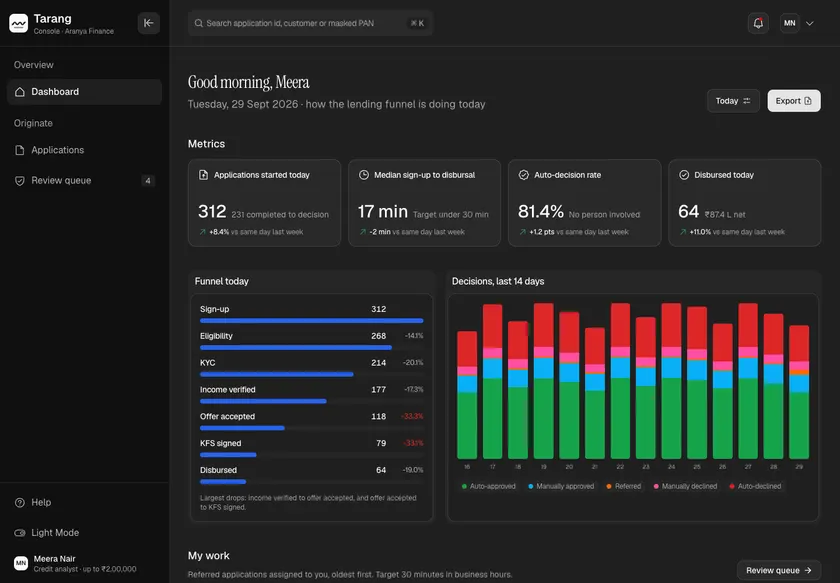
Tarang - Instant Personal Loan App and Lending Operations Console
Designed a personal loan app and operations console for an RBI-registered NBFC: borrowers apply, complete KYC, share bank data, sign the Key Fact Statement and receive funds in minutes, while credit, KYC and operations teams review referred applications against a versioned rule set.
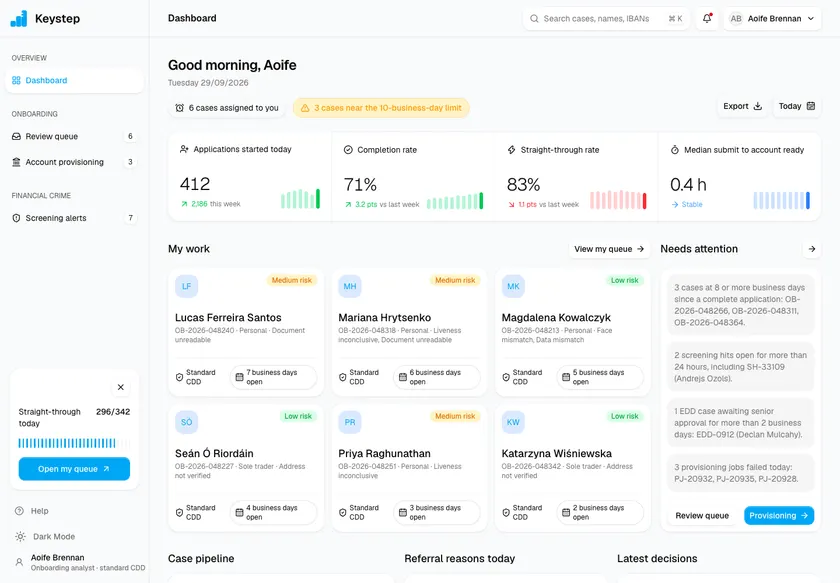
Keystep - Digital Bank Onboarding with ID, Liveness and Risk-Based Review
An onboarding platform for an Irish digital bank: applicants open a EUR current account from their phone with ID and selfie liveness checks, and a staff console lets onboarding and financial crime teams review the cases the rules cannot decide, through to an issued Irish IBAN.
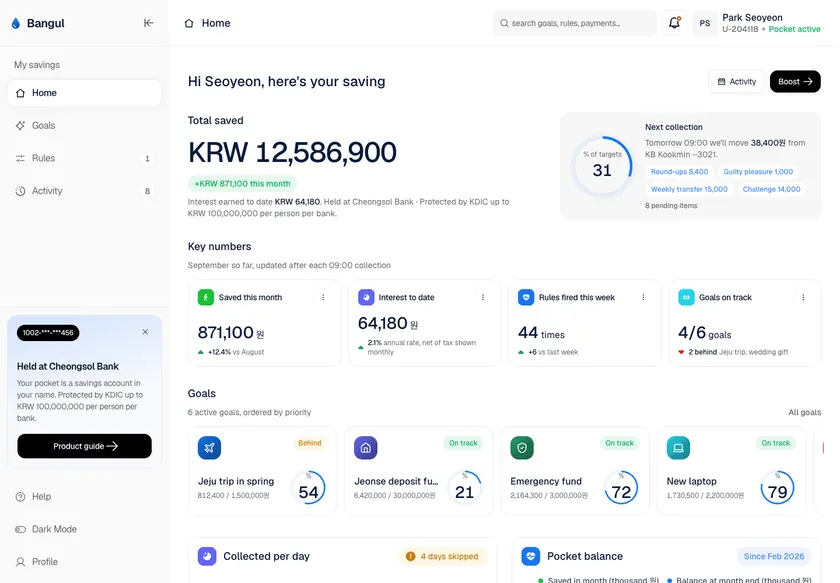
Bangul - Savings Goals and Round-Ups App with Bank-Held Savings
Designed and built a clickable savings app for a Seoul fintech with a MyData licence: customers set goals, switch on round-ups, payday, weekly, guilty pleasure, rainy day and challenge rules, and see every won their rules move into a savings pocket held in their name at a partner bank.
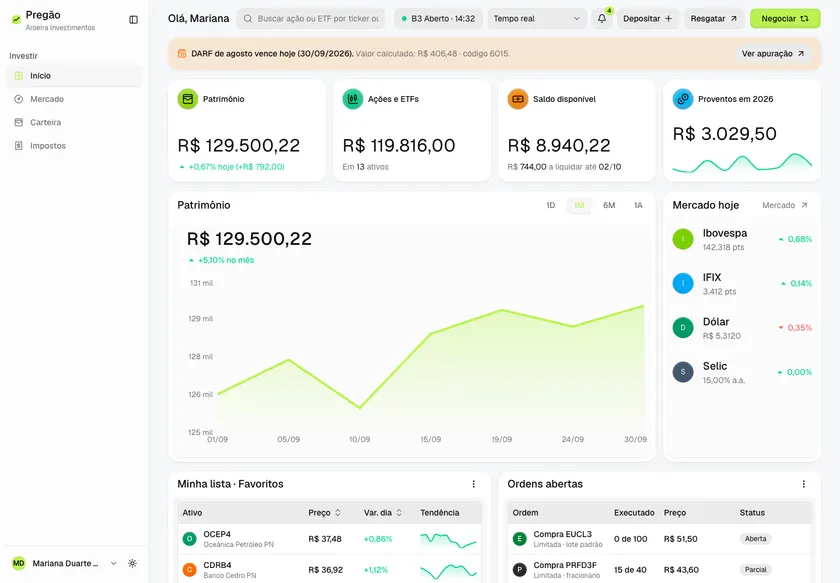
Pregão - Stock and ETF Trading App with the Income Tax Explained
Designed and built a clickable investor app for a Brazilian broker trading B3 stocks and ETFs: patrimônio at a glance, a market overview, an asset page with an order ticket that shows the lot and fractional split before sending, a portfolio at average price, and a tax centre that works out the monthly DARF.
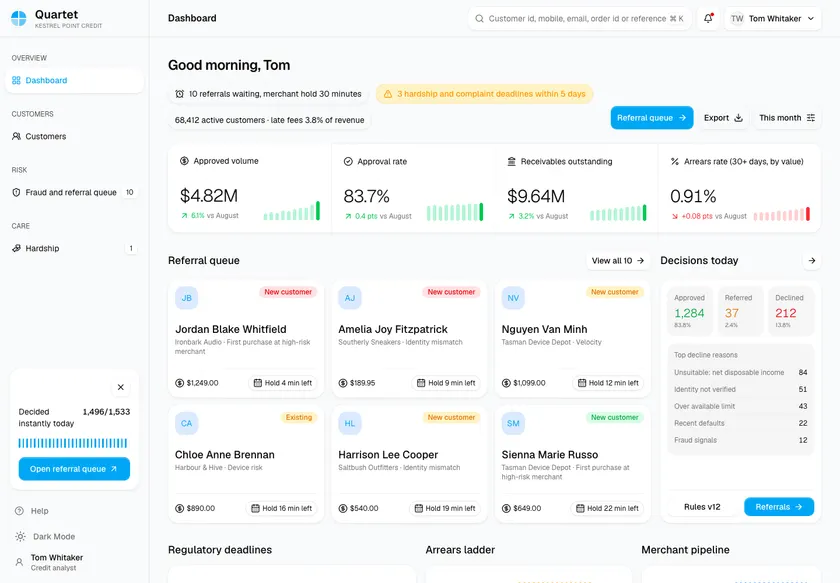
Quartet - Buy Now, Pay Later Platform with an Ops Console for Credit, Risk and Hardship
Designed and built a clickable ops console for an Australian buy now, pay later lender that splits online purchases of AUD 50 to AUD 3,000 into 4 or 8 fortnightly instalments: the health of the book, customer records, the fraud and referral queue and hardship cases with their regulatory deadlines.
