Keystep - Digital Bank Onboarding with ID, Liveness and Risk-Based Review
Remote Account Opening and Onboarding Review Console
An onboarding platform for an Irish digital bank: applicants open a EUR current account from their phone with ID and selfie liveness checks, and a staff console lets onboarding and financial crime teams review the cases the rules cannot decide, through to an issued Irish IBAN.
Most of our work is under NDA. Per agreement, we can share the work but not the company details - all names and identifying information shown here have been changed.
Impact
Dashboard, review queue, case review, screening alerts and account provisioning, each with working filters, panels and actions.
Document authenticity, NFC chip, data extraction, face match, liveness, address, phone, email, device, duplicate and sanctions, PEP and media screening.
Approve stays disabled while a check has failed, a data mismatch or screening hit is open, or the case is rated high risk and needs EDD.
20 applications with Eircodes, PPSNs and risk factors, plus 12 screening hits, 4 EDD cases, 5 provisioning jobs and 7 staff roles.
The Problem
Corrib Bank's off-the-shelf onboarding flow treated every applicant the same. Anything slightly off - a blurred ID photo, an unmatched address, a partial sanctions name match - landed in one shared inbox, and reviewers worked across the ID vendor's dashboard, the screening tool and a spreadsheet without seeing the selfie next to the document.
Our Solution
We designed Keystep: a mobile-first account opening flow with ID capture, selfie liveness, tax residency and consents, risk-based due diligence and screening, and a staff console where each referred case shows its evidence, risk rating, screening hits and history in one place - built as a clickable demo of the review side.
The Challenge: Remote Onboarding Under AML Rules
Opening a bank account remotely in Ireland means verifying identity, rating risk and screening every applicant before an IBAN exists, while keeping the flow simple enough that people finish it and every decision can be shown to the Central Bank of Ireland.
One Inbox for Every Exception
Blurred IDs, unmatched addresses and partial sanctions matches all went to the same queue with no reason attached, so simple fixes waited behind financial crime cases and the evidence sat in three different tools.
Risk-Based Due Diligence
Every applicant needs a documented risk rating that sets simplified, standard or enhanced due diligence. PEPs and links to EC high-risk third countries require EDD, source of wealth and senior management approval.
Remote Identity You Can Defend
EBA/GL/2022/15 expects document security checks, selfie-to-document matching and liveness, with a fallback such as a video call when automated checks are inconclusive. Face matching is biometric data, so it needs explicit consent and an alternative route.
An Audit Trail for the Regulator
Nobody could show in one place why a customer was rated low risk or who approved a PEP. Every rating, decision, override and approval has to record who made it, the evidence seen, the rule version and the reason.
Our Approach: From Spec to Clickable Demo
Spec and Rules Research
Mapped eight roles, from applicant and onboarding analyst to screening analyst, MLRO and operations, and the Irish and EU rules the flow must follow: AML and CDD under the Criminal Justice Act 2010, EBA remote onboarding guidelines, EU sanctions, CRS and FATCA, GDPR, the Payment Accounts Directive and PSD2. Specified 35 screens and the data model behind them.
Clickable Demo on a Production UI Kit
Built the staff console on a production dashboard kit: a dashboard with case pipeline and referral reasons, a review queue with bulk assign, a case review with evidence tabs and approve, decline, request information, video call and EDD escalation, screening match comparison with clear or confirm, and provisioning with retry.
What a Production Build Adds
The 13-screen applicant mobile flow, EDD, MLRO, audit, reports and settings screens, plus live integrations: ID and liveness vendors, sanctions and PEP screening, Eircode lookup, one-time codes, device risk signals, open banking evidence and core banking for IBAN issuance, with staff auth and a full audit log.
Why It Works: Designed Around the Decision
Every Case Says Why It Is There
Referral reasons such as face mismatch, address not verified or screening hit are shown on each row and case, so analysts pick up work they are allowed to decide and fix the actual problem.
Evidence Side by Side
The case review puts check results and scores, document and liveness evidence, risk factors, tax residency, screening hits and the activity timeline on one page, instead of three vendor tools.
Rules Built Into the Buttons
Approve is blocked with the reasons listed until failed checks, mismatches and hits are resolved; declines need a second approver; revealing a PPSN is logged. The controls enforce the policy, not a checklist.
No Tipping Off
Decline reason categories stay internal and the applicant only sees a neutral message offering a written reason and how to complain, so an AML-related decline never reveals that a report is being considered.
Related case studies
View all: Banking & lending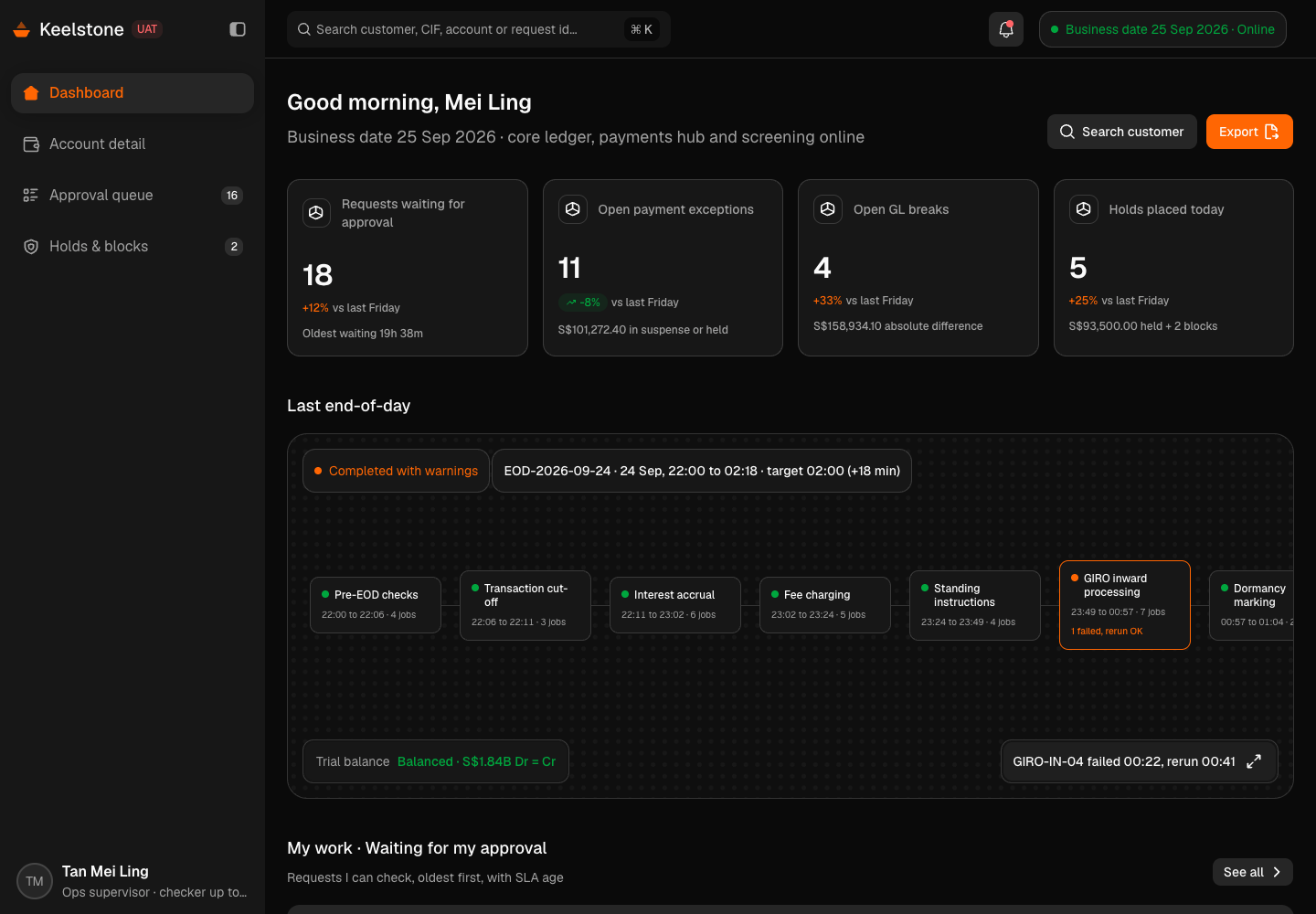
Keelstone - Core Banking Back-Office Console with Maker-Checker
Designed and built a clickable back-office console for a Singapore bank's deposit operations: holds and blocks, limit changes, fee waivers, payment repairs and end-of-day, with every money-moving change going through maker-checker approval.
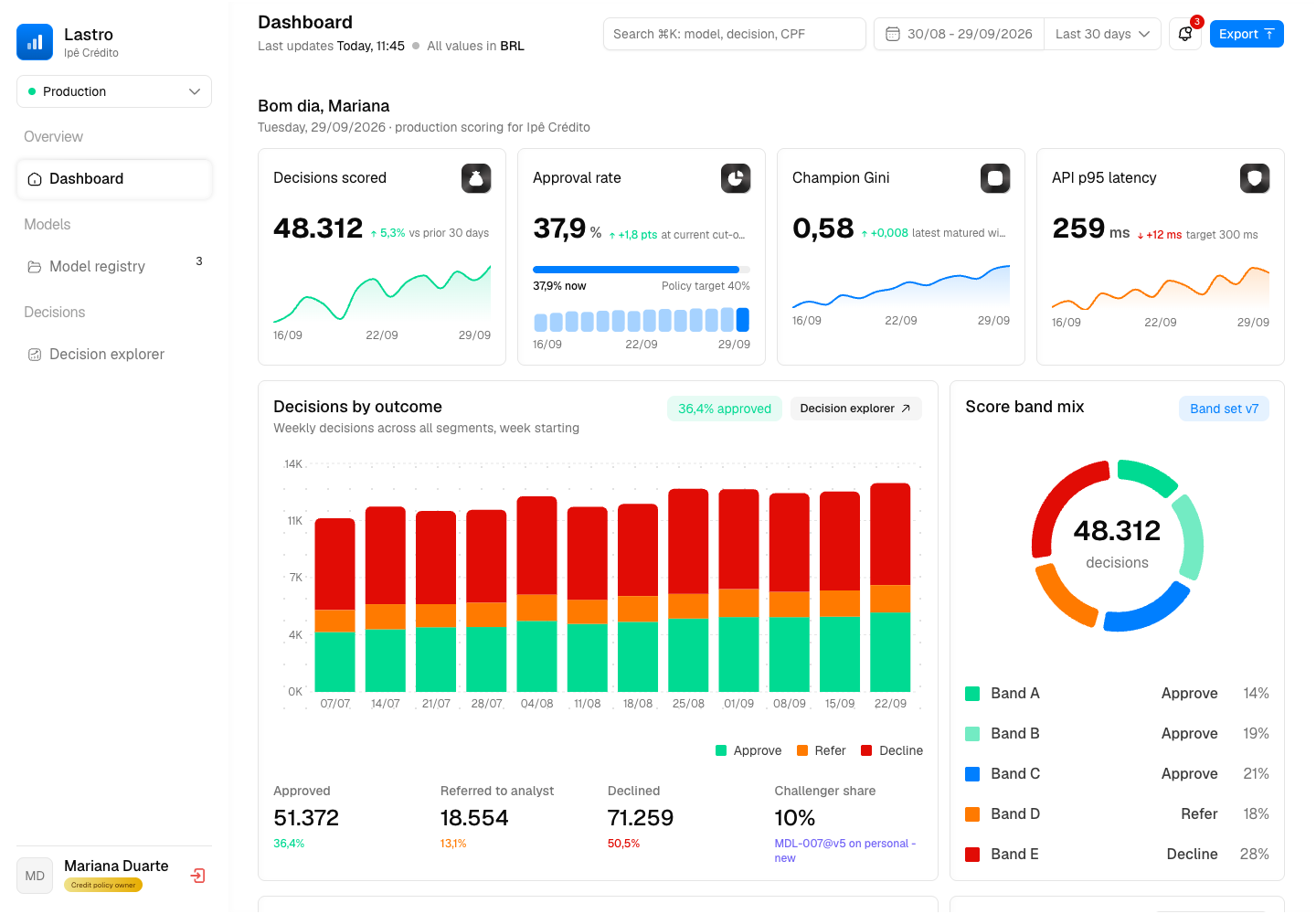
Lastro - Credit Scoring Engine with Explainable Decisions
A credit scoring engine for Ipê Crédito, a fictional Brazilian digital lender, that combines Cadastro Positivo bureau data, Open Finance account data and Pix patterns into one score, returns reason codes with every decision and keeps the model governance evidence risk, compliance and credit teams need.
Enterprise Software Engineering - Human + AI
Contact Us
© 2026 - Copyright. All Rights reserved Oceanlab
Location
Global Headquarters
21 Merchant Road, 3rd Floor, Singapore 058267
Main corporate office and leadership operations
North America Office
548 Market Street, PMB 12345, San Francisco, CA 94104
Client operations and business development
India Office
402 Shivalik Shilp II, SG Highway, Ahmedabad 380015
Engineering and delivery center

Enterprise Software Engineering - Human + AI
Contact Us
Locations
Global Headquarters
21 Merchant Road, 3rd Floor, Singapore 058267
Main corporate office and leadership operations
North America Office
548 Market Street, PMB 12345, San Francisco, CA 94104
Client operations and business development
India Office
402 Shivalik Shilp II, SG Highway, Ahmedabad 380015
Engineering and delivery center
© 2026 - Copyright. All Rights reserved Oceanlab