Keelstone - Core Banking Back-Office Console with Maker-Checker
Deposit Operations Console for a Singapore Bank
Designed and built a clickable back-office console for a Singapore bank's deposit operations: holds and blocks, limit changes, fee waivers, payment repairs and end-of-day, with every money-moving change going through maker-checker approval.
Most of our work is under NDA. Per agreement, we can share the work but not the company details - all names and identifying information shown here have been changed.
Impact
Dashboard, approval queue, approval detail, account detail and holds & blocks, with a role switcher across 5 staff roles.
Self-approval blocked, checker authority by amount (S$20,000 to S$1M), and a second checker for limit changes above S$20,000.
Product limits, scam pattern, maker vs checker, checker authority, signing rules and regulatory holds - shown before the checker decides.
18 customers, 22 holds, 26 change requests, 11 FAST, PayNow and GIRO exceptions and an 11-stage end-of-day run.
The Problem
Straits Meridian's operations team worked in the core banking green screen, a shared mailbox, an Excel approvals tracker and a separate reconciliation tool. Holds were "checked" over a colleague's shoulder, limit increases were approved by email, and a MAS inspection finding on segregation of duties and weak maker-checker evidence triggered the project.
Our Solution
Keelstone gives operations, payments, finance and compliance staff one console on top of the core ledger: find the account, raise a hold, limit change, fee waiver or payment repair, and route it to a checker who sees the before and after, the GL preview and the policy checks - with self-approval blocked and every decision recorded.
The Challenge: Controls That Leave Evidence
Deposit operations touch customer money, authority orders and the general ledger every day. The bank needed controls that are enforced by the system, not by habit, and an audit trail that lives outside inboxes.
Maker-Checker Without Evidence
Checks happened by glancing over a shoulder or replying to an email, so there was no record of what the checker actually saw. MAS TRM Guidelines expect segregation of duties and complete audit logs.
Holds From Many Sources
Police orders, court and garnishee orders, compliance holds, operational holds and customer kill-switch blocks each have different lift rules. Getting one wrong either releases ring-fenced funds or locks out a genuine customer.
Payments Worked From CSV Files
FAST, PayNow and GIRO exceptions and returns sat in suspense and were repaired from exported files, with no link between the repair, the GL posting and the approval.
End-of-Day Nobody Could See
When the batch overran, only the IT batch team knew which job failed or which GL accounts were out of balance the next morning. Finance and operations started the day blind.
Our Approach: From Rules to a Clickable Console
Spec and Rules Research
Mapped 8 staff roles, 33 screens and the data model for accounts, holds, change requests, payment exceptions, end-of-day runs and GL breaks. Wrote down the rules the design must follow: MAS TRM Guidelines and Notice FSM-N05, MAS Notice 626, authority orders, the E-Payments User Protection Guidelines, PDPA and section 47 of the Banking Act.
Clickable Demo on a Production UI Kit
Built 5 key screens on a production dashboard kit: the operations dashboard with the last end-of-day pipeline, the approval queue with SLA ageing and bulk decisions for low-risk types, the approval detail with GL preview and policy checks, the account detail with hold, limit, fee and closure requests, and holds & blocks with lift rules by source. Requests raised or decided anywhere update the queue and holds live.
What a Production Build Adds
Integration with the core ledger (such as Thought Machine Vault, Temenos Transact or Mambu), the FAST, PayNow and GIRO payments hub, sanctions screening, Singpass MyInfo for reactivation, reconciliation matching and batch scheduling. Staff SSO with MFA, maker-checker enforced in the backend, a full audit log shipped to the SIEM, and the remaining screens for dormancy, closures, reconciliation, journals and settings.
Why It Works: Controls Built Into the Screen
The Checker Sees What Changes
Every approval shows the before and after, a balanced GL preview for money movements, the reason and documents, and the account's other holds and open requests. The approval is a record of what was actually reviewed.
Rules Explain Themselves
When a user cannot approve, the screen says why: they raised it, the amount is above their authority, or it needs a finance or payments checker. No silent grey buttons.
Every Block Shows Its Source
Holds from police, court or garnishee orders can only be lifted by compliance. A customer kill-switch block needs a 4-point verification checklist and a second checker before operations can lift it.
Sensitive Data Masked by Default
Account numbers are masked in lists and revealed on request, in line with PDPA and banking secrecy. The dashboard adapts to each role, so staff see their own work first.
Related case studies
View all: Banking & lending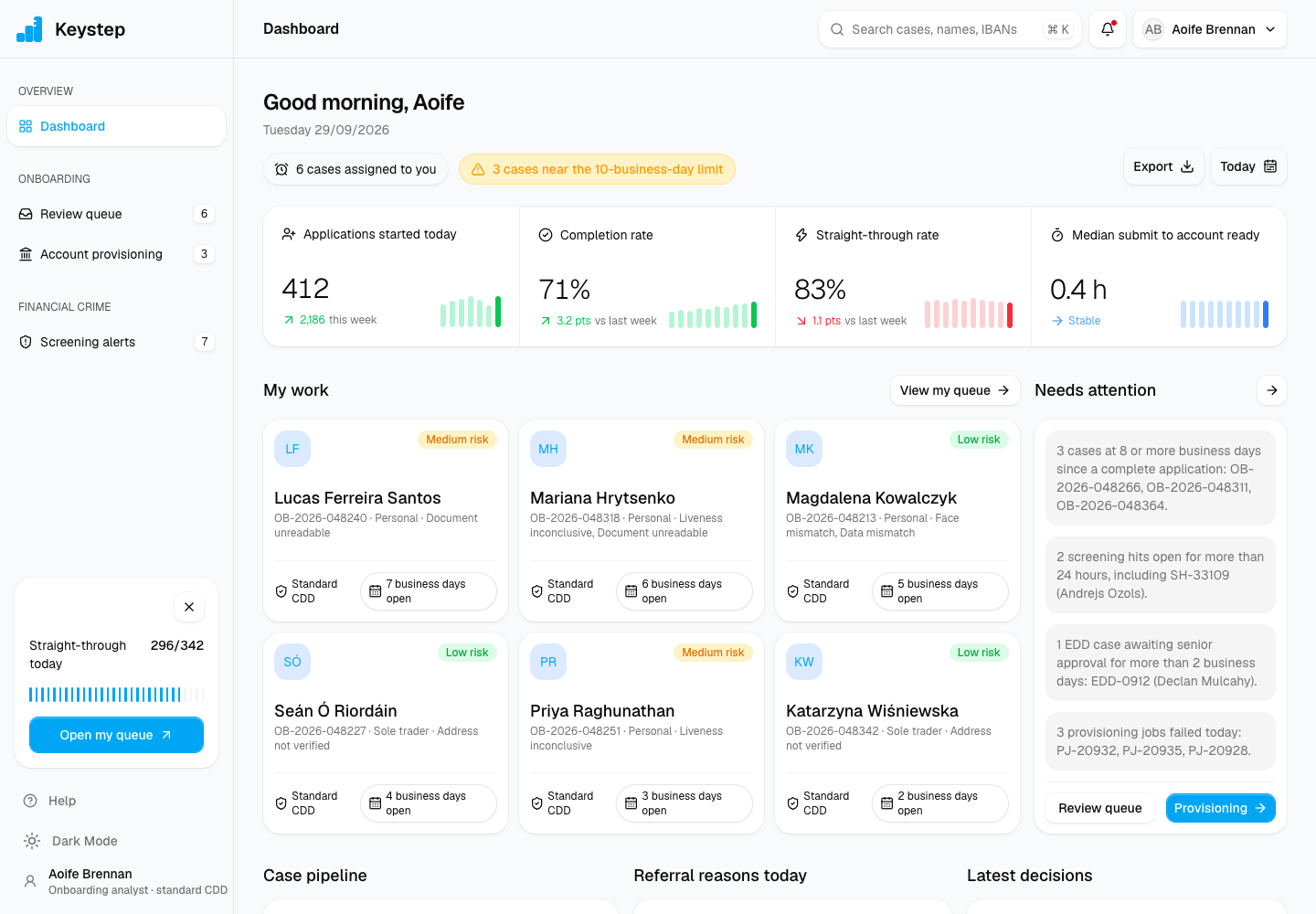
Keystep - Digital Bank Onboarding with ID, Liveness and Risk-Based Review
An onboarding platform for an Irish digital bank: applicants open a EUR current account from their phone with ID and selfie liveness checks, and a staff console lets onboarding and financial crime teams review the cases the rules cannot decide, through to an issued Irish IBAN.
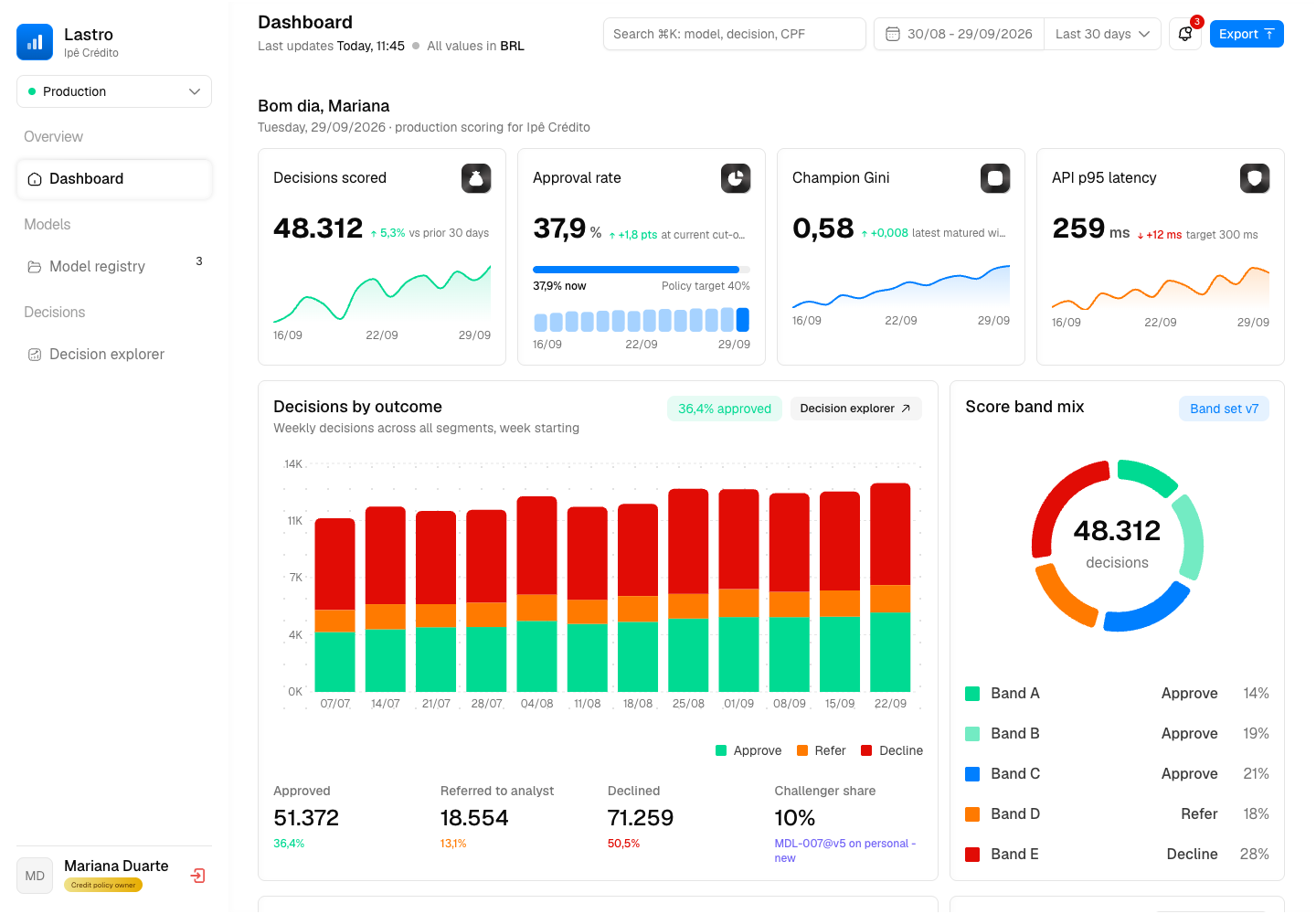
Lastro - Credit Scoring Engine with Explainable Decisions
A credit scoring engine for Ipê Crédito, a fictional Brazilian digital lender, that combines Cadastro Positivo bureau data, Open Finance account data and Pix patterns into one score, returns reason codes with every decision and keeps the model governance evidence risk, compliance and credit teams need.
Enterprise Software Engineering - Human + AI
Contact Us
© 2026 - Copyright. All Rights reserved Oceanlab
Location
Global Headquarters
21 Merchant Road, 3rd Floor, Singapore 058267
Main corporate office and leadership operations
North America Office
548 Market Street, PMB 12345, San Francisco, CA 94104
Client operations and business development
India Office
402 Shivalik Shilp II, SG Highway, Ahmedabad 380015
Engineering and delivery center

Enterprise Software Engineering - Human + AI
Contact Us
Locations
Global Headquarters
21 Merchant Road, 3rd Floor, Singapore 058267
Main corporate office and leadership operations
North America Office
548 Market Street, PMB 12345, San Francisco, CA 94104
Client operations and business development
India Office
402 Shivalik Shilp II, SG Highway, Ahmedabad 380015
Engineering and delivery center
© 2026 - Copyright. All Rights reserved Oceanlab