EHR integration cost calculator
Pick the integration work (FHIR, SMART on FHIR, HL7 v2, patient matching) and get a cost and timeline range.
Free, runs in your browser, no sign-up. Updated 2026-10-25.
Result
Estimated cost $18,200 – $49,700 (USD), 5–12 weeks with a team of 3. Platform: Web app. Design: Existing UI kit / template. Features: FHIR R4 read: patients, encounters, observations (per resource group); SMART on FHIR app launch and OAuth 2.0 scopes; Patient matching and identity reconciliation; Code mapping (LOINC, SNOMED CT, ICD-10); EHR vendor sandbox, app review and go-live testing; PHI access logging, consent and retention; Admin panel.
- Timeline
- 5–12 weeks
- Total hours
- 396–1,081
- Engineering hours
- 273–745
- Team
- 3 people
| Role | Hours | Cost |
|---|---|---|
| Engineering | 273–745 | $13,700 – $37,300 |
| Product design | 41–112 | $1,800 – $5,000 |
| QA / testing | 55–149 | $1,600 – $4,500 |
| Project management | 27–75 | $1,100 – $3,000 |
| Feature | Hours | Cost |
|---|---|---|
| FHIR R4 read: patients, encounters, observations (per resource group) | 41–103 | $2,800 – $6,900 |
| SMART on FHIR app launch and OAuth 2.0 scopes | 41–103 | $2,800 – $6,900 |
| Patient matching and identity reconciliation | 41–124 | $2,800 – $8,300 |
| Code mapping (LOINC, SNOMED CT, ICD-10) | 33–103 | $2,200 – $6,900 |
| EHR vendor sandbox, app review and go-live testing | 41–124 | $2,800 – $8,300 |
| PHI access logging, consent and retention | 33–83 | $2,200 – $5,500 |
| Admin panel | 41–103 | $2,800 – $6,900 |
Assumptions
Every number the result depends on, and where it comes from. Change any value and the result updates.
| Assumption | Value | Source |
|---|---|---|
| Engineering rate | USD/hour | OceanLab's rates are $30–50/hr depending on role and seniority. Other teams' rates vary several-fold by country and seniority; replace them with the rates you are quoted.Reviewed 2026-10-25 |
| Product design rate | USD/hour | OceanLab's rates are $30–50/hr depending on role and seniority. Other teams' rates vary several-fold by country and seniority; replace them with the rates you are quoted.Reviewed 2026-10-25 |
| QA / testing rate | USD/hour | OceanLab's rates are $30–50/hr depending on role and seniority. Other teams' rates vary several-fold by country and seniority; replace them with the rates you are quoted.Reviewed 2026-10-25 |
| Project management rate | USD/hour | OceanLab's rates are $30–50/hr depending on role and seniority. Other teams' rates vary several-fold by country and seniority; replace them with the rates you are quoted.Reviewed 2026-10-25 |
| Product design hours | 15 % | OceanLab assumption. Hours for this role as a share of engineering hours. Planning assumption.Reviewed 2026-10-25 |
| QA / testing hours | 20 % | OceanLab assumption. Hours for this role as a share of engineering hours. Planning assumption.Reviewed 2026-10-25 |
| Project management hours | 10 % | OceanLab assumption. Hours for this role as a share of engineering hours. Planning assumption.Reviewed 2026-10-25 |
| Contingency | % | OceanLab assumption. Buffer for unknowns found during the build. Planning assumption.Reviewed 2026-10-25 |
| Productive hours per person per week | hours | OceanLab assumption. 40 paid hours minus meetings and review. Planning assumption.Reviewed 2026-10-25 |
| Platform multiplier: Web app | 1 × | OceanLab assumption. Baseline: one responsive web app.Reviewed 2026-10-25 |
| Design multiplier: Existing UI kit / template | 0.9 × | OceanLab assumption. Less custom UI work. Planning assumption.Reviewed 2026-10-25 |
Send this estimate to OceanLab
Opens an email to OceanLab with this result and a link to your inputs. Nothing is sent until you press send, and there is no sign-up.
How this is calculated
The estimate starts from an integration preset: FHIR R4 reads, SMART on FHIR launch, patient matching, code mapping, vendor sandbox testing and PHI audit logging. Each feature has a low and a high hour estimate for development, multiplied by the platform and design level, plus a contingency.
Design, QA and project management are added as shares of development hours, and each role's hours are multiplied by its hourly rate.
Weeks come from total hours divided by team size and productive hours per person per week.
The hour ranges are OceanLab planning assumptions, not market benchmarks. Edit any of them in the assumptions panel.
US certified health IT must offer a standardized FHIR R4 API under ONC criterion 170.315(g)(10), which is why FHIR R4 is the default. Add an HL7 v2 feed if the hospital sends real-time events that way.
Sources
- HL7 FHIR R4 (4.0.1) specification · checked 2026-10-25
- ONC certification criterion 170.315(g)(10): standardized API (FHIR R4) · checked 2026-10-25
Questions about this tool
FHIR or HL7 v2?
FHIR R4 is the standard API that US certified EHRs must offer under ONC's (g)(10) criterion. If the hospital sends real-time events such as admissions or results as HL7 v2 messages, add the HL7 v2 feed as well.
What usually takes longest?
Access, not code: getting into the EHR vendor's sandbox, passing its app review and testing against the hospital's real data. The vendor testing line covers that time.
Which hourly rates does it use?
Default rates are OceanLab's own: $50 an hour for engineering, $45 for design, $40 for project management and $30 for QA. Change any of them to the rates you have been quoted.
Is anything I enter sent anywhere?
No. The tool runs in your browser and there is no sign-up. Nothing leaves the page unless you choose to email your result to OceanLab.
Other free tools
OceanLab product builds like this
Products OceanLab designed and built. Each case study covers the screens, the scope and the rules it was built for.
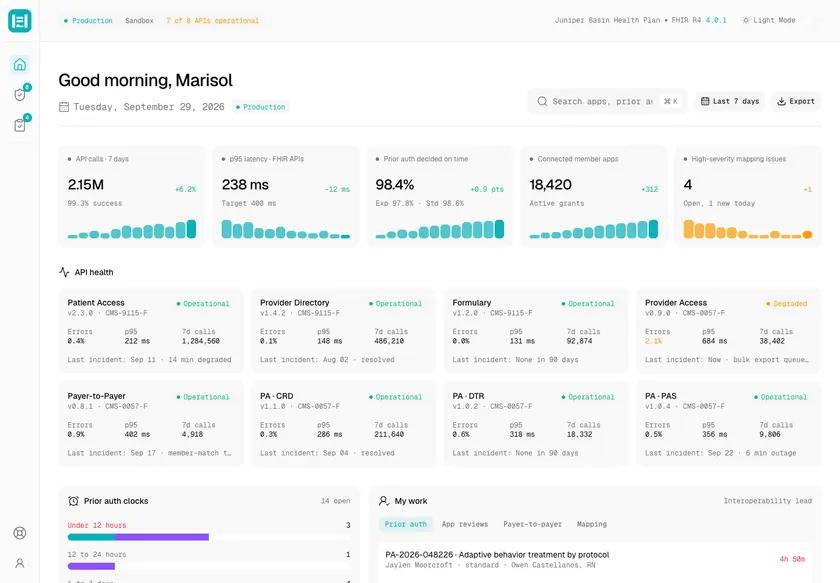
Headgate - FHIR Interoperability API Platform for Claims, Clinical Data and Prior Authorization
Designed and built a clickable console for the FHIR APIs a US regional health plan must run under federal interoperability rules: API health across Patient Access, Provider Directory, Formulary, Provider Access, Payer-to-Payer and Prior Authorization, a security review queue for third-party apps, and one clock for every prior authorization request, however it arrived.
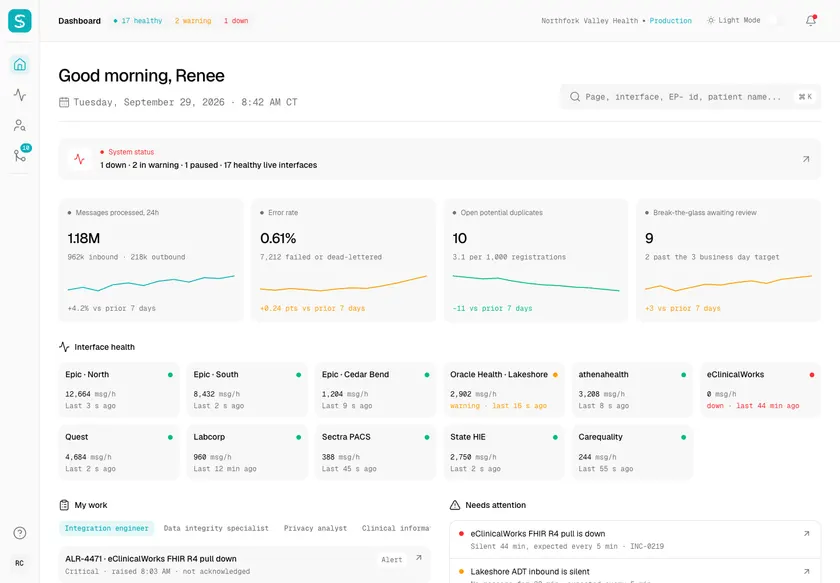
Sutura - HIPAA-Compliant Patient Data Hub over HL7 and FHIR
Designed and built a clickable patient data hub for a US health system running Epic, Oracle Health, athenahealth and eClinicalWorks: a live monitor for every HL7 v2, FHIR and HIE feed, one matched enterprise patient with a provenance-tagged record, and a duplicates queue where a person decides every uncertain match.
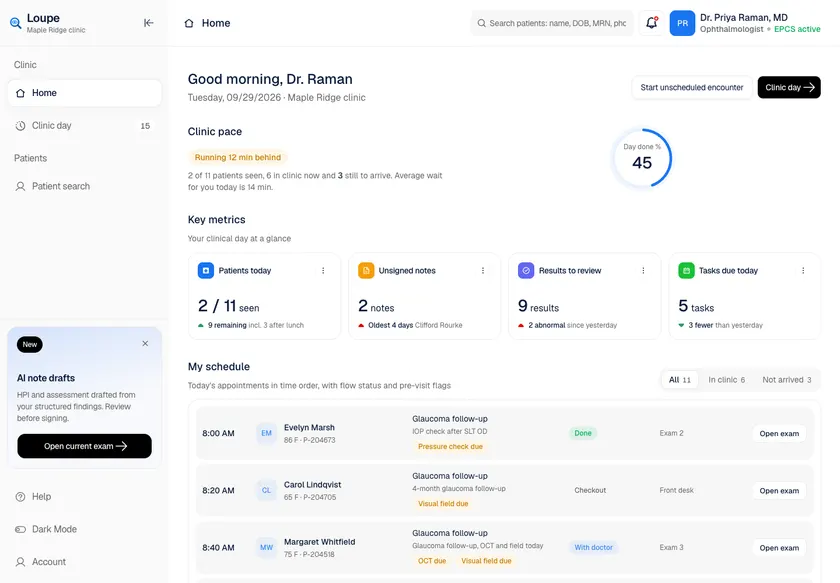
Loupe - Ophthalmology EHR with Per-Eye Charting and Laterality-Aware Coding
Designed and built a clickable ophthalmology EHR for a US eye care group with seven clinics: a clinician's day at a glance, a live patient flow board with dilation timers, patient search with break-the-glass access, a chart summary with right-eye and left-eye findings side by side, and a structured exam workspace per eye.
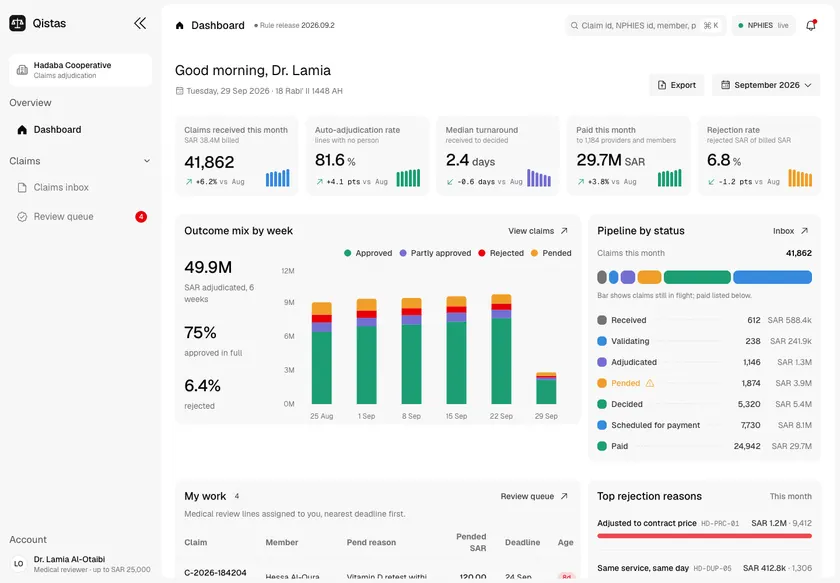
Qistas - Health Claims Adjudication with an Explanation on Every Line
Designed and built a clickable claims adjudication platform for a Saudi cooperative health insurer: claims arrive through NPHIES, from member reimbursements or on paper, a rules engine decides each line with a trace and a provider explanation in Arabic and English, and only uncertain lines reach a medical reviewer.
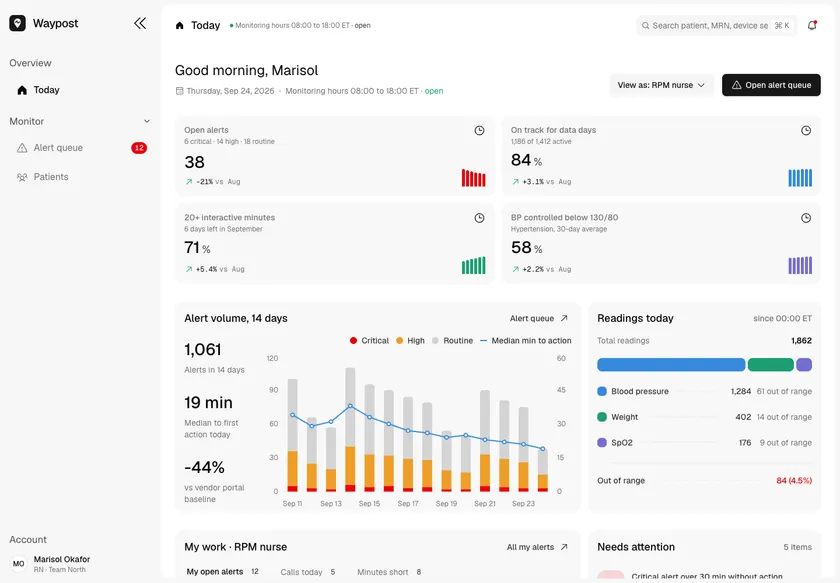
Waypost - Remote Patient Monitoring Platform with Risk-Sorted Alerts
Designed and built a clickable remote patient monitoring platform for a US cardiology and primary care group: home blood pressure, weight and SpO2 readings from cellular devices, a risk-sorted alert queue for nurses, triage with the practice's protocol on screen, and live progress toward each patient's Medicare RPM billing requirements.
