Qistas - Health Claims Adjudication with an Explanation on Every Line
Rules-Driven Claims Adjudication for a Saudi Health Insurer
Designed and built a clickable claims adjudication platform for a Saudi cooperative health insurer: claims arrive through NPHIES, from member reimbursements or on paper, a rules engine decides each line with a trace and a provider explanation in Arabic and English, and only uncertain lines reach a medical reviewer.
Most of our work is under NDA. Per agreement, we can share the work but not the company details - all names and identifying information shown here have been changed.
Impact
Dashboard, claims inbox with quick view, claim detail with line explanations, review queue and the medical review workspace. All 25 demo claims open their own claim detail.
Eligibility, network, timely filing, coding, duplicates, prior authorisation, medical necessity, benefit limits, pricing and co-payment. Each claim line lists the rules it ran in order, with pass, hit or skipped and the values compared.
The review workspace projects the claim total against the signed-in reviewer's limit before decisions are saved, and claims above a decider's authority go to a supervisor approval queue.
22 NPHIES, 2 member reimbursement and 1 paper claim, 18 members across 6 employer groups and 4 benefit classes, 10 providers with CHI accreditation and contracts, and 6 staff users.
The Problem
Hadaba adjudicated claims in a legacy core system whose edits were hard-coded by a vendor. Changing a co-payment rule or a coding edit took a six to ten week release cycle, nobody outside IT could say which rule had rejected a line, around 38% of lines were pended for a person, and providers received rejection codes with no explanation, so they resubmitted the same claim unchanged.
Our Solution
Qistas takes a medical claim from arrival to decision. Every edit is a versioned rule the claims team owns, every line outcome carries a reason code and a plain explanation in Arabic and English, and only genuinely uncertain lines go to a licensed reviewer, who decides them with the clinical evidence and guideline beside the line.
The Challenge: Deciding Every Line, and Saying Why
Hadaba sells employer group health policies to about 2,400 companies covering roughly 610,000 members. Each claim line has to be checked against the member's benefit class, the provider's contract, Saudi coding standards and Hadaba's medical policy, then explained to a provider who will challenge anything unclear.
Rules Locked in Vendor Code
Co-payments, coding edits and medical policy were hard-coded in the core system. A change waited six to ten weeks for a release, and the claims team could not see or test the logic that decided their claims.
Too Many Lines Pended for People
Around 38% of lines were pended, so medical reviewers spent their day on routine lines. Decisions on medical necessity must still be made by licensed clinicians with an SCFHS registration, and a non-clinical role must never overturn one.
Codes Without an Explanation
NPHIES carries claims and responses as HL7 FHIR messages with standard reason codes, but a code alone did not tell a provider what to fix. Providers resubmitted unchanged claims and escalated to account managers.
Sensitive Data and Many Inputs
Diagnoses in ICD-10-AM, services in SBS and medicines by SFDA code all have to validate. Under the PDPL health data is sensitive, so national ID and Iqama numbers are masked, access is by role and every view of clinical detail is logged.
Our Approach: From Claim Rules to a Clickable Platform
Spec and Rules Research
Mapped 13 user roles, 42 screens across staff, provider and member portals, and the data model for policies, benefit classes, members, providers, contracts, claims, claim lines, rule hits, versioned rules, rule releases and test runs. Wrote down the rules the design follows: mandatory employer cover, the CHI unified policy, NPHIES messaging, ICD-10-AM and SBS coding, SCFHS clinician registration, the PDPL and a Sunday to Thursday working week.
Clickable Demo on a Production UI Kit
Built 5 key screens on a production dashboard kit: the dashboard with KPIs, outcome mix, pipeline and needs-attention list, the claims inbox with channel tabs and bulk actions, the claim detail with expandable line explanations, rule hit trace and override panel, the review queue split into medical, administrative and supervisor tabs, and the medical review workspace. A small engine in the demo data prices each line against the contract, applies class co-payment with its visit cap and VAT for non-Saudi members, and records the rule trace.
What a Production Build Adds
NPHIES integration for eligibility, prior authorisation, claims and payment notices, Nafath sign-in for the member portal, loaded ICD-10-AM, SBS and SFDA code sets, SARIE payments through Hadaba's bank, OCR for paper reimbursement claims, and the ERP ledger. Plus the rule editor, test bench and releases with separate approvers, FWA cases, payment runs, appeals, reports, a full audit log and hosting in a Saudi cloud region.
Why It Works: Every Riyal Tied to a Rule
Every Line Explains Itself
Expanding a line shows each rule that ran, its version, pass, hit or skipped, and the values compared, such as billed against contract price. The explanation the provider will see sits beside it in English and right-to-left Arabic.
Only Uncertain Lines Reach People
Pended lines are split by the kind of person they need: medical, administrative or supervisor approval. Ages turn amber after 3 working days and red after 5, and a reviewer can pick up or reassign work to someone of the right role.
Evidence Next to the Decision
The review workspace puts the encounter, documents, 12 months of member history and Hadaba's guideline text on the left, and a decision card per pended line on the right. Reject and adjust need an internal note, and the provider note is written in both languages.
Authority and Privacy by Design
Each user carries an authority limit and, for clinicians, an SCFHS number. The workspace checks the projected claim total against that limit, Iqama and national ID numbers show only the last four digits, and opening clinical evidence is marked as logged to the audit trail.
Related case studies
View all: Insurance
Building Pylon - AI-Native Insurance Operations from Prototype to Production
Replaced fragmented policy spreadsheets and disconnected claims tools with a unified AI-driven workspace, designed and shipped in 8 weeks via clickable AI prototype.
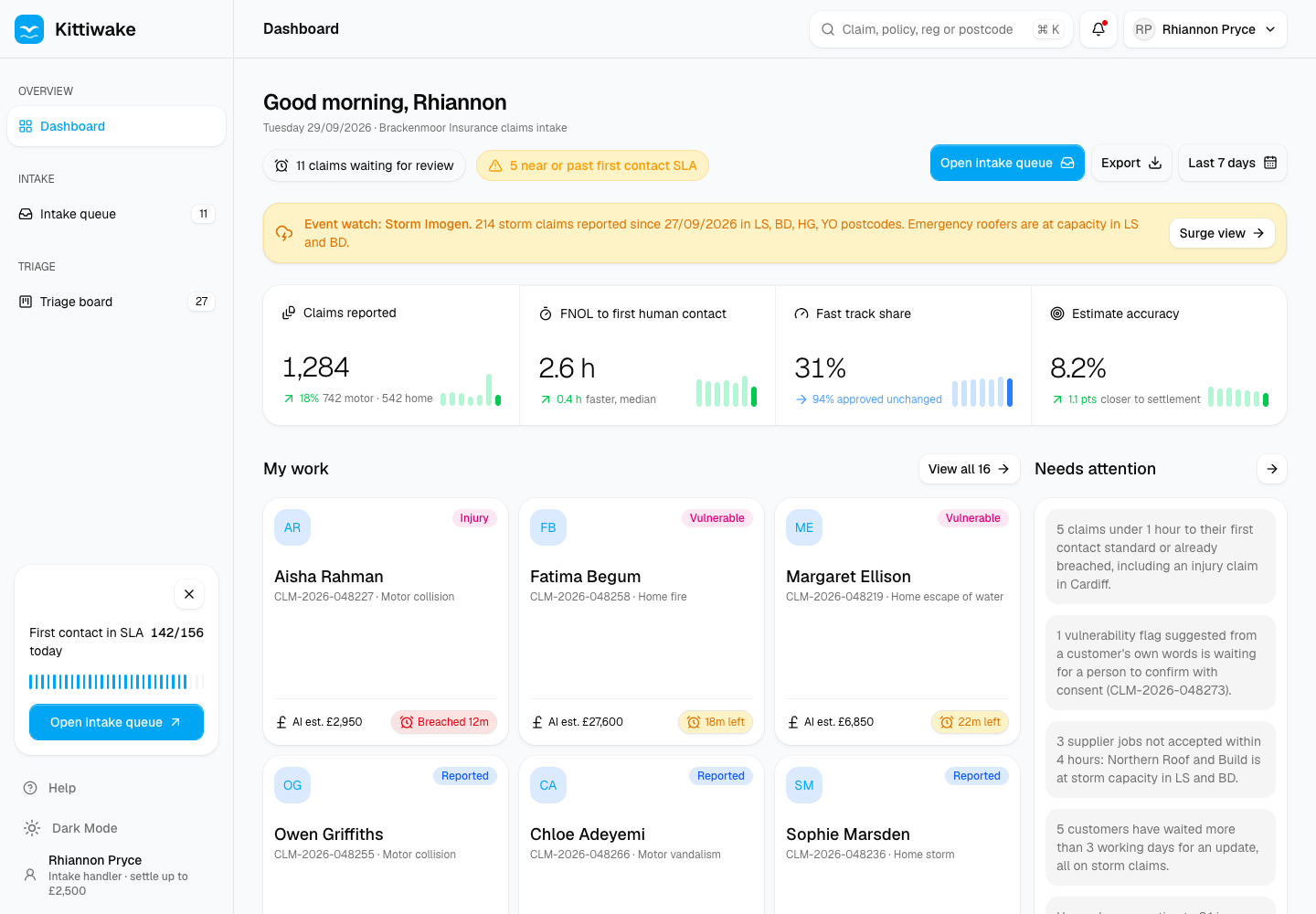
Kittiwake - AI Claims Intake with a Person Behind Every Decision
Designed and built a clickable claims intake console for a UK motor and home insurer: AI reads the customer's story and photos, extracts the facts, drafts a damage estimate and suggests a triage route with its reasons, while a named person confirms cover, routes the claim and makes every call that could go against the customer.
Enterprise Software Engineering - Human + AI
Contact Us
© 2026 - Copyright. All Rights reserved Oceanlab
Location
Global Headquarters
21 Merchant Road, 3rd Floor, Singapore 058267
Main corporate office and leadership operations
North America Office
548 Market Street, PMB 12345, San Francisco, CA 94104
Client operations and business development
India Office
402 Shivalik Shilp II, SG Highway, Ahmedabad 380015
Engineering and delivery center

Enterprise Software Engineering - Human + AI
Contact Us
Locations
Global Headquarters
21 Merchant Road, 3rd Floor, Singapore 058267
Main corporate office and leadership operations
North America Office
548 Market Street, PMB 12345, San Francisco, CA 94104
Client operations and business development
India Office
402 Shivalik Shilp II, SG Highway, Ahmedabad 380015
Engineering and delivery center
© 2026 - Copyright. All Rights reserved Oceanlab