Kittiwake - AI Claims Intake with a Person Behind Every Decision
AI Claims Intake for a UK Motor and Home Insurer
Designed and built a clickable claims intake console for a UK motor and home insurer: AI reads the customer's story and photos, extracts the facts, drafts a damage estimate and suggests a triage route with its reasons, while a named person confirms cover, routes the claim and makes every call that could go against the customer.
Most of our work is under NDA. Per agreement, we can share the work but not the company details - all names and identifying information shown here have been changed.
Impact
Dashboard, intake queue, claim review with 8 tabs, damage assessment and triage board. Every one of the 29 demo claims opens its own claim review and damage assessment.
Fast track, desk handler, field engineer, loss adjuster, injury team and SIU review. Each suggestion shows its confidence and reasons, and moving a claim to another route needs a reason.
Repair cost above 60% of market value suggests a total loss with a salvage category (A, B, S or N) for an engineer to confirm. Fast track stops at £2,500 for motor and £1,500 for home.
14 motor and 15 home claims across 8 claim types and 4 channels, a live storm event, 10 staff users with authority limits, 10 suppliers and 5 fraud signal types.
The Problem
Brackenmoor's claims line took 38% of all inbound calls. A first notice of loss took 25 minutes on the phone, photos arrived later by email and were matched to claims by hand, and every claim, from a cracked windscreen to a house fire, went into the same queue. Simple claims waited days, suspicious ones were spotted after hire cars and repairs were booked, and customers in vulnerable circumstances were often identified only when they complained.
Our Solution
Kittiwake takes a claim from the moment it is reported to the point where it is checked, triaged and handed to the right team. AI drafts the summary, the facts, the damage estimate and the route, each with an AI chip, a confidence level and the reasons behind it. Handlers confirm or change every suggestion, and declines, reductions, total loss calls and SIU referrals always need a named person.
The Challenge: Fast Intake Without Unfair Outcomes
UK claims handling rules ask insurers to handle claims promptly and fairly, support customers who need extra help and keep people in control of decisions that go against a customer. Automation has to speed up the simple claims without hiding the reasons behind any of them.
One Queue for Every Claim
A chipped windscreen and a house fire waited in the same line. Brackenmoor needed claims sorted at intake into fast track, desk handling, engineers, loss adjusters, the injury team or SIU review, using rules the team leaders own.
AI That Must Explain Itself
UK GDPR Article 22 gives people rights around solely automated decisions, and the EU AI Act places some insurance uses in higher-risk categories. Every AI output needed a confidence level, its reasons and the model version, and no decline, reduction or SIU referral could be automatic.
Vulnerability Spotted at the Start
FCA FG21/1 expects firms to identify and respond to customers in vulnerable circumstances. Flags had to be raised at first notice of loss, recorded only with consent, and treated with extra care where they involve health data.
Fraud Checks That Stay Fair
CUE, the Insurance Fraud Register and the Motor Insurance Database all feed the checks, but ICOBS 8 says a claim cannot be rejected or delayed unreasonably. Signals had to show their source and reason and only ever lead to a referral to a person.
Our Approach: From Claims Rules to a Clickable Console
Spec and Rules Research
Mapped 12 user roles, from intake handlers and engineers to SIU, model risk, policyholders and suppliers, and 38 screens across the staff console, customer pages and supplier portal. Defined the data model for claims, extracted facts, damage assessments, coverage checks, fraud signals, triage decisions, overrides and model versions, and wrote down the rules the design follows: ICOBS 8, Consumer Duty, FG21/1, CIDRA 2012, the Insurance Act 2015, UK GDPR Article 22, DISP and the salvage categories.
Clickable Demo on a Production UI Kit
Built 5 key screens on a production dashboard kit: the dashboard with KPIs, a storm event banner and needs-attention list, the intake queue with AI triage and SLA countdowns, the claim review with facts, coverage, damage, people, signals, suppliers, messages and activity tabs, the damage assessment with estimate range and line items, and the triage board with a surge view by postcode district. All actions run on local state.
What a Production Build Adds
Integration with policy administration and Guidewire ClaimCenter, Tractable photo assessment, Audatex estimating, Cap HPI and DVLA vehicle data, CUE, IFR and MID checks, fraud analytics, Met Office weather data, Loqate, Enterprise hire, Copart salvage, loss adjusters, Twilio messaging and a privately deployed LLM. Staff auth by role with authority limits, a tamper-evident audit log with model versions, model monitoring against final settlement, and the customer and supplier portals.
Why It Works: AI Suggests, People Decide
Every AI Output Shows Its Working
Summaries, facts, estimates and routes carry an AI chip, a confidence level and their reasons. The summary names its model version and sources, each fact shows where it came from, and low-confidence facts are highlighted for the handler to confirm or edit.
The Riskiest Claims Rise to the Top
Injury and vulnerable customer claims are pinned to the top of the intake queue within their SLA band, and every row shows its first contact countdown in amber under an hour and red once breached.
Fraud Signals as Reasons, Not Verdicts
Each signal states what it found and where, such as a policy started 9 days before the loss or photos dated before the reported loss. The handler sees a low, medium or high band, never an automatic outcome, and an SIU referral needs a person.
Estimates an Engineer Can Check
The damage assessment shows a low, central and high estimate, line items with labour, parts, paint and confidence, photo quality checks and missing views. Engineer review appears for low confidence, estimates over the fast track limit or a suggested total loss.
Related case studies
View all: Insurance
Building Pylon - AI-Native Insurance Operations from Prototype to Production
Replaced fragmented policy spreadsheets and disconnected claims tools with a unified AI-driven workspace, designed and shipped in 8 weeks via clickable AI prototype.
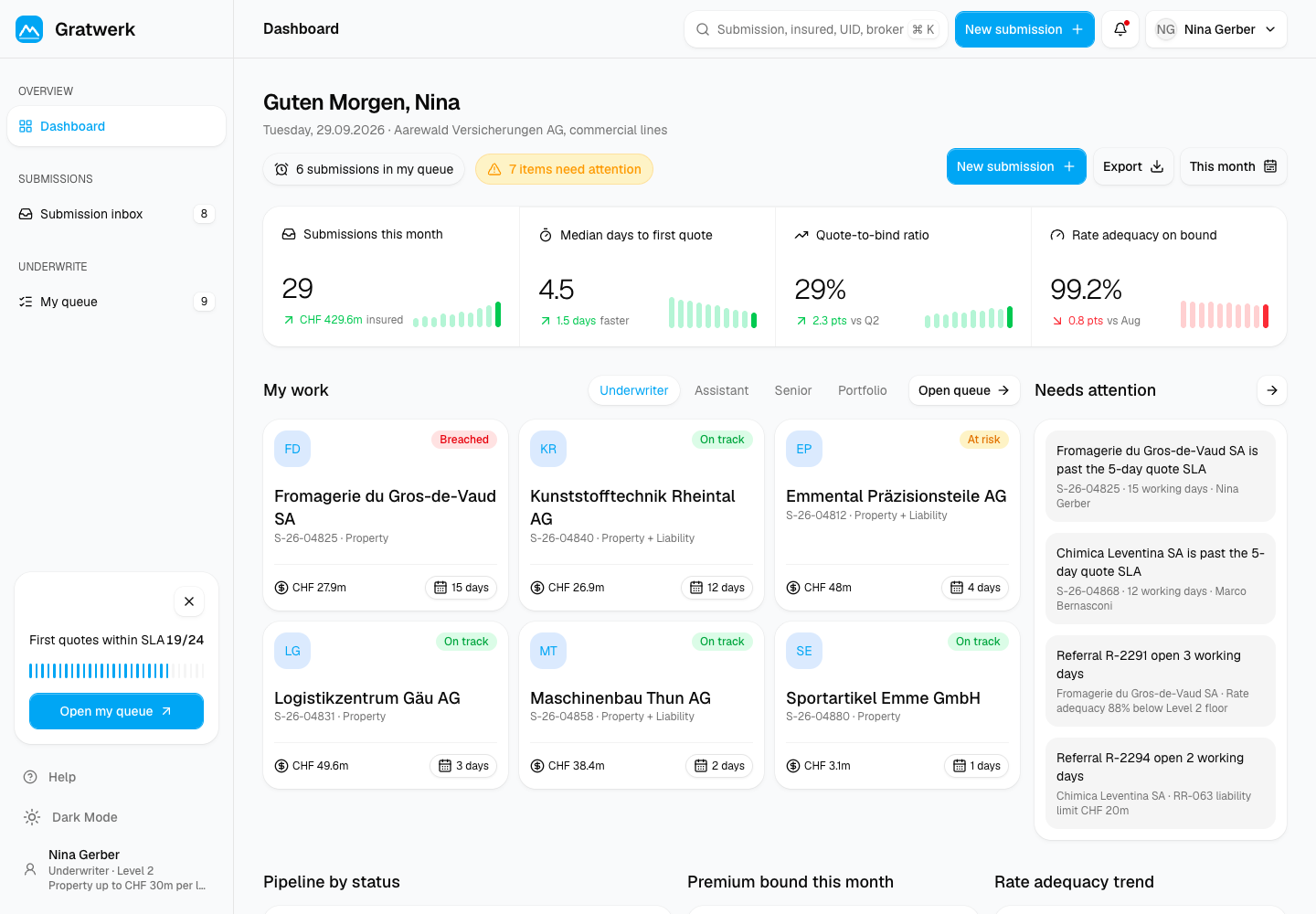
Gratwerk - Commercial Underwriting Workbench from Broker Submission to Quote
Designed and built a clickable underwriting workbench for a Bern-based insurer writing commercial property and liability through brokers: a submission inbox with extraction already done, an underwriter queue with the quote SLA, a submission file enriched with hazard, building and company data, and a workbench that rates the risk, checks every referral rule and shows who may quote.
Enterprise Software Engineering - Human + AI
Contact Us
© 2026 - Copyright. All Rights reserved Oceanlab
Location
Global Headquarters
21 Merchant Road, 3rd Floor, Singapore 058267
Main corporate office and leadership operations
North America Office
548 Market Street, PMB 12345, San Francisco, CA 94104
Client operations and business development
India Office
402 Shivalik Shilp II, SG Highway, Ahmedabad 380015
Engineering and delivery center

Enterprise Software Engineering - Human + AI
Contact Us
Locations
Global Headquarters
21 Merchant Road, 3rd Floor, Singapore 058267
Main corporate office and leadership operations
North America Office
548 Market Street, PMB 12345, San Francisco, CA 94104
Client operations and business development
India Office
402 Shivalik Shilp II, SG Highway, Ahmedabad 380015
Engineering and delivery center
© 2026 - Copyright. All Rights reserved Oceanlab