Building Pylon - AI-Native Insurance Operations from Prototype to Production
AI-Native Insurance Operations Platform
Replaced fragmented policy spreadsheets and disconnected claims tools with a unified AI-driven workspace, designed and shipped in 8 weeks via clickable AI prototype.
Most of our work is under NDA. Per agreement, we can share the work but not the company details - all names and identifying information shown here have been changed.
Impact
1 week scope, 2 weeks clickable AI prototype, 5 weeks production build.
Active portfolio rendered in a single workspace with real-time risk scoring.
Per-policy AI insights, anomaly detection, and a chatbot trained on policy context.
AI prototyping, UI/UX design, and engineering shipped under one accountable team.
The Problem
Pylon's team was managing thousands of policies across spreadsheets, separate claims tools, and inboxes - risk signals lived in three different systems and renewals were tracked manually.
Our Solution
We delivered a unified AI-native workspace - one console for portfolio overview, policy detail, claims, and renewals - validated through a clickable AI prototype before any production code.
The Challenge: Fragmentation at Scale
An insurance ops team running thousands of policies needs a single source of truth. Pylon's didn't have one.
Fragmented Workflow
Policies, claims, renewals, and risk lived in separate tools with no shared spine. Operators reconciled state across systems by hand.
No Real-Time Visibility
Risk scores and renewal urgency were calculated in batch jobs, leaving managers reacting to stale dashboards instead of acting on live signals.
Slow Policy Onboarding
Adding a new client policy meant updating four tools and a checklist - hours per policy and an audit trail that didn't quite line up.
AI Without Context
Existing analytics were static reports. There was no way for an underwriter to ask 'what changed on Henderson Corp last week?' and get an answer.
Our Approach: 3 Phases in 8 Weeks
Discovery & Scope
Week 1: embedded with underwriters and ops to map every workflow, click, and edge case. Defined the production target and success metrics on day five.
AI-Driven Clickable Prototype
Weeks 2–3: built an interactive prototype using AI prototyping tools so the Pylon team could click through the actual product - including AI insights and chatbot - and refine it in real time before any production code.
Production Build & Launch
Weeks 4–8: shipped the production console with portfolio overview, per-policy detail, claims hub, renewals tracker, AI insights panel, and an integrated chatbot trained on policy context.
Why It Works: Outcome-Based Differentiation
Speed to Value
Most enterprise insurance software takes 6–12 months. We delivered a clickable AI prototype in 2 weeks and a production system in 8.
AI-First Prototyping
Every workflow was validated in the prototype before any production code, eliminating the costly 'build then redesign' loop. Pylon clicked through the actual product before we wrote a line of production code.
Single Accountable Team
Design, AI prototyping, and engineering under one roof - no handoff, no telephone game between agencies, no integration debt between teams.
Outcome-Based Engagement
Pylon paid for milestones and demonstrated results, not hours. Our incentives were tied directly to shipping production-quality software on schedule.
Related case studies
View all: Insurance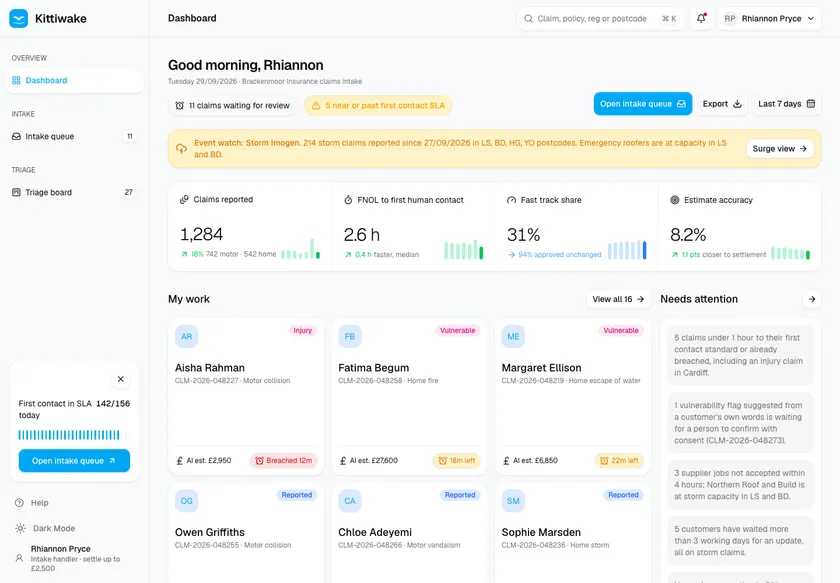
Kittiwake - AI Claims Intake with a Person Behind Every Decision
Designed and built a clickable claims intake console for a UK motor and home insurer: AI reads the customer's story and photos, extracts the facts, drafts a damage estimate and suggests a triage route with its reasons, while a named person confirms cover, routes the claim and makes every call that could go against the customer.
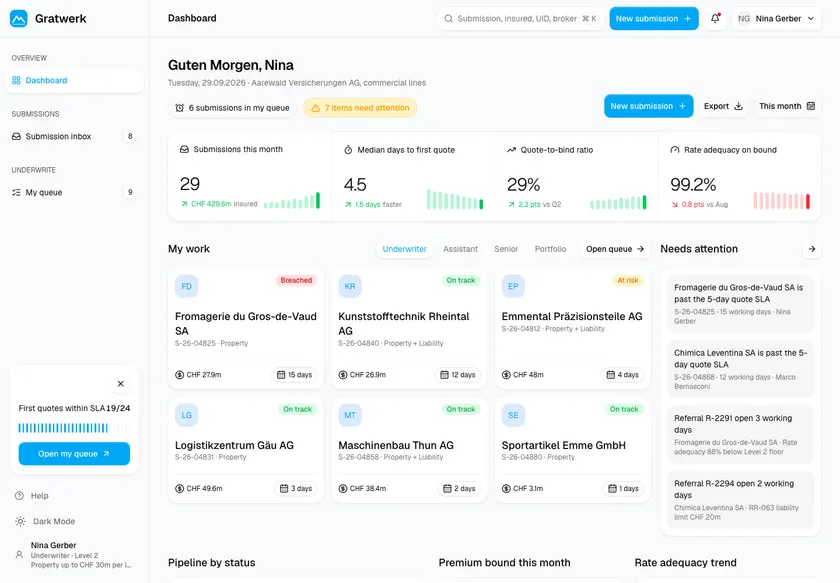
Gratwerk - Commercial Underwriting Workbench from Broker Submission to Quote
Designed and built a clickable underwriting workbench for a Bern-based insurer writing commercial property and liability through brokers: a submission inbox with extraction already done, an underwriter queue with the quote SLA, a submission file enriched with hazard, building and company data, and a workbench that rates the risk, checks every referral rule and shows who may quote.
