Gratwerk - Commercial Underwriting Workbench from Broker Submission to Quote
Underwriting Workbench for a Swiss Commercial Insurer
Designed and built a clickable underwriting workbench for a Bern-based insurer writing commercial property and liability through brokers: a submission inbox with extraction already done, an underwriter queue with the quote SLA, a submission file enriched with hazard, building and company data, and a workbench that rates the risk, checks every referral rule and shows who may quote.
Most of our work is under NDA. Per agreement, we can share the work but not the company details - all names and identifying information shown here have been changed.
Impact
Dashboard, submission inbox with quick view, my queue, submission detail with 7 tabs and the three-column underwriting workbench. Every one of the 22 demo submissions opens its own file and workbench.
Exposure, hazard, occupancy, losses, company, pricing and compliance rules, each showing the value against its threshold, such as contents and stock in a red flood zone above CHF 2m referring to Senior.
Level 1 up to CHF 10m per location, Level 2 up to CHF 30m, Senior up to CHF 75m and Head above, with rate adequacy floors of 100%, 95% and 85%. Issue quote stays disabled until the risk is within the user's authority.
16 broker emails in German, French and Italian, 8 brokers, 11 occupancy classes, 12 staff users and locations across Swiss cantons with flood, runoff, hail and seismic data.
The Problem
Aarewald's 34 commercial underwriters received around 1,100 broker submissions a month by email, in German, French and Italian, with statements of values in Excel and loss runs as scanned PDFs. An assistant re-keyed each one into a rating spreadsheet, hazard maps were looked up by hand on cantonal geoportals, and referrals went by email with no record of who approved what. Quotes took 6 to 12 working days and a third of submissions were never answered before the broker placed elsewhere.
Our Solution
Gratwerk takes a broker submission from the inbox to a quote. Attachments are classified and extracted, locations are geocoded and enriched with natural hazard, building and company data, the rating engine produces a technical price, and referral rules and the authority matrix decide who may quote, with every input, override and decision recorded.
The Challenge: Pricing Swiss Commercial Risks Under Swiss Rules
Commercial property and liability in Switzerland is written through brokers in three languages, priced partly by law and partly by the underwriter, and supervised by FINMA, so every quote has to show where each number came from and who was allowed to give it.
Submissions in Every Format and Language
Each broker sends its own mix of emails, Excel statements of values, scanned loss runs and questionnaires, in German, French, Italian or English. Re-keying them by hand was the first delay on every quote.
Parts of the Price Are Fixed by Law
Natural hazard cover comes with fire insurance at a uniform tariff that all private insurers apply. In most cantons buildings must be insured with the cantonal building insurer, and federal stamp duty is a separate line on every quote. The rating has to respect all three.
Hazard Data Scattered Across Sources
Flood zones come from cantonal hazard maps, surface runoff from FOEN, hail from MeteoSwiss and seismic zones from SIA 261. Looked up by hand per location, nobody could say how much value sat in red flood zones along the Aare.
Decisions Without a Record
Referrals went by email, so there was no trace of who approved a price, under what authority or why. The revised VVG also means the insurer can generally rely only on risk questions it asked in writing, so each quote must keep the questionnaire it relied on.
Our Approach: From Underwriting Rules to a Clickable Workbench
Spec and Rules Research
Mapped 9 user roles from underwriting assistant to compliance plus brokers on signed links, 30 screens and the data model for submissions, inbound emails, documents, locations, hazard profiles, losses, credit reports, screening hits, quote versions, referral rules and authority levels. Wrote down the rules the design follows: FINMA supervision under the ISA and AVO with professional policyholder classification, the revised VVG, the natural hazard uniform tariff, cantonal building insurance, federal stamp duty, the revFADP, SECO sanctions screening and the FINMA intermediary register.
Clickable Demo on a Production UI Kit
Built 5 key screens on a production dashboard kit: the dashboard with KPIs, my work, needs attention and pipeline, the submission inbox with email, attachment and extraction quick view, my queue with SLA status, the submission detail with checklist, locations, losses, documents and enrichment, and the underwriting workbench. Rating, rule results and the authority check are computed from the demo data and update live as inputs, deductibles and discounts change.
What a Production Build Adds
Integration with the Microsoft 365 inbox, Azure AI Document Intelligence, DeepL, swisstopo, the GWR building register, cantonal hazard layers, a cat model such as Verisk or Moody's RMS, Zefix, credit data, SECO screening, the FINMA register, the claims system and policy administration. Staff auth by role, a tamper-evident audit log, real maps, the actuarial team's rating factors, and the remaining screens: quote versions, bind with four-eyes approval above CHF 250,000, referrals, peer reviews, portfolio accumulation, rate adequacy, control, settings and the broker link pages.
Why It Works: Every Price Shows Its Reasons
Rules Show Their Numbers
Each referral rule shows its result, the value against the threshold and the authority level it refers to, with a count such as 2 triggered of 15. Clicking a rule opens its definition and the data it used.
Blocked Quotes Say Why
Issue quote is enabled only when the risk is within the user's authority, there is no sanctions hit and the pricing rationale is complete. Otherwise the action bar names the reason, such as Senior authority needed or a rationale missing for adequacy below 100%.
Swiss Rules Built Into the Rating
The natural hazard premium is a fixed tariff line that cannot be edited, building cover is not rated in cantons with a cantonal building insurer, and stamp duty and commission show as their own lines. The header names the rating, rules and authority versions in use.
Every Input Has a Source
Rating inputs are marked as extracted, enriched, broker-declared or overridden, and an override needs a reason. Locations carry hazard chips for flood zone, runoff, hail and seismic zone, and every submission shows its days against the 5 working day quote SLA.
Related case studies
View all: Insurance
Building Pylon - AI-Native Insurance Operations from Prototype to Production
Replaced fragmented policy spreadsheets and disconnected claims tools with a unified AI-driven workspace, designed and shipped in 8 weeks via clickable AI prototype.
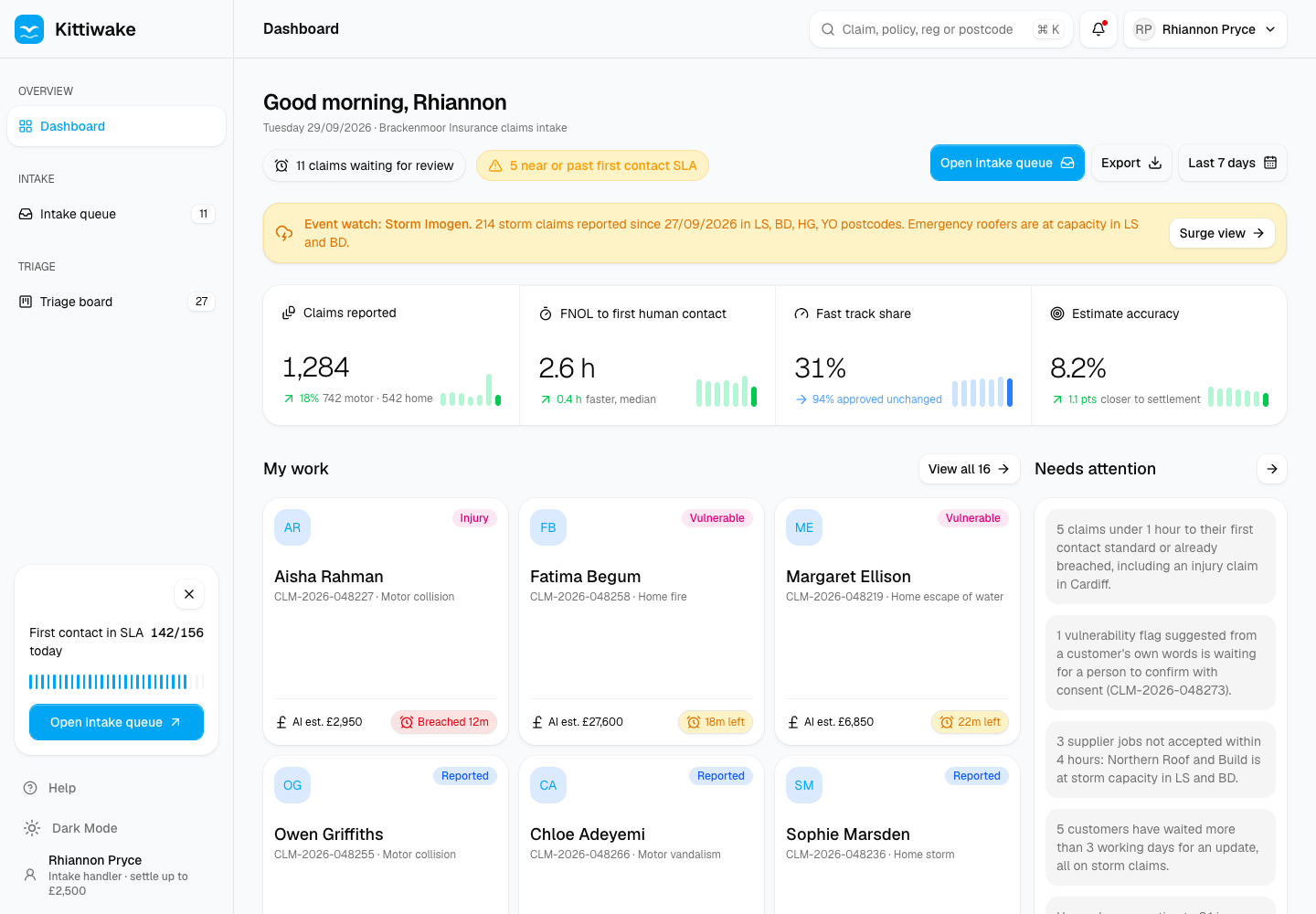
Kittiwake - AI Claims Intake with a Person Behind Every Decision
Designed and built a clickable claims intake console for a UK motor and home insurer: AI reads the customer's story and photos, extracts the facts, drafts a damage estimate and suggests a triage route with its reasons, while a named person confirms cover, routes the claim and makes every call that could go against the customer.
Enterprise Software Engineering - Human + AI
Contact Us
© 2026 - Copyright. All Rights reserved Oceanlab
Location
Global Headquarters
21 Merchant Road, 3rd Floor, Singapore 058267
Main corporate office and leadership operations
North America Office
548 Market Street, PMB 12345, San Francisco, CA 94104
Client operations and business development
India Office
402 Shivalik Shilp II, SG Highway, Ahmedabad 380015
Engineering and delivery center

Enterprise Software Engineering - Human + AI
Contact Us
Locations
Global Headquarters
21 Merchant Road, 3rd Floor, Singapore 058267
Main corporate office and leadership operations
North America Office
548 Market Street, PMB 12345, San Francisco, CA 94104
Client operations and business development
India Office
402 Shivalik Shilp II, SG Highway, Ahmedabad 380015
Engineering and delivery center
© 2026 - Copyright. All Rights reserved Oceanlab