Sutura - HIPAA-Compliant Patient Data Hub over HL7 and FHIR
Patient Data Hub for a US Regional Health System
Designed and built a clickable patient data hub for a US health system running Epic, Oracle Health, athenahealth and eClinicalWorks: a live monitor for every HL7 v2, FHIR and HIE feed, one matched enterprise patient with a provenance-tagged record, and a duplicates queue where a person decides every uncertain match.
Most of our work is under NDA. Per agreement, we can share the work but not the company details - all names and identifying information shown here have been changed.
Impact
Dashboard, interface monitor, patient search, the unified patient record with 7 tabs, and the potential duplicates queue with side-by-side pair review.
The demo record joins Epic, Oracle Health, athenahealth, Quest, Sectra PACS and the state HIE. Every item carries a source chip and opens a provenance panel with its local and standard code.
A production replay needs a second approver who is not the requester, and merging twin or newborn records waits for a second reviewer. Every merge and replay needs a reason.
12 sources over HL7 v2, FHIR R4, C-CDA and HIE query, 6 alerts, 18 synthetic patients, 20 coded clinical items and 12 duplicate tasks.
The Problem
Northfork Valley Health grew by acquisition, and its patient data grew apart. One patient seen at an Epic hospital, the Oracle Health hospital and an athenahealth practice had three medical record numbers and three partial charts. The interface team ran more than 140 point-to-point HL7 interfaces with no shared dashboard, so a failed feed was usually found by a clinician asking where a result had gone, and nobody could say how many duplicate patient records existed.
Our Solution
Sutura takes in HL7 v2 feeds, FHIR R4 APIs, C-CDA documents and HIE queries from every source, matches each record to one enterprise patient and serves a unified, provenance-tagged record to authorised clinicians. Integration engineers watch every feed in one monitor, data integrity staff work a duplicates queue, and every access has a stated basis.
The Challenge: One Patient, Many Systems
Northfork runs four hospitals, 38 owned clinics and an affiliated network of about 220 independent practices on four different EHRs, plus reference labs, imaging and health information exchanges. Joining that data is a technical problem, a patient safety problem and a privacy problem at once.
Feeds That Fail Silently
ADT, results, orders, documents, scheduling and immunization feeds arrive as HL7 v2 over MLLP, alongside FHIR R4 pulls and HIE queries. With no shared view, a silent interface or a burst of unmapped codes went unnoticed until a result was missing on the ward.
No National Patient Identifier
The US has no national patient id, so matching relies on demographics and local MRNs. A wrong merge puts one person's results in another's chart, so uncertain pairs need a person, and twins and newborns need extra care.
Sensitive Data With Its Own Rules
Substance use disorder records are protected by 42 CFR Part 2, and state laws add rules for HIV, mental health, genetic testing, minors and reproductive health. These records had been kept out of the shared record because there was no safe way to segment them.
Access That Must Be Explained
The HIPAA Security Rule expects access controls, emergency access procedures and audit controls, and the Cures Act limits withholding data without a recognised exception. The privacy office could not produce one access report for a patient across systems.
Our Approach: From Interoperability Rules to a Clickable Hub
Spec and Rules Research
Mapped 10 user roles, 36 screens (32 staff screens, a 3-screen developer portal and an embedded viewer launched from the EHR), 5 slide-over panels and the data model for sources, interfaces, messages, enterprise patients, match rules, duplicate tasks, sensitive categories, care relationships, break-the-glass events and access events. Wrote down the rules the design follows: the HIPAA Privacy and Security Rules, business associate agreements, Cures Act information blocking, HL7 v2, FHIR R4 with US Core and SMART App Launch, TEFCA, 42 CFR Part 2, HL7 security labels and CMS event notifications.
Clickable Demo on a Production UI Kit
Built 5 key screens on a production dashboard kit: the dashboard with system status, KPIs, interface health tiles and work that changes by role, the interface monitor with baselines, warning reasons, a 24-hour throughput chart and replay requests, patient search with care relationship badges and break-the-glass, the unified record with timeline, results grouped by LOINC and medications collapsed by RxNorm, and the duplicates queue with merge, not the same person and needs more information. All actions run on local state.
What a Production Build Adds
An interface engine such as InterSystems Health Connect or Rhapsody, a FHIR server under the hosting BAA, live connections to Epic, Oracle Health, athenahealth, eClinicalWorks, Quest, Labcorp, the PACS, the state HIE and national networks, referential matching, NLM terminology content, SSO with MFA, hash-chained audit and access logs exported to the security team, and the remaining screens: message search, the dead letter queue, merge history, matching rules, the privacy pages, data quality, the API gateway, reports, settings, the developer portal and the embedded SMART viewer.
Why It Works: Every Fact Traced, Every Access Explained
Every Fact Shows Where It Came From
Each item on the unified record carries a source chip such as "Epic · North" or "HIE" and opens a provenance panel with the source system, message or API reference, received and recorded times, the local code, the mapped standard code and the mapping version applied.
Failed Feeds Surface Before Anyone Asks
A status chip on every page counts healthy, warning and down interfaces. Each interface is measured against its hourly baseline, and a warning row states its reason, such as "No message for 22 min, expected every 5 min" or an unmapped local code behind a rising error rate.
Uncertain Matches Go to a Person
Pairs in the review band are shown side by side with each field's agreement and weight in the score, plus recent clinical items from both records. Twins carry a caution badge, a merge needs a reason and a surviving id, and "not the same person" stops the pair being raised again.
Access Has a Basis, Sensitive Data Stays Quiet
Search shows whether the user has a care relationship, and opening a record without one goes through break-the-glass with a reason that the privacy office reviews. The record states its access basis, and withheld data shows only a neutral banner that never names the category.
Related case studies
View all: Health data & interoperability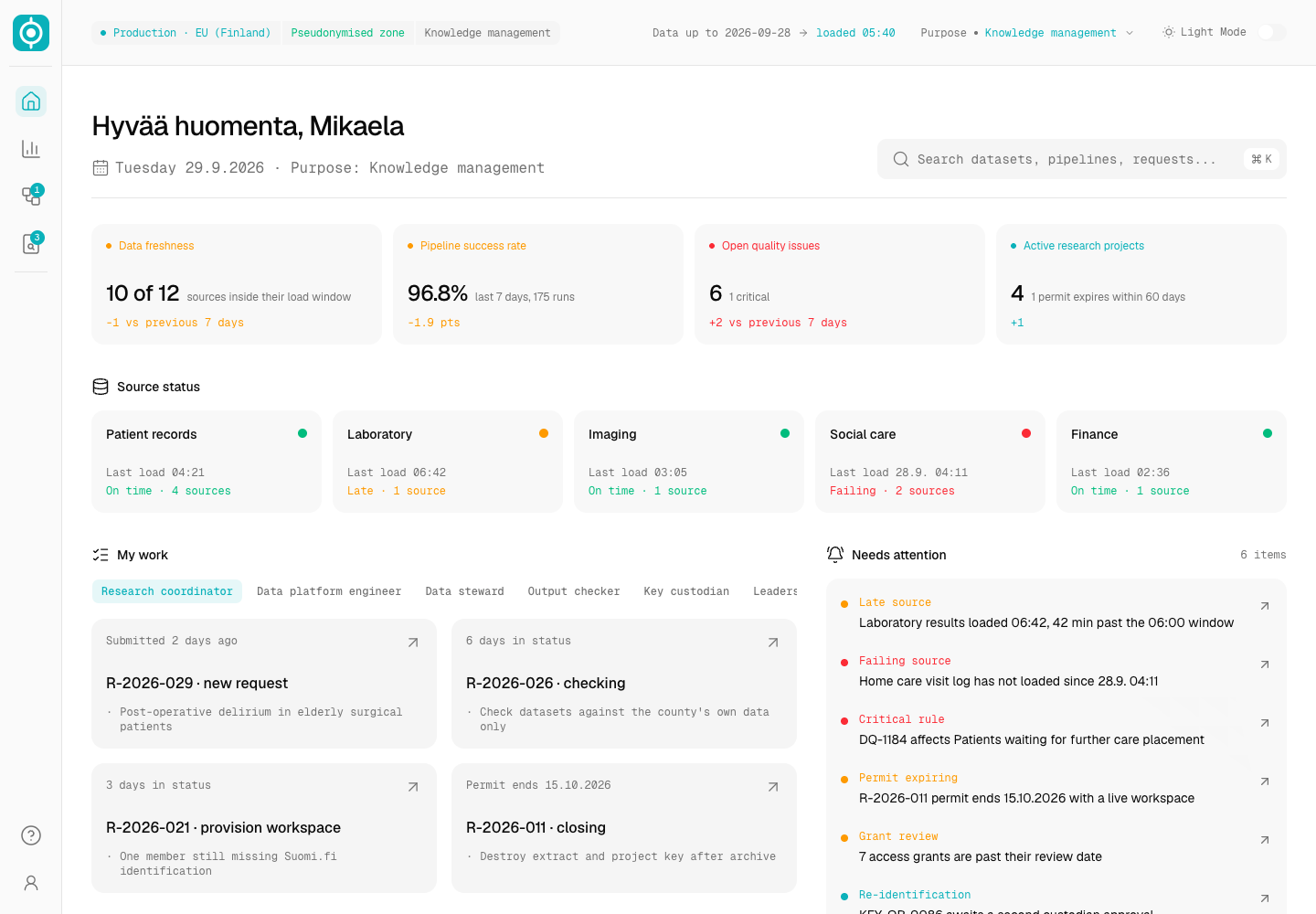
Kaivo - Pseudonymised Health Data Warehouse for Leadership Analytics and Permitted Research
Designed and built a clickable data platform console for a bilingual Finnish wellbeing services county: nightly pipelines that pseudonymise patient, lab, imaging, social care and finance data, leadership dashboards built only from aggregates, and a research request desk that ties every project to its data permit.
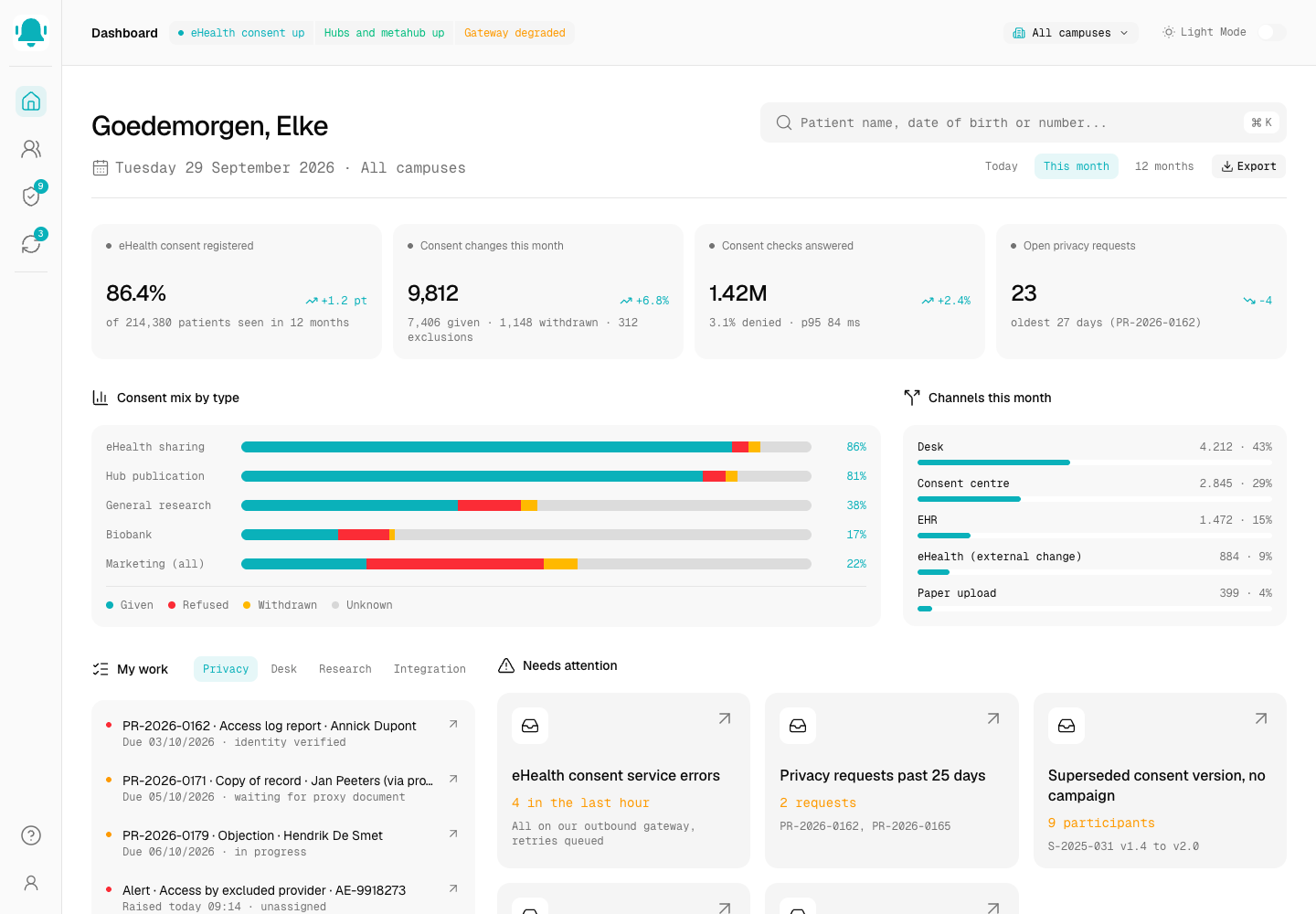
Beiaard - Consent Management Platform for Health Data Sharing, Research and Communication
Designed and built a clickable consent platform for a four-campus Belgian hospital network: one record per patient for eHealth sharing, hub publication, research, biobank and newsletter consent, kept in step with the national eHealth record, with access log review for the DPO and a sync console for the hubs and the metahub.
Enterprise Software Engineering - Human + AI
Contact Us
© 2026 - Copyright. All Rights reserved Oceanlab
Location
Global Headquarters
21 Merchant Road, 3rd Floor, Singapore 058267
Main corporate office and leadership operations
North America Office
548 Market Street, PMB 12345, San Francisco, CA 94104
Client operations and business development
India Office
402 Shivalik Shilp II, SG Highway, Ahmedabad 380015
Engineering and delivery center

Enterprise Software Engineering - Human + AI
Contact Us
Locations
Global Headquarters
21 Merchant Road, 3rd Floor, Singapore 058267
Main corporate office and leadership operations
North America Office
548 Market Street, PMB 12345, San Francisco, CA 94104
Client operations and business development
India Office
402 Shivalik Shilp II, SG Highway, Ahmedabad 380015
Engineering and delivery center
© 2026 - Copyright. All Rights reserved Oceanlab