Beiaard - Consent Management Platform for Health Data Sharing, Research and Communication
Consent Platform for a Belgian Hospital Network
Designed and built a clickable consent platform for a four-campus Belgian hospital network: one record per patient for eHealth sharing, hub publication, research, biobank and newsletter consent, kept in step with the national eHealth record, with access log review for the DPO and a sync console for the hubs and the metahub.
Most of our work is under NDA. Per agreement, we can share the work but not the company details - all names and identifying information shown here have been changed.
Impact
Dashboard, patient search, the patient consent record with 7 tabs, access log review and hub and eHealth sync. Every one of the 24 demo patients opens their own record.
eHealth sharing, hub publication, general research, biobank and newsletter, each with its state, channel, the text version shown and who recorded it. Marketing never sits inside care consent.
No therapeutic relationship, excluded provider, emergency override, staff member's record, VIP-flagged record, same family name as the user and unusual volume.
Across 4 campuses, with 7 exclusions, 7 proxies, 24 access events, 13 sync items, 6 connected services and a nightly reconciliation run per campus.
The Problem
Scheldeborg's four campuses each handled consent their own way. The eHealth consent was registered through a vendor screen at the admission desk, research consent lived on paper in study binders, biobank forms were scanned into a separate folder and newsletter opt-ins sat in the mailing tool. Nobody could answer "who can see my file?" without calling three departments, the hub publication job could not check exclusions before sending documents, and two campuses kept using a consent form version after the ethics committee had approved a new one.
Our Solution
Beiaard keeps one record of every permission a patient has given, from national eHealth sharing to research, biobank and newsletter consent. Desk staff see and change consent per type, the national record is read and written through the eHealth platform instead of a local copy, the DPO reviews access with the consent and relationship state at that moment, and integration staff keep the hubs and the metahub in step.
The Challenge: Many Permissions, One Patient
A Belgian hospital patient gives permissions under different laws to different parties: a national eHealth consent, relationships with named care providers, study and biobank consents approved by an ethics committee, and marketing opt-ins. Each one is recorded somewhere else and each one changes on its own.
Consent Alone Is Not Enough
Sharing through the eHealth platform and the hubs needs the patient's informed consent, registered once nationally, plus a therapeutic relationship with the care provider. A patient can also exclude a named provider, and that exclusion holds even when a relationship exists.
The National Record Changes Elsewhere
Patients, doctors, pharmacists and health insurance funds can all give or withdraw the eHealth consent outside the hospital. A local copy that is not checked against the national record quietly goes out of date.
Care, Research and Marketing Under Different Rules
Care itself does not rest on consent under GDPR article 9(2)(h). Trials follow the EU Clinical Trials Regulation with versioned, ethics-approved forms, biobanks follow the law of 19 December 2008 on human body material, and newsletters need their own opt-in. Bundling any of these breaks the rules.
Who May Act, and Who May Look
Parents act for minors, unless a minor can reasonably assess their own interests, and adults can designate a representative. The INSZ number may only be used for authorised purposes, and the DPO must answer access requests, generally within one month.
Our Approach: From Belgian Consent Rules to a Clickable Platform
Spec and Rules Research
Mapped 11 roles, from desk agents and research coordinators to the DPO, integration engineers, patients and proxies, and 40 screens: 29 for staff and 11 for a mobile patient consent centre in Dutch, French and English. Defined the data model for consents and their history, therapeutic relationships, exclusions, proxies, study versions, access events, privacy requests and sync items, and a consent check API for internal systems. Wrote down the rules the design follows: eHealth informed consent, therapeutic relationships and exclusions, GDPR and the Belgian data protection law of 30 July 2018, the patients' rights law of 22 August 2002, the EU Clinical Trials Regulation, the human body material law and the limits on INSZ use.
Clickable Demo on a Production UI Kit
Built 5 key screens on a production dashboard kit: the dashboard with consent mix, channel mix, My work by role and Needs attention, patient search with a consent chip per type and a quick view, the patient consent record with consents, relationships, exclusions, research, communication, access and history tabs, access log review with alert rules and the access event panel, and hub and eHealth sync with service status, queues and nightly reconciliation. Giving or withdrawing consent, resolving a national mismatch, closing an alert and retrying a sync item all update the screen on local state.
What a Production Build Adds
Integration with the eHealth platform's consent and therapeutic link services, the regional hubs (such as CoZo and Abrumet) and the metahub, itsme and eID login through the federal authentication service, eID card readers at the desk, the hospital EHR (such as Epic, KWS or HiX), electronic signature for research forms and the mailing tool. The consent check API with mutual TLS and client keys, staff single sign-on with multi-factor authentication, a tamper-evident audit log, and the remaining screens: the desk registration wizard, research studies and re-consent campaigns, privacy requests, API clients, reports, settings and the patient consent centre.
Why It Works: Every Permission Answerable
The National Record Stays the Truth
The eHealth consent card shows whether the national record matches. A mismatch shows a warning and a Resolve action that re-reads the national record, and the nightly reconciliation lists, per campus, every patient whose local state and national record differ.
Unknown Means No
Internal systems ask Beiaard before they share, publish or extract data. The answer is allow, deny or unknown, with reason codes such as PROVIDER_EXCLUDED or NO_THERAPEUTIC_RELATIONSHIP, and callers must treat unknown as deny, including when the national service is down.
Access Reviewed in Context
Each access event opens with the consent, relationship and exclusion state at that moment and other access by the same user that day. Alerts can be assigned, escalated to the DPO or closed as justified, and closing needs a reason.
Identity Numbers Stay Masked
The INSZ number shows as 85.07.30-xxx-xx in search and on the record. Revealing it asks for a reason and is logged, and every consent change records who made it, through which channel and the text version shown.
Related case studies
View all: Health data & interoperability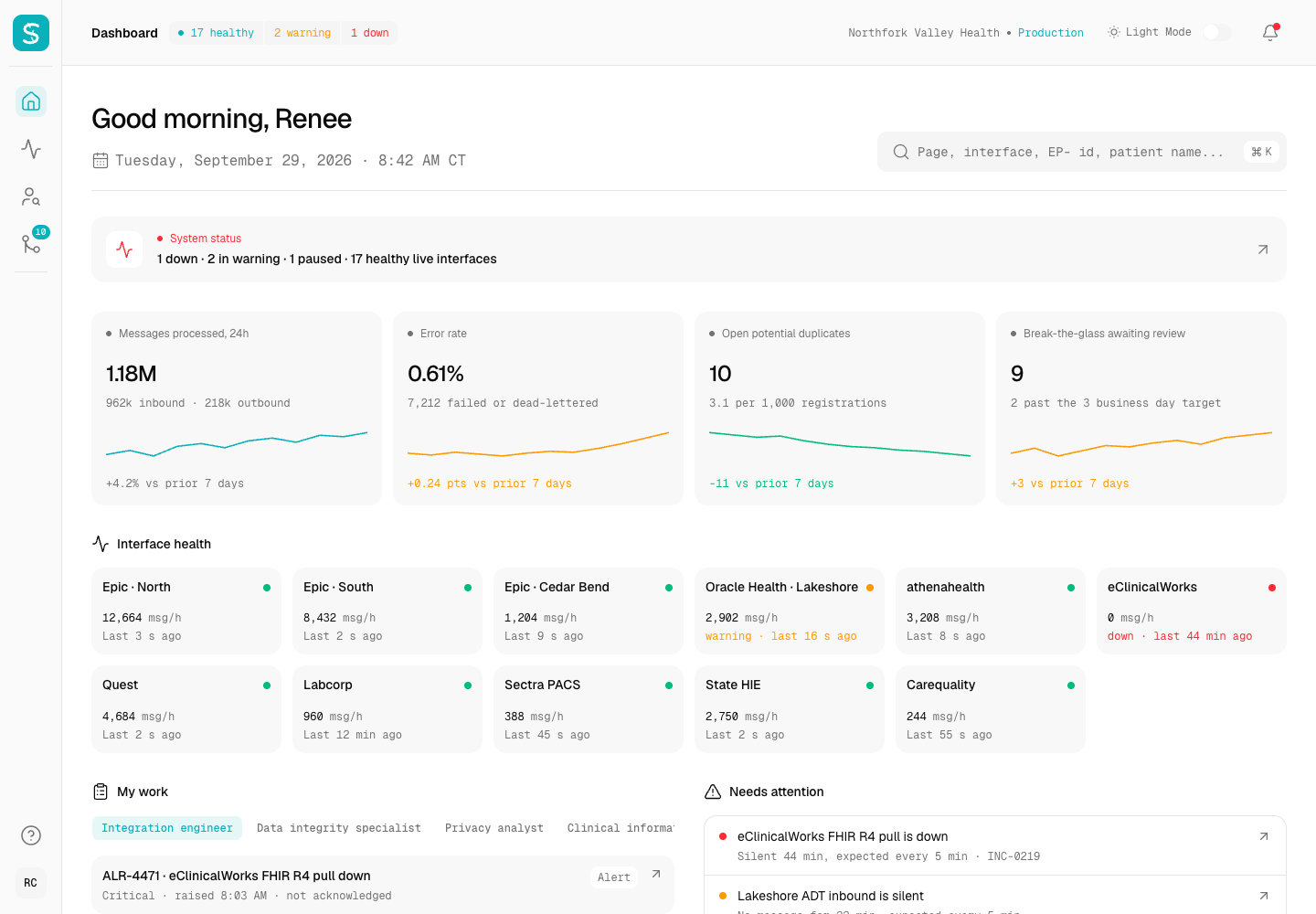
Sutura - HIPAA-Compliant Patient Data Hub over HL7 and FHIR
Designed and built a clickable patient data hub for a US health system running Epic, Oracle Health, athenahealth and eClinicalWorks: a live monitor for every HL7 v2, FHIR and HIE feed, one matched enterprise patient with a provenance-tagged record, and a duplicates queue where a person decides every uncertain match.
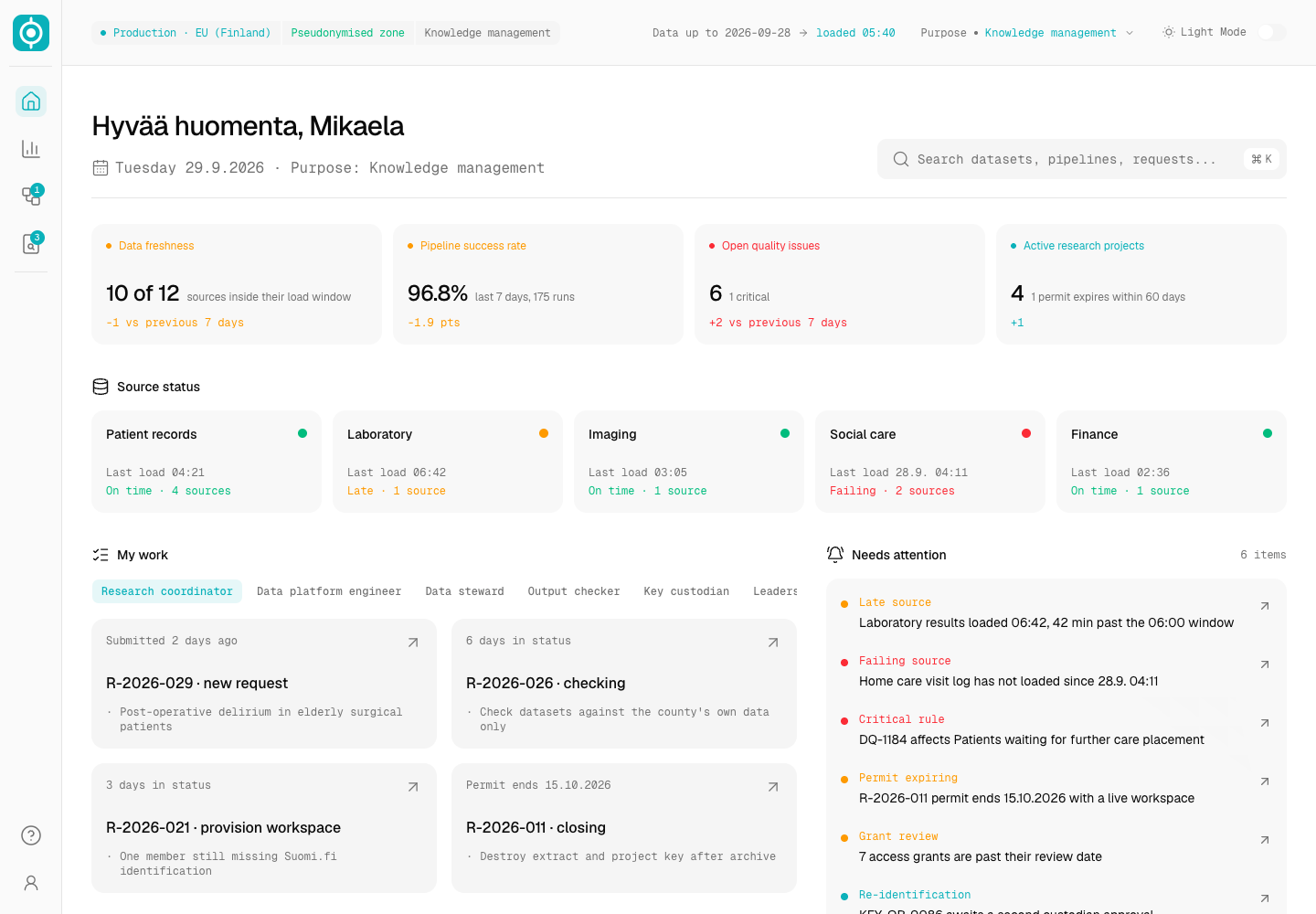
Kaivo - Pseudonymised Health Data Warehouse for Leadership Analytics and Permitted Research
Designed and built a clickable data platform console for a bilingual Finnish wellbeing services county: nightly pipelines that pseudonymise patient, lab, imaging, social care and finance data, leadership dashboards built only from aggregates, and a research request desk that ties every project to its data permit.
Enterprise Software Engineering - Human + AI
Contact Us
© 2026 - Copyright. All Rights reserved Oceanlab
Location
Global Headquarters
21 Merchant Road, 3rd Floor, Singapore 058267
Main corporate office and leadership operations
North America Office
548 Market Street, PMB 12345, San Francisco, CA 94104
Client operations and business development
India Office
402 Shivalik Shilp II, SG Highway, Ahmedabad 380015
Engineering and delivery center

Enterprise Software Engineering - Human + AI
Contact Us
Locations
Global Headquarters
21 Merchant Road, 3rd Floor, Singapore 058267
Main corporate office and leadership operations
North America Office
548 Market Street, PMB 12345, San Francisco, CA 94104
Client operations and business development
India Office
402 Shivalik Shilp II, SG Highway, Ahmedabad 380015
Engineering and delivery center
© 2026 - Copyright. All Rights reserved Oceanlab