How to build a loan origination system
The modules a loan origination system needs, from application to funding, how to structure the credit decision so it can be explained, and an order to build it in.
What a loan origination system does
A loan origination system takes a loan from application to money paid out. It collects the application and documents, checks identity and affordability, runs the credit decision, lets underwriters handle the exceptions, makes the offer, gets the contract signed and hands the loan to servicing.
The same parts serve consumer loans, SME lending and mortgages. What changes is the evidence needed, how much of the decision is automated and the consumer credit rules that apply.
The modules you need
Most teams need all of these in the end. The phased plan below sets the order.
Application intake
Online, broker and branch applications into one record, with save and resume.
Documents and data
Bank statements, payslips, accounts and property details, from uploads or open banking, checked and extracted.
Identity and KYC
Identity checks, sanctions screening and fraud signals before credit is assessed.
Credit decisioning
Bureau data, scorecards and policy rules that approve, decline or refer, with the reasons for every result.
Underwriting workbench
Referred cases with all the data in one view, conditions, exceptions and notes.
Pricing and offer
Rate, fees and terms from the pricing rules, and the offer documents the law requires.
Approvals
Authority limits by role and amount, with a second approver above each limit.
Signing and funding
E-signature, final checks and payment of the loan, then the handover to servicing.
Reporting and audit
Pipeline, approval rates and time to decision, plus an audit trail of every decision.
How the parts fit together
- 01
The application as the central record
A state machine from draft to funded, with an event log of every change.
- 02
Decision engine
Versioned rules and models, run the same way every time, with each decision stored alongside the inputs and version it used.
- 03
Data and document services
Fetching, checking and extracting applicant data, with a person reviewing what the software cannot read.
- 04
Integration layer
Adapters for bureaus, open banking, KYC vendors, e-signature and the core, with retries and fallbacks.
- 05
Workbench and queues
Underwriter and approver queues fed by the decision engine's referrals.
- 06
Reporting store
A read copy for dashboards, model monitoring and regulator reports.
Data model sketch
- 01
Applicant and application
People and businesses applying, the product, amount, term and purpose.
- 02
Document and data source
Each document or data pull, its source and what was extracted.
- 03
Credit check
Bureau and open banking results, kept as evidence.
- 04
Decision
Outcome, reasons, rule and model version, and whether a person changed it.
- 05
Condition and offer
Conditions to meet before funding, and the offer with its terms.
- 06
Approval and disbursement
Who approved, under which limit, and the payment made.
Systems it has to talk to
- 01
Credit bureaus
Credit reports and scores for people and businesses.
- 02
Open banking
Account data and income verification through open banking or account aggregators, with consent.
- 03
KYC and fraud vendors
Identity, sanctions and fraud checks.
- 04
E-signature
Signing the loan agreement and keeping the signed copy.
- 05
Core banking and servicing
Booking the loan and handing it to servicing and collections.
- 06
Valuations and brokers
Property valuations for mortgages, and broker systems for intermediated lending.
Rules to design for
Which rules apply depends on your market and product.
- 01
Consumer credit rules
Affordability checks, pre-contract information and notices when credit is refused, under laws such as the Consumer Credit Act in the UK and ECOA and Regulation B in the US.
- 02
Fair lending
Decisions must not discriminate. Keep the reasons for every decision and monitor outcomes across groups.
- 03
Automated decisions
Under the GDPR, people have rights when a significant decision is made solely by software, including human review.
- 04
AI credit scoring
AI that assesses the creditworthiness of people is high-risk under the EU AI Act, with duties on data, logging and human oversight.
- 05
AML and digital lending rules
KYC before funding, and in some markets specific digital lending rules, such as the RBI's in India.
From prototype to production
Build in this order so something real is in users' hands early.
- 01
Clickable prototype
The application flow and the underwriter's workbench for one product, tried by real users before code is written.
- 02
One product live
One product and channel in production: intake, documents, a rules-based decision with reasons, approvals and funding.
- 03
Automation and data
Open banking data, document extraction, more automated decisions and the broker channel.
- 04
Scale
More products, scorecard or model updates under monitoring, and reporting for the regulator.
What drives the cost
These decide most of the budget. For a number based on your own scope, use the cost tool. OceanLab bills $30-50/hr or per milestone.
- 01
Products and channels
Each product brings its own evidence, rules and documents; each channel its own intake.
- 02
Decision complexity
Simple policy rules cost far less than custom scorecards or models with monitoring.
- 03
Data integrations
Bureaus, open banking, KYC and valuations, each with its own contract and API.
- 04
Manual underwriting share
The more cases are referred, the richer the workbench has to be.
- 05
Core system integration
Booking loans into an older core without a clean API.
- 06
Regulatory reporting
Reports and records the regulator and auditors expect.
Product builds that match this guide
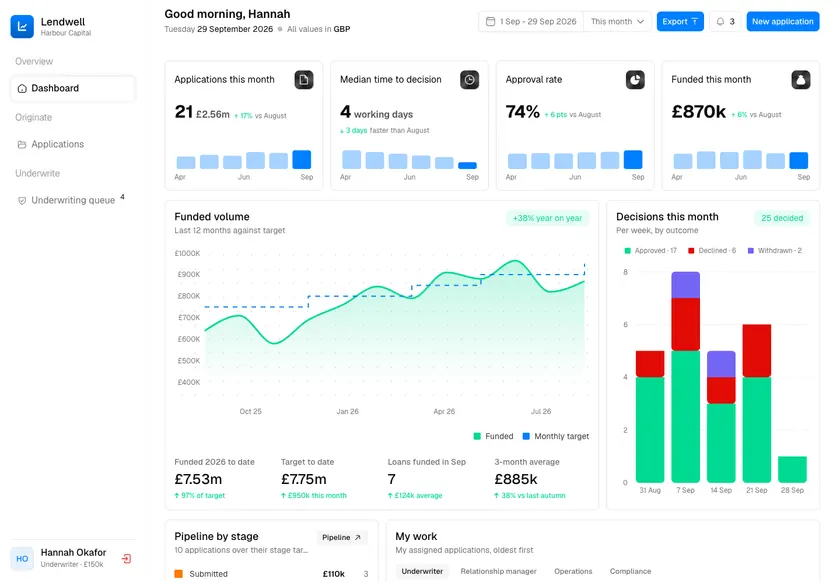
Lendwell - SME Loan Origination from Application to Funded
A loan origination platform for Harbour Capital, a UK digital lender offering £25,000 to £500,000 term loans to small businesses - one workspace for applications, KYB and KYC, open banking and bureau data, underwriting, credit committee, offers and funding.
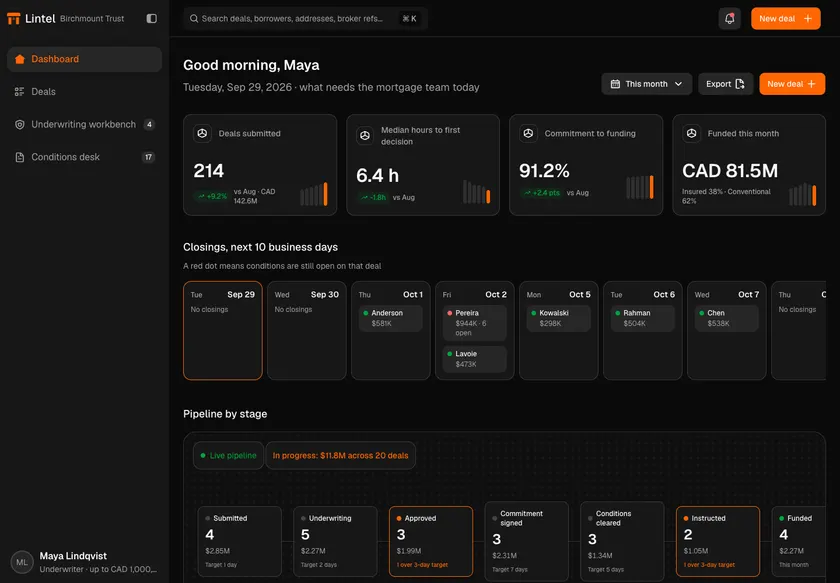
Lintel - Residential Mortgage Portal with Stress-Tested Underwriting
Designed a residential mortgage portal for a Canadian trust company's borrowers, brokers and staff, and built a clickable staff workspace: deal pipeline, deal detail, an underwriting workbench that runs the stress test and checks lending authority, and a conditions desk that tracks every condition against the closing date.
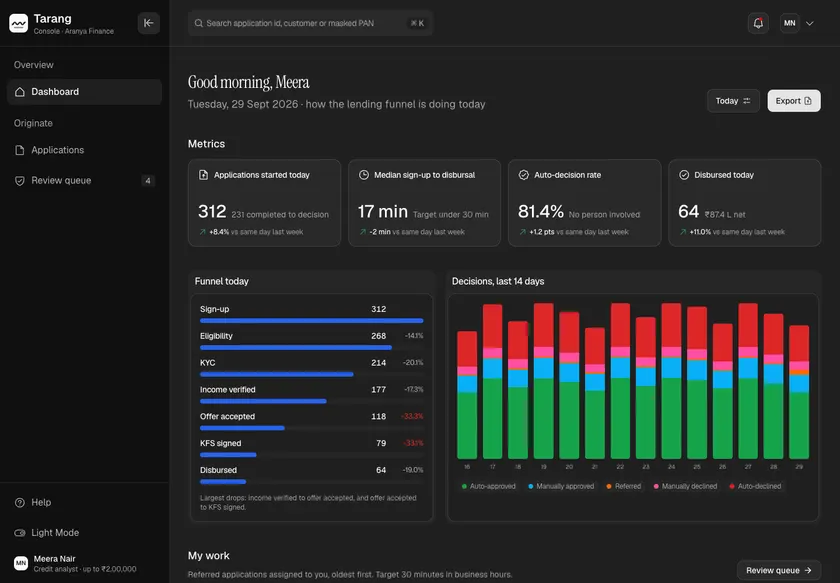
Tarang - Instant Personal Loan App and Lending Operations Console
Designed a personal loan app and operations console for an RBI-registered NBFC: borrowers apply, complete KYC, share bank data, sign the Key Fact Statement and receive funds in minutes, while credit, KYC and operations teams review referred applications against a versioned rule set.
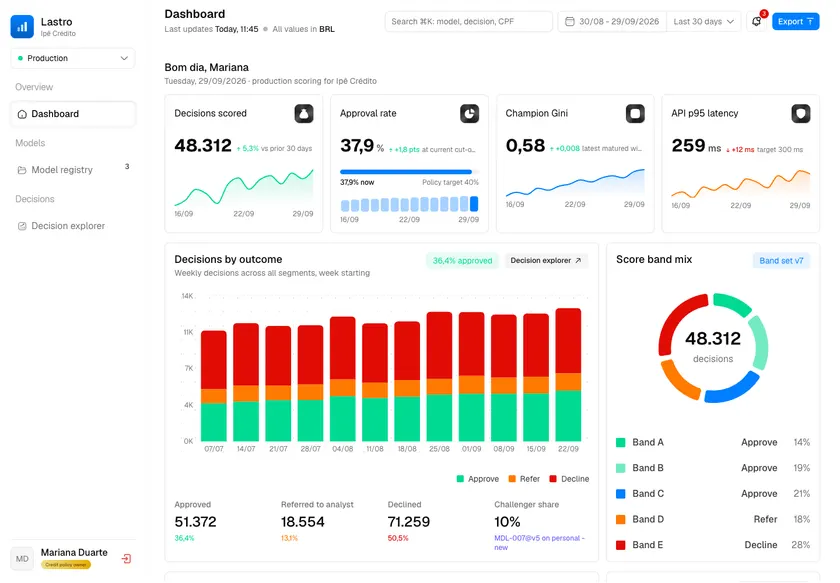
Lastro - Credit Scoring Engine with Explainable Decisions
A credit scoring engine for Ipê Crédito, a Brazilian digital lender, that combines Cadastro Positivo bureau data, Open Finance account data and Pix patterns into one score, returns reason codes with every decision and keeps the model governance evidence risk, compliance and credit teams need.
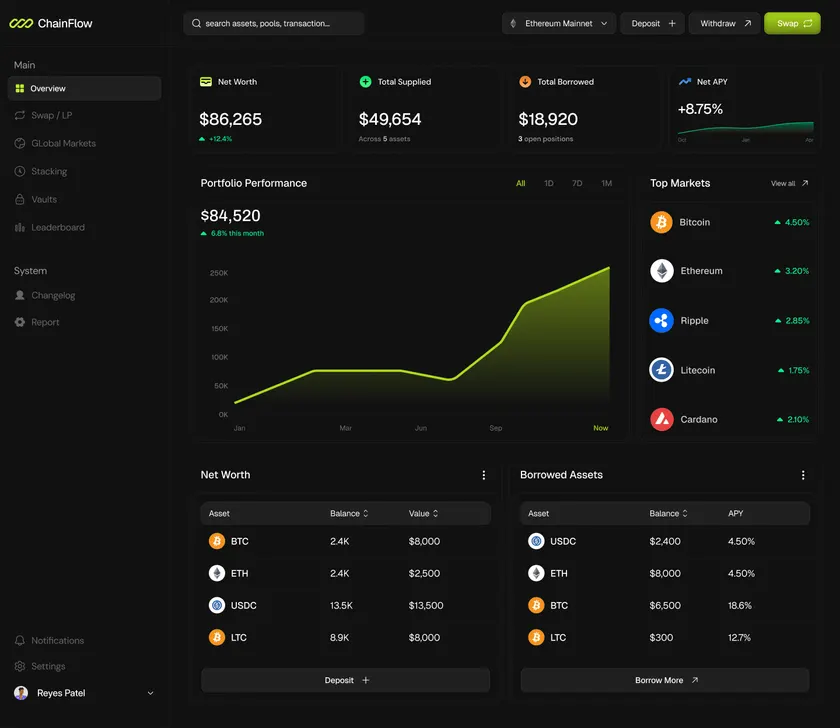
ChainFlow - On-Chain Lending, Borrowing and Swap Console from Prototype to Production
Unified supply, borrow, swap, vault staking and portfolio analytics into a single multi-chain console - shipped from clickable AI prototype to production in 8 weeks.
Two ways to work with OceanLab
Project build
We design and build the system as one project. It starts with a clickable prototype your team tries before any production code is written. Pay per milestone (outcome-based) or hourly at $30-50/hr, depending on role and seniority.
Embedded engineers
Our engineers join your team on a flexible monthly retainer. Part-time is fine and it runs month to month, with hours that overlap the US, UK and Europe, the Middle East, and Australia and Asia. Outcome-based or $30-50/hr.
Questions
Should the credit decision be fully automated?
Automate the clear approvals and declines, and refer the rest to an underwriter. Keep the reasons for every decision either way, because applicants and regulators can ask for them.
Can we start with rules and add a model later?
Yes, and it is usually the better order. Policy rules are easy to explain. A model can be added later behind the same decision engine, once there is data to train and monitor it.
Does a loan origination system replace the core?
No. It handles everything up to funding, then books the loan into the core or loan servicing system.
