Personal finance apps on the user's side
Budgeting and cashflow over open banking, subscription tracking and cancellation, debt payoff planning, family money with parent controls, and savings round-ups. Built to help people, not to sell them products.
What personal finance software has to get right
Personal finance apps depend on bank data that is reliable, permitted and fresh. Bank connections break, consents expire and categories are wrong, and every one of those problems erodes trust.
The builds below handle connections and consent as first-class features, explain every number they show, and keep money with regulated partners. None of them push users toward offers they do not need.
Problems we are asked to fix
The problems teams bring to us, the system that fixes each one and the builds that did it.
Bank data aggregation
Budgeting apps need reliable bank connections under open banking.
Bank connections through licensed providers, with consent shown and renewed, and clear messages when a bank is down.
Subscription tracker
Users lose money on forgotten subscriptions.
Recurring charges found in bank data, with cancellation help and a check that the charge actually stopped.
Debt payoff planner
People struggle to plan debt payoff.
Side-by-side payoff plans the user can compare, with no offers or referrals mixed in.
Family money app
Parents want to teach kids money with controls.
Cards for children with parent controls on limits and merchants, issued through a regulated partner.
Savings and round-ups
Saving goals fail without automation.
Goals and round-ups that move money into savings held at a bank, with clear protection for the user's balance.
5 kinds of personal finance system we have built
Each one links the product build behind it, counted from our case studies.
Personal finance products we built
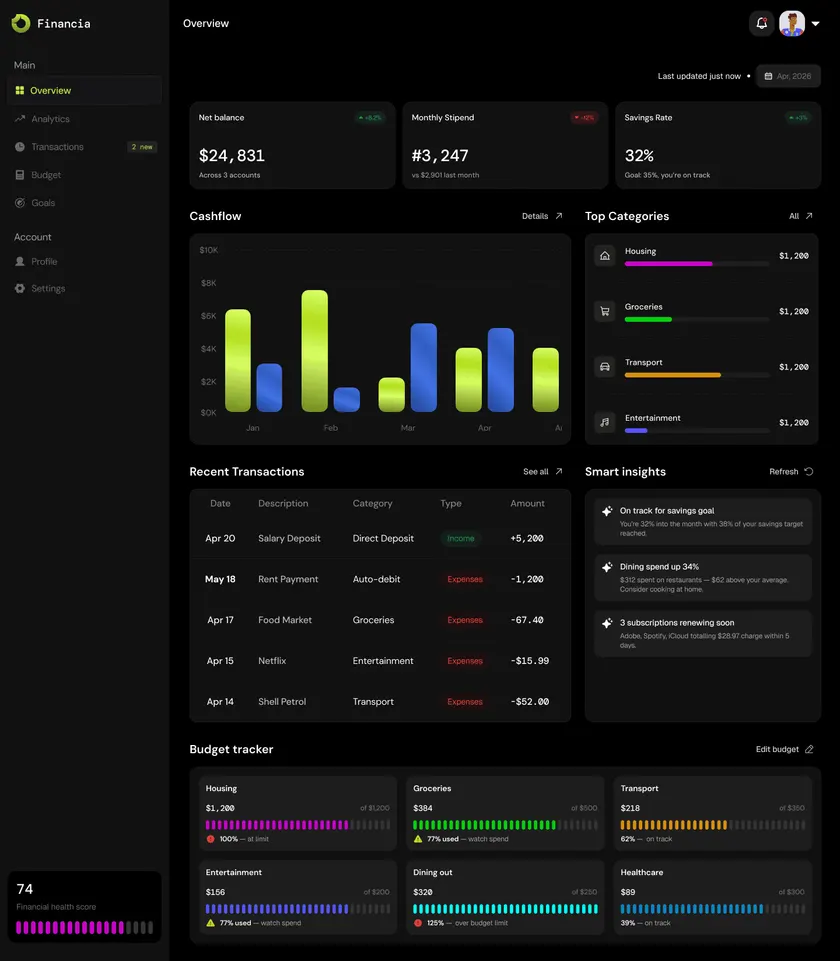
Financia - Personal Finance Console with AI Cashflow Insights
Built a personal finance dashboard that ingests transactions across accounts, attributes spend by category, surfaces AI cashflow insights, and runs a live budget tracker with goal setting - shipped from clickable AI prototype to production in 10 weeks.
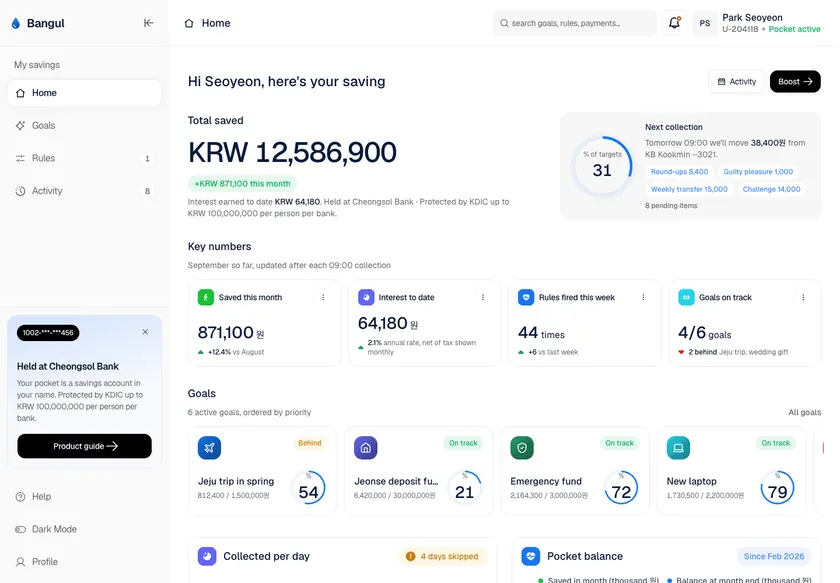
Bangul - Savings Goals and Round-Ups App with Bank-Held Savings
Designed and built a clickable savings app for a Seoul fintech with a MyData licence: customers set goals, switch on round-ups, payday, weekly, guilty pleasure, rainy day and challenge rules, and see every won their rules move into a savings pocket held in their name at a partner bank.
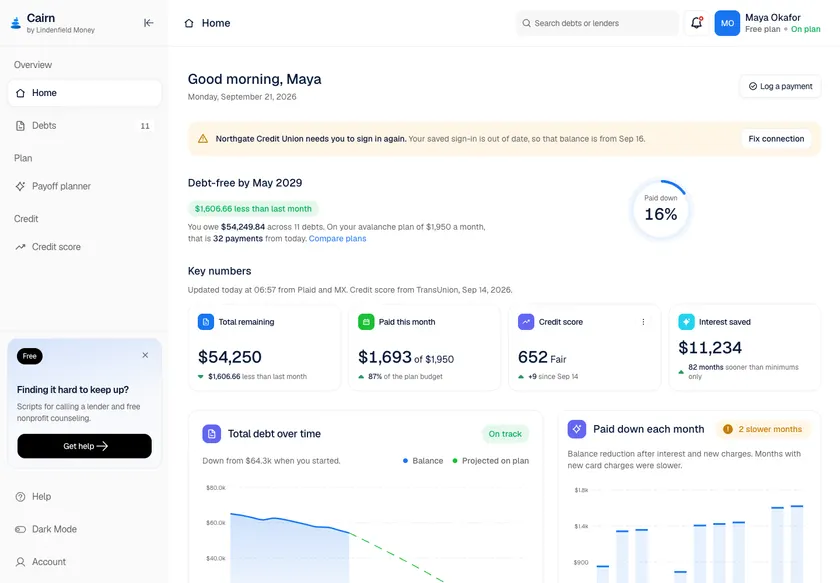
Cairn - Debt Payoff Coach with Side-by-Side Payoff Plans and No Offers
Designed and built a clickable debt payoff coach for a US personal finance company: every card and loan in one list, avalanche, snowball and custom plans compared against paying only the minimums, a minimum-only versus plan view on every debt, and a read-only credit score with no card or loan offers anywhere.
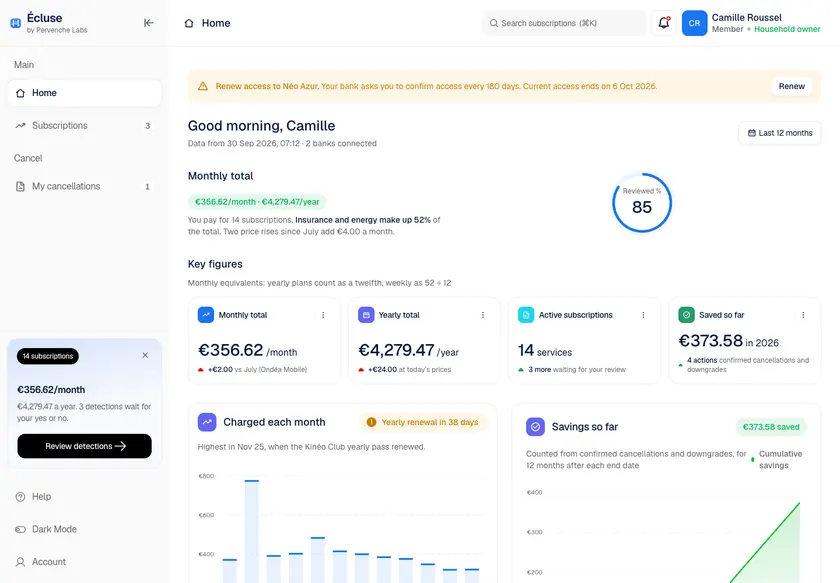
Écluse - Subscription Tracker That Finds, Cancels and Checks Every Recurring Charge
Designed and built a clickable subscription tracker for a Lyon consumer app company: it finds the recurring charges in a member's bank accounts, explains which French consumer rule lets them leave, writes the cancellation letter or email, and watches the account until the charges really stop.
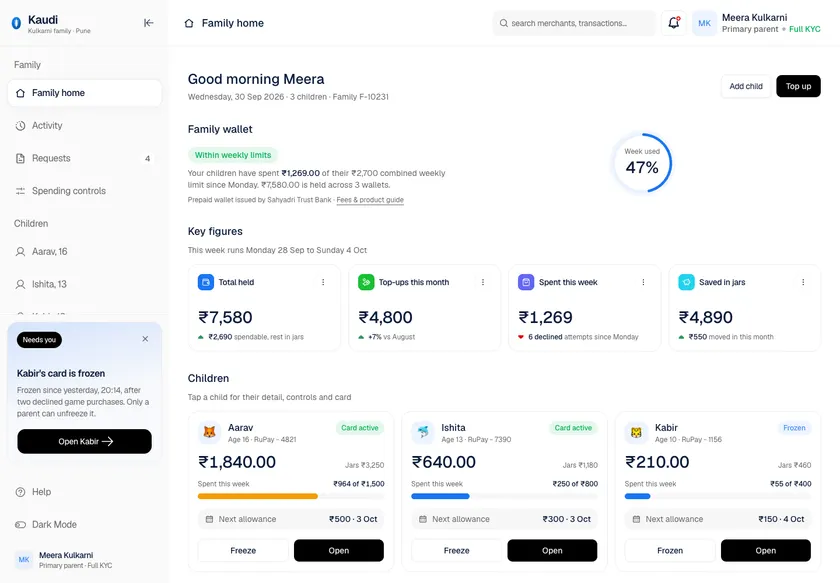
Kaudi - Family Money App with Parent-Controlled RuPay Cards
Designed and built a clickable family money app for a Bengaluru fintech and its partner bank: parents top up each child's bank-issued prepaid wallet over UPI, set allowances and limits, approve requests and freeze cards, while teens aged 10 to 17 spend on a RuPay card that only works where their parent allows.
The rules involved
The rules this kind of software usually has to follow. Guidance, not legal advice.
- 01
Open banking
PSD2 in the EU and UK, and national schemes elsewhere, decide who may read accounts and start payments, and how consent works.
- 02
Payments and e-money
Card issuing and stored value need a licensed partner, with strong customer authentication and refund rules.
- 03
Consumer protection
Rules on fair treatment, subscriptions, credit advice and marketing to consumers.
- 04
Data protection
Financial data is sensitive. The GDPR and similar laws limit what can be done with it beyond the service the user asked for.
Framework guides
Rules our personal finance builds cite most
- GDPR2
- PSD22
- BaFin1
- CAN-SPAM1
- CARD Act1
- CFPB Section 10331
- Consumer Rights Directive1
- Credit Information Use and Protection Act (MyData)1
- Credit Repair Organizations Act1
Two ways to work with OceanLab
Project build
We design and build the system as one project. It starts with a clickable prototype your team tries before any production code is written. Pay per milestone (outcome-based) or hourly at $30-50/hr, depending on role and seniority.
Embedded engineers
Our engineers join your team on a flexible monthly retainer. Part-time is fine and it runs month to month, with hours that overlap the US, UK and Europe, the Middle East, and Australia and Asia. Outcome-based or $30-50/hr.
Guides and tools
Personal finance software questions
Do we need a licence to read bank data?
In the EU and UK, reading account data for a user is an account information service, which needs registration. Many apps start with a licensed provider that holds it and offers the bank connections.
How do you handle broken bank connections?
We detect them, tell the user plainly what happened and what to do, and retry or ask for re-consent without losing their history.
Can AI give financial advice in the app?
We keep AI to explaining the user's own data, such as where money went and what changed. Personal recommendations on credit or investments are regulated, so they need a licensed setup.
