Kaudi - Family Money App with Parent-Controlled RuPay Cards
Family Money App for an Indian Fintech
Designed and built a clickable family money app for a Bengaluru fintech and its partner bank: parents top up each child's bank-issued prepaid wallet over UPI, set allowances and limits, approve requests and freeze cards, while teens aged 10 to 17 spend on a RuPay card that only works where their parent allows.
Most of our work is under NDA. Per agreement, we can share the work but not the company details - all names and identifying information shown here have been changed.
Impact
Family home, activity, requests, child detail and spending controls. Each of the 3 children opens their own detail and controls page, with top-up, send money and freeze or unfreeze working in place.
Each category has an allow switch, a weekly cap and spent this week. 6 more, from gambling to crypto and money transfer, are always blocked and no allowed-merchant override can open them.
Per payment, per day and per week limits stop at ₹500, ₹800 and ₹1,500 for ages 10 to 12, and ₹2,500, ₹3,000 and ₹5,000 for ages 13 to 17. Approving any request above ₹2,000 asks for the PIN again.
One Pune family with 3 children, 2 co-parents, 5 savings jars and 13 requests. 7 declined payments show 6 different reasons, from quiet hours to a frozen card.
The Problem
Saanjh surveyed 900 parents in Bengaluru, Pune and Lucknow. Most gave pocket money in cash or by UPI from their own phone and could not see where it went. Teens who needed to pay online were handed a parent's debit card or borrowed a friend's UPI. Saanjh's first pilot used a generic prepaid card and a WhatsApp group: no limits by category, no proof of which parent consented to the child's data being processed, and card blocks resolved by emailing the bank.
Our Solution
Kaudi gives each child aged 10 to 17 a prepaid wallet and RuPay card issued by Sahyadri Trust Bank. The parent tops up over UPI from their own account, sets an allowance, and decides where the card works: limits per payment, day and week, caps per category, blocked and allowed merchants, quiet hours and channel switches. Every payment, decline, request and rule change shows up for the parent as it happens.
The Challenge: A Child's Card Under Bank and Data Rules
Kaudi is not the bank. Sahyadri Trust Bank issues the prepaid wallet, runs KYC and holds the money, while Saanjh builds the product, so every screen has to respect RBI prepaid rules, card security rules and India's children's data law at once.
The Bank Holds the Money
Under the RBI Master Directions on Prepaid Payment Instruments the bank is the issuer and owns the customer relationship. Kaudi issues full-KYC wallets only, keeps the caps in force as settings and blocks any top-up that would breach them. Every balance says who issued the wallet.
Consent Before Any Child Data
Section 9 of the DPDP Act, 2023 requires verifiable consent from a parent or lawful guardian before a child's data is processed, and rules out tracking, behavioural monitoring and targeted ads aimed at children. Consent has to be itemised, verified, stored with evidence and possible to withdraw.
Card Controls in a Parent's Hands
RBI card security rules start new cards on domestic contact use only, with online and contactless off until switched on. Kaudi gives these switches to the parent, not the teen, and adds ATM with a daily cap and UPI through UPI Circle, where the parent approves each payment or sets a monthly limit.
Places a Child Should Never Pay
Gambling, alcohol and tobacco, adult content, dating, crypto exchanges and money transfer services are blocked for every child card. Online real-money games are prohibited under the Online Gaming Act, 2025, and gaming merchants are blocked by default unless a parent allows one named store.
Our Approach: From Prepaid Rules to a Clickable Parent App
Spec and Rules Research
Mapped 11 user roles plus the partner bank, and 58 screens: 18 in the parent app, 11 in the teen app, 2 public pages and 27 in the staff console. Defined the data model for families, consents, wallets, cards, versioned spending controls, transactions, top-ups, allowances, chores, jars, requests, lessons, KYC cases, alerts and disputes. Wrote down the rules the design follows: RBI prepaid and card security directions, card-on-file tokenisation, UPI Circle, the DPDP Act and Rules, the RBI failed-transaction timelines and Integrated Ombudsman Scheme, and TRAI DLT messaging.
Clickable Demo on a Production UI Kit
Built 5 key parent app screens on a production dashboard kit: family home with each child's balance, jars, weekly limit bar and one-tap freeze, a UPI top-up sheet that shows the headroom left under the prepaid cap, the activity feed with declines and their reasons, requests with approve, partly approve or decline, child detail with spend by category and lessons progress, and spending controls with limits, categories, merchants, quiet hours and channels. All actions run on local state.
What a Production Build Adds
Integration with the partner bank's API and settlement files, an issuing processor (such as M2P Fintech or Zeta) for RuPay cards and the secure card reveal, a payment aggregator (such as Razorpay or Cashfree) for UPI top-ups and AutoPay, UPI Circle through the bank's PSP app, Digio or IDfy for KYC, DigiLocker for consent, and DLT-registered SMS. Then the teen app, the parent consent page, Hindi throughout, and the staff console for KYC, cards, safety and fraud alerts, disputes, reconciliation and an append-only audit log.
Why It Works: The Parent Sees and Decides
Every Decline Explains Itself
Declined attempts show in red with the reason, such as quiet hours, a blocked merchant or a frozen card. From any transaction the parent can block the merchant, change the category limit or raise a dispute.
Limits Inside the Bank's Maximums
Each limit slider shows the cap for the child's age band, every category shows spent this week against its cap, and saving creates a new controls version with who changed it and when. The child is told "Your parent updated your limits".
Asks Become Approvals
A teen asks for money, a higher limit, an unblocked shop or a UPI payment. The parent sees the reason, the child's balance and this week's spend, then approves, approves a different amount or declines with a message. UPI approvals show their network expiry.
Freezing Is One Tap
Any card freezes from family home or child detail with a confirm. Money in the wallet and jars stays safe, and only a parent can unfreeze, with the PIN.
Related case studies
View all: Personal finance
Financia - Personal Finance Console with AI Cashflow Insights
Built a personal finance dashboard that ingests transactions across accounts, attributes spend by category, surfaces AI cashflow insights, and runs a live budget tracker with goal setting - shipped from clickable AI prototype to production in 10 weeks.
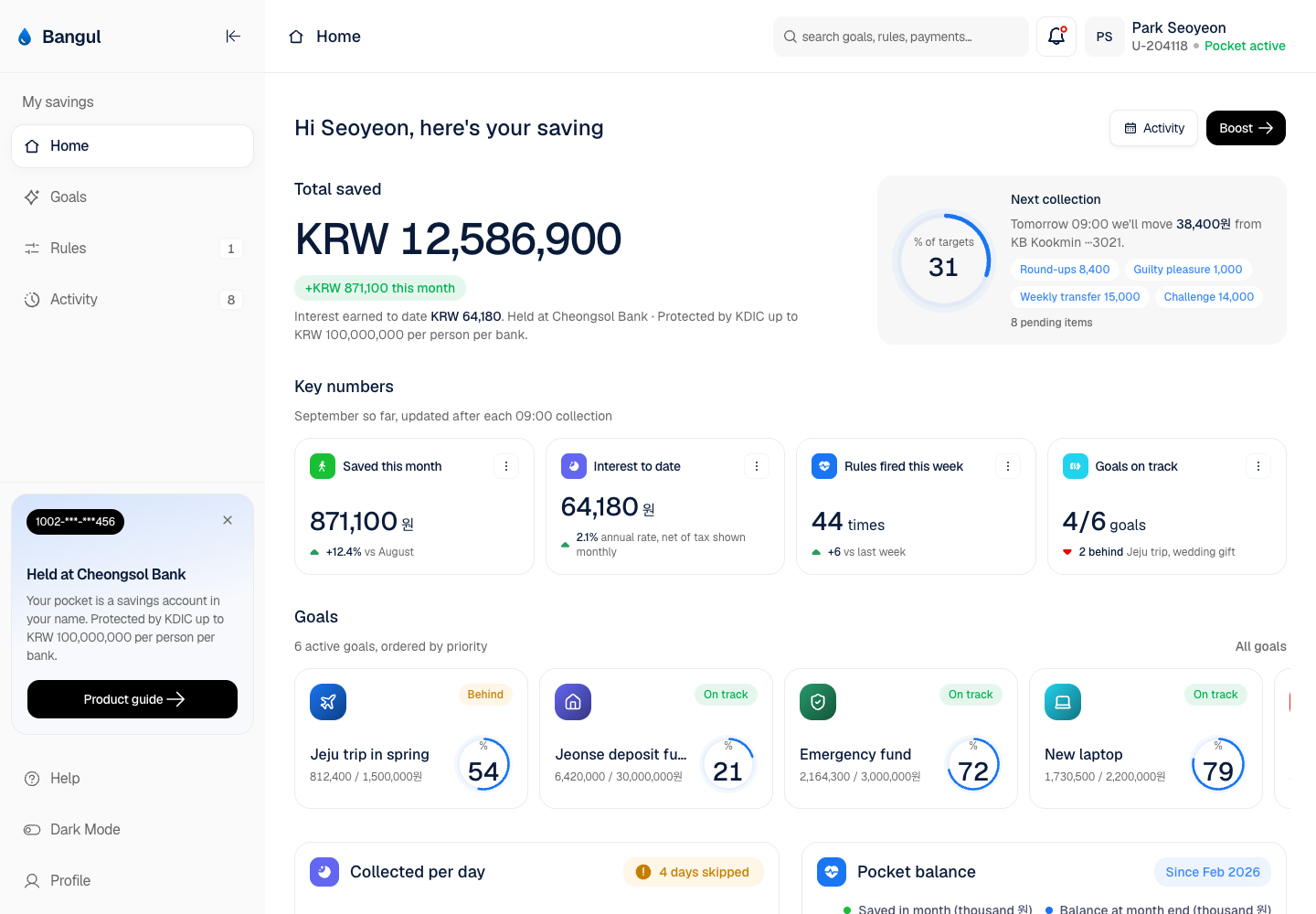
Bangul - Savings Goals and Round-Ups App with Bank-Held Savings
Designed and built a clickable savings app for a Seoul fintech with a MyData licence: customers set goals, switch on round-ups, payday, weekly, guilty pleasure, rainy day and challenge rules, and see every won their rules move into a savings pocket held in their name at a partner bank.
Enterprise Software Engineering - Human + AI
Contact Us
© 2026 - Copyright. All Rights reserved Oceanlab
Location
Global Headquarters
21 Merchant Road, 3rd Floor, Singapore 058267
Main corporate office and leadership operations
North America Office
548 Market Street, PMB 12345, San Francisco, CA 94104
Client operations and business development
India Office
402 Shivalik Shilp II, SG Highway, Ahmedabad 380015
Engineering and delivery center

Enterprise Software Engineering - Human + AI
Contact Us
Locations
Global Headquarters
21 Merchant Road, 3rd Floor, Singapore 058267
Main corporate office and leadership operations
North America Office
548 Market Street, PMB 12345, San Francisco, CA 94104
Client operations and business development
India Office
402 Shivalik Shilp II, SG Highway, Ahmedabad 380015
Engineering and delivery center
© 2026 - Copyright. All Rights reserved Oceanlab