How to build a regulatory reporting system
How regulatory returns are built from source data instead of spreadsheets, the checks and sign-off around them, and an order to build it in.
What a regulatory reporting system does
A regulatory reporting system builds the returns a firm must file with its regulators and tax authorities: prudential returns, AML reports, tax returns or sector returns. It pulls data from source systems, maps it to each return's fields, validates it, gets sign-off and submits it.
The point is not a nicer form. It is that every number can be traced back to its source, every change has a reason, and the same return can be produced again for any past period.
The modules you need
Most teams need all of these in the end. The phased plan below sets the order.
Source extracts
Data pulled from core systems, ledgers and data stores on a schedule.
Mappings
Rules that turn source data into each return's fields, versioned by return and period.
Validation
The regulator's own checks plus internal ones, run before anyone signs.
Adjustments
Manual adjustments with reason, evidence and approval.
Review and sign-off
Preparer, reviewer and accountable executive sign-off, recorded on the return.
Submission
Files in the required format, sent through the regulator's portal or API.
Calendar
Every return's due dates and status in one view.
How the parts fit together
- 01
Data lineage
Every reported number traces to its source records and the mapping version used.
- 02
Mappings as configuration
A change to a return's rules is a new mapping version, not new code.
- 03
Point-in-time data
Snapshots by period, so any past return can be reproduced exactly.
- 04
Workflow
States from extract to submitted, with sign-off steps that cannot be skipped.
- 05
Format generators
Output in XBRL, XML, CSV or whatever each regulator requires.
Data model sketch
- 01
Return and period
Which return, which period, which entity, and its status.
- 02
Source snapshot
The data as extracted for that period.
- 03
Mapping version
The rules used to build each field.
- 04
Adjustment
Amount, reason, evidence, maker and checker.
- 05
Sign-off and submission
Who signed, when, and the submission reference.
Systems it has to talk to
- 01
Source systems
Core banking, ledgers, payroll, ERP and data warehouses.
- 02
Regulator portals
Submission through each regulator's portal or API.
- 03
Taxonomies
Regulator-published taxonomies and validation rules, loaded when they change.
- 04
Document storage
Evidence for adjustments and sign-offs.
Rules to design for
Which rules apply depends on your market and product.
- 01
Reporting rules
Each regulator sets its returns, formats, deadlines and validation rules.
- 02
Accountability
Accountability regimes in many countries name the executive responsible for each return.
- 03
Operational resilience
For financial firms, the reporting system falls under ICT risk rules such as DORA.
- 04
Data protection
Returns with personal data, such as AML or payroll returns, follow privacy law.
From prototype to production
Build in this order so something real is in users' hands early.
- 01
Clickable prototype
The return calendar, validation results and sign-off, tried by the reporting team.
- 02
First return live
One return built from source data with lineage, validation and sign-off.
- 03
More returns
Further returns on the same data and mapping layer.
- 04
Automation
Scheduled extracts, regulator API submission and taxonomy updates.
What drives the cost
These decide most of the budget. For a number based on your own scope, use the cost tool. OceanLab bills $30-50/hr or per milestone.
- 01
Number of returns
Each return has its own fields, rules and format.
- 02
Source data quality
Messy source data needs cleaning before it can be mapped.
- 03
Regulators
Each regulator brings its own portal and taxonomy.
- 04
Rule change frequency
How often the returns change and how fast updates must ship.
- 05
History
How many past periods must be reproducible.
Product builds that match this guide
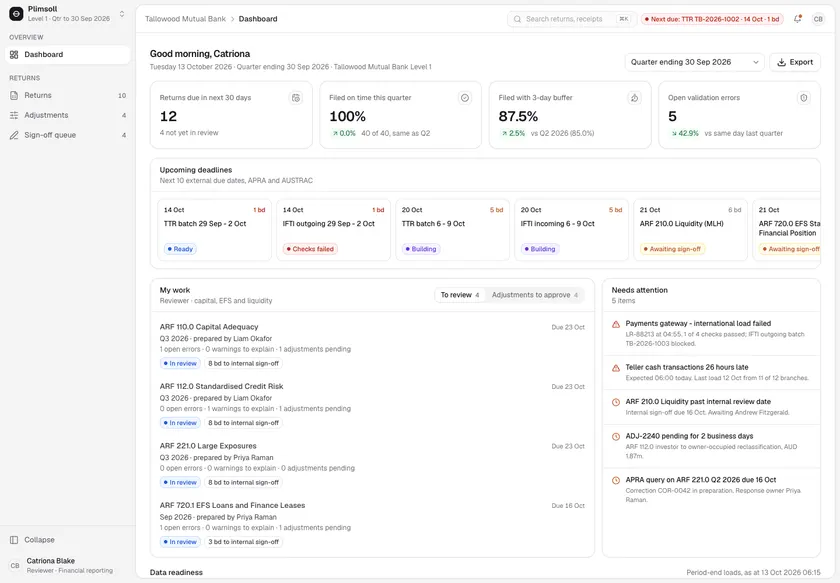
Plimsoll - Regulatory Reporting Platform for APRA and AUSTRAC Returns
Designed and built a clickable regulatory reporting platform for an Australian customer-owned bank: prepare APRA returns from core banking and general ledger data, clear validation errors, comment on variances, approve adjustments within policy limits and sign off against an evidence pack, with every reported number traceable to its source.
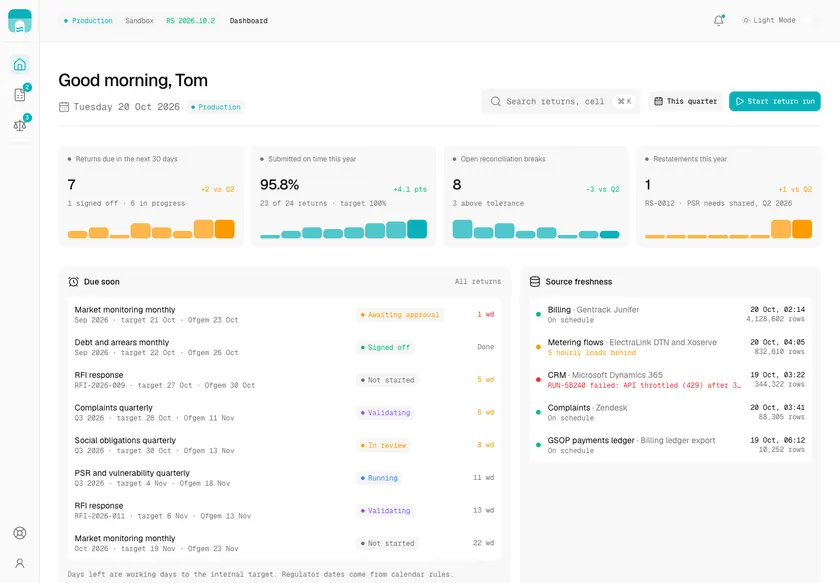
Culvert - Compliance Reporting Pipeline from Source Extract to Signed-Off Ofgem Return
Designed and built a clickable regulatory reporting pipeline for a Great Britain electricity and gas supplier: pinned source extracts, versioned transformation rules, reconciliations between systems, validation of every filled return and maker-checker sign-off, with every figure traceable back to the rows that produced it.
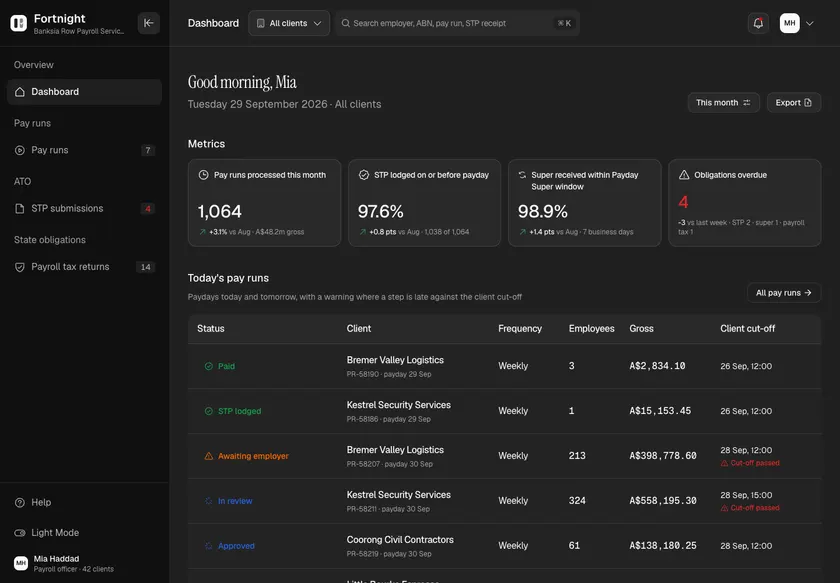
Fortnight - Payroll Tax and Filing Workbench for an Australian Payroll Bureau
Designed and built a clickable filing workbench for a Brisbane payroll bureau that runs payroll for about 380 Australian employers: a pay run board with cut-off timers, a pay run review with automated checks and a four-eyes rule, STP Phase 2 lodgments with plain-English ATO guidance, and state payroll tax returns with group apportionment.
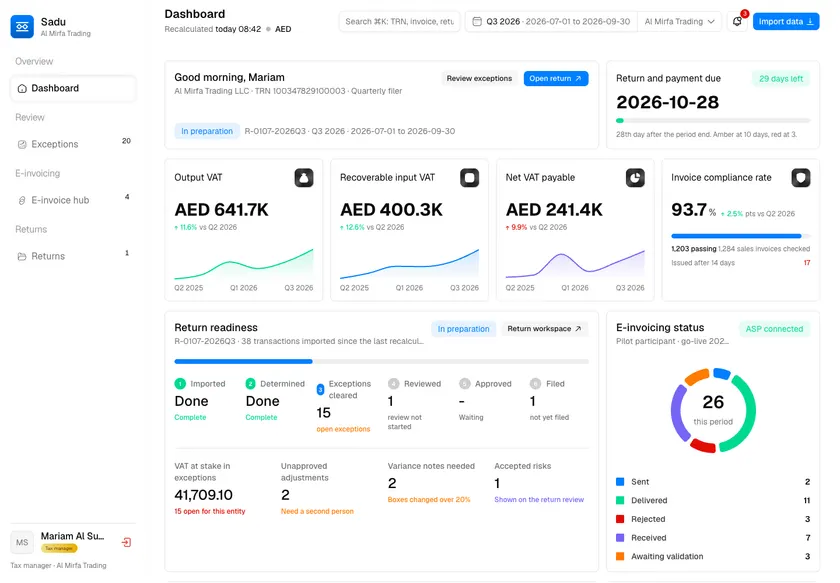
Sadu - UAE VAT Compliance Platform from ERP Data to a Filed VAT201
Designed and built a clickable VAT compliance platform for a Dubai tax technology company serving mid-size UAE businesses and their tax agents: one queue for everything that blocks a clean return, Peppol e-invoices traced hop by hop through an Accredited Service Provider, and the VAT201 built box by box with drill-down to the source lines.
Two ways to work with OceanLab
Project build
We design and build the system as one project. It starts with a clickable prototype your team tries before any production code is written. Pay per milestone (outcome-based) or hourly at $30-50/hr, depending on role and seniority.
Embedded engineers
Our engineers join your team on a flexible monthly retainer. Part-time is fine and it runs month to month, with hours that overlap the US, UK and Europe, the Middle East, and Australia and Asia. Outcome-based or $30-50/hr.
Questions
Can we stop building returns in spreadsheets?
Yes. The spreadsheet logic becomes versioned mappings over source data, and manual adjustments become recorded entries with approval.
How do you handle a regulator changing a return?
A new mapping version from the effective period, tested against past data, while old periods keep the rules in force at the time.
Can one system serve several regulators?
Yes. Source data and lineage are shared, and each regulator gets its own mappings and output formats.
