Sadu - UAE VAT Compliance Platform from ERP Data to a Filed VAT201
VAT Compliance Platform for a Dubai Tax Technology Company
Designed and built a clickable VAT compliance platform for a Dubai tax technology company serving mid-size UAE businesses and their tax agents: one queue for everything that blocks a clean return, Peppol e-invoices traced hop by hop through an Accredited Service Provider, and the VAT201 built box by box with drill-down to the source lines.
Most of our work is under NDA. Per agreement, we can share the work but not the company details - all names and identifying information shown here have been changed.
Impact
Dashboard, exceptions queue, e-invoice hub, returns list and the return workspace, with the transaction panel, e-invoice detail and box drill-down as slide-overs.
From a missing customer TRN and zero-rating without export evidence to reverse charge not self-assessed and no CBUAE rate for a foreign currency line. Each exception shows the VAT at stake and turns amber after 3 days, red after 7.
Every VAT201 box shows last period's figure next to this one. A box that moves more than 20% is flagged, and the return cannot go to review until each flagged box has a note.
Three VAT registrants on calendar quarters, quarters ending February, May, August and November, and monthly filing, with 16 returns, 24 exceptions, 26 e-invoices and 15 customers and suppliers.
The Problem
Barjeel's customers prepared VAT returns in spreadsheets exported from three or four ERPs. Tax codes were set once at ERP go-live and never reviewed, so zero-rated exports, designated zone sales and reverse charge imports landed in the wrong boxes. Missing TRNs and late tax invoices surfaced only when an FTA audit asked, every correction after filing meant a voluntary disclosure, and tax agents with 30 or more clients tracked deadlines in a calendar and chased approvals by WhatsApp.
Our Solution
Sadu takes ERP data to a filed return. It decides the VAT treatment of every line with ordered rules, sends anything it cannot decide to one exceptions queue, sends and receives e-invoices through an Accredited Service Provider, and builds the VAT201 box by box with the previous period, variance notes and drill-down to source, so the return can be proved before it goes to the approver.
The Challenge: A Return You Can Prove
UAE VAT is 5% on paper, but each line of a return depends on who the customer is, where the goods went, which zone they moved through and what evidence the business holds. The Federal Tax Authority can ask for the proof years later, and the move to Peppol e-invoicing pushes those checks back to the moment of invoicing.
Treatment Decided by Stale Tax Codes
A line can be standard-rated, zero-rated, exempt, out of scope or subject to the reverse charge. Zero-rated and exempt look alike on a sales report but treat input tax differently, and designated zone sales depend on conditions, not a blanket exemption. A tax code set at ERP go-live cannot make those calls.
Invoice Rules Found at Audit
A full tax invoice needs the supplier and recipient TRNs, a sequential number, rate and VAT per line, totals in AED at the Central Bank of the UAE rate, and generally must be issued within 14 days of supply. Breaches showed up only when the FTA asked for records.
Every Box Has to Reconcile
Form VAT201 is filed by the 28th day after the period end, with output VAT split across the seven emirates. Errors above the legal threshold after filing need a voluntary disclosure, and the FTA can request an FTA Audit File built from the same data as the return.
E-Invoicing on Moving Dates
The UAE mandate moves invoice exchange onto a Peppol 5-corner model: supplier and buyer each connect through an Accredited Service Provider, invoices travel in the PINT AE format and tax data is reported to the FTA. The pilot starts in July 2026 and phase dates have changed more than once.
Our Approach: From UAE VAT Rules to a Clickable Platform
Spec and Rules Research
Mapped 9 roles, from tax manager, accountant and tax reviewer to authorised signatory, tax agent, client approver and auditor, and 39 screens including a mobile client approval portal. Defined the data model for entities, tax groups, imports, transactions, versioned tax rules, exceptions, invoice checks, e-invoices, returns, adjustments, bad debt relief, disclosures and FAF exports. Wrote down the rules the design follows: the UAE VAT Law and Executive Regulation, supply types, designated zones, the reverse charge, tax invoice rules, the VAT201, bad debt relief, voluntary disclosure, record keeping and e-invoicing.
Clickable Demo on a Production UI Kit
Built 5 key screens on a production dashboard kit: the dashboard with deadline, KPIs, return readiness rail, supplies mix and output VAT by emirate; the exceptions queue with fix in place, bulk resolve and accept risk; the e-invoice hub with readable content, UBL XML, ASP validation codes and the message timeline; the returns list; and the return workspace with VAT201 sections 1 to 3, box drill-down, adjustments and readiness. Switching the entity re-derives the whole dashboard, and all actions run on local state.
What a Production Build Adds
Connectors for SAP S/4HANA, Oracle NetSuite, Dynamics 365 Business Central, Odoo and Zoho Books, an FTA accredited ASP such as Pagero, Sovos or Comarch, TRN verification on EmaraTax and CBUAE exchange rates. Filing is recorded after entry on EmaraTax, as no public filing API is assumed. Role-based staff auth, magic link or UAE PASS sign-in for client approvers, UAE-region hosting, an append-only audit trail, Arabic right-to-left mode and the remaining 34 screens, from the rule editor and invoice checker to disclosures, FAF exports and the client portal.
Why It Works: Every Number Traced to Its Source
Rules First, Then a Person
Each line's treatment comes from an ordered rule, and the transaction panel shows the source values, the treatment and the rule that matched. Lines no rule covers drop to the exceptions queue instead of getting a guessed box.
One Queue for What Blocks the Return
All 12 exception types sit in one queue with VAT at stake per item and by type. Accountants fix a line in place or bulk resolve items of the same type, and only a tax manager can accept a risk, with a reason the approver sees.
Boxes as They Appear on EmaraTax
The return workspace lays out the VAT201 box by box with last period and variance chips. Any box opens its lines by rule with a reconciliation to the GL, and adjustments such as bad debt relief need a second person to approve.
E-Invoices Traced Hop by Hop
Each e-invoice shows its readable content, the raw XML, the ASP's validation results with rule codes such as BR-AE-02 for a missing buyer TRN, and every hop from created to reported to the FTA, so a rejection points straight at the fix.
Related case studies
View all: Accounting & tax
CryptoTax - FIFO Tax & PnL Reporting Engine for Retail Crypto Investors
Built a tax and portfolio reporting platform that ingests transactions from 30+ exchanges and wallets, computes FIFO cost-basis, and generates IRS Form 8949 + Schedule C in one click - shipped from clickable AI prototype to production in 10 weeks.
Kladde - AI Bookkeeping for German Freelancers and Small Firms
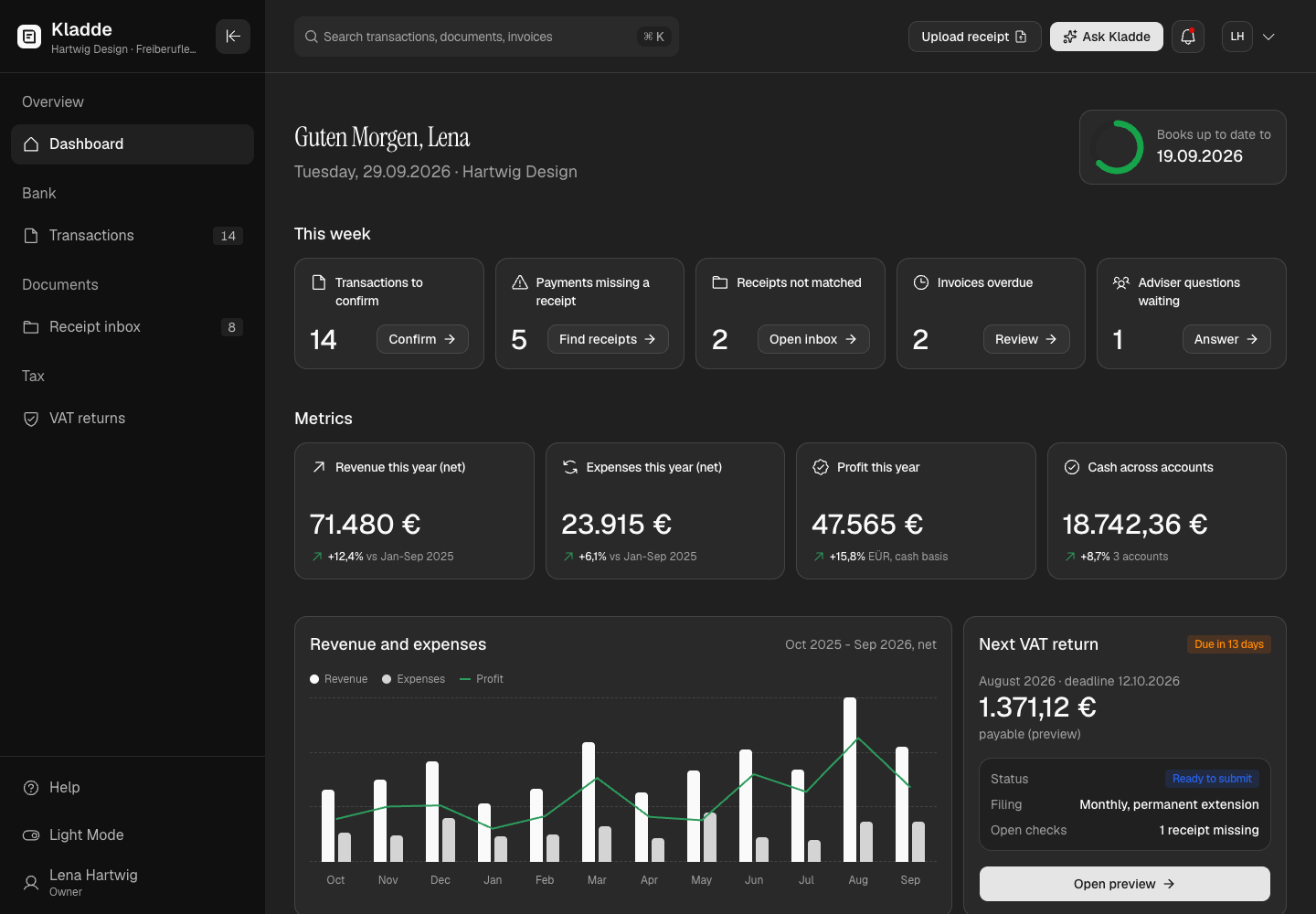
Designed and built a clickable AI bookkeeping product for German freelancers, sole traders and small GmbHs: a bank feed with a suggested booking and confidence score on every payment, a receipt inbox that validates e-invoices and checks §14 UStG fields, and a VAT advance return previewed box by box and submitted through ELSTER.
Enterprise Software Engineering - Human + AI
Contact Us
© 2026 - Copyright. All Rights reserved Oceanlab
Location
Global Headquarters
21 Merchant Road, 3rd Floor, Singapore 058267
Main corporate office and leadership operations
North America Office
548 Market Street, PMB 12345, San Francisco, CA 94104
Client operations and business development
India Office
402 Shivalik Shilp II, SG Highway, Ahmedabad 380015
Engineering and delivery center

Enterprise Software Engineering - Human + AI
Contact Us
Locations
Global Headquarters
21 Merchant Road, 3rd Floor, Singapore 058267
Main corporate office and leadership operations
North America Office
548 Market Street, PMB 12345, San Francisco, CA 94104
Client operations and business development
India Office
402 Shivalik Shilp II, SG Highway, Ahmedabad 380015
Engineering and delivery center
© 2026 - Copyright. All Rights reserved Oceanlab