Serambi - Embedded Insurance Platform for Micro-Insurance Inside Partner Checkouts
Embedded Insurance Ops Console for an Indonesian Insurtech Broker
Designed an embedded insurance platform for a Jakarta insurtech broker that places device, parcel, flight delay, personal accident and driver income cover inside partner checkouts, and built its clickable ops console: partners, policy search with the customer's consent record, and a claims queue that checks authority, payee name and screening before any payout.
Most of our work is under NDA. Per agreement, we can share the work but not the company details - all names and identifying information shown here have been changed.
Impact
Dashboard, partners, policy search, policy detail and the claims queue with its decision panel. Every one of the 24 demo policies opens its own detail page.
Approve is allowed only up to the lower of the handler's authority and the insurer's delegated limit, and stays blocked while the payee name does not match or a screening alert is open.
The offer headline, offer copy and key facts versions, consent text, privacy notice, language, time, channel, partner app version, IP address and quote the customer agreed to.
11 partners, 4 insurers including 1 sharia insurer, 5 products, 24 policies, 18 claims and 7 staff users, in IDR with WIB times.
The Problem
Payung Lintas sold about 1.6 million micro-policies a month, but every partner integration was a one-off with its own endpoint, premium spreadsheet and PDF wording, taking six to ten weeks to launch. Partner remittance CSVs rarely matched the policies issued, so finance spent the first two weeks of each month reconciling. Flight delay claims were checked by hand against airline websites, taking 9 to 14 days for an IDR 250,000 payout, and OJK channel reports were rebuilt from four databases.
Our Solution
Serambi gives partners one API, a sandbox and an embedded widget that offers cover at checkout and binds with one tap, and gives Payung Lintas staff one ops console. In the demo, staff see volume and money position, manage partners from onboarding to go-live, find any policy with what the customer saw and agreed to, and decide claims within their authority.
The Challenge: Insurance Sold in Someone Else's Checkout
Payung Lintas is an OJK-licensed broker. It carries no risk, places every product with licensed insurers, and sells through marketplaces, travel agents, a ride-hailing app and a paylater fintech it does not control, while staying accountable for what each customer is told.
Accountable for Partner Channels
OJK rules let insurers and brokers market through e-commerce and ride-hailing platforms under a written agreement, with the broker still responsible for the offer. Each partner needs due diligence, sandbox tests and a reviewed widget before go-live, and a way to pause new quotes.
Proof of What the Customer Saw
POJK 22/2023 expects clear information before purchase, a record of consent, no forced bundling and complaint handling. With checkout copy living in partner apps, Payung Lintas had no copy of the offer, key facts summary or consent behind each policy.
Conventional and Sharia Side by Side
One of the four insurers is a sharia operator. Its customers pay a contribution rather than a premium, its wording uses sharia terms, and its money has to stay separate from conventional premiums all the way to settlement.
Small Claims, Many Limits
Most claims are small, but each handler has an authority limit, each insurer delegates its own claims limit, payees must match the policyholder and be screened against the DTTOT and sanctions lists, and flight delay claims should pay automatically from flight data.
Our Approach: From Distribution Rules to a Clickable Console
Spec and Rules Research
Mapped 12 roles across partner, policyholder and ops audiences, 47 screens and the data model for partners, agreements, API keys, insurers, placement agreements, versioned products, quotes, policies, consents, claims, flight watches, remittances, settlements and OJK reports. Wrote down the rules the design follows: the Insurance Law as amended by UU P2SK, OJK product and marketing channel rules, POJK 22/2023, sharia operation under DSN-MUI fatwas, broker premium handling, Bahasa Indonesia wording, UU ITE e-policies, UU PDP and AML screening.
Clickable Demo on a Production UI Kit
Built the ops console's 5 key screens on a production dashboard kit: the dashboard with policies per day by line and the money position, partners by live, onboarding and paused with go-live and pause actions, policy search with masked policyholders and bulk resend, policy detail with the consent record, refund preview and audited reveal, and the claims queue with fraud flags, SLA badges and a decision panel. All actions run on local state.
What a Production Build Adds
The partner developer console and the policyholder widget and secure-link pages, then integrations with Xendit or Midtrans for premiums, Xendit Disbursements or Flip for payouts, Cirium or FlightAware for flight status, WhatsApp and email delivery, VIDA or Verihubs for NIK checks, Privy for e-signatures and ComplyAdvantage or World-Check screening. Staff auth by role, an audit log, and the remaining ops screens for insurers, products, money, compliance and settings.
Why It Works: Every Policy Traceable, Every Payout Checked
Consent Kept Exactly as Shown
Each policy shows the offer headline, the offer copy and key facts versions, the consent text from an unticked checkbox, the privacy notice and the language, with the time, channel, app version and IP of the click. The disclosure line names the broker and the insurer the policy is issued for.
Personal Data Masked by Default
Policy search and policy detail show policyholder names, phones and emails masked. Reveal is one click and is written to the policy's activity, exports are recorded in the audit log, and corrections keep the old and new value.
Payouts Stop at the Right Limit
The claim decision panel shows the handler's authority next to the insurer's delegated limit and only approves within the lower one. A name mismatch or open screening hit blocks payment, and a rejection takes a reason from the wording, sent with complaint rights.
Sharia Kept Visibly Separate
Sharia products carry a Syariah label and their own SYR policy numbers, the dashboard splits sharia from conventional premium, and the money position notes that the sharia settlement batch runs separately.
Related case studies
View all: Insurance
Building Pylon - AI-Native Insurance Operations from Prototype to Production
Replaced fragmented policy spreadsheets and disconnected claims tools with a unified AI-driven workspace, designed and shipped in 8 weeks via clickable AI prototype.
Kittiwake - AI Claims Intake with a Person Behind Every Decision
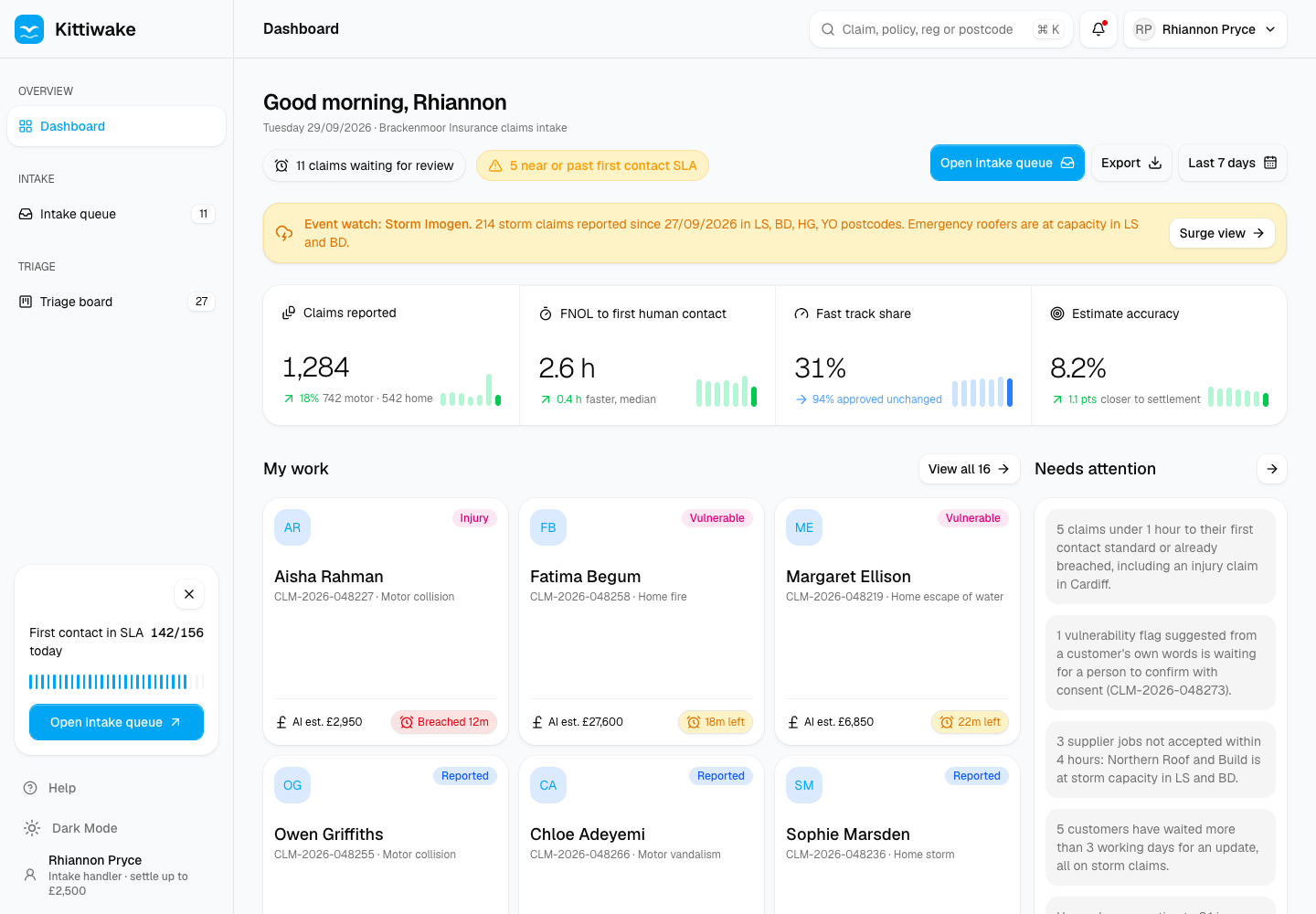
Designed and built a clickable claims intake console for a UK motor and home insurer: AI reads the customer's story and photos, extracts the facts, drafts a damage estimate and suggests a triage route with its reasons, while a named person confirms cover, routes the claim and makes every call that could go against the customer.
Enterprise Software Engineering - Human + AI
Contact Us
© 2026 - Copyright. All Rights reserved Oceanlab
Location
Global Headquarters
21 Merchant Road, 3rd Floor, Singapore 058267
Main corporate office and leadership operations
North America Office
548 Market Street, PMB 12345, San Francisco, CA 94104
Client operations and business development
India Office
402 Shivalik Shilp II, SG Highway, Ahmedabad 380015
Engineering and delivery center

Enterprise Software Engineering - Human + AI
Contact Us
Locations
Global Headquarters
21 Merchant Road, 3rd Floor, Singapore 058267
Main corporate office and leadership operations
North America Office
548 Market Street, PMB 12345, San Francisco, CA 94104
Client operations and business development
India Office
402 Shivalik Shilp II, SG Highway, Ahmedabad 380015
Engineering and delivery center
© 2026 - Copyright. All Rights reserved Oceanlab