Sampan - KYC Refresh Platform for Periodic and Trigger Reviews
Ongoing Customer Due Diligence for a Hong Kong Bank
Designed and built a clickable KYC refresh platform for a Hong Kong bank's existing customers: periodic reviews by risk tier, reviews opened by trigger events, pre-filled case files that show what changed, risk re-rating and a fair, documented ladder for customers who do not respond.
Most of our work is under NDA. Per agreement, we can share the work but not the company details - all names and identifying information shown here have been changed.
Impact
Dashboard, case queue, case review, trigger events inbox and non-response ladder, with 13 working slide-over panels and dialogs.
A case only goes to the four-eyes check with no open screening hits, no unresolved changes, a written rating rationale and the required approvals requested.
Two reminders, an RM call, final notice, partial and full restriction, then exit review - each with a waiting period, and compliance manager approval before any restriction or exit.
24 retail, corporate and private customers, 24 review cases across 3 campaigns, 19 trigger events, 14 ladder states and a 9-factor risk model.
The Problem
Lantern Peak ran periodic KYC reviews from a quarterly spreadsheet export. Analysts copied details into a Word template, searched the Companies Registry and the screening tool by hand and chased customers by letter. About 14% of high-risk reviews were overdue, an HKMA examination found files that did not show what had changed or why the rating stayed the same, and non-responders sat in limbo for months.
Our Solution
Sampan schedules reviews by risk tier, opens reviews when something changes, pre-fills each case from the bank's own and external sources, shows the analyst exactly what changed since the last review, re-rates risk factor by factor, and moves non-responders through a fair ladder of reminders, restriction and exit with approvals at every step.
The Challenge: Keeping Due Diligence Current
Onboarding is checked once. Ongoing monitoring has to happen for 380,000 retail and 21,000 corporate customers, year after year, with a file that explains every decision to an examiner.
Reviews Without a Record of Change
The AMLO expects customer due diligence to be kept up to date. Review files in a Word template could not show what had changed since the last review, where the new data came from, or why the risk rating stayed the same.
Triggers Between Reviews
Adverse media, a new address, unusual activity or a change in directors can arrive any day. Each one has to be triaged: open a review, merge it into an open case, bring the periodic review forward, or dismiss it with a reason.
Ownership Behind Corporate Customers
Corporate customers range from sole proprietorships to holding companies with offshore parents. Beneficial owners above 25% have to be traced through intermediate companies, and the significant controllers register is kept by the company, not filed publicly.
Non-Responders Treated Fairly
The HKMA has told banks not to de-risk customers wholesale. Customers who never reply need reasonable notice, help channels, a check for vulnerability and a documented approval before any restriction or exit - and no customer message may hint at suspicion.
Our Approach: From Rules to a Clickable Review Desk
Spec and Rules Research
Mapped 9 roles from KYC analyst and QC checker to MLRO and senior management approver, 30 screens including a 6-screen customer portal, and the data model for cases, changes, related parties, documents, screening hits, risk assessments, trigger events and ladder states. Wrote down the rules the design follows: AMLO Cap. 615 and the HKMA AML/CFT Guideline, beneficial ownership under the Companies Ordinance, PEP and sanctions screening, tipping-off, the PDPO and fair treatment under the Code of Banking Practice.
Clickable Demo on a Production UI Kit
Built 5 key screens on a production dashboard kit: the dashboard with backlog by risk tier and the customer response funnel, the case queue with working days to due, the case review with what changed, related parties and ownership tree, documents, screening and the risk rating, the trigger events inbox, and the non-response ladder board. Changes, documents, hits, calls and pauses all work on local state.
What a Production Build Adds
Integrations with core banking, the Companies Registry, World-Check One or Dow Jones screening, iAM Smart, Onfido or Jumio, DocuSign, the government Address Lookup Service, transaction monitoring, Twilio and SendGrid. Staff SSO, four-eyes rules enforced in the backend, a tamper-evident audit log, and the remaining screens: calendar and campaigns, QC queue and review, restrictions and exits, reports, settings and the mobile-first customer portal.
Why It Works: Every Decision Leaves a Trail
The Review Starts With What Changed
Each case opens on a list of differences since the last review, grouped by source, with old and new values - for example declared monthly turnover of HKD 200,000 against an actual 6-month average of HKD 1,140,000. Each change is accepted, queried or marked as needing explanation.
The Risk Rating Shows Its Working
Every factor shows its value, points, source and movement since the last review. The calculated tier sits beside the proposed tier, and an override needs a reason and an approval request before the case can move on.
Ask Only for What Is Missing
Data is pre-filled and labelled by source: core banking, Companies Registry, iAM Smart or the customer. Documents still valid from the last review are marked for reuse, so customers are not asked again for what the bank already holds.
Fair by Design, Silent on Suspicion
The ladder only advances after each waiting period, a promised date from an RM call pauses it, and vulnerable customers are flagged. Referral to the MLRO stays internal, and customer messages are checked for neutral wording.
Related case studies
View all: Banking & lending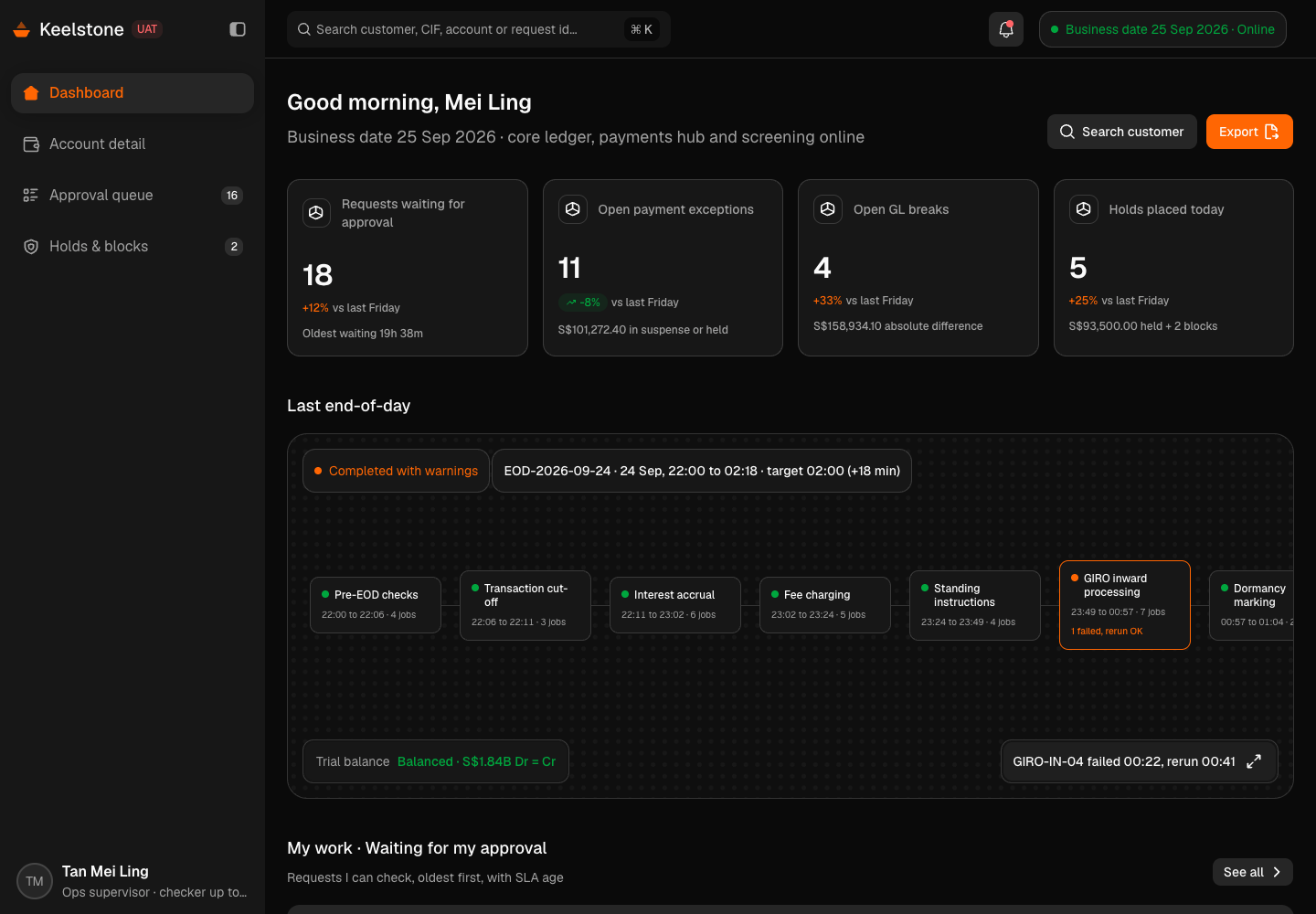
Keelstone - Core Banking Back-Office Console with Maker-Checker
Designed and built a clickable back-office console for a Singapore bank's deposit operations: holds and blocks, limit changes, fee waivers, payment repairs and end-of-day, with every money-moving change going through maker-checker approval.
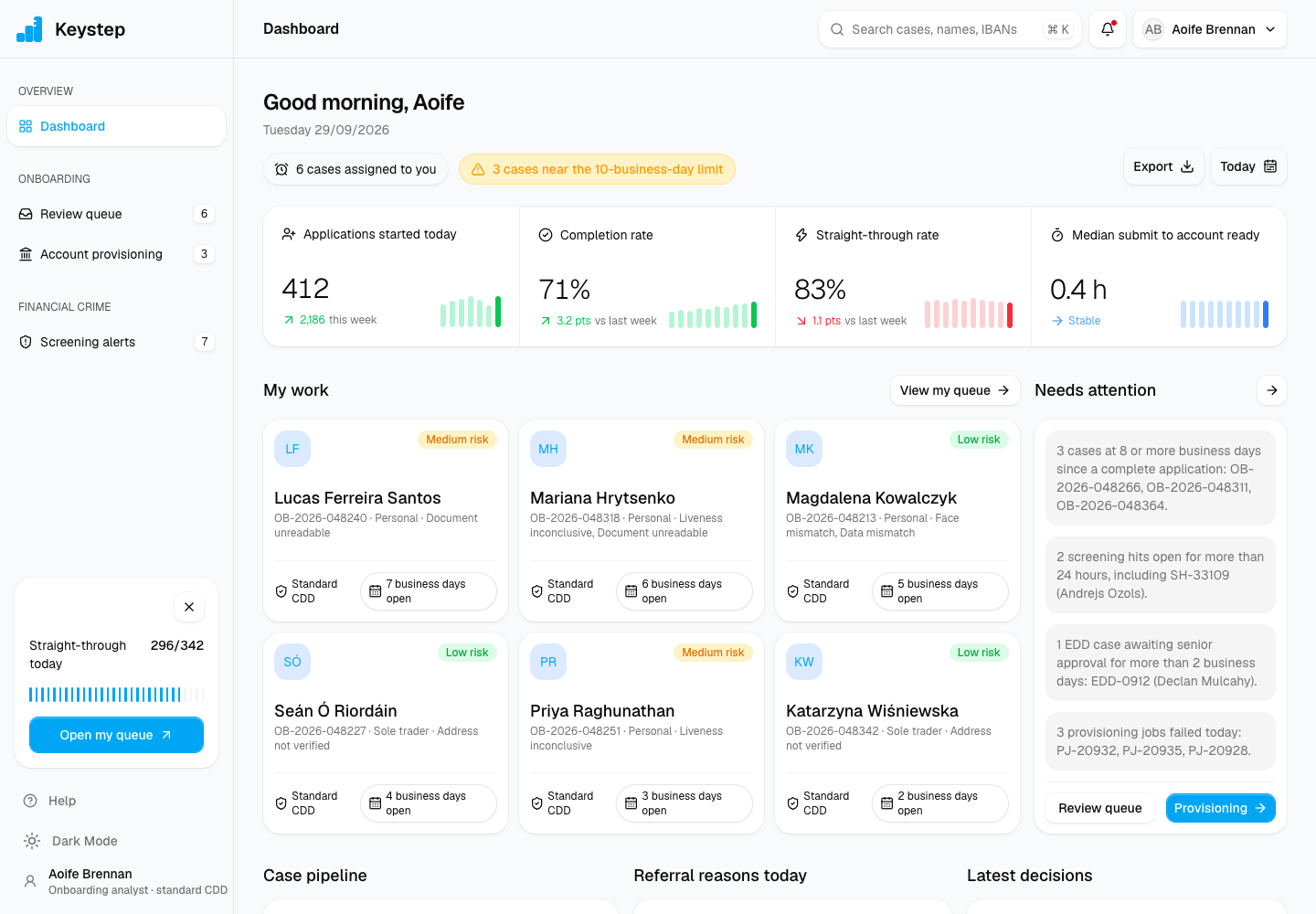
Keystep - Digital Bank Onboarding with ID, Liveness and Risk-Based Review
An onboarding platform for an Irish digital bank: applicants open a EUR current account from their phone with ID and selfie liveness checks, and a staff console lets onboarding and financial crime teams review the cases the rules cannot decide, through to an issued Irish IBAN.
Enterprise Software Engineering - Human + AI
Contact Us
© 2026 - Copyright. All Rights reserved Oceanlab
Location
Global Headquarters
21 Merchant Road, 3rd Floor, Singapore 058267
Main corporate office and leadership operations
North America Office
548 Market Street, PMB 12345, San Francisco, CA 94104
Client operations and business development
India Office
402 Shivalik Shilp II, SG Highway, Ahmedabad 380015
Engineering and delivery center

Enterprise Software Engineering - Human + AI
Contact Us
Locations
Global Headquarters
21 Merchant Road, 3rd Floor, Singapore 058267
Main corporate office and leadership operations
North America Office
548 Market Street, PMB 12345, San Francisco, CA 94104
Client operations and business development
India Office
402 Shivalik Shilp II, SG Highway, Ahmedabad 380015
Engineering and delivery center
© 2026 - Copyright. All Rights reserved Oceanlab