Gabarre - Fleet Electrification Planner Built on Real Duty Cycles
Fleet Electrification Planner for a French Utility Services Company
Designed and built a clickable fleet electrification planner for a Lyon utility and facilities services company with about 1,100 vans, cars and light trucks across 14 depots: which vehicles an EV can replace based on a year of daily driving, what switching costs, and how many chargers each depot needs against its grid connection.
Most of our work is under NDA. Per agreement, we can share the work but not the company details - all names and identifying information shown here have been changed.
Impact
Dashboard, vehicle register, vehicle detail with 5 tabs, suitability analysis, depot list and depot charging plan, all running against a switchable active scenario.
A vehicle counts as suitable when an EV in the catalogue covers 95% of its driving days on depot charging alone, after a 27% winter range derate and a 10% battery reserve. A slider from 85% to 100% updates the counts live.
Each depot gets a phased charger plan, a check that every vehicle recovers its 95th percentile daily energy within its overnight dwell, and a load profile with and without smart charging against the subscribed power.
Each with 364 seeded vehicle-days and no driver data, plus 9 EV models, 14 depots, 3 scenarios, 11 users, 11 sourced assumptions and fleet totals for 1,108 vehicles.
The Problem
Ternaye's board committed to electrifying the fleet, but nobody could say which vehicles could do their job on a battery. The fleet team had a leasing spreadsheet, a telematics portal nobody exported from, and charger quotes from three installers that each assumed a different number of vehicles per depot. Finance distrusted the savings because nobody knew which fuel price, tariff or residual value they used, two depots had ordered electric vans they could not charge overnight without tripping the site supply, and leases kept being renewed on diesel because the decision came too late.
Our Solution
Gabarre turns telematics trips into daily duty cycles, checks every vehicle against an editable catalogue of electric models, compares total cost of ownership, schedules replacements by lease end and budget, and sizes each depot's charging against its grid connection. Every number the analysis uses lives in an assumptions register with a source and an owner.
The Challenge: Electrifying a Fleet Without Guesswork
Switching a working fleet to electric depends on how each vehicle is really driven, what each depot's grid connection can carry, and costs and rules that keep changing. Ternaye's fleet, finance, sustainability and depot teams each held part of the answer.
Which Vehicles Can Go Electric
Annual mileage from the lease file says little about the longest days, payload, towing or how long a van sits at the depot overnight. Winter cuts real range, and a van that fails on a handful of days still needs an answer.
Telematics Is Personal Data
Trip data from vehicles driven by employees falls under the GDPR and France's Loi Informatique et Libertés, and CNIL guidance limits what an employer may do with location data. The planner needs duty cycles, not where a driver went.
Depots That Cannot Charge Overnight
Each depot has its own connection, subscribed power and existing peak. Grid upgrades go through the distribution system operator, Enedis for most of mainland France, with their own cost and lead time, and installers' quotes did not agree on how many vehicles to plan for.
Rules and Prices That Keep Moving
LOM fleet greening quotas have been amended, the 2025 Finance Law added an incentive tax for companies with more than 100 light vehicles, low-emission zones have been contested and changed, and incentives such as ADVENIR shift often. None of it can be hard-coded.
Our Approach: From Fleet Data to a Clickable Planner
Spec and Rules Research
Mapped 9 user roles plus drivers who never log in, 26 screens across the fleet console and a depot manager view, and the data model for vehicles, vehicle-days, EV models, depots, site capacity, scenarios, assumptions and compliance rules. Wrote down the rules the design follows: GDPR and the Loi Informatique et Libertés with CNIL guidance, LOM greening quotas and the 2025 incentive tax, ZFE-m zones by Crit'Air class, IRVE-qualified installation and Enedis grid connections.
Clickable Demo on a Production UI Kit
Built 6 key screens on a production dashboard kit: the dashboard with KPIs against the last published scenario, the electrification curve against the entered greening quota and upcoming lease decisions, the vehicle register with saved views and bulk actions, vehicle detail with a 12-month duty cycle heat map, suitability, TCO and emissions, the suitability analysis with its coverage slider and result funnel, and depot charging plans with editable phases, a smart charging toggle and grid upgrade quotes.
What a Production Build Adds
Imports from telematics providers such as Geotab, Webfleet or Samsara, lessor exports from Ayvens or Arval and fuel card files, emission factors from ADEME Base Empreinte and RTE éCO2mix, PDF and PPTX board reports stored in SharePoint, and Microsoft Entra ID sign-in. Role-based access, an audit log of every assumption change, published scenario and telematics export, and the remaining screens: imports, TCO, CO2, replacement schedule, scenarios, board report, compliance tracker, EV catalogue, assumptions register, settings and the depot manager view.
Why It Works: Every Answer Shows Its Working
Suitability From Every Day, Not Averages
Each vehicle's year of driving shows as a calendar heat map and a histogram with the EV's usable range marked, next to its percentiles and overnight dwell. Vehicles that fail name their limiting factor: range, payload, towing, dwell, no model or not enough data.
Numbers Finance Can Trace
Costs and emission factors point to a numbered assumption with its source, owner and review status. An expired diesel price surfaces on the dashboard, and any changed input marks results out of date until the analysis is run again.
Charging Sized Against the Connection
Depot plans show unmanaged and smart charging peaks against subscribed power, flag where an upgrade is needed, and hold the Enedis quote as entered data. Costs run per phase, with the ADVENIR subsidy as its own line.
Duty Cycles Without Drivers
Only vehicle-day aggregates are kept: distance, trips, dwell, depot or not and a low-emission zone flag. No driver identifier or trip coordinate is stored, and greening quotas and zones are entered as dated data rather than hard-coded.
Related case studies
View all: Mobility & EV
DriveLuxe - All-Electric Premium Ride-Hailing for Hong Kong
Built a rider mobile app for an all-electric premium ride-hailing service - live EV map, charge-aware vehicle selection, real-time booking, and trip-completion CO₂ accounting - shipped from clickable AI prototype to App Store in 10 weeks.
Voltone - Electric Car Sharing Platform with Telematics, Damage and Fines Control
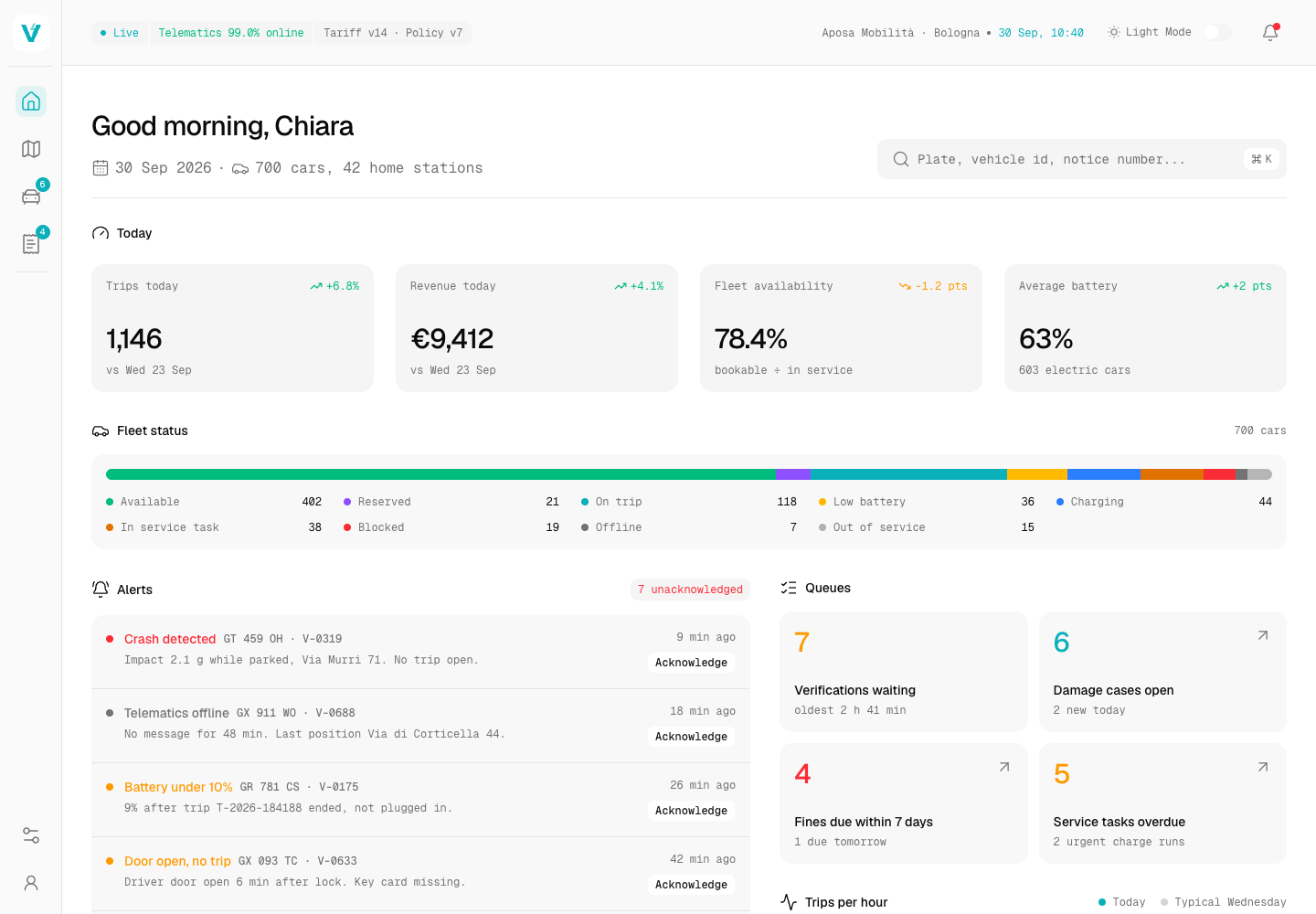
Designed a car sharing platform for a Bologna operator of about 700 mostly electric cars and built its operator console as a clickable demo: a live fleet map with telematics and remote commands behind safeguards, damage reviews that compare before and after photos, and a fines desk sorted by the deadline to identify the driver.
Enterprise Software Engineering - Human + AI
Contact Us
© 2026 - Copyright. All Rights reserved Oceanlab
Location
Global Headquarters
21 Merchant Road, 3rd Floor, Singapore 058267
Main corporate office and leadership operations
North America Office
548 Market Street, PMB 12345, San Francisco, CA 94104
Client operations and business development
India Office
402 Shivalik Shilp II, SG Highway, Ahmedabad 380015
Engineering and delivery center

Enterprise Software Engineering - Human + AI
Contact Us
Locations
Global Headquarters
21 Merchant Road, 3rd Floor, Singapore 058267
Main corporate office and leadership operations
North America Office
548 Market Street, PMB 12345, San Francisco, CA 94104
Client operations and business development
India Office
402 Shivalik Shilp II, SG Highway, Ahmedabad 380015
Engineering and delivery center
© 2026 - Copyright. All Rights reserved Oceanlab