Fine-tuning vs RAG
Answer eight questions about your use case to see whether retrieval, fine-tuning, both or a good prompt fits best.
Free, runs in your browser, no sign-up. Updated 2026-10-25.
Guidance, not a benchmark. The points behind each answer are stated rules of thumb, not test results. Try the approach on your own data.
Result
Suggested: Retrieval (RAG). Scores: Retrieval (RAG) 15, Prompting alone (no RAG, no fine-tuning) 3, Fine-tuning -1. Guidance from a stated rubric, not a test result.
- Retrieval (RAG)
- 15
- Prompting alone (no RAG, no fine-tuning)
- 3
- Fine-tuning
- -1
How each answer scored
- Facts from our own documents or dataRetrieval +3Retrieval puts the source text in the prompt; fine-tuning is an unreliable way to store facts.
- Every few monthsRetrieval +2, Fine-tuning +0.5Retrieval still updates more easily than a training run.
- YesRetrieval +3Retrieval knows which document each passage came from, so it can cite it. A fine-tuned model cannot.
- A few dozenPrompting alone +2, Fine-tuning +0.5A few dozen fit as examples in the prompt; often too few to fine-tune well.
- Far more than one promptRetrieval +3Retrieval picks the few relevant passages from a large corpus.
- Yes, permissions differRetrieval +3Retrieval can filter by permission per query. Anything trained into a model is visible to every user of it.
- Normalno pointsNo effect.
- Not yetRetrieval +1, Prompting alone +1, Fine-tuning -2Without that capacity a fine-tuned model goes stale; retrieval and prompting are easier to maintain.
Guidance from a transparent scoring rubric, not a guarantee. The points per answer are planning assumptions; test the approach on your own data.
Send this result to OceanLab
Opens an email to OceanLab with this result and a link to your inputs. Nothing is sent until you press send, and there is no sign-up.
How this is calculated
Each answer adds points to RAG, fine-tuning and/or prompting alone, and the reason is shown next to it. The highest total is the recommendation.
When RAG and fine-tuning are the top two and the second scores at least 70% of the first, the tool suggests combining them: they solve different problems.
The points per answer are OceanLab planning assumptions that encode common engineering reasoning. They are not measured results.
Questions about this tool
When is RAG the better choice?
When answers depend on facts in your documents, the content changes often, answers need citations, or different users may see different documents.
When is fine-tuning the better choice?
When you need a consistent style, format or narrow task, have many good examples, and run enough volume that shorter prompts or a smaller model pay off.
Can I use both?
Yes. They solve different problems, and the tool suggests combining them when both score well.
Is anything I enter sent anywhere?
No. The tool runs in your browser and there is no sign-up. Nothing leaves the page unless you choose to email your result to OceanLab.
Other free tools
OceanLab product builds like this
Products OceanLab designed and built. Each case study covers the screens, the scope and the rules it was built for.
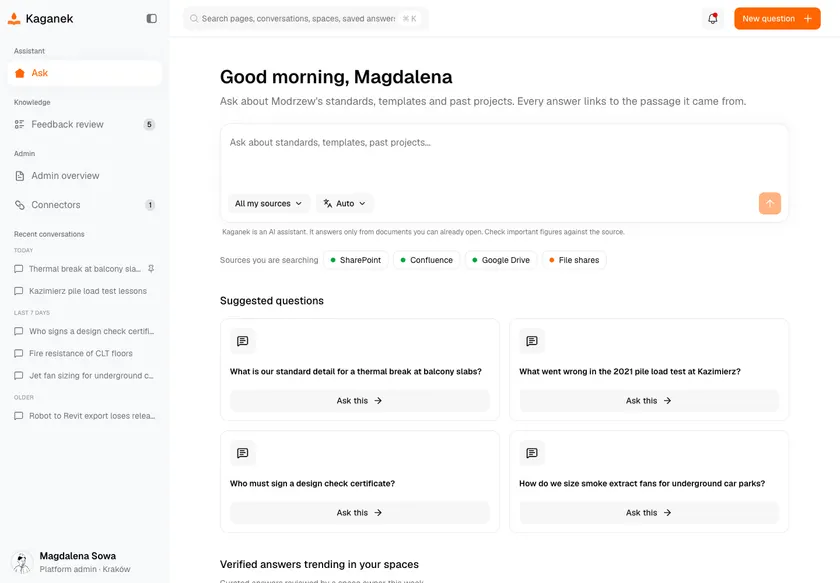
Kaganek - RAG Knowledge Assistant with Citations and Permissions Intact
Designed and built a clickable internal knowledge assistant for a Kraków consulting engineering firm: staff ask in Polish or English and get answers built only from the firm's own SharePoint, Confluence, Google Drive and file share documents, with every claim linked to its source passage and an honest "I don't know" when the sources are weak.
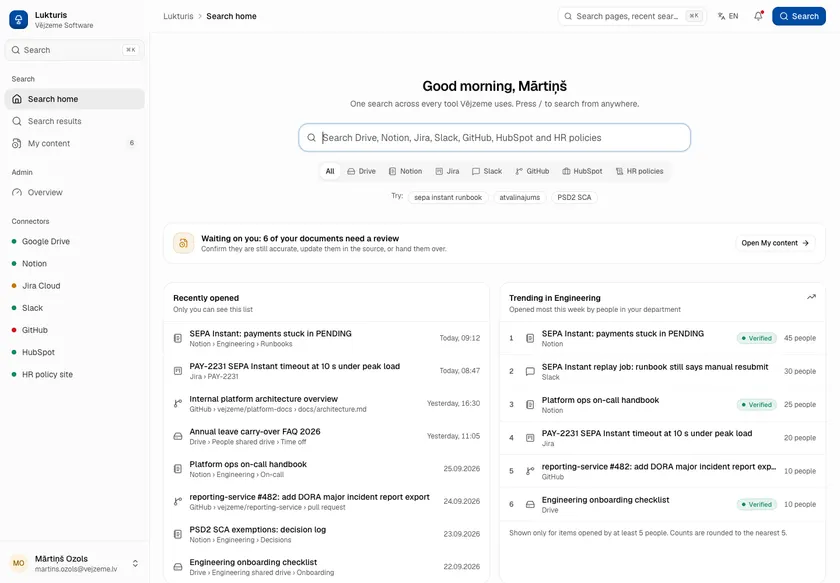
Lukturis - Permission-Aware Enterprise Search Across Seven Internal Tools
Designed and built a clickable enterprise search product for a 600-person Riga software company: one search box over Google Drive, Notion, Jira, Slack, GitHub, HubSpot and the HR policy site, with every result filtered by what the person can already open in the source tool, extractive answer cards that always link to the source, review nudges for content owners and an admin view of connector health and index freshness.
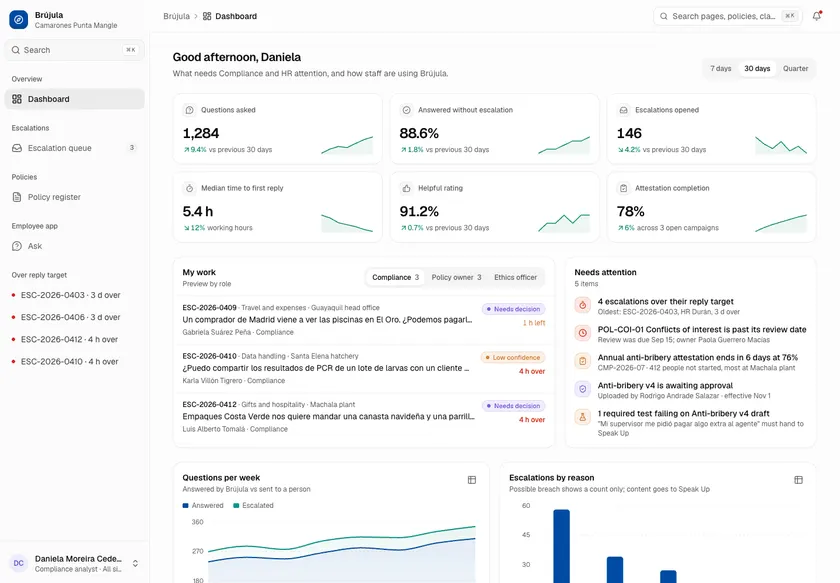
Brújula - AI Policy Assistant That Cites the Clause and Escalates the Risky Questions
Designed and built a clickable internal policy assistant for a Guayaquil shrimp farmer, processor and exporter: staff ask in Spanish or English and get answers built only from company policies, each statement linked to its clause and version, while gift approvals, conflicts and possible breaches go to Compliance, HR or the confidential Speak Up channel instead of being answered.
