AI agent cost calculator
Estimate what an AI agent costs per task and per month, including the context it re-sends on every step.
Free, runs in your browser, no sign-up. Updated 2026-10-25.
Result
57,840 tokens per task, 1,000 tasks a month: from $4.53 a month on Claude Haiku 5.5 to $453 on gpt-6-astra.
- Tokens per task
- 57,840
- Uncached input
- 31,880
- Cached input
- 23,760
- Output
- 2,200
| Model | Per task | Per month | Price checked |
|---|---|---|---|
| Claude Haiku 5.5Anthropic | $0.0045 | $4.53 | 2026-10-23 |
| gpt-6-lunaOpenAI | $0.0045 | $4.53 | 2026-10-23 |
| MiniMax M3.1-FlashMiniMax | $0.0065 | $6.46 | 2026-10-23 |
| gpt-5.6-lunaOpenAI | $0.0095 | $9.49 | 2026-10-23 |
| deepseek-flashDeepSeek | $0.012 | $12.35 | 2026-10-23 |
| MiniMax M3MiniMax | $0.014 | $13.63 | 2026-10-23 |
| Gemini 2.5 FlashGoogle | $0.016 | $15.78 | 2026-10-23 |
| Gemini 3.8 FlashGoogle | $0.034 | $33.94 | 2026-10-23 |
| gpt-5.4-miniOpenAI | $0.036 | $35.59 | 2026-10-23 |
| Claude Haiku 4.5Anthropic | $0.045 | $45.26 | 2026-10-23 |
| deepseek-v4-proDeepSeek | $0.052 | $51.84 | 2026-10-23 |
| Gemini 2.5 ProGoogle | $0.065 | $64.82 | 2026-10-23 |
| Claude Sonnet 5.5Anthropic | $0.088 | $88.14 | 2026-10-23 |
| gpt-6.1-solOpenAI | $0.088 | $88.14 | 2026-10-23 |
| Gemini 4 ArgonGoogle | $0.088 | $88.14 | 2026-10-23 |
| Claude Sonnet 5Anthropic | $0.091 | $90.51 | 2026-10-23 |
| gpt-5.6-terraOpenAI | $0.095 | $94.91 | 2026-10-23 |
| Gemini 3.1 Pro PreviewGoogle | $0.095 | $94.91 | 2026-10-23 |
| Claude Opus 5.5Anthropic | $0.18 | $176 | 2026-10-23 |
| gpt-5.6-solOpenAI | $0.18 | $181 | 2026-10-23 |
| Claude Opus 5Anthropic | $0.23 | $226 | 2026-10-23 |
| Claude Fable 5.1Anthropic | $0.43 | $435 | 2026-10-23 |
| gpt-6-astraOpenAI | $0.45 | $453 | 2026-10-23 |
Assumptions
Every number the result depends on, and where it comes from. Change any value and the result updates.
| Assumption | Value | Source |
|---|---|---|
| Tasks per month | tasks | OceanLab planning assumption. Use your own volume.Reviewed 2026-10-25 |
| Model calls (steps) per task | steps | OceanLab planning assumption: plan, a few tool calls, check, answer. Log a real run to replace it.Reviewed 2026-10-25 |
| System prompt + tool definitions + task (tokens) | tokens | OceanLab planning assumption. Tool schemas are often the largest part; paste them into the token counter.Reviewed 2026-10-25 |
| Model output per step (tokens) | tokens | OceanLab planning assumption: a tool call or a short reasoning step.Reviewed 2026-10-25 |
| Tool calls per step | calls | OceanLab planning assumption.Reviewed 2026-10-25 |
| Tokens returned per tool call | tokens | OceanLab planning assumption: search results, a record, a file excerpt. Large results dominate cost.Reviewed 2026-10-25 |
| Share of the base prompt served from cache | % | OceanLab planning assumption: the base prompt repeats on every step. Set 0 if you do not use caching.Reviewed 2026-10-25 |
| Share of earlier-step history served from cache | % | OceanLab planning assumption: 0 is the cautious default. Agents that keep a stable prefix can cache history too.Reviewed 2026-10-25 |
| Extra steps from retries and failures | % | OceanLab planning assumption: failed tool calls and re-plans.Reviewed 2026-10-25 |
Ask OceanLab about your agent build
Opens an email to OceanLab with this result and a link to your inputs. Nothing is sent until you press send, and there is no sign-up.
How this is calculated
An agent re-sends its whole history on every step. Step i sends the base prompt (system prompt, tool definitions and task) plus everything produced in steps 1 to i−1: model output and tool results.
The base prompt is the part a prompt cache can serve; the history is uncached by default. Retries add a share of extra steps.
The tokens for one task are priced on every model at its published rates, cheapest first, then multiplied by tasks per month.
Sources
- Anthropic API pricing · checked 2026-10-23
- OpenAI API pricing · checked 2026-10-23
- Google API pricing · checked 2026-10-23
- DeepSeek API pricing · checked 2026-10-23
- MiniMax API pricing · checked 2026-10-23
Questions about this tool
Why do agents cost more than single calls?
An agent re-sends its history on every step, so each step's input includes all earlier outputs and tool results. Cost grows faster than the number of steps.
What counts as a step?
One model call. A step may request one or more tool calls, and their results are added to the next step's input.
Does caching help?
Yes. The system prompt and tool definitions repeat on every step and can be served from the provider's prompt cache at a lower rate.
Where do the prices come from?
Each price is read from the provider's official pricing page and shows the date it was checked. Prices that could not be verified are left out, or start at 0 for you to fill in.
Other free tools
OceanLab product builds like this
Products OceanLab designed and built. Each case study covers the screens, the scope and the rules it was built for.
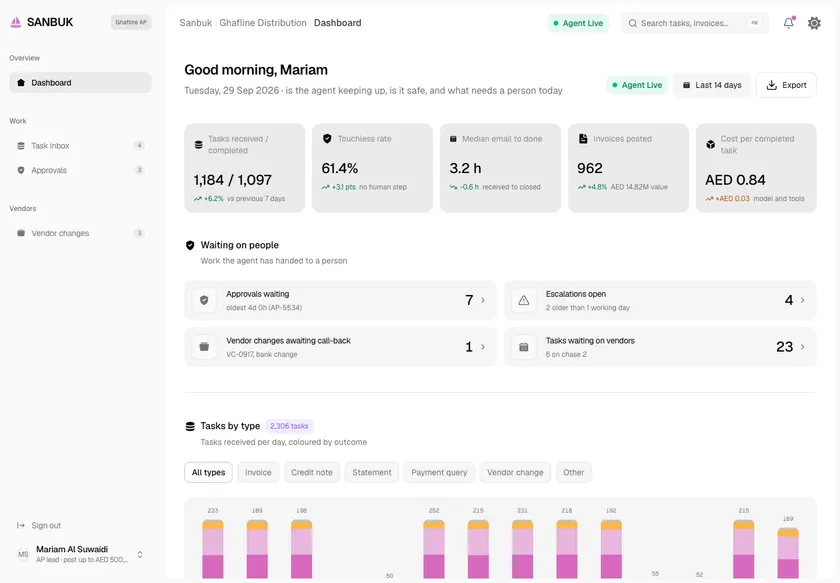
Sanbuk - Accounts Payable Agent with an Operator Console and Approval Gates
Designed and built a clickable back-office agent for a Dubai mainland distributor: it reads the AP and vendor mailboxes, matches invoices to POs and goods receipts, checks UAE tax invoice fields, drafts replies and posts to the ERP, while people approve by amount, see every tool call and handle every bank detail change themselves.
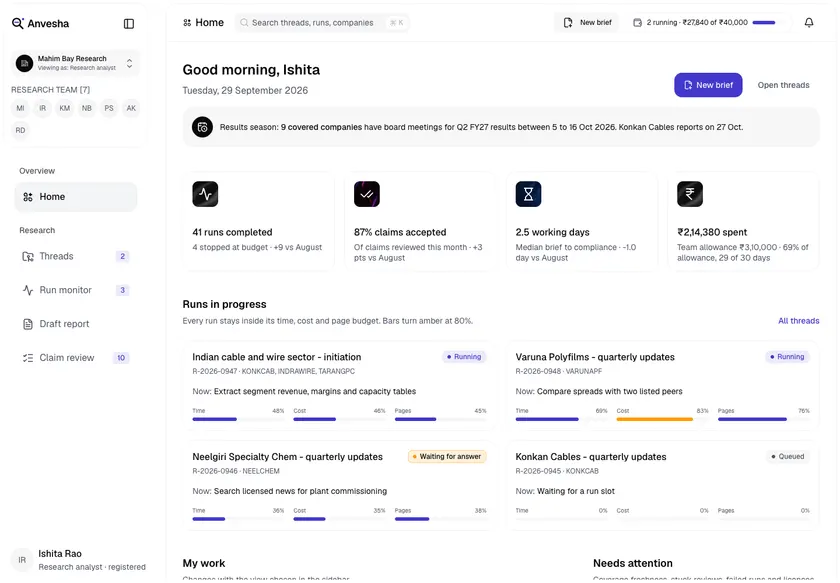
Anvesha - Deep-Research Agent for Cited Equity Research
Designed and built a clickable deep-research agent for a SEBI-registered Mumbai research boutique: analysts brief the agent, watch each run stay inside its time, cost and page budget, and get a draft report in which every factual sentence links to a quoted source passage they must accept before it can leave the team.
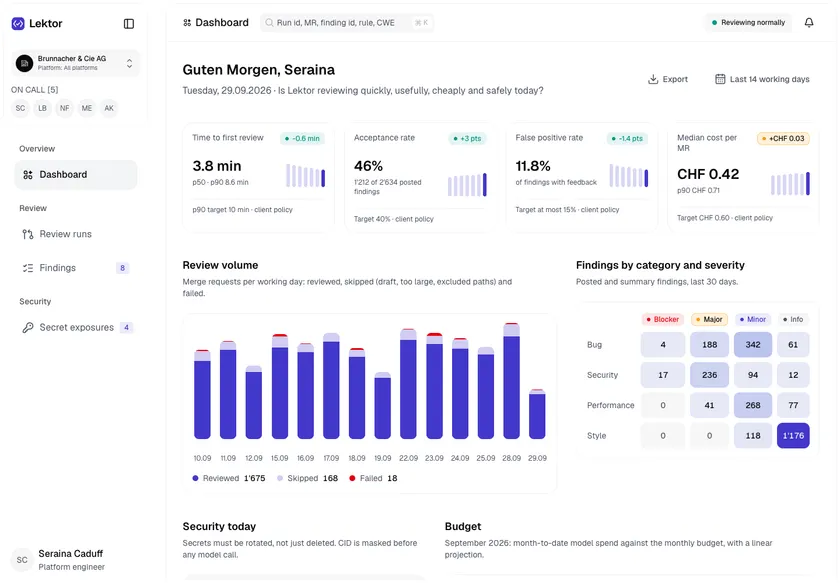
Lektor - AI Code Review Agent That Comments but Never Merges, Hosted Inside a Private Bank
Designed and built a clickable AI code review agent for the engineering team of a Zurich private bank: it reviews every merge request on GitLab and GitHub Enterprise with models hosted in the bank's own tenancy, masks client data and secrets before any model sees the diff, posts inline findings with rule, CWE and suggested patch, and never approves or merges.
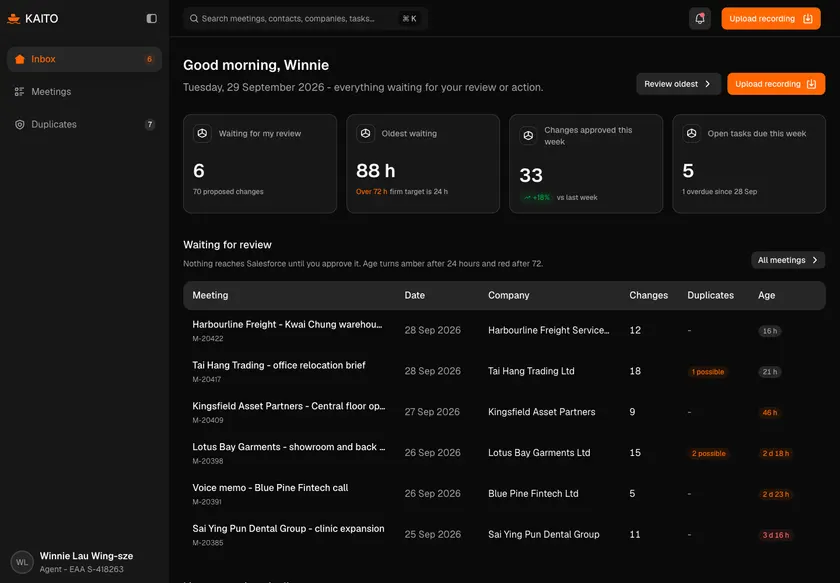
Kaito - Meeting Notes to CRM Assistant with Field-Level Review
Designed and built a clickable meeting assistant for a Hong Kong commercial property brokerage: it transcribes brokers' meetings and calls in Cantonese, English and Mandarin, proposes CRM changes as a field-level diff with evidence from the transcript, flags likely duplicate contacts, and writes nothing to Salesforce until the agent approves.
