Vitrine - Collection Management System for Four Museums
Collections Platform for a Spanish Regional Museum Service
Designed and built a clickable collection management system for a Valencian museum consortium with four museums and about 180,000 objects: one object record for catalogue, provenance, care and rights, verified locations, and loans that cannot be dispatched until agreements are signed and export permits are recorded.
Most of our work is under NDA. Per agreement, we can share the work but not the company details - all names and identifying information shown here have been changed.
Impact
Dashboard, object search with grid and table views, the object record with 9 tabs, the loans list and the loan detail with 8 tabs, plus a scan panel and a New loan panel.
Record dispatch stays blocked on an international loan out until every signer has signed and the temporary export permit for its protected objects is recorded.
Registrar approval to move an object insured above €250,000, director approval for loans above €1,000,000 in total, and a 12-month notice check on every new loan out.
Paintings, specimens, looms and house contents across 4 museums, with 12 loans (9 out, 3 in), 4 exhibitions, 10 staff users and 6 open provenance gaps.
The Problem
Each of the consortium's four museums kept its own records: a desktop database last updated in 2011, spreadsheets per department, index cards with a partial Access file, and a printed inventory from 1994. Nobody could say where an object was without phoning a store technician, provenance gaps stayed hidden in curators' files, loan paperwork travelled by email, and the last full count found about 1,400 objects not where the records said.
Our Solution
Vitrine gives the registrars, curators, conservators, technicians and digitisation staff of all four museums one system for the life of an object: a single record for catalogue, acquisition, provenance, condition, media and rights, a current location with its movement history, and loans that check approvals, signatures and permits before anything leaves the building.
The Challenge: Four Museums, One Record per Object
An art museum, a natural history museum, a silk and industry museum and a historic house hold very different things, but they share two off-site stores, one registrar team and the same legal duties for public heritage.
Where Is This Object Now?
About 180,000 objects sit across four museum buildings and two shared stores. Movements were not recorded in one place, so a stocktake of one store took three people six weeks and the last full count found about 1,400 objects out of place.
Protected Heritage Leaving Spain
Under Ley 16/1985 objects above certain age thresholds or listed in the heritage inventories generally need a state permit to leave Spain, and BIC objects only travel on temporary export. Outside the EU, Regulation 116/2009 generally applies too. A loan must not ship without the permit on file.
Provenance Gaps Out of Sight
Museums are expected to research and publish ownership gaps, especially for 1933 to 1945, the Civil War years and material covered by the 1970 UNESCO Convention. Notes lived in curators' files, so gaps only surfaced when a borrower asked.
Restricted Data in Shared Records
Insurance values, purchase prices, donor and lender contacts and secure store locations sit on the same records that curators, technicians and volunteers use every day, and GDPR and the LOPDGDD apply to every donor, lender and courier.
Our Approach: From Collection Rules to a Clickable System
Spec and Rules Research
Mapped 14 user roles from registrar to public visitor, 45 screens across the staff app, a borrower portal and the public online collection, and the data model for objects, acquisitions, provenance events, condition reports, movements, stocktakes, loans, permits, media and rights. Wrote down the rules the design follows: Spectrum procedures as a reference, Ley 16/1985 and the Valencian heritage law, EU export licences, GDPR and the LOPDGDD, image copyright and the DSM Directive, and provenance research expectations.
Clickable Demo on a Production UI Kit
Built 5 key screens on a production dashboard kit: the dashboard with catalogue, location, image and provenance KPIs and work by role, object search across all four museums, the object record with titles in Castellano, Valencià and English and a provenance chain with its gap drawn in, and loans with approvals, e-signature status, facility report review and permits. A museum switcher filters every list and an account switcher shows five roles. All actions run on local state.
What a Production Build Adds
Integration with an IIIF image server, a 3D viewer, Getty AAT, ULAN and TGN vocabularies, the Art Loss Register, a search index, e-signature for loan agreements, Zebra label printers and handheld scanners, and Europeana export. Staff auth by role with restricted-data permissions, an append-only audit log, migration of the four legacy sources, and the remaining screens: entries, stocktakes, conservation, exhibitions and labels, deaccessions, reports, admin, the borrower portal and the public online collection.
Why It Works: The Record Knows the Rules
Blocked Steps Say Why
On a loan, Record dispatch is disabled with the reason underneath, and a banner names the missing temporary export permit and points to the Permits tab. Once the last signature is in and the permit is recorded, dispatch opens.
Gaps Drawn, Not Hidden
The provenance tab lists ownership events oldest first with their sources and certainty, and draws a gap such as 1936 to 1952 as a red dashed segment. A pre-1946 object with a gap carries an alert on its record.
Restricted by Role, Revealed on Purpose
Only the registrar sees insurance values and purchase prices, behind a Show control, and secure store locations read Restricted for users without that permission. Switching to the curator's account turns the same values into Restricted.
Location and Care in One Record
Each object shows its location code, path, last sighting and movement history next to its condition and handling notes. Requesting a move of a high-value object warns that the registrar must approve it, and the scan panel tells a technician whether an object is here as expected, moved here or unknown.
Related case studies
View all: Museums & heritage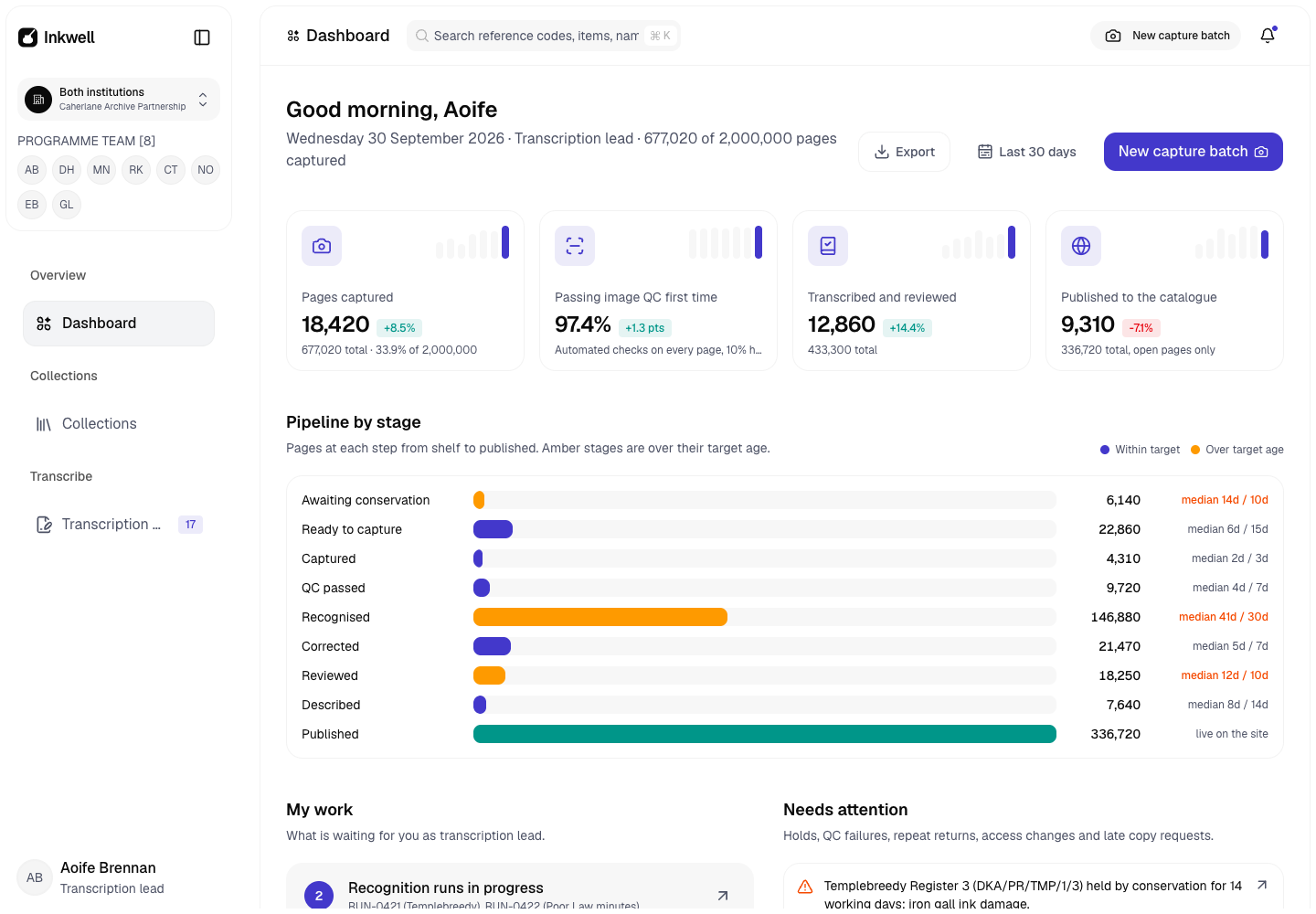
Inkwell - Archive Digitisation Platform with Handwriting Recognition and Volunteer Correction
Designed and built a clickable digitisation platform for a county record office and diocesan archive in Cork digitising about 2 million pages of parish registers, court rolls, estate papers and letters: one pipeline from shelf to published, handwriting recognition with a confidence score on every line, staff and volunteer correction, and closures that keep sensitive pages off the public site.
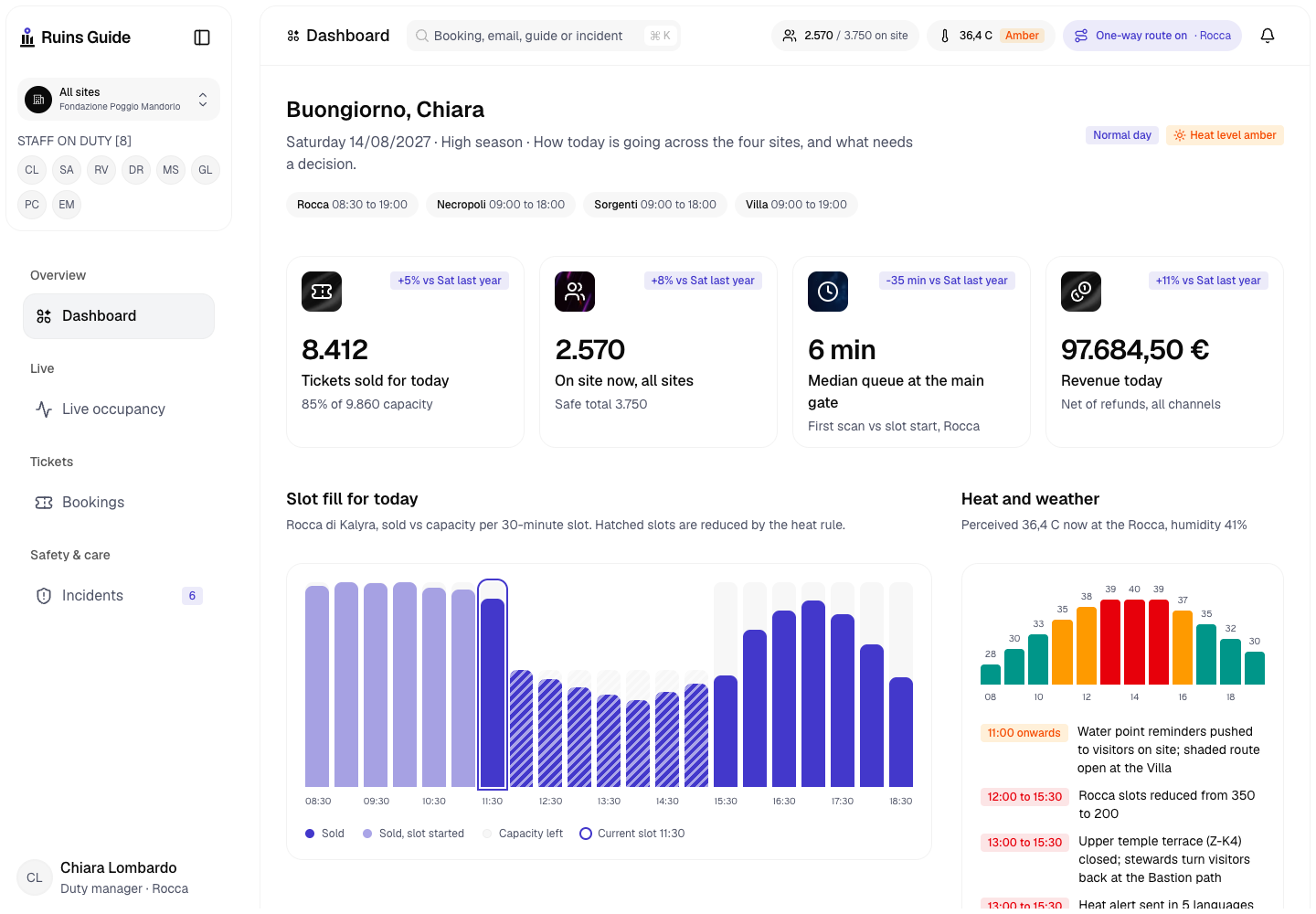
Ruins Guide - Timed Tickets, Live Crowd Flow and Safety for Four Archaeological Sites
Designed and built a clickable operations console for a heritage trust running four archaeological sites near Agrigento: timed-entry slots that shrink on red heat days, live occupancy by zone against safe capacity and conservation limits, bookings with gate scans and concession checks, and one incident log with lost child cases pinned at the top.
Enterprise Software Engineering - Human + AI
Contact Us
© 2026 - Copyright. All Rights reserved Oceanlab
Location
Global Headquarters
21 Merchant Road, 3rd Floor, Singapore 058267
Main corporate office and leadership operations
North America Office
548 Market Street, PMB 12345, San Francisco, CA 94104
Client operations and business development
India Office
402 Shivalik Shilp II, SG Highway, Ahmedabad 380015
Engineering and delivery center

Enterprise Software Engineering - Human + AI
Contact Us
Locations
Global Headquarters
21 Merchant Road, 3rd Floor, Singapore 058267
Main corporate office and leadership operations
North America Office
548 Market Street, PMB 12345, San Francisco, CA 94104
Client operations and business development
India Office
402 Shivalik Shilp II, SG Highway, Ahmedabad 380015
Engineering and delivery center
© 2026 - Copyright. All Rights reserved Oceanlab