Inkwell - Archive Digitisation Platform with Handwriting Recognition and Volunteer Correction
Archive Digitisation Platform for an Irish Archive Partnership
Designed and built a clickable digitisation platform for a county record office and diocesan archive in Cork digitising about 2 million pages of parish registers, court rolls, estate papers and letters: one pipeline from shelf to published, handwriting recognition with a confidence score on every line, staff and volunteer correction, and closures that keep sensitive pages off the public site.
Most of our work is under NDA. Per agreement, we can share the work but not the company details - all names and identifying information shown here have been changed.
Impact
Dashboard, collections, collection detail with 6 tabs, the transcription queue with 4 tabs and the line-by-line page editor, plus panels for boxes, line history, closures and new capture batches.
Awaiting conservation, ready to capture, captured, QC passed, recognised, corrected, reviewed, described and published, each with a page count and amber when its median age passes the target.
Line boxes on the page image turn amber below 0.80 and red below 0.60 (client policy). On the sample baptism page, 8 of 13 lines fall below the threshold and 11 entities are tagged.
2,000,000 estimated pages across 2 institutions, 677,020 captured, 25 queue pages, 5 volunteer projects, 5 HTR models, 8 closures with their sources and 11 staff users.
The Problem
The partnership won funding to digitise its most-requested series, but the work lived in five places. Conservators logged fragile volumes on paper slips, the capture studio tracked batches in a spreadsheet, recognition output sat in a vendor tool nobody else could see, and volunteers transcribed into shared documents that were never reviewed. Nobody could say which scanned pages named living people and had to stay closed, and family historians still wrote letters asking staff to search registers by hand, a single request taking up to a week of reading room time.
Our Solution
Inkwell puts every page on one track from the box on the shelf to a searchable, transcribed image in the online catalogue, with a clear owner at each step, a confidence score on every recognised line, a review trail on every correction and an access status that the public site respects automatically.
The Challenge: Four Centuries of Handwriting, Opened Safely
The records run from the 1500s to the 1900s, in Latin, English and Irish, in hands from court hand to copperplate. Some are fragile, some name people who may still be alive, and some are still in copyright, so every page has to be handled, read and released on its own terms.
Machines Read Old Hands Unevenly
Handwriting recognition does well on Victorian copperplate and badly on 16th-century court hand. Without a confidence score per line, staff could not tell which pages needed a person and which only needed a check.
Living People in Old Registers
The GDPR generally does not cover the deceased, but a 1930s register can name someone still alive, and parish registers reveal religious belief. Closures come from depositor conditions, diocesan rules and client policy, and closed pages must never reach the public site or a copy order.
Volunteer Work Nobody Reviewed
Volunteer corrections had no review, no record of who changed what and no licence attached. Every correction now needs a second pair of eyes, a version history and the contribution licence the volunteer agreed to.
Dates, Places and Description Standards
Ireland moved to the Gregorian calendar in 1752 and earlier years began on 25 March, so dates must be kept as written and normalised. Places must match real townlands, and descriptions have to follow ISAD(G) and export as EAD.
Our Approach: From Archive Rules to a Clickable Platform
Spec and Rules Research
Mapped 11 roles from archivist and conservator to volunteer and public user, 46 screens across the staff console, volunteer app and public search site, and the data model for collections, boxes, items, pages, capture batches, recognition runs, lines with version history, entities, closures and copy requests. Wrote down the rules the design follows: GDPR and the Data Protection Act 2018, special category data, closure rules with a named source, the Copyright and Related Rights Act 2000, ISAD(G) and EAD, dual dating before 1752, IIIF and WCAG 2.1 AA.
Clickable Demo on a Production UI Kit
Built 5 key staff screens on a production dashboard kit: the dashboard with KPIs against the 2 million page target, the stage pipeline, My work by role and confidence by script before and after correction; collections with captured, transcribed and published bars; collection detail with hierarchy, boxes, pages, access and activity; the transcription queue; and the page editor with line boxes, markup buttons, entity tagging and a date helper. All actions run on local state.
What a Production Build Adds
Integration with an HTR provider (such as Transkribus or eScriptorium), a IIIF image server and viewer, the online catalogue (AtoM or ArchivesSpace), Archivematica for master files, OpenSearch, logainm.ie for place names, Stripe for copy requests and Postmark for email. Staff roles with a separate closed-record permission, an append-only audit log, and the remaining screens: conservation, capture and QC, review, entities, publishing, data protection requests, the volunteer app and the public site.
Why It Works: Every Line Has a Score and a History
Confidence Decides Where People Look
Each line shows its recognition score, coloured on the page image and in the list, so a corrector goes straight to the uncertain lines. Lines above 0.80 can be accepted in one step, and the queue shows how many lines on each page fall below the threshold.
Closed Pages Stay With Staff
Closed and under-review pages are marked in the queue and cannot be moved into a volunteer project. Each closure names its rule, its source and the date the pages open, and the data protection basis is recorded per collection.
Corrections Keep the Original
The recognised text is kept unchanged beside the corrected text, and the line history shows every version with who made it, when and under which licence. Pages lock to one editor while open, so two people never overwrite each other.
Built for the Records as Written
Markup buttons follow the transcription guidelines for unclear text, expansions, deletions and insertions. Tagged people, places and dates are underlined by type, and the date helper keeps the date as written, gives the normalised date and flags dual-dated entries before 1752.
Related case studies
View all: Museums & heritage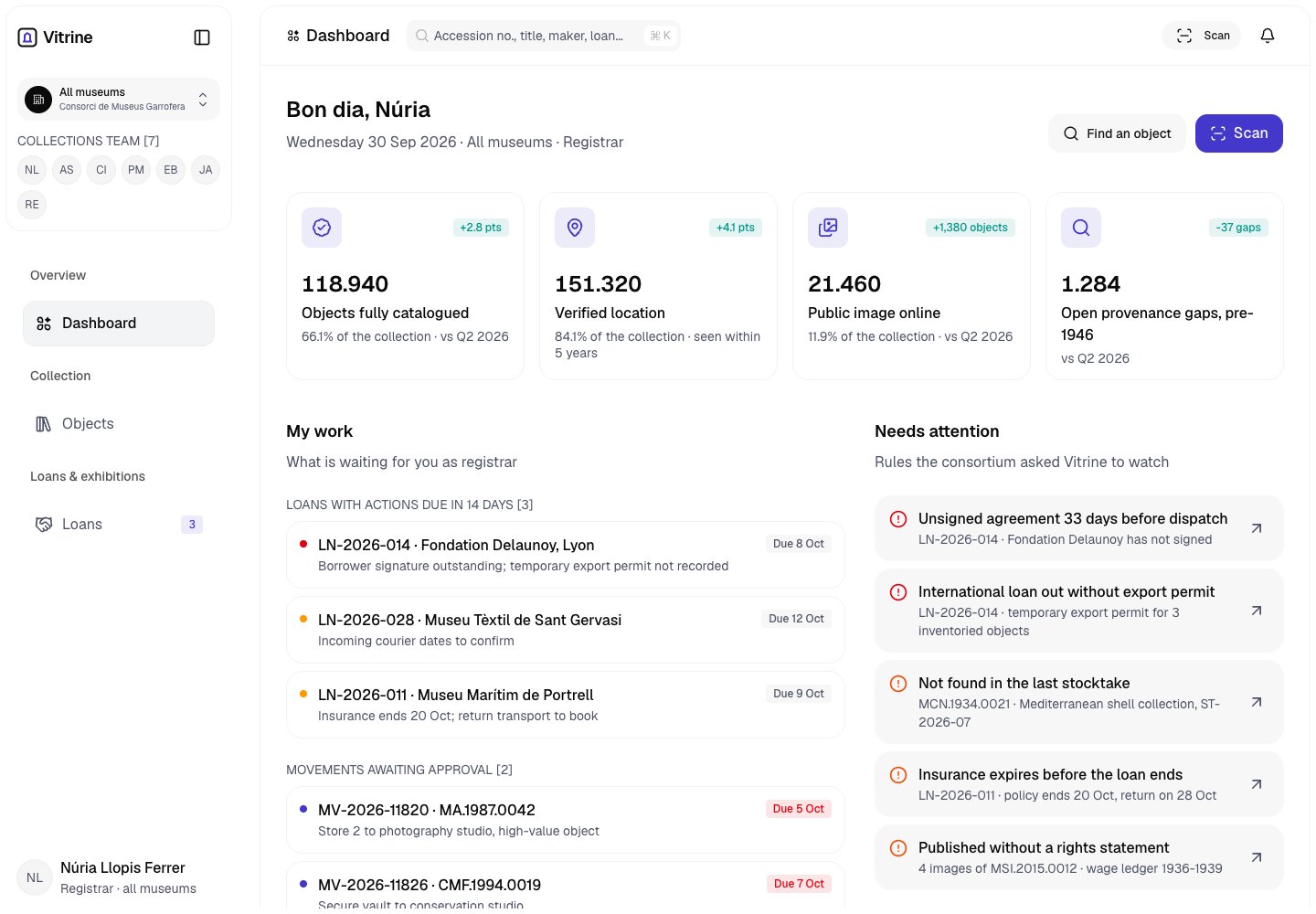
Vitrine - Collection Management System for Four Museums
Designed and built a clickable collection management system for a Valencian museum consortium with four museums and about 180,000 objects: one object record for catalogue, provenance, care and rights, verified locations, and loans that cannot be dispatched until agreements are signed and export permits are recorded.
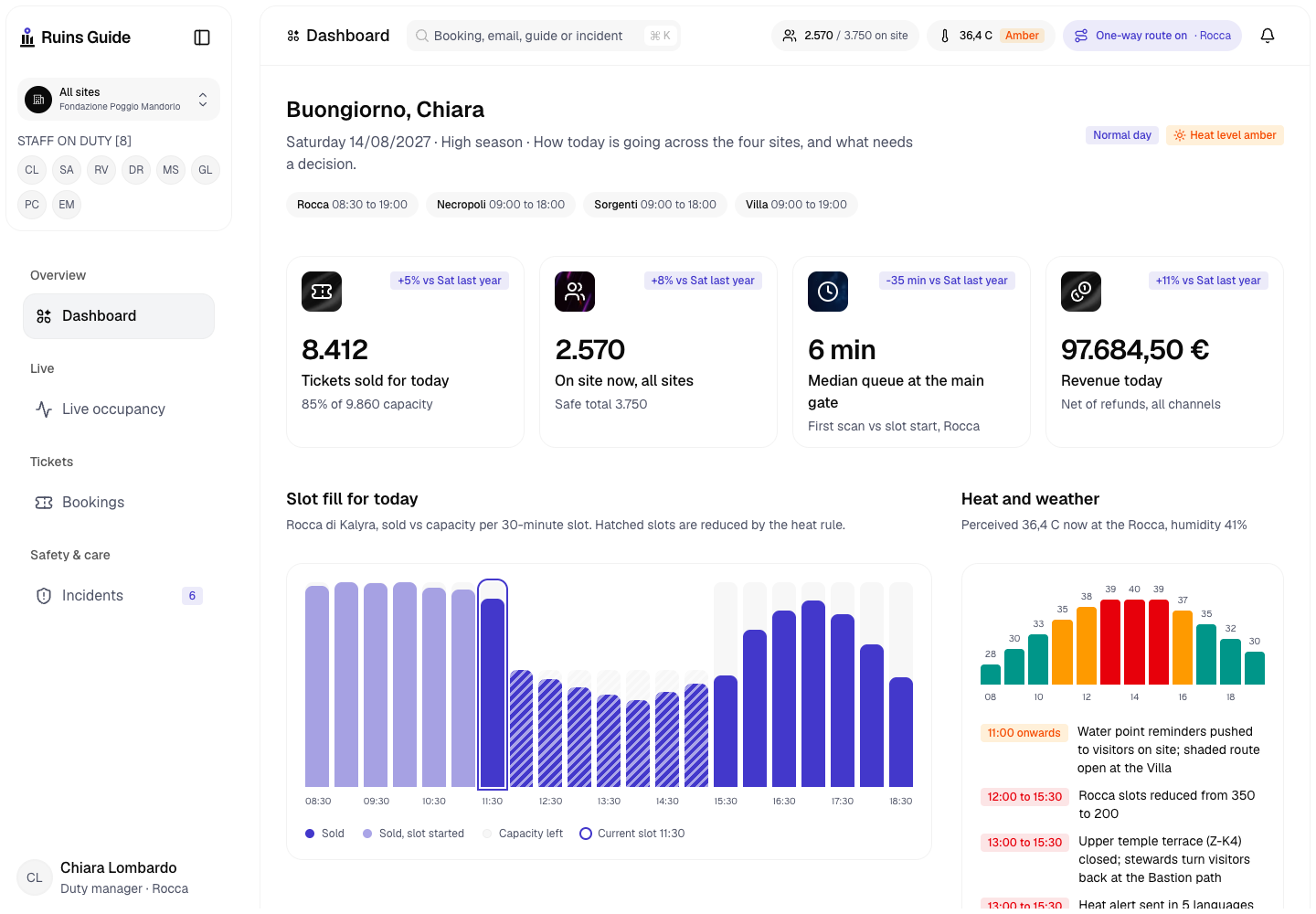
Ruins Guide - Timed Tickets, Live Crowd Flow and Safety for Four Archaeological Sites
Designed and built a clickable operations console for a heritage trust running four archaeological sites near Agrigento: timed-entry slots that shrink on red heat days, live occupancy by zone against safe capacity and conservation limits, bookings with gate scans and concession checks, and one incident log with lost child cases pinned at the top.
Enterprise Software Engineering - Human + AI
Contact Us
© 2026 - Copyright. All Rights reserved Oceanlab
Location
Global Headquarters
21 Merchant Road, 3rd Floor, Singapore 058267
Main corporate office and leadership operations
North America Office
548 Market Street, PMB 12345, San Francisco, CA 94104
Client operations and business development
India Office
402 Shivalik Shilp II, SG Highway, Ahmedabad 380015
Engineering and delivery center

Enterprise Software Engineering - Human + AI
Contact Us
Locations
Global Headquarters
21 Merchant Road, 3rd Floor, Singapore 058267
Main corporate office and leadership operations
North America Office
548 Market Street, PMB 12345, San Francisco, CA 94104
Client operations and business development
India Office
402 Shivalik Shilp II, SG Highway, Ahmedabad 380015
Engineering and delivery center
© 2026 - Copyright. All Rights reserved Oceanlab