Turnaround - Turn Control Platform with a Live Milestone Timeline
Turnaround Control for a Philippine Ground Handler
Designed and built a clickable turn control console for a ground handler serving 14 airlines at a regional hub in Cebu: a live dashboard of turns at risk, a flight board fed by the airport, a minute-by-minute timeline for every turn with its critical path and predicted off-block, a delay coding queue and a stand map with equipment.
Most of our work is under NDA. Per agreement, we can share the work but not the company details - all names and identifying information shown here have been changed.
Impact
Live dashboard, flight board, turnaround detail, delay coding queue and apron view. Every one of the 31 demo turns opens its own timeline, including the closed, cancelled and diverted ones.
From on-block to pushback, each with its dependencies. Late starts and overruns are pushed through those dependencies to give each turn its critical path, predicted off-block and predicted delay.
To code, awaiting approval, disputed and agreed. Coded minutes must equal the delay before submission, reactionary minutes are coded separately, and a duty manager cannot approve their own coding.
14 airlines, 6 aircraft types with turn standards from 25 to 60 minutes, 14 stands, 8 ramp teams, 23 equipment items, 8 issues, 16 delay codes and 7 delay codings, one of them disputed.
The Problem
Hunasan's turn controllers ran the day from a printed schedule, a whiteboard of stand numbers, three radio channels and a group chat per airline. Milestone times were written on paper and typed into a spreadsheet after the shift, so nobody saw a turn slipping until the aircraft was already late, and when it was, the only evidence of who caused the delay was memory and radio logs.
Our Solution
Turnaround takes the flight schedule and stand allocation from the airport and turns each arrival and departure pair into a timeline of milestones. The turn control team sees in real time which turns are slipping, which milestone is behind and which team or piece of equipment can fix it, and every late departure has its minutes coded against evidence before the airline sees it.
The Challenge: Every Minute on the Ramp, Accounted For
A ground handler at a busy hub runs about 180 departures a day, from 25-minute turboprop turns to 60-minute widebody turns, for airlines that each hold it to its own service levels. Every turn involves several teams, a set of ground equipment and more than a dozen tasks that depend on each other.
Delays Seen Too Late
With milestone times on paper, a late catering truck or a slow baggage load only showed up as a late pushback. Controllers had no way to see which task on which stand was about to push the departure past its scheduled time.
Disputes Without Evidence
A delay is coded against its first cause, with knock-on minutes coded separately, so the airline and the handler can agree who owns each minute. Without recorded times, Hunasan paid service credits on delays it could not prove were not its own.
Equipment Faults by Word of Mouth
Tugs, belt loaders and GPUs move between stands all day. A faulty item was reported verbally, so a tug with a failed brake could be dispatched twice before anyone knew it was out of service.
Staff Data and Apron Rules
Milestone taps tied to a named person fall under the Philippine Data Privacy Act, apron work under the occupational safety law RA 11058, and ground handling under CAAP and airport operator rules. Monitoring has to stay proportionate, and safety checks have to be recorded as evidence.
Our Approach: From Ramp Practice to a Clickable Console
Spec and Rules Research
Mapped 10 user roles and 38 screens across the turn control console, the ground staff app and the airline portal, and the data model for flights, turns, versioned turn standards, append-only milestone events, predictions, equipment, faults, safety checks, issues and delay codings. Wrote down the rules the design follows: IATA IGOM for the turn, IATA AHM delay codes and the SGHA, CAAP and airport apron rules, RA 11058 and the Data Privacy Act.
Clickable Demo on a Production UI Kit
Built 5 key screens on a production dashboard kit: the live dashboard with KPIs, at-risk turns and resource pressure per 15-minute slot, the flight board with feed change markers and team assignment, the turnaround detail with its Gantt timeline, the delay coding queue with a replay of the turn, and the apron view with stands, equipment and a 3-hour time slider. All actions run on local state.
What a Production Build Adds
The airport AODB feed over IATA AIDX, SITA Type B movement messages, apron camera events from Assaia ApronAI, GSE telematics from Undagrid or Samsara, push and SMS alerts, Microsoft Entra ID single sign-on and photo storage in an Asia Pacific region. Plus the ground staff app, the airline portal, SLA reports and a full audit log of milestone times, codes and reallocations.
Why It Works: The Critical Path, Always in View
Predictions From the Turn Itself
Each turn's predicted off-block comes from its standard's dependencies and the live progress of its milestones, with the milestones driving it and a confidence level. The dashboard sorts turns at risk by predicted delay and names the milestone behind, with a Fix button that opens the turn.
Every Time Shows Its Source
Each milestone time is marked as coming from the staff app, a sensor, an apron camera, the airport feed or a manual entry. When a camera event and a staff tap are more than 3 minutes apart, the timeline flags it and shows both times.
Delay Codes Built on Evidence
The coding form replays the turn with late milestones marked. Each cause line carries a code, minutes, the responsible party and its evidence, and the form will not submit until coded minutes match the delay, so a dispute is settled on record.
Space and Equipment at a Glance
The apron view shows each stand's turn, progress and status colour, the equipment parked there and items out of service crossed out. Resource pressure turns amber in any 15-minute slot where planned turns need more teams or equipment than are free.
Related case studies
View all: Aviation & airports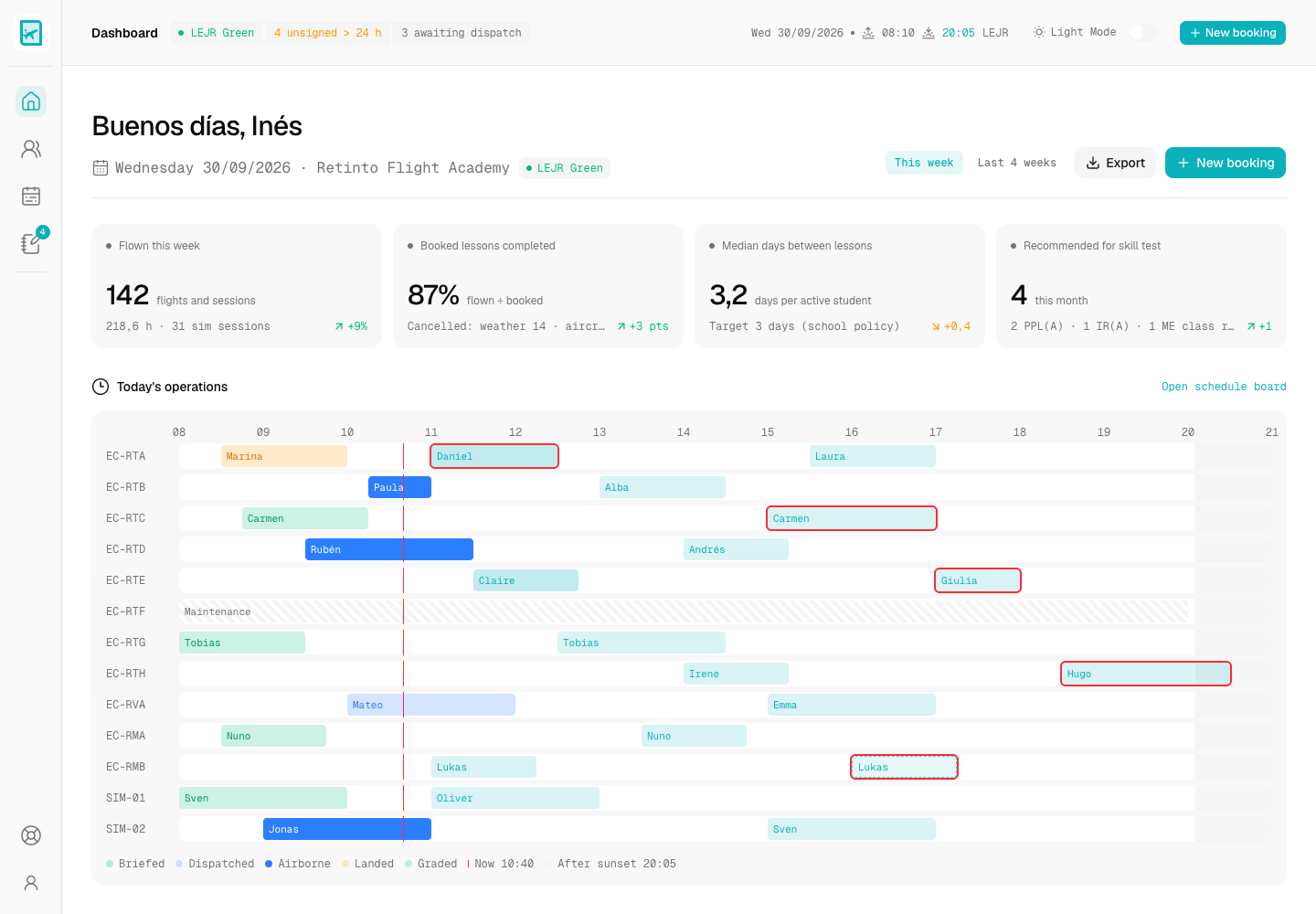
Logbook - Training Records, Scheduling and Currency Tracking for a Flight School
Designed and built a clickable training records platform for an approved training organisation at Jerez Airport: every student's syllabus progress, documents and logbook in one record, a schedule board that checks each booking against the rules, and lesson records that are sealed once the instructor signs.
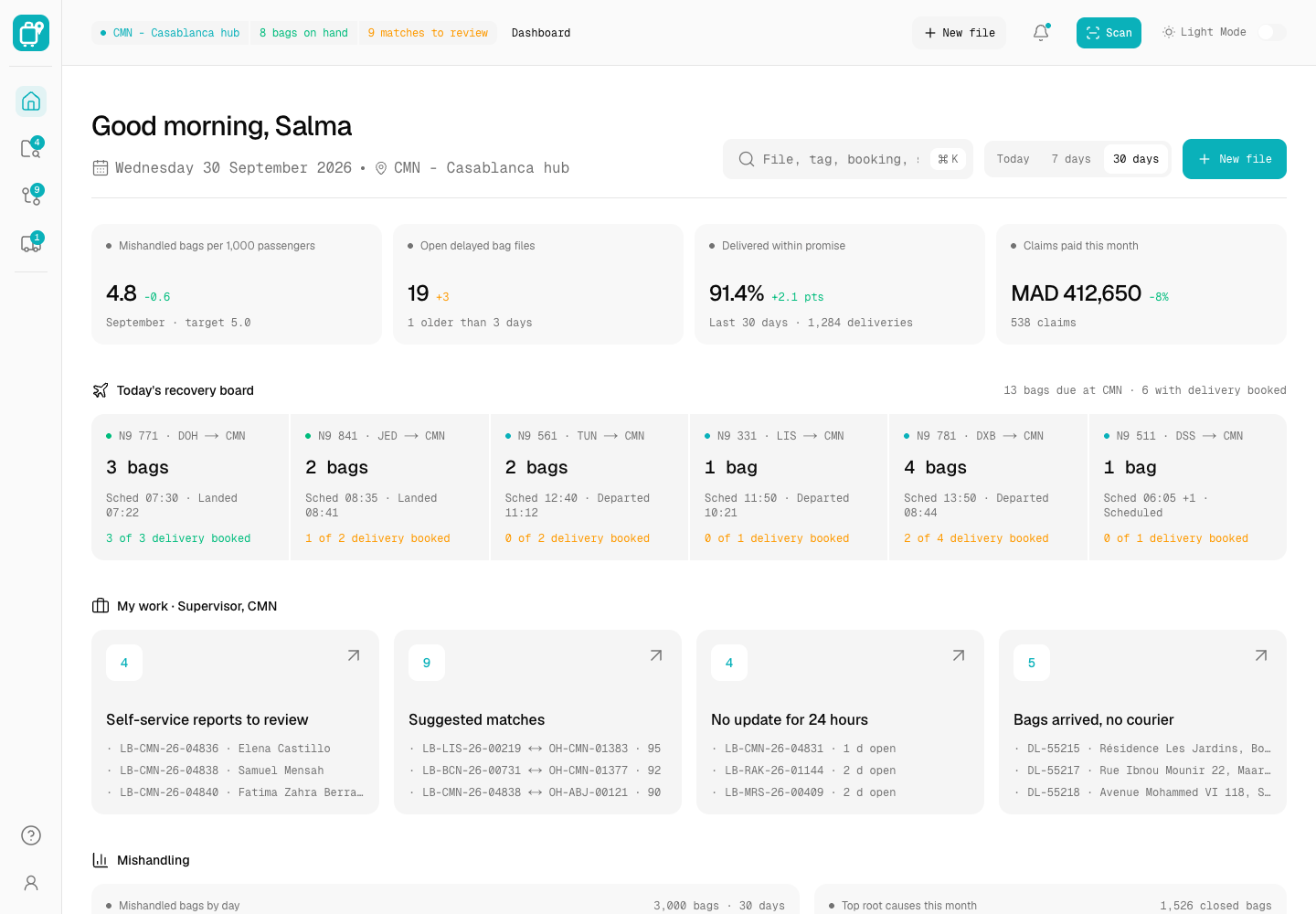
Lost Bag - Mishandled Baggage Tracing and Delivery Platform
Designed and built a clickable mishandled baggage platform for a Casablanca-based regional airline: baggage services agents work files that mirror WorldTracer, read each bag's scan history, confirm scored matches between open files and on-hand bags, and dispatch couriers against the delivery promise.
Enterprise Software Engineering - Human + AI
Contact Us
© 2026 - Copyright. All Rights reserved Oceanlab
Location
Global Headquarters
21 Merchant Road, 3rd Floor, Singapore 058267
Main corporate office and leadership operations
North America Office
548 Market Street, PMB 12345, San Francisco, CA 94104
Client operations and business development
India Office
402 Shivalik Shilp II, SG Highway, Ahmedabad 380015
Engineering and delivery center

Enterprise Software Engineering - Human + AI
Contact Us
Locations
Global Headquarters
21 Merchant Road, 3rd Floor, Singapore 058267
Main corporate office and leadership operations
North America Office
548 Market Street, PMB 12345, San Francisco, CA 94104
Client operations and business development
India Office
402 Shivalik Shilp II, SG Highway, Ahmedabad 380015
Engineering and delivery center
© 2026 - Copyright. All Rights reserved Oceanlab