Lost Bag - Mishandled Baggage Tracing and Delivery Platform
Baggage Tracing Platform for a Moroccan Regional Airline
Designed and built a clickable mishandled baggage platform for a Casablanca-based regional airline: baggage services agents work files that mirror WorldTracer, read each bag's scan history, confirm scored matches between open files and on-hand bags, and dispatch couriers against the delivery promise.
Most of our work is under NDA. Per agreement, we can share the work but not the company details - all names and identifying information shown here have been changed.
Impact
Dashboard, files list, file detail with up to 8 tabs, matching workbench and delivery dispatch board. Every one of the 30 demo files opens its own file detail.
Each suggested match between a file and an on-hand bag shows its score and the points behind it, such as 60 for an exact tag number and 15 for route overlap, with differing fields highlighted side by side.
The airline's own policy, held as settings: MAD 600 for the first day and MAD 350 for each further day. Every file shows what was claimed against the cap.
Delayed, damaged and pilfered files across 8 stations, 13 on-hand bags, 9 suggested matches, 14 deliveries, 6 couriers including a partner, and passenger messages in Arabic, French and English.
The Problem
Nakhla Wings mishandles a few thousand bags a month, most of them short-shipped on tight transfers at its Casablanca hub. Passengers queued to fill in a paper report, agents re-keyed it into WorldTracer, matched on-hand bags by eye, booked couriers by phone and kept delivery notes in a spreadsheet. Expense receipts arrived by email in three languages, claims had no consistent limits, and nobody could say which station or transfer was causing the problem.
Our Solution
Lost Bag takes a mishandled bag from report to delivery in one place. Each file mirrors its WorldTracer record and shows the bag's scan history from the baggage system, open files are matched to on-hand bags with a score and its reasons, and the dispatch board assigns couriers against the delivery promise for each zone.
The Challenge: Finding Bags Across a Hub and Its Outstations
Nakhla Wings flies 60 routes through Casablanca Mohammed V, where it handles its own bags, while outstations use contracted handlers. A delayed bag can be held at any of them, and the passenger can be anywhere.
Two Records of Every File
Mishandled bags are traced through SITA WorldTracer as delayed bag files, damage or pilferage reports and on-hand records. Agents re-keyed paper reports into it, so the airline's own record and the industry one drifted apart.
Where the Bag Actually Went
IATA Resolution 753 expects bags to be tracked at acceptance, loading, transfer and arrival, through BSM and BPM messages from the baggage system. Agents could not see that history next to the file, so a missed load on a connecting flight had to be found by phone.
Matching Bags by Eye
Bags arrive at the store with a torn tag, a name label or nothing but a type and colour. Matching them to open files depended on an agent remembering the IATA type and colour codes and the passenger's description.
Limits Set by Law and by Policy
The Montreal Convention sets the carrier's liability limit in SDR and the deadlines for a written complaint, domestic files fall under Moroccan civil aviation law, and Law 09-08 governs passenger data. The airline adds its own expense caps and delivery promises on top.
Our Approach: From Tracing Rules to a Clickable Platform
Spec and Rules Research
Mapped 13 roles, from baggage services agents and couriers to claims handlers, fraud analysts and the data protection officer, and 43 screens across the staff product, the passenger pages and the courier app. Defined the data model for files, bag descriptions, scan events, on-hand bags, matches, forwardings, deliveries, claims and the versioned claims policy, and wrote down the rules the design follows: the Montreal Convention, Law 40-13, Law 09-08 and the CNDP, WorldTracer file types, the IATA bag type chart and Resolution 753.
Clickable Demo on a Production UI Kit
Built 5 key screens on a production dashboard kit: the dashboard with KPIs, today's recovery board and needs-attention list, the files list with filters and a quick view panel, the file detail with progress rail, deadlines, scan history, matches, messages and tracing log, the matching workbench with confirm, reject and skip, and the delivery dispatch board with courier capacity. All actions run on local state.
What a Production Build Adds
Integration with SITA WorldTracer, the hub baggage system's BSM and BPM feed, departure control (such as Amadeus Altéa), a flight schedule feed, Infobip or Twilio messaging, receipt OCR, bank payouts and a courier partner. Microsoft Entra ID sign-in, an audit log for every payout, approval, match and closure, legal sign-off on the liability limit and deadlines, and the remaining screens: on-hand bags, forwarding, claims and approvals, fraud review, reports, settings, the passenger pages and the courier app.
Why It Works: The Scan History Behind Every File
Gaps in the Scan History Stand Out
Every bag shows its scans in time order with the source message and station, from check-in to courier pickup. A bag that was checked through Casablanca with no load scan on the connecting flight is highlighted in red, so the agent sees where it stopped.
Matches Explain Their Score
The workbench lists suggestions highest score first, from Lost Bag's rules or a WorldTracer match message, and compares the file and the bag field by field. Confirming one moves the file to bag found and rejects the other suggestions for that bag.
Deadlines Come From the Policy
Each file shows its complaint deadline, the date the bag will be treated as lost and the days since it was due, calculated from the claims policy version in force when it opened. None of the legal values are hard-coded.
Promises Drive the Dispatch Board
Deliveries turn amber within 2 hours of the promise and red once it is missed, couriers show their load against capacity, and a failed delivery carries its reason. Closing a file needs a root cause, so the airline can see which transfers cause mishandling.
Related case studies
View all: Aviation & airports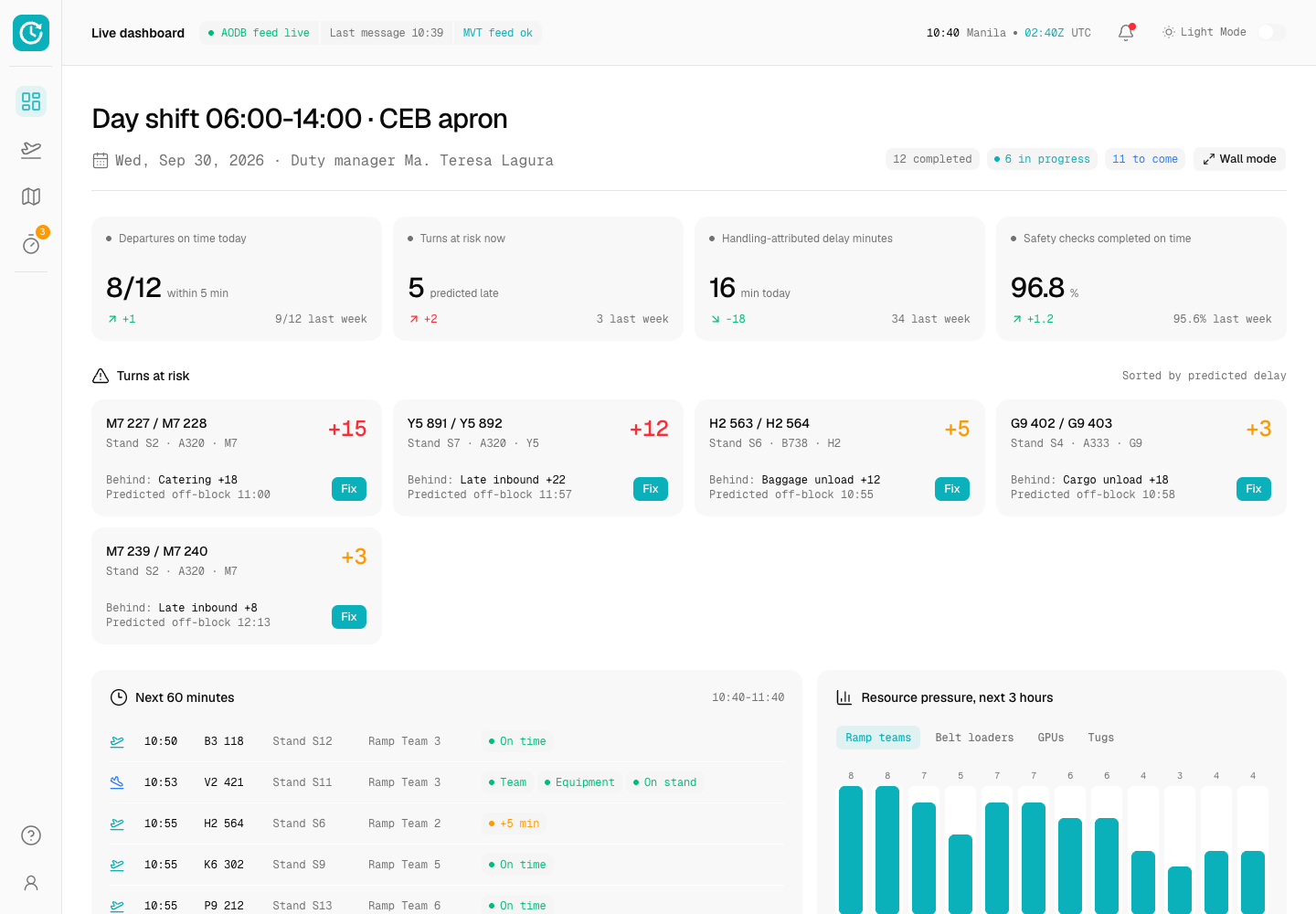
Turnaround - Turn Control Platform with a Live Milestone Timeline
Designed and built a clickable turn control console for a ground handler serving 14 airlines at a regional hub in Cebu: a live dashboard of turns at risk, a flight board fed by the airport, a minute-by-minute timeline for every turn with its critical path and predicted off-block, a delay coding queue and a stand map with equipment.
Logbook - Training Records, Scheduling and Currency Tracking for a Flight School
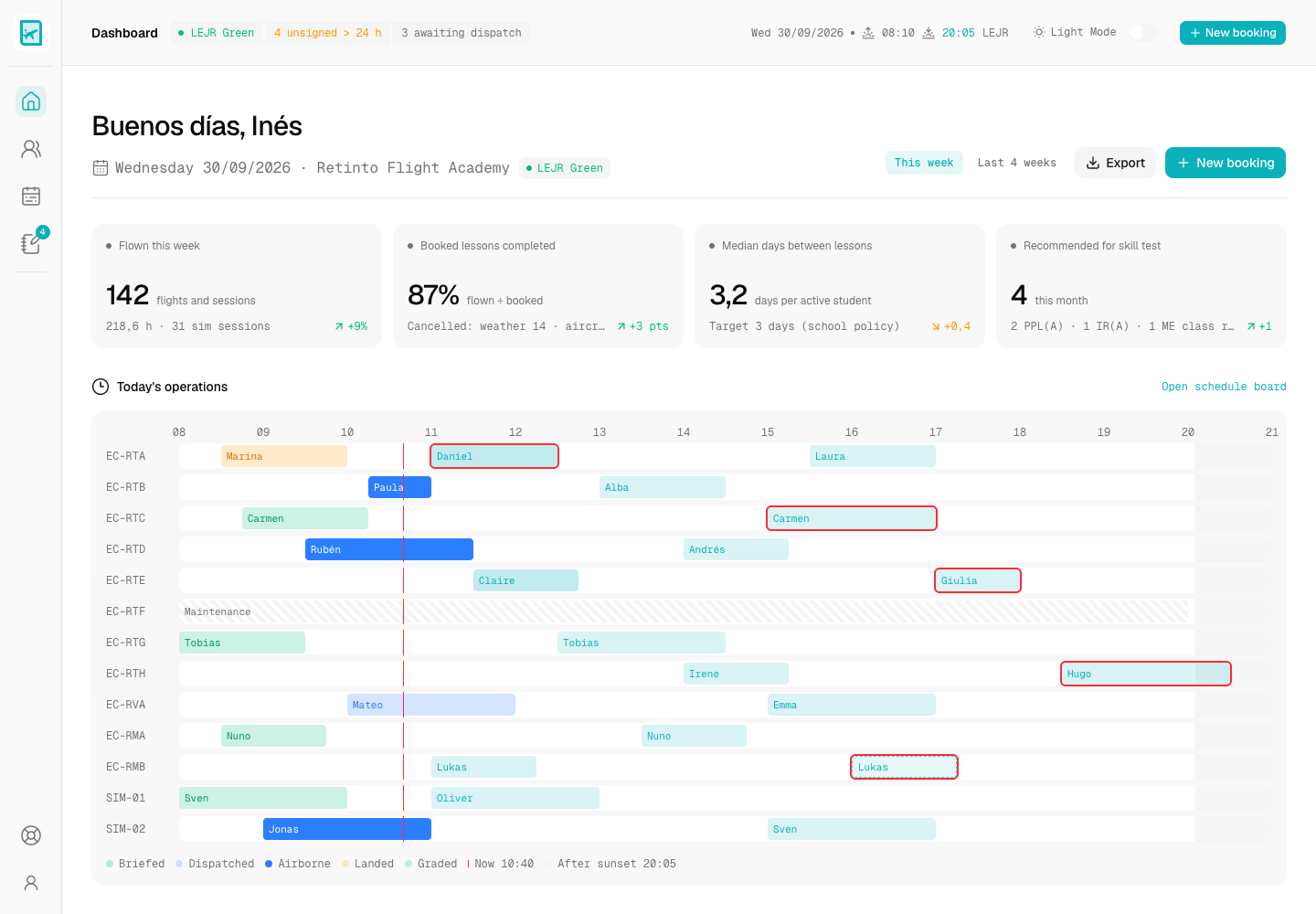
Designed and built a clickable training records platform for an approved training organisation at Jerez Airport: every student's syllabus progress, documents and logbook in one record, a schedule board that checks each booking against the rules, and lesson records that are sealed once the instructor signs.
Enterprise Software Engineering - Human + AI
Contact Us
© 2026 - Copyright. All Rights reserved Oceanlab
Location
Global Headquarters
21 Merchant Road, 3rd Floor, Singapore 058267
Main corporate office and leadership operations
North America Office
548 Market Street, PMB 12345, San Francisco, CA 94104
Client operations and business development
India Office
402 Shivalik Shilp II, SG Highway, Ahmedabad 380015
Engineering and delivery center

Enterprise Software Engineering - Human + AI
Contact Us
Locations
Global Headquarters
21 Merchant Road, 3rd Floor, Singapore 058267
Main corporate office and leadership operations
North America Office
548 Market Street, PMB 12345, San Francisco, CA 94104
Client operations and business development
India Office
402 Shivalik Shilp II, SG Highway, Ahmedabad 380015
Engineering and delivery center
© 2026 - Copyright. All Rights reserved Oceanlab