Tropeiro - Equipment Tracking Platform for Plant, Tools and Hire
Plant and Equipment Tracking for a Brazilian Civil Contractor
Designed and built a clickable equipment tracking console for a Minas Gerais civil engineering contractor and its plant hire division: a live map of about 900 assets, an asset register with service and certificate state, the full life of each machine, and one alert queue for theft, geofence, defect and certificate events.
Most of our work is under NDA. Per agreement, we can share the work but not the company details - all names and identifying information shown here have been changed.
Impact
Dashboard, live map with asset panel, asset register with quick view, asset detail with 8 tabs, and the alert queue with its alert panel. Every one of the 28 demo assets opens its own detail page.
Ignition or movement outside site hours (Monday to Saturday) or outside a geofence raises a critical alert, which turns amber after 10 minutes and red after 30 if nobody picks it up.
Hour meter readings that differ from telematics by more than 5% are flagged, and so is fuel issued that exceeds fuel burned by more than 15% in a week.
11 on OEM telematics feeds from 5 manufacturers, 15 on aftermarket trackers and 2 tag-only, across 12 asset classes, 10 sites and yards with geofences, and 16 alerts.
The Problem
Canela de Ema's plant manager ran the fleet from a spreadsheet of serial numbers, five OEM telematics websites, a paper hour-meter book in each site container and a WhatsApp group for broken machines. Services were missed, idle machines sat on finished sites while the same class was hired in, a crane's lifting certificate lapsed unnoticed, and a compactor and a generator were stolen over a weekend while their trackers reported them moving at 02:00.
Our Solution
Tropeiro puts every asset in one place: where it is now, how many hours it has run, when its next service and certificate are due, who it is allocated or hired to, and what needs a person today. A live map, an asset register and one alert queue replace the separate portals, and unsafe or uncertified assets are blocked on screen.
The Challenge: 900 Assets, Five Portals and No One Watching
Canela de Ema owns excavators, cranes, rollers, generators and hundreds of small tools, spread across road, sanitation and earthworks sites in Minas Gerais and hired out to third parties when idle. Each asset reports differently, and each one carries its own service, safety and commercial rules.
Telematics From Many Sources
Newer machines report through OEM feeds, some through ISO 15143-3 and others through the manufacturer's own API, older plant and generators through aftermarket trackers, and small tools only when someone scans a tag. The fields each source reports vary by make and model.
Services and Certificates Missed
Heavy plant is serviced every 250 engine hours or 6 months, whichever comes first, and nobody added the hours up in time. Cranes need periodic inspections by a qualified professional, recorded with an ART, and a lapsed certificate was found by a client's safety inspector.
Theft Signals Nobody Saw
Trackers already reported after-hours ignition and movement, but the data sat in separate portals overnight. The plant team needed one queue that raises an alert, tells the right people by SMS or WhatsApp and shows how long it has been waiting.
Machine Data That Points to People
Once a machine is linked to the operator who signed its pre-start, its location and hours show where that person was and how they worked. Under LGPD that history has to be treated as personal data, restricted by role and never used to score individual operators.
Our Approach: From Plant Rules to a Clickable Console
Spec and Rules Research
Mapped 11 user roles, 46 screens across the web console, a workshop view for mechanics, an offline-first mobile app for operators and a public asset tag page, and the data model for assets, telemetry, allocations, alerts, maintenance plans, pre-start checks, inspections, hire contracts and charge-back. Wrote down the rules the design follows: NR-11, NR-12 and NR-18, LGPD, ISO 15143-3, Súmula Vinculante 31 on dry hire, and the client's own service, idle and hire policies.
Clickable Demo on a Production UI Kit
Built 5 key screens in Portuguese on a production dashboard kit: the dashboard with utilisation against the 65% target, fleet status and My work, the live map with geofences, state filters, day replay and a theft trail, the asset register with status pills and bulk actions, asset detail with block, transfer and mark stolen actions, and the alert queue with acknowledge, assign, close and escalate to theft. All actions run on local state.
What a Production Build Adds
Integration with OEM telematics (Caterpillar VisionLink, Komatsu Komtrax, John Deere JDLink, Volvo CareTrack, JCB LiveLink), aftermarket trackers, Google Maps, Ticket Log fuel cards, TOTVS Protheus, e-signature for hire contracts and Zenvia or Twilio alerts. Role-based access, an audit log of every status, hours, rate and certificate change, and the remaining screens: maintenance, work orders, inspections, hire, charge-back, disposals, the workshop view and the mobile app.
Why It Works: The Fleet Tells You What Needs a Person
Theft Alerts Come First
After-hours ignition and geofence exits are pinned at the top of the dashboard in red, and the alert panel shows the trail around the event, the rule that fired and who was notified by push, SMS or WhatsApp. Escalate to theft marks the asset stolen in one step.
Unsafe Assets Stay Blocked
A blocking pre-start defect or an expired lifting certificate blocks the asset, and the reason shows on its header, in the register and in the alert queue. A crane is blocked the day after its certificate expires, with the inspector's CREA registration and the ART on record.
Every Source in One Register
Each asset shows its hours with their source (OEM feed, tracker, app or workshop), its tracking type and its last report. Search finds an asset by fleet number, serial number, PIN or tag code, whichever is on hand.
Reported by Asset, Not by Operator
Idle and fuel figures are shown by asset and site, not ranked by operator. The idle ratio counts engine running without work for more than 15 minutes, and an asset over 30% of its engine hours in a week is flagged for the plant team to act on.
Related case studies
View all: Construction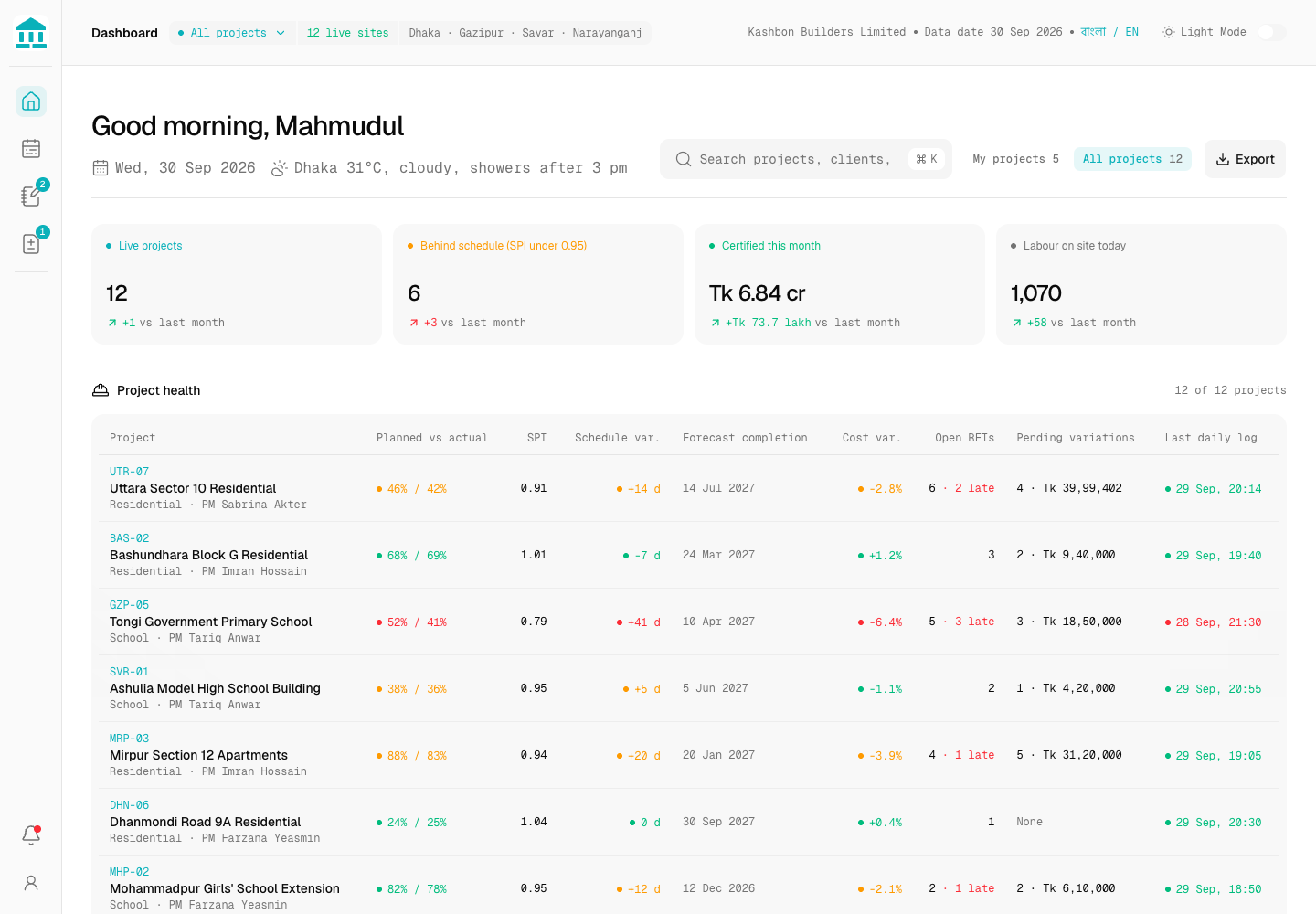
Bhitti - Site Project Management Platform with Critical Path and Variation Control
Designed and built a clickable site project management platform for a Dhaka general contractor running 12 live residential and school sites: a portfolio dashboard with site health, a master programme with critical path and baselines, the daily site diary, and a variations register that routes every change to the right approver by limit.
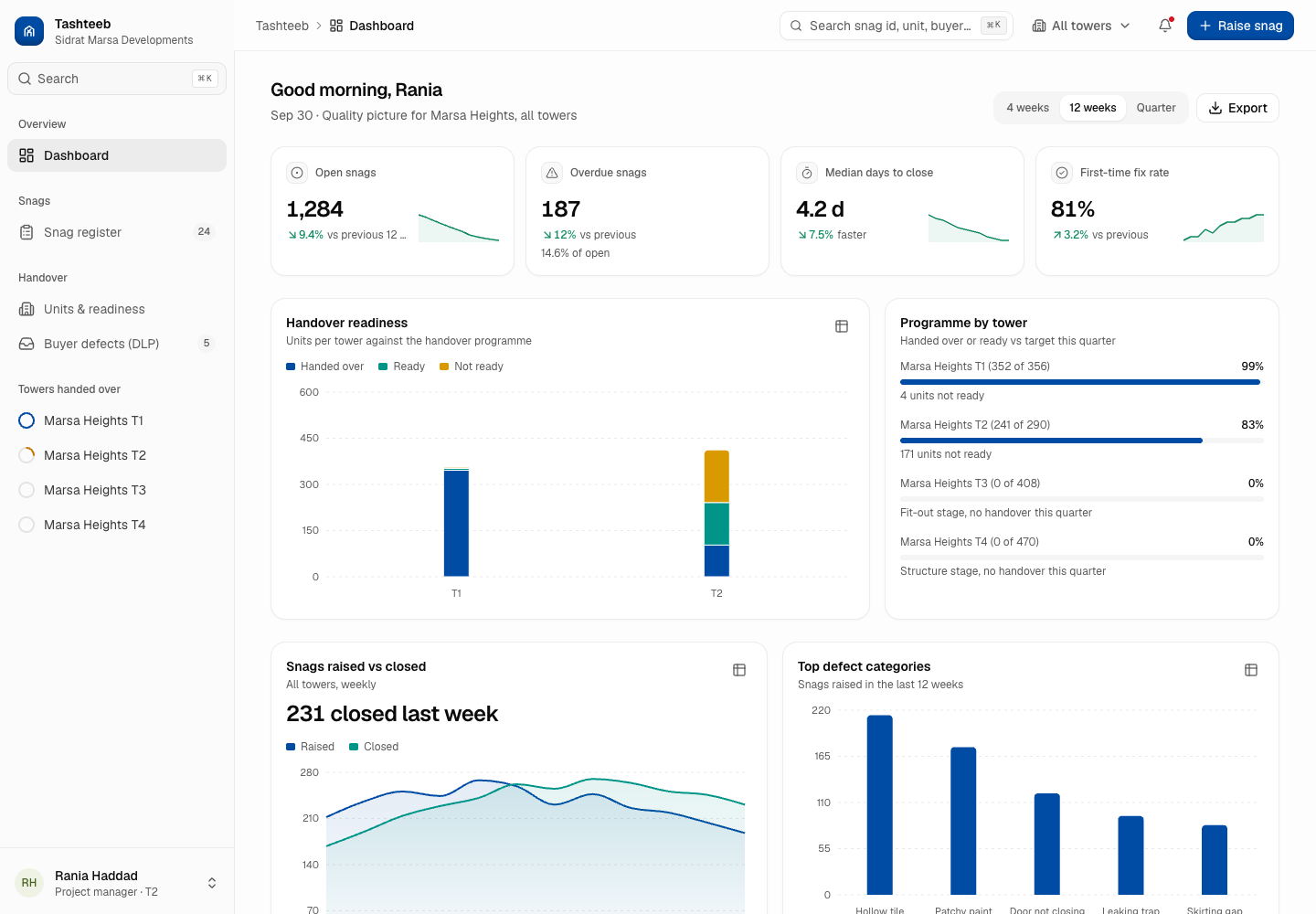
Tashteeb - Snagging, Inspections and Buyer Handover Platform
Designed and built a clickable snagging and handover console for a Dubai apartment developer-builder: a snag register with plan pins and photo evidence, subcontractor fixes and disputes, a handover readiness rule on every unit, and a queue for defects buyers report after moving in.
Enterprise Software Engineering - Human + AI
Contact Us
© 2026 - Copyright. All Rights reserved Oceanlab
Location
Global Headquarters
21 Merchant Road, 3rd Floor, Singapore 058267
Main corporate office and leadership operations
North America Office
548 Market Street, PMB 12345, San Francisco, CA 94104
Client operations and business development
India Office
402 Shivalik Shilp II, SG Highway, Ahmedabad 380015
Engineering and delivery center

Enterprise Software Engineering - Human + AI
Contact Us
Locations
Global Headquarters
21 Merchant Road, 3rd Floor, Singapore 058267
Main corporate office and leadership operations
North America Office
548 Market Street, PMB 12345, San Francisco, CA 94104
Client operations and business development
India Office
402 Shivalik Shilp II, SG Highway, Ahmedabad 380015
Engineering and delivery center
© 2026 - Copyright. All Rights reserved Oceanlab