Tack Room - Livery, Riding School and Horse Care in One Yard System
Yard System for an Irish Livery Yard and Riding School
Designed and built a clickable yard manager console for an Irish equestrian centre with 70 stables and a riding school: every horse with its feeding plan, allergies and food chain status, health observations that escalate until someone acknowledges them, and school horse workload checked against the yard's welfare policy.
Most of our work is under NDA. Per agreement, we can share the work but not the company details - all names and identifying information shown here have been changed.
Impact
Dashboard, horses list, horse detail with 7 tabs, observations and escalations, and school horses and workload. Every one of the 26 demo horses opens its own detail page.
At most 3 lessons and 3 hours a day, 2 lessons back to back before a 30-minute break, 15 hours a week and at least 1 rest day. Each horse shows green, amber at limit or red blocked, with the reason.
An urgent observation alerts the head groom and yard manager at once and re-alerts every 10 minutes until acknowledged. The owner is always told, and severity can be raised above the checklist's suggestion but never lowered.
14 livery and 12 school horses, 12 owners, 11 staff users, 13 health observations, 5 farrier, vet and dental visits, 6 medication records and 9 lessons on the demo day.
The Problem
Glenmoragh ran on a whiteboard in the feed room, a lesson diary, three WhatsApp groups and a spreadsheet of invoices. Feed changes were chalked up and rubbed off, so a horse with a soya allergy was given the wrong mix twice in one winter. Owners texted to ask whether their horse had been turned out or rugged, school horses were booked back to back on busy Saturdays with nobody checking their total workload, and worming and vaccination dates were chased by memory.
Our Solution
Tack Room gives the yard manager one console for stables, horses, health, welfare and the school. Each horse carries its versioned feeding plan, allergies, turnout and rug rules, food chain status and health record, urgent observations climb an escalation chain until someone acknowledges them, and school horses are checked against the welfare policy before they are allocated to a lesson.
The Challenge: Running a Yard Around Each Horse
Glenmoragh lets 70 stables on full, part and DIY livery and runs a riding school with 25 school horses teaching about 400 lessons a week. Every horse has its own feed, turnout, health and paperwork, and the people caring for it change round by round.
Feed Changes That Did Not Stick
A feeding plan changes with the season, the vet and the owner, and the groom on the next round has to know. On a whiteboard, an allergy or an exclusion could be rubbed off with the old plan, and nobody could say who changed what or why.
School Horses With No Workload Check
The Animal Health and Welfare Act 2013 sets a general duty of care, and Glenmoragh's own welfare policy limits each school horse's lessons per day, hours per week and rest days. Lessons were booked from a diary, so a horse could be over its limits before anyone noticed.
Medicines, Food Chain and Competition
Horses count as food-producing animals unless the passport declares otherwise, so under the Veterinary Medicines Regulation (EU) 2019/6 medicines generally have to be recorded and withdrawal periods apply. Competition horses also follow FEI and Horse Sport Ireland rules, where a detection time is not the same as a withdrawal period.
Sensitive Records About People and Horses
Passport and microchip details, rider weight and medical notes are restricted, and much of the riding school's data is about children, under the GDPR and Ireland's Data Protection Act 2018. Staff who work with children need Garda vetting, and the accident book was a paper ledger nobody could search.
Our Approach: From Yard Rules to a Clickable Console
Spec and Rules Research
Mapped 10 user roles and 48 screens across the yard manager console, the yard staff app, the owner app, the riding school app and a visiting professional link, with the data model for horses, stables, livery contracts, versioned feeding plans, rug rules, the daily task board, observations, visits, medication records, school horse profiles, lessons, incidents and invoices. Wrote down the rules the design follows: GDPR and the Data Protection Act 2018, EU equine identification rules, the Veterinary Medicines Regulation, FEI medication rules, the Children First Act 2015 and Garda vetting, animal welfare and workplace safety law.
Clickable Demo on a Production UI Kit
Built 5 key screens of the yard manager console on a production dashboard kit: the dashboard with weather, settable turnout advice, board completion, today's board by round, school today, visits and a needs attention list; the horses list with livery, block, health flag and status filters; the horse detail with its food chain chip, allergy band and 7 tabs; observations and escalations with the escalation chain; and school horses with workload status, row actions and a weekly heat map. All actions run on local state.
What a Production Build Adds
Stripe and GoCardless for cards and SEPA Direct Debit, a Xero or Sage export, Twilio and Postmark messaging, Met Éireann weather, Bluetooth microchip scanners and maps for visiting professionals. Staff sign-in by role with restricted fields, an append-only audit log, an offline staff app, and the remaining screens: stable map, liveries, task board planner, medication, worming and vaccination, lessons, arenas, incident book, billing, reports, settings and the staff, owner and riding school apps.
Why It Works: The Horse's Rules on Every Screen
Allergies in Red, Plans With History
A horse's allergies sit in a red band across its detail page and on every feed card, and a feeding plan item that contains the allergen is refused. Each plan change is a new version with who made it and why.
Workload Checked Before Allocation
Every school horse shows lessons and hours today, hours this week, lessons back to back and rest days, coloured green, amber or red with the reason from the welfare policy. A blocked horse cannot be allocated, and a manager override needs a reason that is logged.
Urgent First, Until Someone Answers
Urgent observations sit at the top in red with minutes since escalation. The observation panel shows the groom's checklist and each step of the chain with its acknowledgement time, and a banner asks whether the vet has been called while an urgent alert is unacknowledged.
Medication Gated by the Passport
The food chain status from the passport sits in the horse's header, and recording medication is blocked while it is unknown. Competition dates are only ever the vet's advised "not before" date, shown with a reminder to confirm with the vet, and opening passport or microchip details needs a reason and is logged.
Related case studies
View all: Agriculture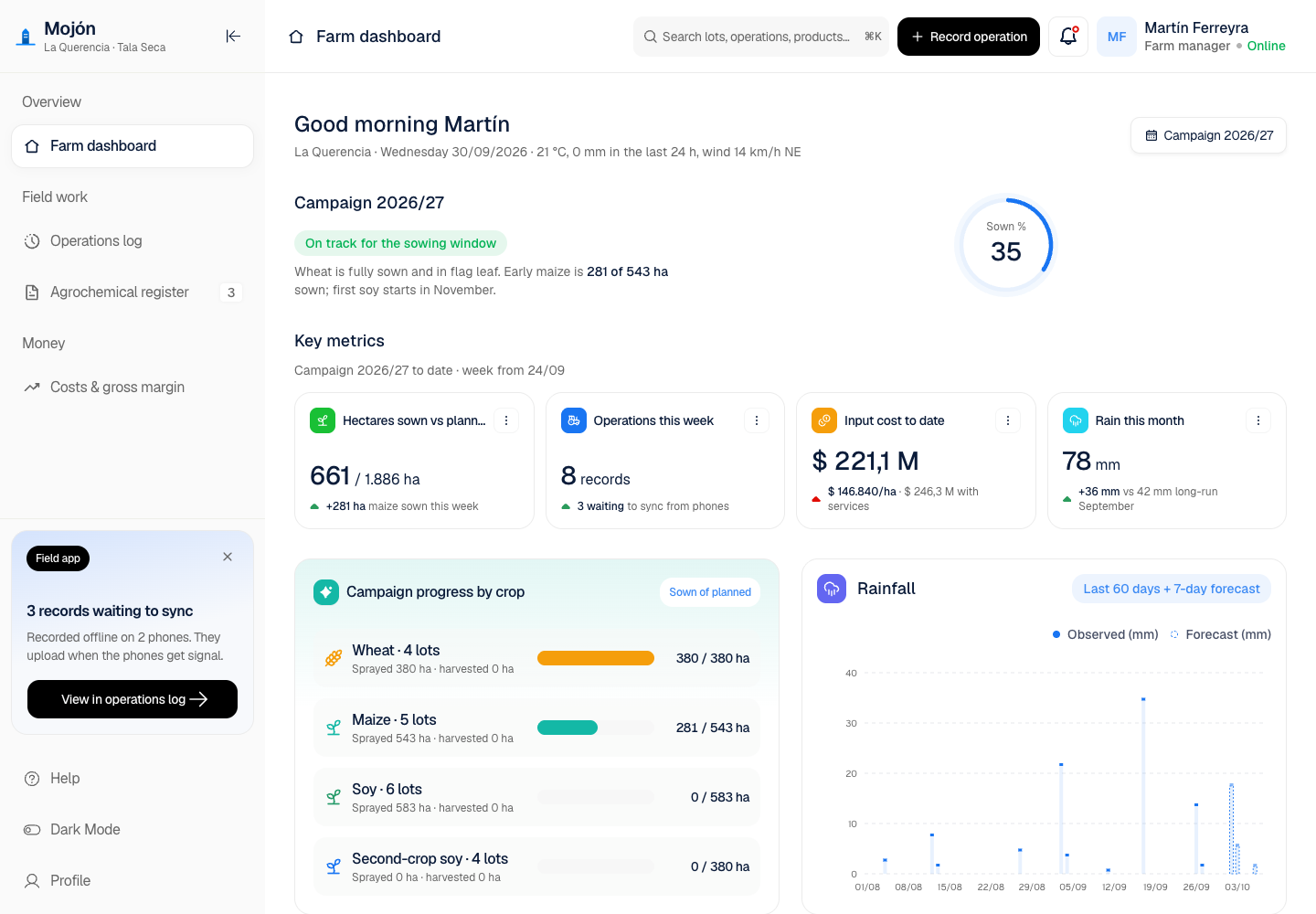
Mojón - Farm Management with Offline Field Records and a Cooperative Console
Designed and built a clickable farm management app for the member farms of a grain cooperative in Córdoba, Argentina: a field operations log, an agrochemical register that ties every spray to a signed agronomic prescription, application records ready for inspectors and grain buyers, and costs and gross margin per lot. The full design adds an offline mobile field app and a cooperative console.
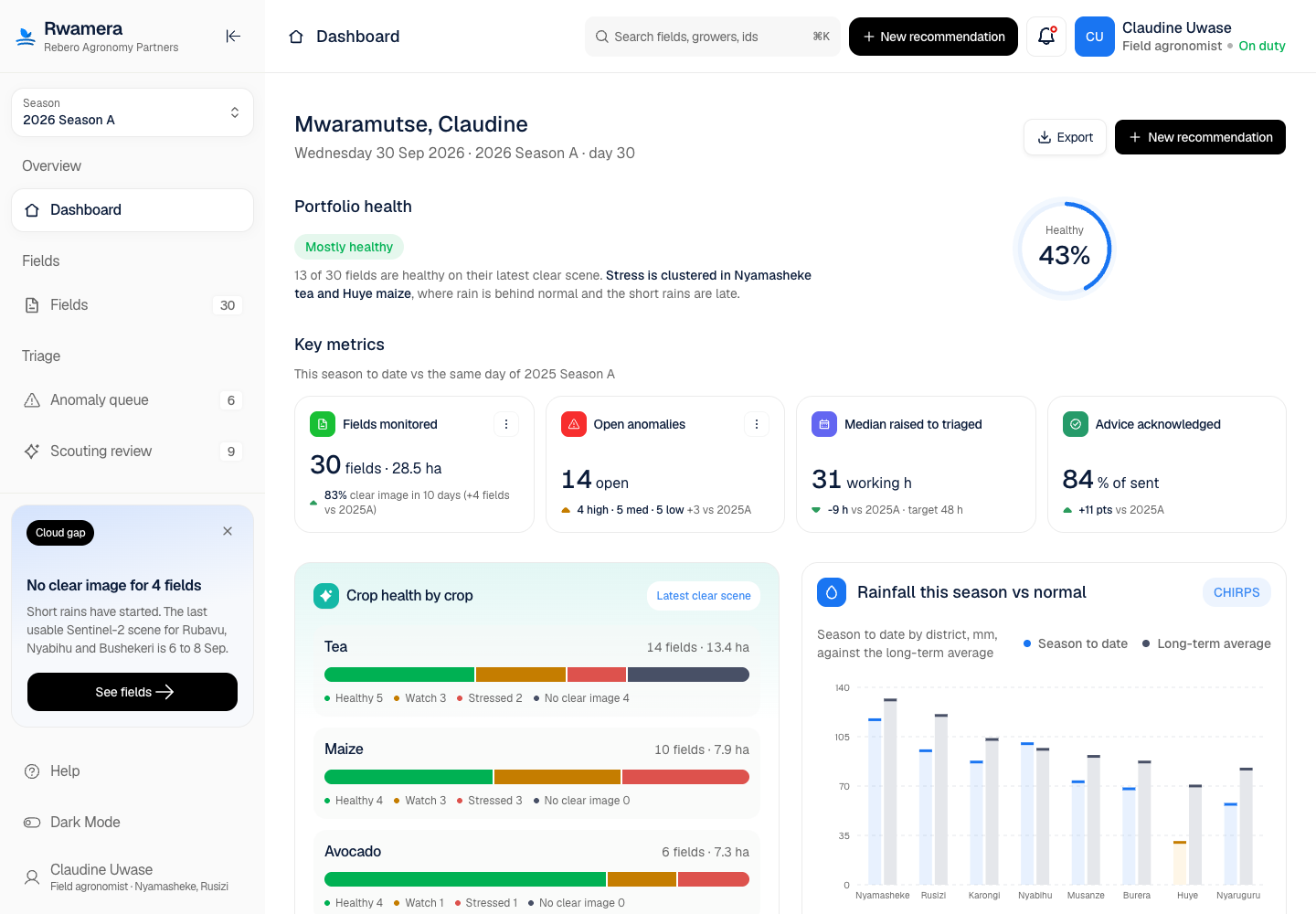
Rwamera - Satellite Crop Monitoring with Cloud-Aware Field Maps and Agronomist Triage
Designed and built a clickable crop monitoring console for a Kigali agronomy advisory firm serving tea, maize and avocado growers: satellite index maps per field with cloud masked out, a queue of stress anomalies to triage, scouting photos with an advisory-only AI suggestion, and advice that cannot name an unregistered pesticide or reach a grower without senior approval.
Enterprise Software Engineering - Human + AI
Contact Us
© 2026 - Copyright. All Rights reserved Oceanlab
Location
Global Headquarters
21 Merchant Road, 3rd Floor, Singapore 058267
Main corporate office and leadership operations
North America Office
548 Market Street, PMB 12345, San Francisco, CA 94104
Client operations and business development
India Office
402 Shivalik Shilp II, SG Highway, Ahmedabad 380015
Engineering and delivery center

Enterprise Software Engineering - Human + AI
Contact Us
Locations
Global Headquarters
21 Merchant Road, 3rd Floor, Singapore 058267
Main corporate office and leadership operations
North America Office
548 Market Street, PMB 12345, San Francisco, CA 94104
Client operations and business development
India Office
402 Shivalik Shilp II, SG Highway, Ahmedabad 380015
Engineering and delivery center
© 2026 - Copyright. All Rights reserved Oceanlab