Soroban - Group Spend Analytics Across Four ERPs
Spend Cube for a Japanese Trading and Manufacturing Group
Designed and built a clickable spend analytics platform for an Osaka trading and manufacturing group with companies in Japan, Thailand and Vietnam: messy vendor records from four ledgers folded into supplier families, every line classified to UNSPSC and converted to yen, and one spend cube to slice it by category, supplier, entity and period.
Most of our work is under NDA. Per agreement, we can share the work but not the company details - all names and identifying information shown here have been changed.
Impact
Dashboard, spend cube, supplier families, supplier family detail with its family tree, and classification review. The account menu switches between 6 demo users, and My work follows the role.
Narumi Kozai's 11 vendor records from SAP, OBIC7 and Business Central, in kanji, katakana and romaji, sit under one family with 2 legal entities. Each link shows whether it came from the corporate number or a name match a person approved.
SAP S/4HANA, OBIC7, Dynamics 365 Business Central and MISA AMIS plus a corporate card file, for 4 companies in 3 countries. JPY, THB and VND spend is reported in yen, net of consumption tax by default.
24 named supplier families with full family trees plus a tail of 1,806, 24 months of spend by entity, 18 classification review groups in Japanese, Thai and Vietnamese, 25 UNSPSC v26 commodity codes and 6 group contracts.
The Problem
Hinokawa's group procurement office could not say how much the group spent with a supplier without a two-week spreadsheet exercise. Each company ran its own ledger with its own vendor master, account codes and currency, the same steel trader appeared under eleven spellings, card spend sat in uncoded bank files, nobody could check whether subsidiaries used group contracts or whether savings claims held up against invoices, and nobody could list the suppliers whose invoices lacked a valid qualified invoice registration number.
Our Solution
Soroban pulls accounts payable, purchase order and card data from all four ledgers, turns vendor records into supplier families, classifies every line to UNSPSC with rules first and machine learning suggestions second, converts it all to yen and puts it in one spend cube. Group procurement sees spend by category, supplier, entity and month, and the data analyst sees what still needs a person's decision.
The Challenge: One Group, Four Ledgers, Three Scripts
Hinokawa Shoji in Osaka trades industrial materials, and its subsidiaries make precision parts in Shizuoka, Rayong and Binh Duong. Every company buys from its own suppliers, in its own currency and language, recorded in a different ERP.
The Same Supplier, Many Names
Vendor names arrive in kanji, full-width and half-width katakana, romaji, Thai and Vietnamese, with legal suffixes such as 株式会社, (株), Co., Ltd. and Công ty TNHH written every possible way. Matching has to use corporate numbers and tax ids first, and leave name matches to a person.
Classification That Can Be Trusted
UNSPSC has four levels and numbered versions in which codes are added, moved and retired, so every line has to record the version used. Ledger descriptions are short and multilingual, and a wrong code quietly distorts every category number above it.
Japanese Tax and Supplier Rules
Since 1 October 2023 the full consumption tax credit generally needs a qualified invoice from a registered issuer, and a registration can start or end on a given date. The Subcontract Act protects smaller suppliers on payment terms. Soroban flags both for the tax and legal teams and does not give tax or legal advice.
Numbers That Finance Will Sign
The parent is listed, so its reporting controls fall under J-SOX. Each load has to reconcile to the ledger's own control totals, every FX rate used must be stored on the line, and every merge, reclassification and rule change must say who made it and why.
Our Approach: From Ledger Rules to a Clickable Spend Cube
Spec and Rules Research
Mapped 10 user roles, from the group procurement director to cardholders coding their own transactions, and 35 screens across Explore, Clean, Insight, Value, Reports and Settings. Defined the data model for loads, supplier records, legal entities and families, match candidates, transactions, classifications, rules, FX rates, contracts and savings, and wrote down the rules the design follows: UNSPSC versioning, the qualified invoice system, consumption tax, the Subcontract Act, APPI and the Thai and Vietnamese data laws, ISO 4217 currencies, PCI DSS card data and J-SOX.
Clickable Demo on a Production UI Kit
Built 5 key screens on a production dashboard kit: the dashboard with five KPI cards, month-close status per source, spend by month and a UNSPSC treemap; the spend cube with saved views, pivot, heat shading, Pareto view and cell drill-down; the supplier list with search in any script or by T-number; the family detail with the family tree, split and move, the National Tax Agency registration check and the payment terms watch; and classification review. Decisions, splits, flag edits and saved views update local state.
What a Production Build Adds
Connectors to SAP S/4HANA, OBIC7, Business Central, MISA AMIS and the issuing banks' card files, the National Tax Agency registration and corporate number Web-APIs, company family data from Teikoku Databank or similar, MUFG, Bank of Thailand and State Bank of Vietnam rates, and the contracts system, on a Snowflake warehouse with row-level security. Microsoft Entra ID sign-on, a full audit log, the trained classification model, and the remaining screens: data loads, matching, rules, data quality, insights, savings, reports, settings and the light-login pages.
Why It Works: Every Number Traces Back
Supplier Families Show How They Were Built
The family tree runs from parent to legal entities to each ledger's vendor records, labelled by entity and source. Every link says whether it came from an identifier, external company data or a name match approved by a named analyst, and any record can be split out or moved with a logged reason.
One Decision Covers Many Lines
Classification review groups lines by supplier and description pattern, such as 112 end mill lines from one tool maker. Each group shows the top 3 UNSPSC suggestions with confidence and the reasons behind them, and only suggestions below the 85% policy bar reach a person.
Data Freshness Is Always Visible
A data as of chip and the month-close view show each source's load stage, from received to published, with late sources marked. Loads stay unpublished while their control totals differ from the ledger beyond the 0.05% tolerance.
Flags for People, Not Verdicts
Registration status is checked against the invoice date, so a cancelled registration flags only the invoices dated after it. The Subcontract Act watch flag is set by legal alone, and Soroban highlights spend and payment terms without deciding the law.
Related case studies
View all: Procurement & ESG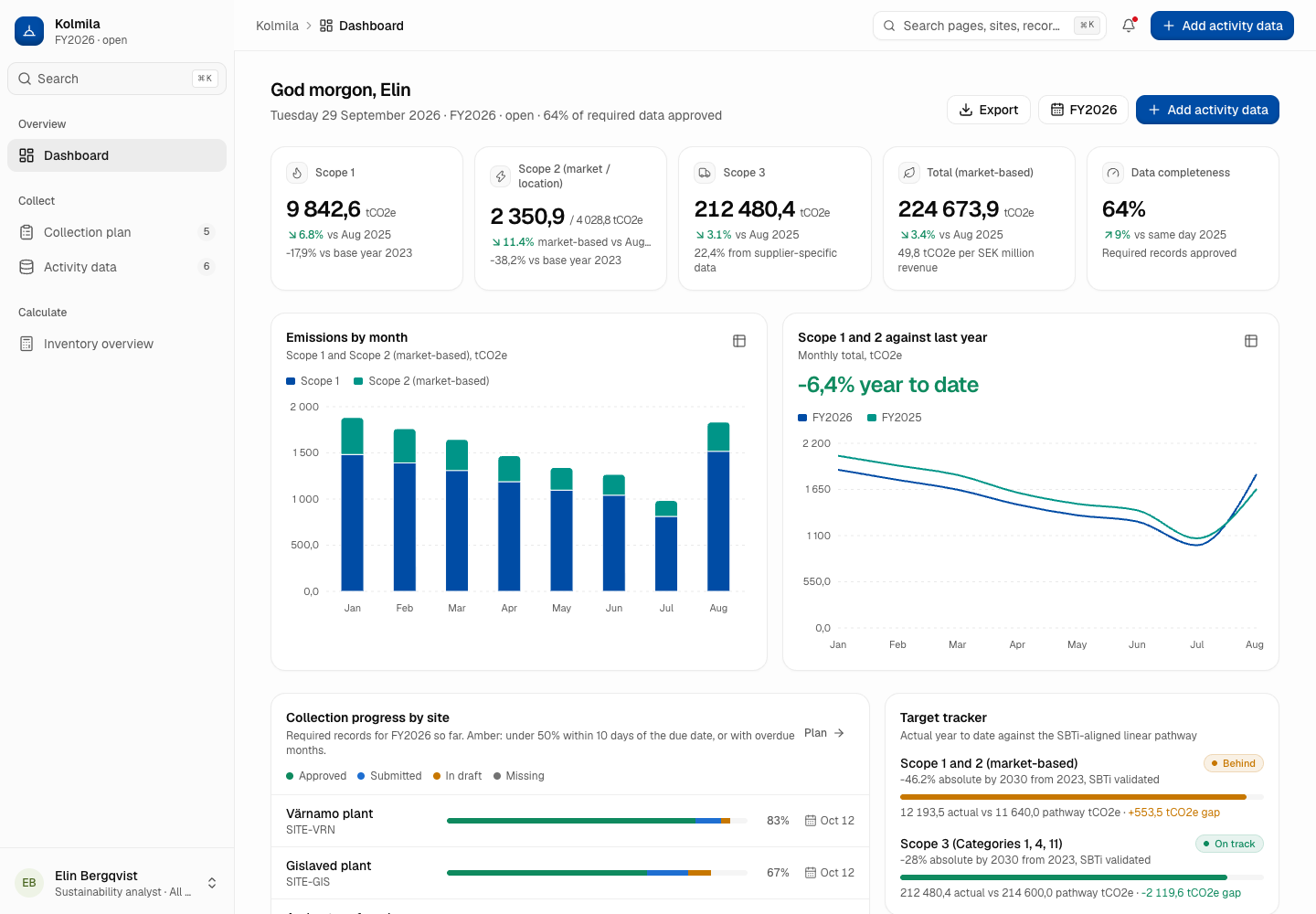
Kolmila - GHG Inventory and Sustainability Reporting Platform with Evidence Behind Every Number
Designed and built a clickable sustainability data platform for a Swedish manufacturer of hydraulic cylinders, steel fabrications and castings: site data collection with evidence, two-step review, a versioned emission factor library and a Scope 1, 2 and 3 inventory under the GHG Protocol, built to feed an ESRS sustainability statement and limited assurance.
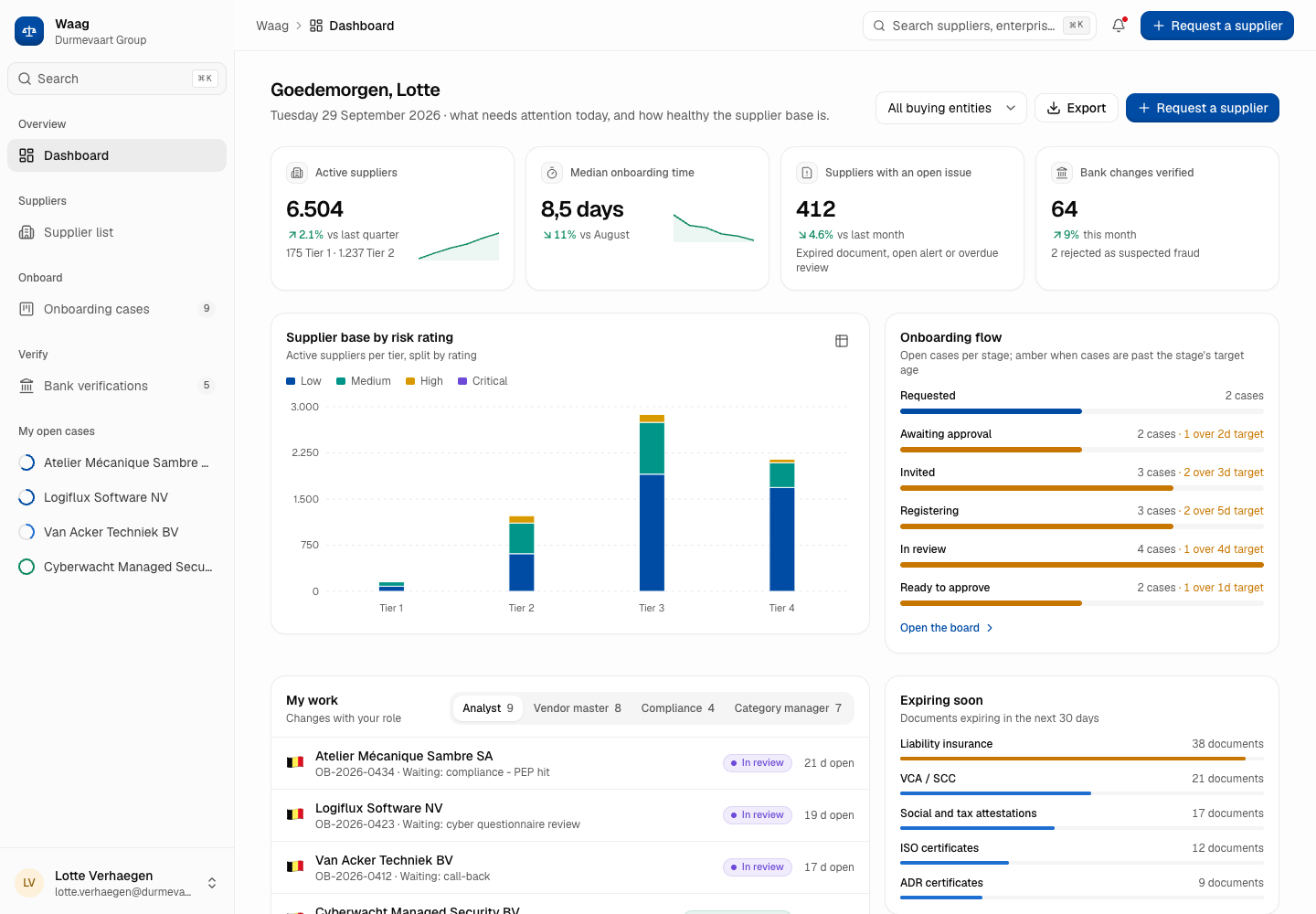
Waag - Supplier Onboarding and Third-Party Risk Platform
Designed and built a clickable supplier onboarding and third-party risk platform for a Belgian industrial and logistics group: a 10-item onboarding checklist from request to approved vendor, registry, VAT and ownership checks, bank details confirmed by an independent call-back and a second person, and a supplier base scored by tier and risk rating.
Enterprise Software Engineering - Human + AI
Contact Us
© 2026 - Copyright. All Rights reserved Oceanlab
Location
Global Headquarters
21 Merchant Road, 3rd Floor, Singapore 058267
Main corporate office and leadership operations
North America Office
548 Market Street, PMB 12345, San Francisco, CA 94104
Client operations and business development
India Office
402 Shivalik Shilp II, SG Highway, Ahmedabad 380015
Engineering and delivery center

Enterprise Software Engineering - Human + AI
Contact Us
Locations
Global Headquarters
21 Merchant Road, 3rd Floor, Singapore 058267
Main corporate office and leadership operations
North America Office
548 Market Street, PMB 12345, San Francisco, CA 94104
Client operations and business development
India Office
402 Shivalik Shilp II, SG Highway, Ahmedabad 380015
Engineering and delivery center
© 2026 - Copyright. All Rights reserved Oceanlab