Sneck - Subcontractor Pre-Qualification and Compliance Platform
Subcontractor Compliance for a Scottish Main Contractor
Designed and built a clickable subcontractor compliance platform for a Glasgow main contractor with about 400 subcontractors and 25 live sites: a register where every firm's status carries its reason, three-way pre-qualification reviews against a 5-working-day clock, and an expiry tracker that shows what each lapsed certificate will stop.
Most of our work is under NDA. Per agreement, we can share the work but not the company details - all names and identifying information shown here have been changed.
Impact
Dashboard, subcontractor register with quick view, subcontractor detail with 6 tabs, the approvals queue as a board or table, and the expiry tracker as a table or weekly calendar.
H&S, commercial and quality reviewers each decide their own area within 5 working days, with the clock paused while information is requested. Final approval unlocks only when all three have decided.
At 60, 30, 14 and 7 days and on the day, with the supply chain manager and site managers copied at 7 days. Each expiry says whether it suspends the firm, suspends an activity or refuses a worker at the gate.
140 compliance documents, 239 workers, 10 sites, 13 pre-qualification reviews, 7 non-conformances and 4 payment holds, with register-wide counts for 398 active firms.
The Problem
Craigmallen's supply chain team kept subcontractor records in a shared mailbox, a SharePoint folder per firm and a 1,900-row expiry spreadsheet updated by hand. Approvals took three to five weeks, a groundworks firm once started on site before its employer's liability certificate had been seen, and in one audit 11% of firms on live sites had at least one expired document.
Our Solution
Sneck gives Craigmallen one register for its subcontractors. Every firm has a compliance status worked out from its documents, with the reason on screen; pre-qualification reviews run per area against a visible clock; and every insurance, accreditation, RAMS and CSCS card expiry is tracked with its reminders and what it will stop when it lapses.
The Challenge: Who Is Cleared to Work Today
A main contractor has to know, for every firm and worker on every site, whether their insurance, accreditations, RAMS, cards and tax status are in order. That answer changes daily and is spread across health and safety, commercial, quality, site and finance teams.
Records in Five Places
Each new subcontractor filled in a Word questionnaire that three departments read separately. When the board asked for modern slavery and payment practices data, it took two people a month to assemble it from five sources.
Insurance Found Expired Too Late
Employers' liability cover is generally required by law, and Craigmallen's own terms ask for at least £10,000,000.00 EL and £5,000,000.00 public liability, raised to £10,000,000.00 near live roads, rail or water. Expiries were noticed late or not at all.
Gate and Payments Blind to Status
CDM 2015 expects the principal contractor to induct every worker and prevent unauthorised access, yet site managers kept paper registers and checked CSCS cards by eye. Commercial paid applications without knowing a firm was suspended, and CIS status was checked only on the day of first payment.
Many Rulebooks at Once
CIS verification before payment, pay less notices under the Construction Act and the Scottish Scheme, the Modern Slavery Act statement, payment practices reporting, extended right-to-work liability from 1 October 2026 and UK GDPR for gate records all touch the same subcontractor data.
Our Approach: From Supply Chain Rules to a Clickable Platform
Spec and Rules Research
Mapped 12 user roles and 41 screens across the contractor console, a mobile gate check, the subcontractor portal and worker pages, plus the data model for firms, the requirements matrix, documents, CIS verifications, questionnaires and reviews, workers and cards, sites, inductions, gate events, RAMS, audits, non-conformances, payment holds and performance scores. Wrote down the rules the design follows: CDM 2015, PAS 91 question areas, CIS, employers' liability insurance, CSCS checks, right to work, the Modern Slavery Act, payment practices reporting, the Construction Act and UK GDPR, alongside Craigmallen's own policies on cover levels, status, reminders and scoring.
Clickable Demo on a Production UI Kit
Built 5 key screens on a production dashboard kit: the dashboard with compliance KPIs, a clickable status bar, my work, expiries by week and gate activity by site; the subcontractor register with filters and bulk actions; subcontractor detail with Companies House data, a requirements checklist, a document viewer and CIS, workers and performance tabs; the approvals queue with per-area decision chips; and the expiry tracker with reminder history. Suspend, block, lift and override each ask for a reason and are written to the firm's activity, and extending a grace period needs a reason too.
What a Production Build Adds
Integration with HMRC CIS verification through the finance system (such as COINS or Sage 200), the Companies House API, CSCS Smart Check, Constructionline and CHAS, certificate data extraction, DocuSign, Postmark and Twilio reminders and UK-region file storage. Staff roles scoped to sites, an append-only audit log, and the remaining screens: pre-qualification review, documents inbox, RAMS, audits, non-conformances, payment holds, reports, settings, the offline-capable gate check with QR site passes, the subcontractor portal and worker pre-induction.
Why It Works: Every Status Explains Itself
Status Comes With Its Reason
A firm is Approved, Approved with conditions, At risk, Suspended or Blocked, and the chip always carries why, such as "EL certificate expired 14 Sep 2026". The status history shows whether the daily compliance job or a named person made the change.
Each Expiry Shows What It Stops
An expired EL or PL certificate suspends the firm, an expired accreditation or RAMS suspends only that activity, and an expired card refuses only that worker. The tracker shows this next to the reminders already sent and whether a replacement is waiting.
Reviews Against a Visible Clock
Each review shows working days left, amber at 2 and red when over, and the clock pauses while information is requested. Reviewers decide only their own area, and final approval stays locked until H&S, commercial and quality have all decided.
Holds Are Flags, Not Withholding
A payment hold is shown as an internal flag with a note that any withholding must follow the subcontract and the statutory pay less notice process. The CIS tab shows the UTR masked, and the design holds no card photos, dates of birth or identity documents.
Related case studies
View all: Construction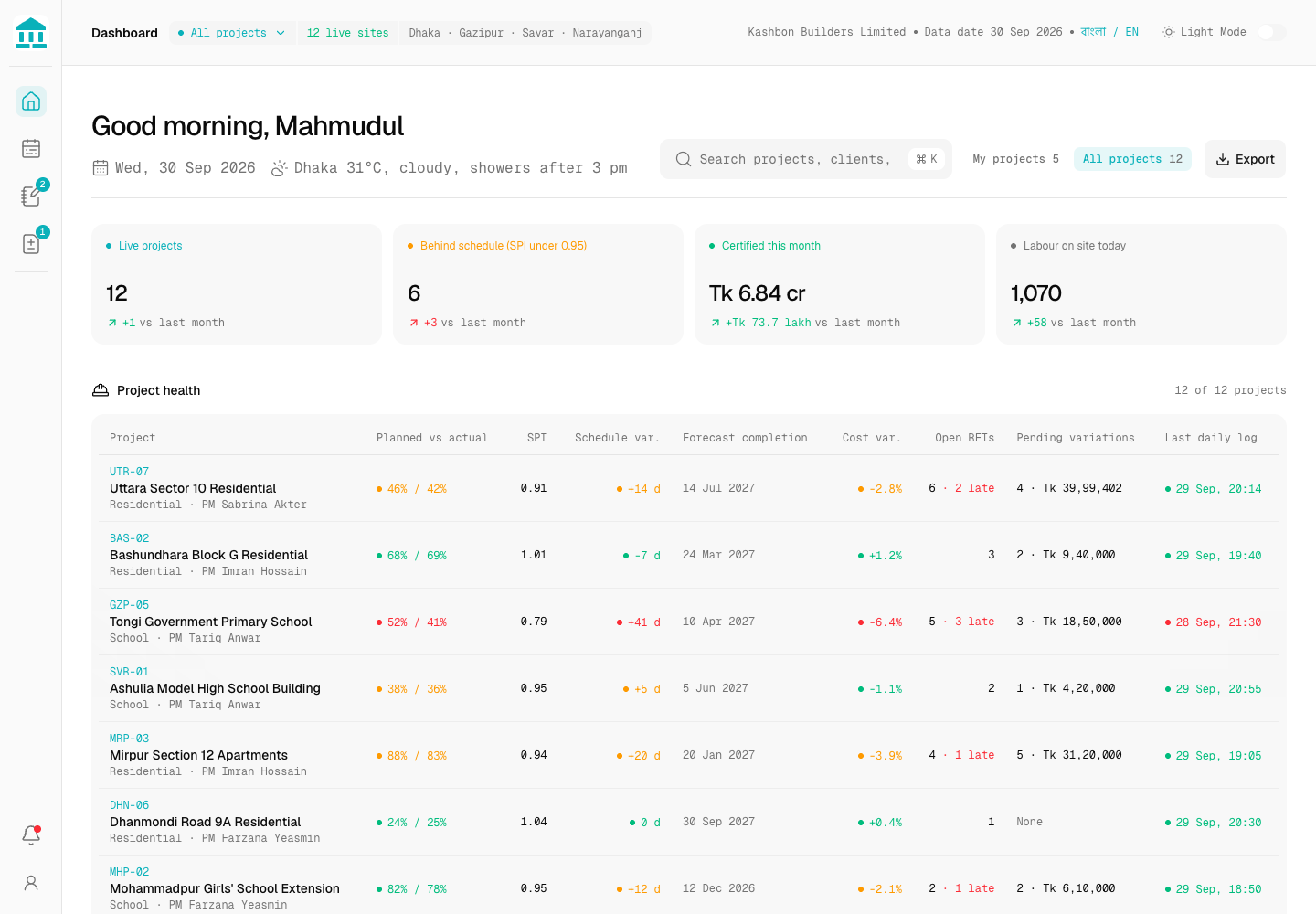
Bhitti - Site Project Management Platform with Critical Path and Variation Control
Designed and built a clickable site project management platform for a Dhaka general contractor running 12 live residential and school sites: a portfolio dashboard with site health, a master programme with critical path and baselines, the daily site diary, and a variations register that routes every change to the right approver by limit.
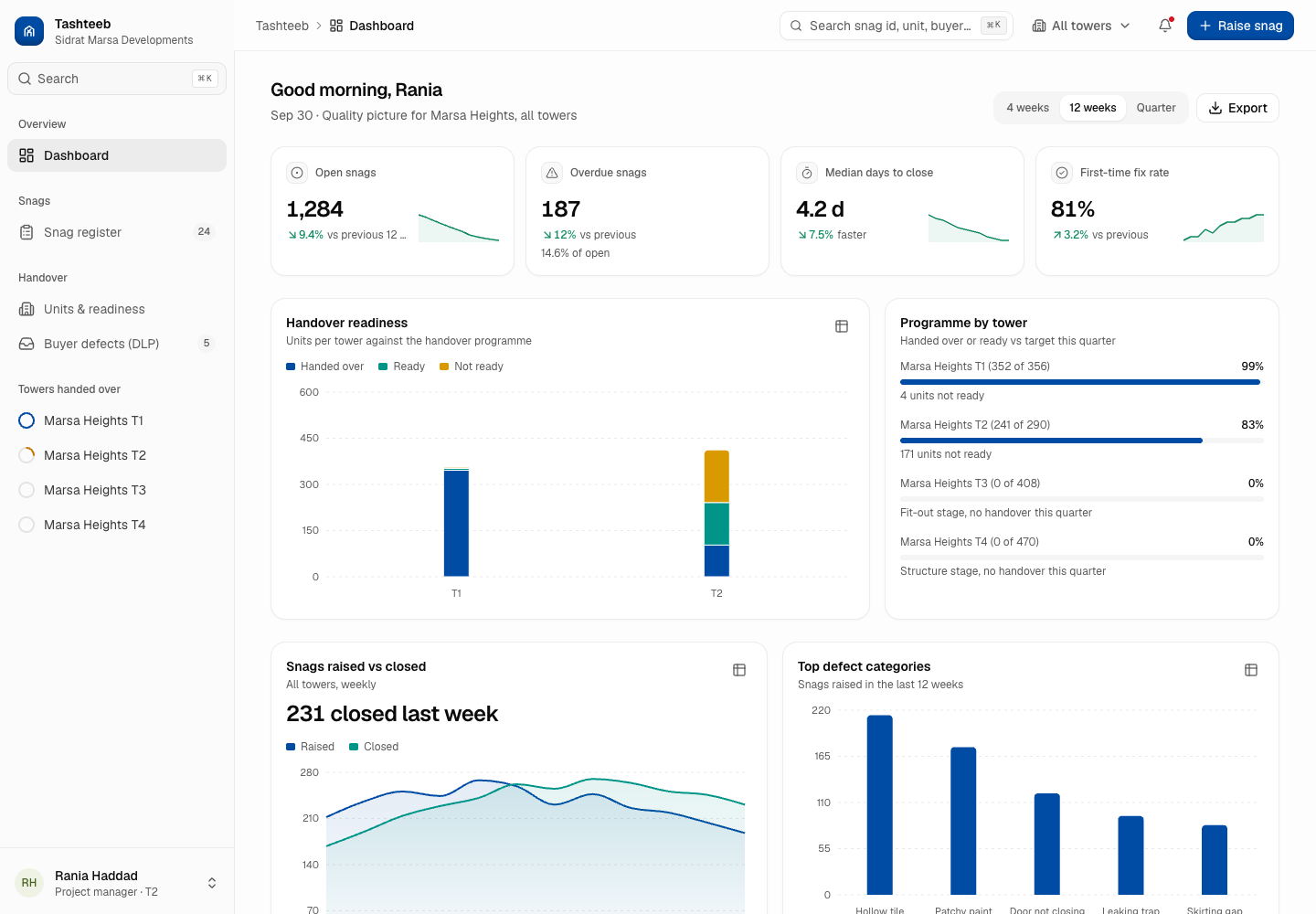
Tashteeb - Snagging, Inspections and Buyer Handover Platform
Designed and built a clickable snagging and handover console for a Dubai apartment developer-builder: a snag register with plan pins and photo evidence, subcontractor fixes and disputes, a handover readiness rule on every unit, and a queue for defects buyers report after moving in.
Enterprise Software Engineering - Human + AI
Contact Us
© 2026 - Copyright. All Rights reserved Oceanlab
Location
Global Headquarters
21 Merchant Road, 3rd Floor, Singapore 058267
Main corporate office and leadership operations
North America Office
548 Market Street, PMB 12345, San Francisco, CA 94104
Client operations and business development
India Office
402 Shivalik Shilp II, SG Highway, Ahmedabad 380015
Engineering and delivery center

Enterprise Software Engineering - Human + AI
Contact Us
Locations
Global Headquarters
21 Merchant Road, 3rd Floor, Singapore 058267
Main corporate office and leadership operations
North America Office
548 Market Street, PMB 12345, San Francisco, CA 94104
Client operations and business development
India Office
402 Shivalik Shilp II, SG Highway, Ahmedabad 380015
Engineering and delivery center
© 2026 - Copyright. All Rights reserved Oceanlab