Sheave - Predictive Maintenance Platform for a Pulp and Paper Mill
Failure Prediction for a Canadian Pulp and Paper Mill
Designed and built a clickable predictive maintenance console for an integrated pulp and paper mill in Ontario: anomaly scores that explain which signals moved, an alert queue sorted by consequence, remaining useful life shown as a band against planned shutdowns, and work requests sent to the CMMS - advisory only, never controlling a machine.
Most of our work is under NDA. Per agreement, we can share the work but not the company details - all names and identifying information shown here have been changed.
Impact
Mill health dashboard, alert triage queue, alert detail with 5 evidence tabs, asset detail with 7 tabs and the remaining useful life board. Every alert in the queue opens its own detail page.
Alert policy v6 is encoded on screen: class A assets go amber at an anomaly score of 0.60 and red at 0.85, and an untriaged red alert turns amber in the queue after 4 hours and red after 12.
Each remaining useful life estimate is drawn as its 10th to 90th percentile band with a median tick and a confidence level, against the mill's 4 planned shutdowns and wash-ups in the next 120 days.
25 monitored assets across 7 mill areas, 22 alerts at every stage, 14 RUL estimates, 11 failure modes, 7 work requests and 8 staff users.
The Problem
Greyspruce's four reliability engineers were watching about 2,000 rotating assets with three disconnected tools: vendor vibration software only one engineer knew well, a sensor dashboard raising hundreds of fixed-threshold alarms a week, and oil lab results arriving as PDFs by email. Nothing ranked assets by how much a failure would hurt, alarms were dismissed without a reason, and the team could not show how many failures it had caught early.
Our Solution
Sheave brings online vibration and temperature, historian motor current, route readings and oil lab results into one console. It scores each asset for anomalies, explains which signals moved and which failure modes they point to, estimates remaining useful life with an uncertainty band, and turns a confirmed finding into a work request in SAP PM. A person confirms every alert; Sheave never writes to the control system.
The Challenge: Predicting Failures Without Crying Wolf
A paper mill runs pumps, fans, gearboxes, refiners and paper machine rolls around the clock. A spare pump and the PM2 dryer drive gearbox look the same in a sensor feed, but one failure costs a day of paper machine production and the other costs a repair.
Alarms Nobody Trusted
Fixed thresholds raised hundreds of alarms a week, and dismissals carried no reason. Without knowing which alerts turned out to be real, neither the team nor a model could learn which ones were worth acting on.
Data in Four Places
Online sensors, historian tags for current, speed and load, handheld route readings uploaded when someone remembered, and lab PDFs with ISO 4406 particle codes. An engineer had to line these up by hand to see one bearing's condition.
Limits That Belong to the Client
Vibration severity is judged in zones A to D in the style of ISO 10816 and ISO 20816, but the right values depend on machine class, power and foundation. Nothing could be hard-coded: every limit, criticality weight and alert threshold is the mill's own versioned policy.
Advice, Not Control
Machine protection and lockout stay in the mill's own systems and procedures under Ontario's health and safety rules. Sheave had to recommend clearly enough to act on, while never starting, stopping or tripping a machine.
Our Approach: From Condition Monitoring Practice to a Clickable Console
Spec and Rules Research
Mapped 9 user roles, 40 screens across the reliability console and an offline technician app, and the data model for assets, measurement points, sensors, readings, spectra, limit sets, criticality, alert policy, models and savings. Wrote down the practice the design follows: the ISO 13374 acquire to advise layers, ISO 17359 condition monitoring, ISO 13381-1 prognostics, an ISO 14224 style failure taxonomy, and Ontario's electronic monitoring policy rule for route and location data.
Clickable Demo on a Production UI Kit
Built 5 key screens on a production dashboard kit: the mill health dashboard with KPIs, the six-stage pipeline, a health map and needs-attention list, the triage queue with tabs, filters and pick up, the alert detail with explanation, trends, spectra against a baseline and a confirm, dismiss or escalate decision, the asset detail with nameplate, limit set, oil and work history, and the RUL board. All actions run on local state.
What a Production Build Adds
Read-only feeds from sensor platforms such as SKF Enlight Collect or Emerson AMS, AVEVA PI and an OPC UA gateway, route collector and oil lab imports, and SAP PM or IBM Maximo work requests. Entra ID sign-in, the offline technician app under Intune, model versions promoted only with two approvers, and an audit log of every alert decision, limit change and savings approval.
Why It Works: Evidence Before Every Decision
Worst Consequence First
The queue sorts by severity times criticality, then age, so a red alert on a class A refiner sits above an amber one on a spare pump. Ages change colour as the client's triage window runs out, and repeat alerts on the same asset are marked.
Every Score Explains Itself
An alert shows its anomaly score against the policy thresholds, the signals that drove it by share, a plain-language summary, the suspected failure modes with confidence, and the envelope spectrum with BPFO markers against a baseline from a good period.
Dismissals That Teach the Model
Closing an alert needs a decision. A dismissal takes a reason from a fixed list, such as process change or below action level, and counts as training feedback, except sensor faults, which go to sensor health instead.
Honest About Uncertainty
Remaining useful life is a band, a median and a confidence level, with the assumption that load and speed continue. Shutdown markers show whether the band crosses the next stop, so a work request can target a real window.
Related case studies
View all: Manufacturing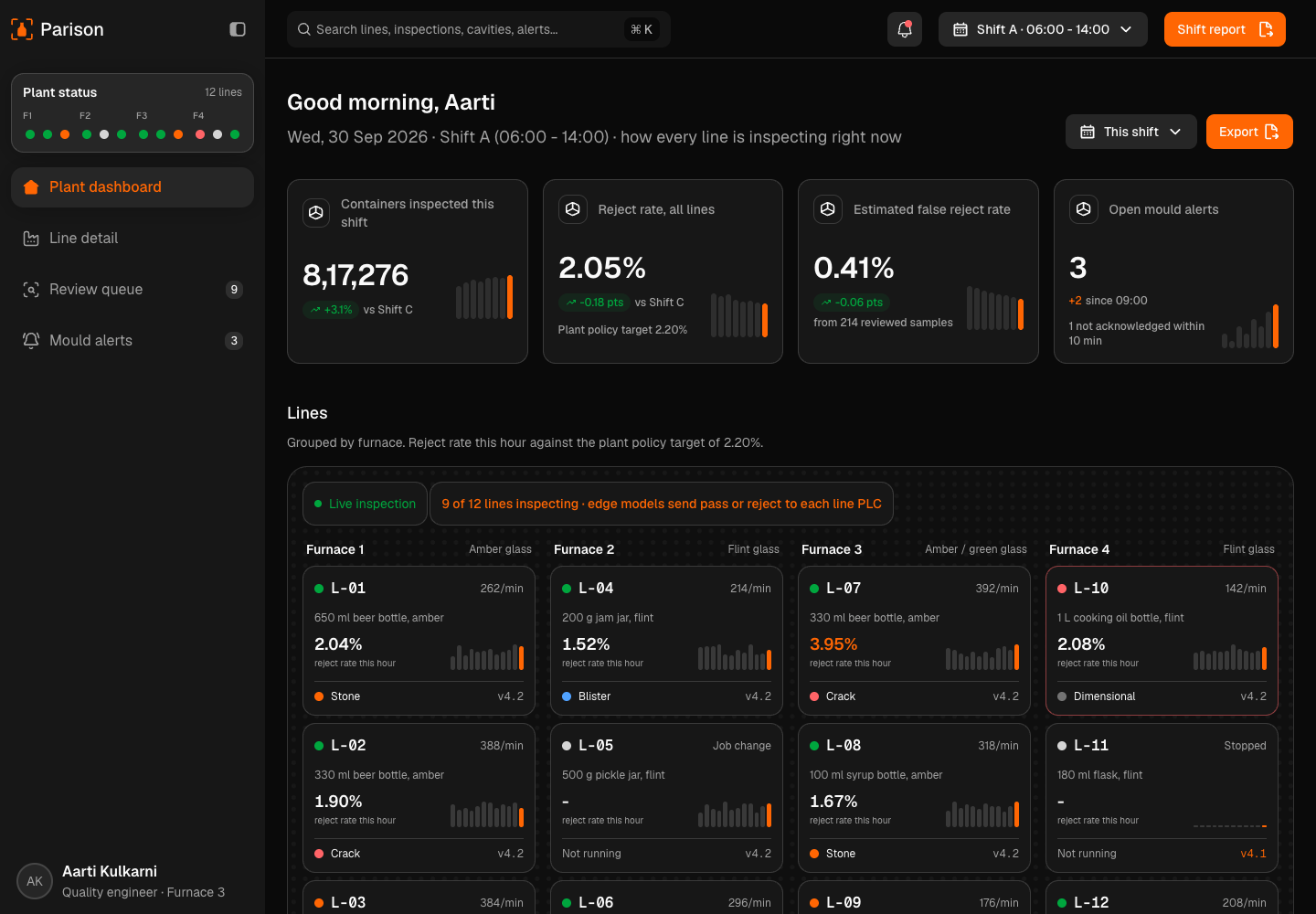
Parison - AI Visual Inspection for Glass Bottle and Jar Lines
Designed and built a clickable quality console for a glass container maker near Pune with 4 furnaces and 12 forming lines: cameras and edge models classify every bottle and jar at the cold end, uncertain images go to a person, rejects are traced to the mould cavity that made them, and every decision shows the rule behind it.
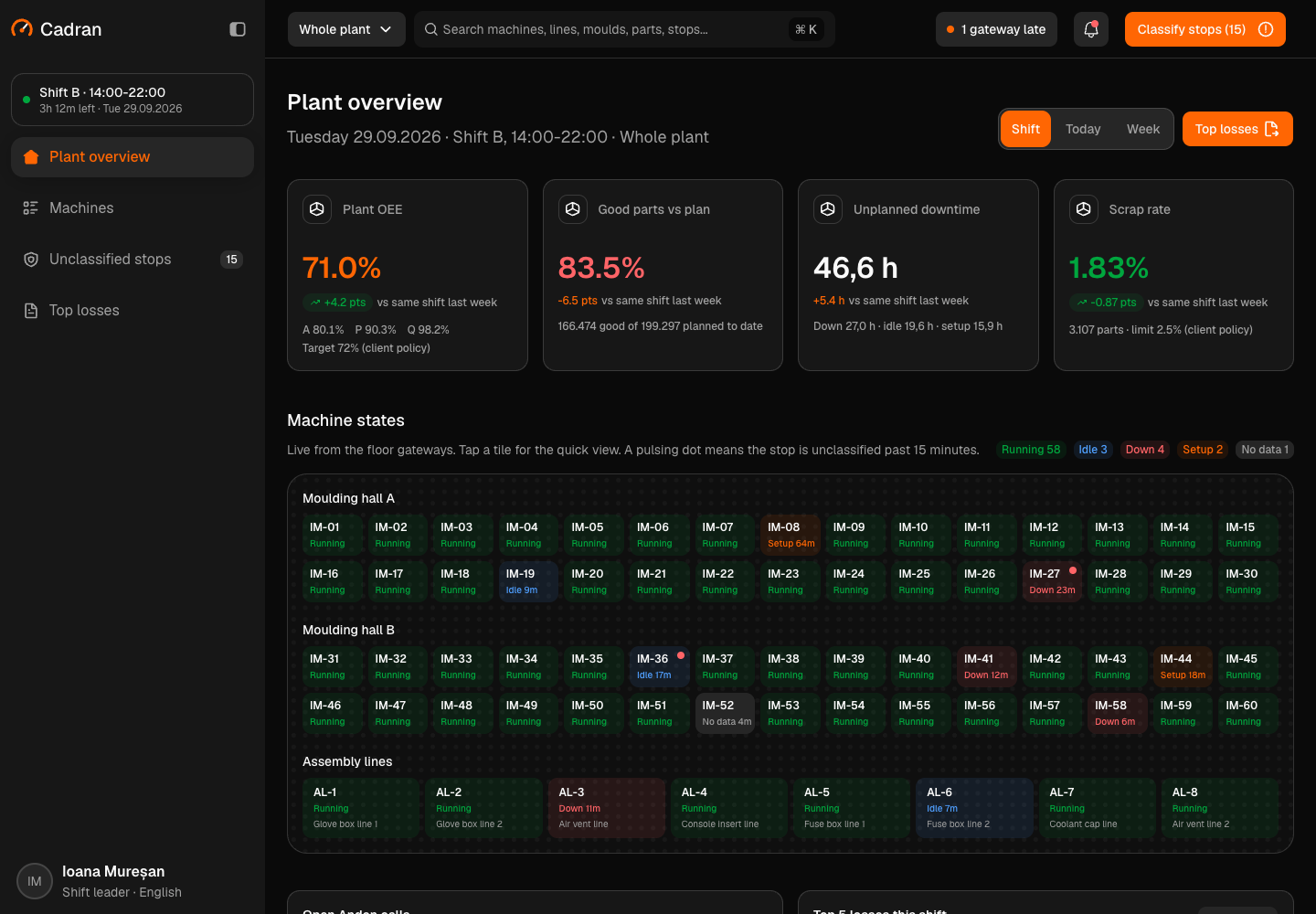
Cadran - Machine Telemetry and OEE Platform for an Injection Moulding Plant
Designed and built a clickable machine telemetry and OEE platform for a Romanian injection moulding and assembly plant that supplies automotive Tier 1 customers: live state of 60 moulding machines and 8 assembly lines, OEE with availability, performance and quality per machine, line and shift, a queue for clearing unclassified stops and a Pareto of top losses.
Enterprise Software Engineering - Human + AI
Contact Us
© 2026 - Copyright. All Rights reserved Oceanlab
Location
Global Headquarters
21 Merchant Road, 3rd Floor, Singapore 058267
Main corporate office and leadership operations
North America Office
548 Market Street, PMB 12345, San Francisco, CA 94104
Client operations and business development
India Office
402 Shivalik Shilp II, SG Highway, Ahmedabad 380015
Engineering and delivery center

Enterprise Software Engineering - Human + AI
Contact Us
Locations
Global Headquarters
21 Merchant Road, 3rd Floor, Singapore 058267
Main corporate office and leadership operations
North America Office
548 Market Street, PMB 12345, San Francisco, CA 94104
Client operations and business development
India Office
402 Shivalik Shilp II, SG Highway, Ahmedabad 380015
Engineering and delivery center
© 2026 - Copyright. All Rights reserved Oceanlab