Parison - AI Visual Inspection for Glass Bottle and Jar Lines
AI Visual Inspection for an Indian Glassworks
Designed and built a clickable quality console for a glass container maker near Pune with 4 furnaces and 12 forming lines: cameras and edge models classify every bottle and jar at the cold end, uncertain images go to a person, rejects are traced to the mould cavity that made them, and every decision shows the rule behind it.
Most of our work is under NDA. Per agreement, we can share the work but not the company details - all names and identifying information shown here have been changed.
Impact
Plant dashboard, line detail for all 12 lines with its camera panel and cavity heat grid, review queue, inspection detail and mould alerts.
Crack, stone, blister, dimensional and sealing surface, each graded critical, major or minor with a reject threshold and review band, such as crack reviewed from 0.35 and rejected at 0.60.
An alert is raised when 5 rejects of one class come from the same cavity in its last 200 containers, clears below 2 in 200, and should be acknowledged within 10 minutes.
12 lines on 4 furnaces, 9 container types, 96 cameras, 36 inspections with detections on every camera view, 18 review items and 14 mould alerts.
The Problem
Pawna Valley's rule-based inspection machines at the cold end were tuned years ago and set up differently on each line. They were set tight to avoid complaints, so good bottles were thrown away (roughly 2 to 3% of output, by the client's own estimate) while fine checks near the finish and small stones still reached customers. A cavity making cracked bottles was not linked to its rejects until a shift later, and threshold changes were made at the machine with no record.
Our Solution
Parison photographs every container after annealing, runs defect models on an edge device beside each line and sends one pass or reject signal per container to the line PLC. Quality engineers watch every line from one console, review the images the model was not sure about, trace rejects to the mould cavity and see the exact rule, model and threshold version behind every decision.
The Challenge: Fewer Good Bottles Lost, Fewer Defects Shipped
Glass container inspection is a balance between bottles thrown away and defects that reach a brewery, food or pharma customer. Pawna Valley needed to move that balance on 12 lines without handing control of the line to software.
Tight Settings, Two Kinds of Loss
Lines set tight still let small stones and checks in the finish escape, while good containers were rejected. A crack or a sharp spike is a hazard to the consumer, a blister is cosmetic, and one setting for all of them got neither right.
Bad Cavities Found a Shift Late
A forming machine has up to 10 sections with 1 to 3 cavities each. When one cavity started making cracked bottles, nobody linked the rejects to its number until a shift later.
Settings Changed With No Record
Thresholds were changed at the machine with no record of who changed what and no way to test a new setting first. The plant's ISO 9001 change control and its customers' food packaging audits depend on that record.
A Decision Aid Beside the PLC
The line PLC owns the rejector, its timing and every safety function. Parison may only send a signal, must leave late or missing signals to the PLC's fallback, and has to handle staff data under India's DPDP Act with cameras that look only at containers.
Our Approach: From Inspection Rules to a Clickable Console
Spec and Rules Research
Mapped 9 roles from quality engineer and ML engineer to line operator, 33 screens (30 quality console screens and 3 cold-end operator screens) and the data model for lines, stations, cameras, edge devices, inspections, threshold sets, mould alerts, datasets, training runs, deployments and change requests. Wrote down the rules the design follows: PLC ownership of the rejector and safety, critical, major and minor severity, the DPDP Act, camera privacy, food-contact packaging references and ISO 9001 change control.
Clickable Demo on a Production UI Kit
Built 5 key screens on a production dashboard kit: the plant dashboard with shift KPIs, lines grid by furnace and a needs attention list, line detail with the inspection stations strip, camera panel, reject chart, cavity heat grid, PLC signals and activity, the review queue with zoom, contrast and keyboard shortcuts, inspection detail with every camera view and the decision explanation, and mould alerts with acknowledge, record action and close. Proposing a threshold change opens its modal with the critical class floor.
What a Production Build Adds
Integration with Basler or Teledyne FLIR cameras, NVIDIA Jetson edge devices, the existing mould number readers, the line PLCs over digital I/O, PROFINET or OPC UA as agreed with the line integrator, an MQTT broker, image storage in an Indian cloud region, SageMaker or Azure Machine Learning with MLflow, and Teams or SMS alerts. Staff sign-in with Microsoft Entra ID, change requests approved by a second person, an append-only audit trail, and the remaining screens: live feed, Pareto, cost vs escape tuning, labelling, datasets, training runs, deployments, drift, settings and the operator screens in Hindi, Marathi and English.
Why It Works: Every Reject Can Be Explained
Every Decision Shows Its Rule
An inspection lists, per class, the confidence, the threshold set in force and the rule that decided it, such as "Crack 0.46 in review band 0.35 - 0.60 · Reject and send to review", with the model version, edge device, inference time, cavity source and the PLC acknowledgement.
Uncertain Images Go to a Person
Images in the review band wait in a queue that turns amber after 15 minutes and red after 30. The reviewer sees every camera view of the container and the thresholds that applied, and confirms or corrects the call from the keyboard, or marks the image unclear.
Rejects Traced to the Cavity
Each line has a heat grid of section by cavity, coloured by reject rate. A mould alert states its trigger in plain words, such as 6 crack rejects in the last 200 from one cavity, and records who acknowledged it and what was done: swabbed, mould changed or cavity rejected at the hot end.
Advice, Never Control
Parison sends a pass or reject signal and nothing else. A line with no signal for 60 seconds turns red and the PLC's own fallback takes over, a new model runs in shadow without sending decisions, and mould alerts ask a person to act at the forming machine instead of stopping it.
Related case studies
View all: Manufacturing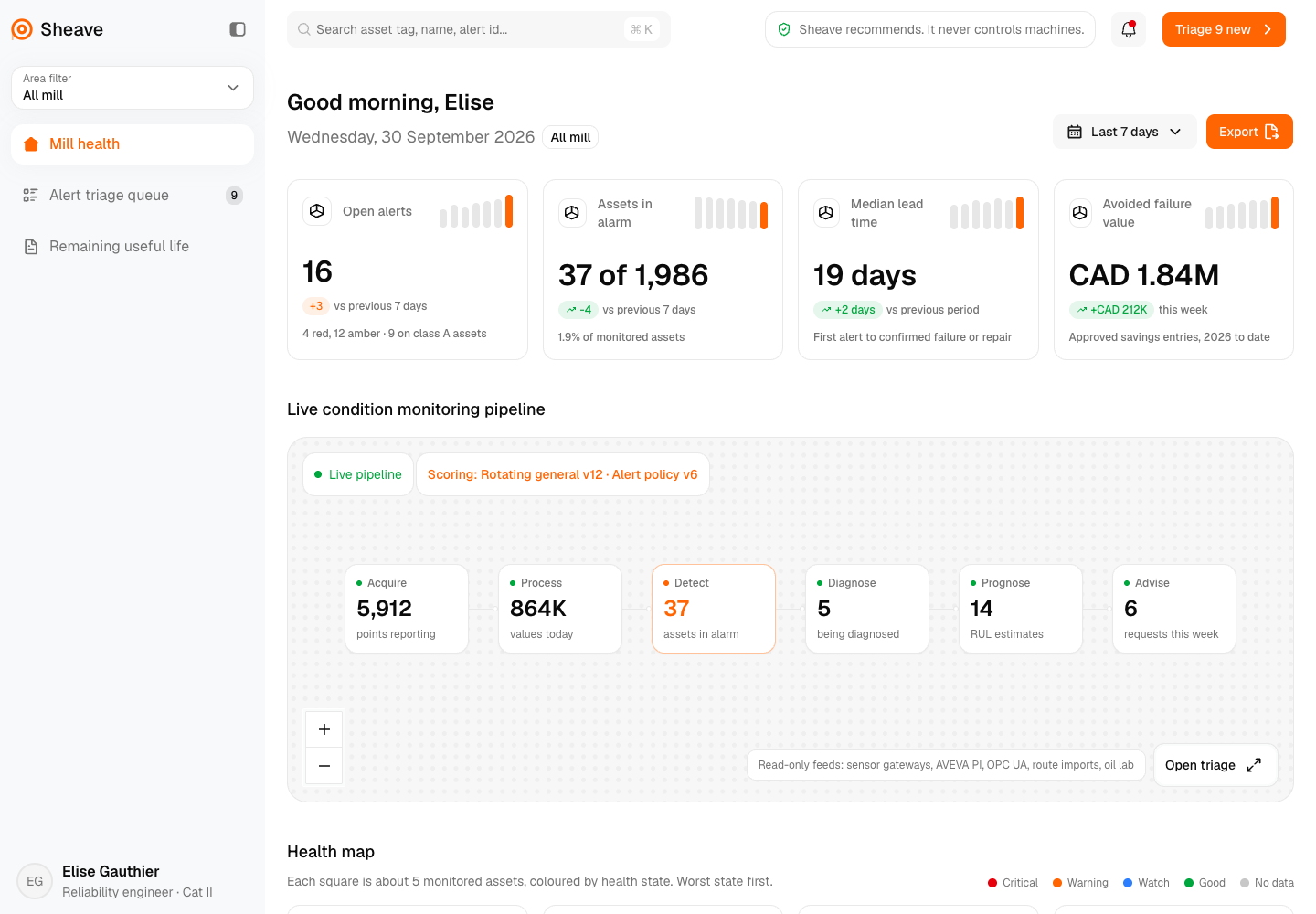
Sheave - Predictive Maintenance Platform for a Pulp and Paper Mill
Designed and built a clickable predictive maintenance console for an integrated pulp and paper mill in Ontario: anomaly scores that explain which signals moved, an alert queue sorted by consequence, remaining useful life shown as a band against planned shutdowns, and work requests sent to the CMMS - advisory only, never controlling a machine.
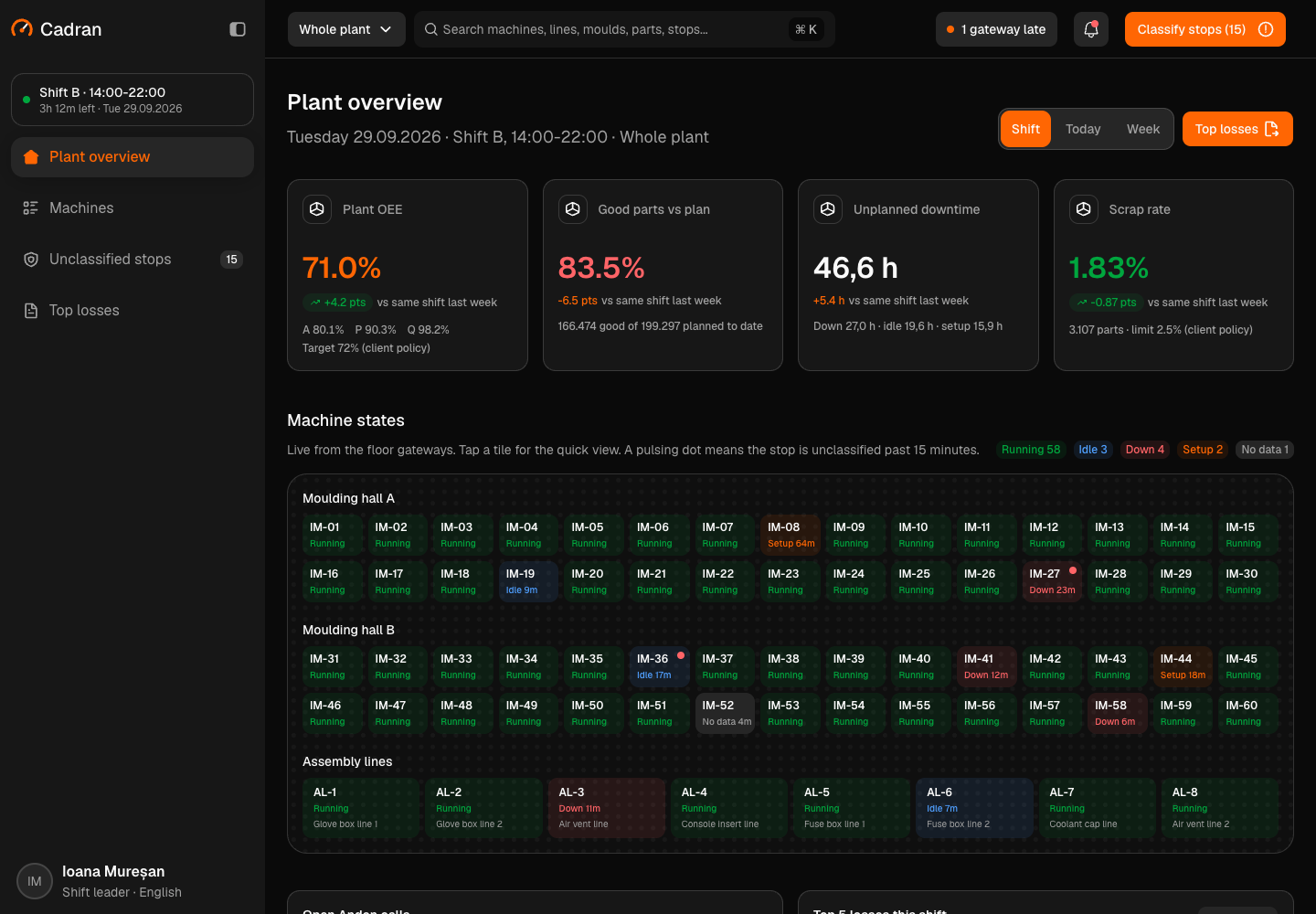
Cadran - Machine Telemetry and OEE Platform for an Injection Moulding Plant
Designed and built a clickable machine telemetry and OEE platform for a Romanian injection moulding and assembly plant that supplies automotive Tier 1 customers: live state of 60 moulding machines and 8 assembly lines, OEE with availability, performance and quality per machine, line and shift, a queue for clearing unclassified stops and a Pareto of top losses.
Enterprise Software Engineering - Human + AI
Contact Us
© 2026 - Copyright. All Rights reserved Oceanlab
Location
Global Headquarters
21 Merchant Road, 3rd Floor, Singapore 058267
Main corporate office and leadership operations
North America Office
548 Market Street, PMB 12345, San Francisco, CA 94104
Client operations and business development
India Office
402 Shivalik Shilp II, SG Highway, Ahmedabad 380015
Engineering and delivery center

Enterprise Software Engineering - Human + AI
Contact Us
Locations
Global Headquarters
21 Merchant Road, 3rd Floor, Singapore 058267
Main corporate office and leadership operations
North America Office
548 Market Street, PMB 12345, San Francisco, CA 94104
Client operations and business development
India Office
402 Shivalik Shilp II, SG Highway, Ahmedabad 380015
Engineering and delivery center
© 2026 - Copyright. All Rights reserved Oceanlab