Returnable - Reusable Cup and Container Platform with Batch-Level Wash Traceability
Reuse Operations Console for a Vancouver Packaging Operator
Designed and built a clickable hub and fleet console for a Vancouver operator of deposit-based reusable cups and takeaway containers: every container tracked by scan from counter to wash hub, every wash batch checked against the food safety plan, and a quarantined batch traced to the partner venues still holding its items.
Most of our work is under NDA. Per agreement, we can share the work but not the company details - all names and identifying information shown here have been changed.
Impact
Dashboard, containers, container detail, wash batches and batch detail with its logger trace panel. Every one of the 30 demo containers opens its own lifecycle, wash history and borrows.
Wash temperature 60 to 77 °C, final rinse 82 to 91 °C and sanitiser 50 to 100 ppm, from hygiene policy v4 of Salal Cove's food safety plan. Sign-off is for a hub supervisor only, and only when all three are in range.
From clean at the hub through borrowed, returned at a partner or drop box, washing and quarantined to lost or retired, each change made by a scan or an audited manual action.
5 container types, 20 wash batches on 3 machines, 14 partner venues including 3 campus outlets, 4 drop boxes and 7 staff users, with a fleet of 36,600 containers on the dashboard.
The Problem
Salal Cove supplies reusable cups and containers to about 400 cafés and restaurants and two university campuses, and ran the scheme on paper punch cards and a spreadsheet. Nobody knew where a given container was, so losses only showed up as new stock bought. Some cafés ran out of clean cups on busy mornings while others had crates of dirty ones piling up, cash deposits left the business unable to say what it owed customers, and the hub's temperature and sanitiser checks sat on a clipboard no inspector could trace to a batch.
Our Solution
Returnable gives every container a unique id and turns every borrow, return, collection, wash and pack into a scan. The console shows where the fleet is, ties each container to the wash batches it went through, checks each batch's readings against Salal Cove's own thresholds before a supervisor can sign it off, and blocks every item of a quarantined batch from being handed out.
The Challenge: Tracking Thousands of Containers That Keep Moving
A reuse scheme only works if a container can be borrowed in seconds, returned anywhere and come back clean. Behind each cup are customers, venue staff, drivers, hub operators and finance, all touching the same item at different points of its loop.
No Container Had a History
Without a scan at each step, a cup could be at a café, with a customer, in a drop box, on a van or in the washer, and nobody could say which. Loss could not be measured, only discovered when stock ran out.
Hygiene Records an Inspector Can Follow
The hub's containers are food-contact equipment under BC's Public Health Act and Food Premises Regulation. Every batch's wash temperature, final rinse temperature and sanitiser readings must be recorded against the thresholds in Salal Cove's approved food safety plan, and a failed batch needs to be traced to wherever its items went.
Deposits That Are Owed Back
Deposits, the 14-day return window and the unreturned fee are terms of Salal Cove's customer agreement. BC's consumer protection law expects fees disclosed clearly and charged only as the terms say, so the business needs to know at any moment how much it holds and owes.
Clean Stock in the Wrong Place
About 400 partners borrow at different rates. With only a spreadsheet of who had how many cups, busy counters ran out of clean stock in the morning rush while quieter ones filled up with crates of dirty items waiting for pickup.
Our Approach: From Reuse Rules to a Clickable Console
Spec and Rules Research
Mapped 11 user roles and 51 screens across the consumer app, the partner venue app, the driver and hub station field screens and the staff console, and the data model for container types, containers, append-only scan events, borrows, wallet and liability ledgers, wash batches, hygiene readings, routes and partners. Wrote down the rules the design follows: BC PIPA and PIPEDA, the BC Food Premises Regulation, BC consumer protection law, PCI DSS, CASL and the Competition Act on environmental claims.
Clickable Demo on a Production UI Kit
Built the console's 5 key screens on a production dashboard kit: the dashboard with KPIs, fleet by state, borrows and returns, wash today and a needs attention list, containers with location tabs, filters and a quick view, container detail with cycle count against design life and its lifecycle timeline, wash batches by status, and batch detail with readings against thresholds, record reading, sign-off, fail and rewash, quarantine and release. All actions run on local state.
What a Production Build Adds
The consumer app, the partner venue app and the driver and hub station screens, with QR scanning by camera. Integration with Stripe or Moneris for deposits and refunds, QuickBooks Online or Xero for partner invoicing, Twilio and Postmark reminders, route optimisation, campus single sign-on, smart drop box events and wash data logger imports. Staff auth by role, an append-only audit log, and the remaining logistics, finance, report and settings screens.
Why It Works: Every Container Traced to Its Wash
A Scan at Every Step
Each container's timeline lists every scan with who and where: received, inspected, washed in a named batch, packed into a crate, delivered on a route, borrowed and returned. Its cycle count is shown against the type's design life, so worn items can be retired on evidence.
Sign-Off Only When Readings Pass
Each batch shows its three readings with the threshold, value, source (logger import or manual) and pass or fail, plus the visual sample and ATP swab. Sign-off is open to a hub supervisor only, and only when every required reading is in range. A failed reading carries its corrective action.
Quarantine Reaches the Counter
Quarantining a batch needs a reason and blocks every item in it from hand-out. The batch lists each item and where it is now, names the partners still holding stock, and the container page shows the block at that venue until the batch is rewashed or released.
Policy Labelled as Policy
Deposits, fees, design life, the return window and hygiene thresholds are shown as Salal Cove's own policy or food safety plan values, with their version. Customers appear by short id only, so the hub works the fleet without seeing personal details.
Related case studies
View all: Waste & circular economy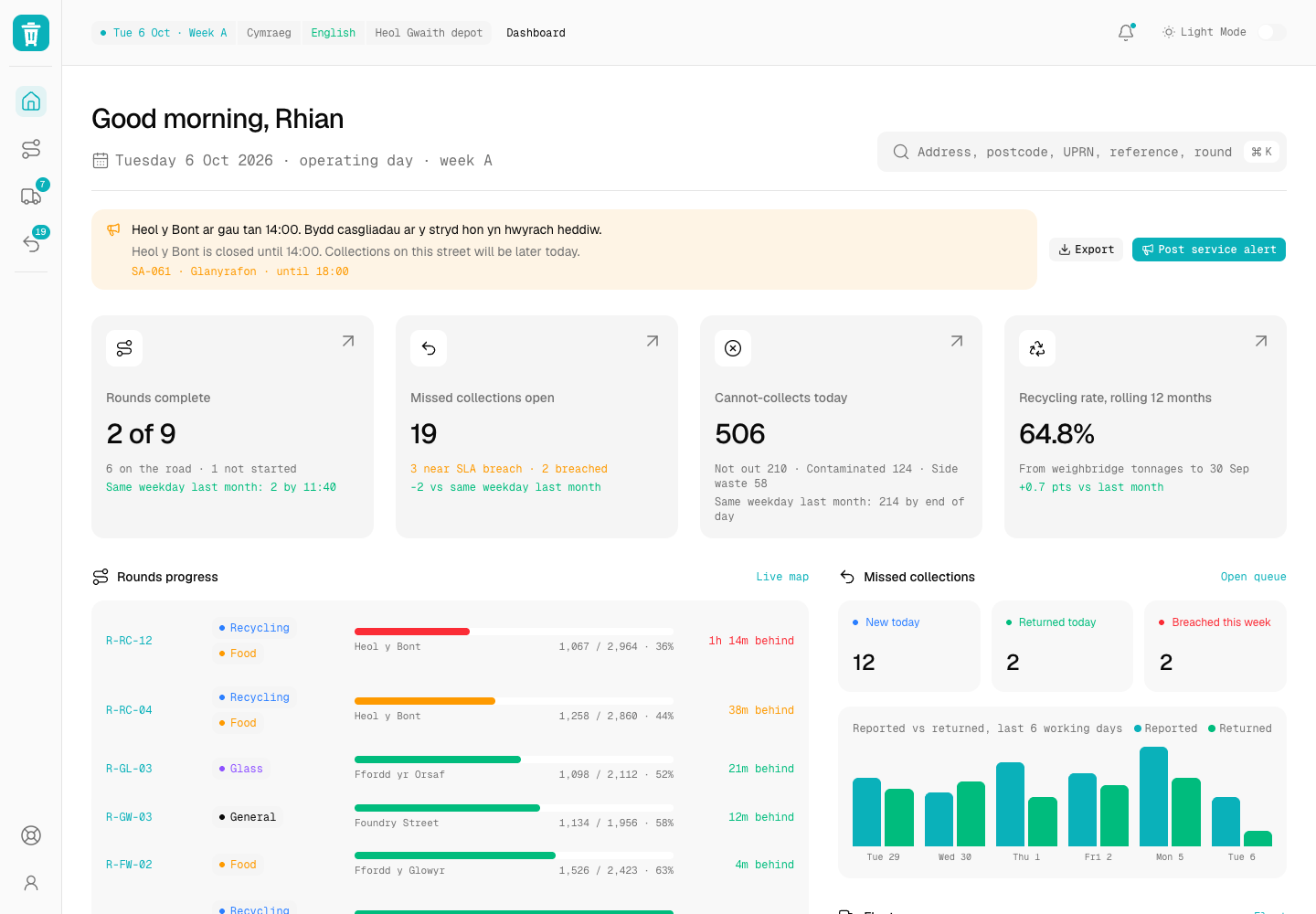
Binday - Bilingual Waste Collection Platform for a Welsh Council
Designed and built a clickable operations console for a Welsh city council's household waste service: live rounds and fleet, missed bins checked against crew records and returned within SLA, round sequences with crew suggestions, and service alerts in Welsh and English.
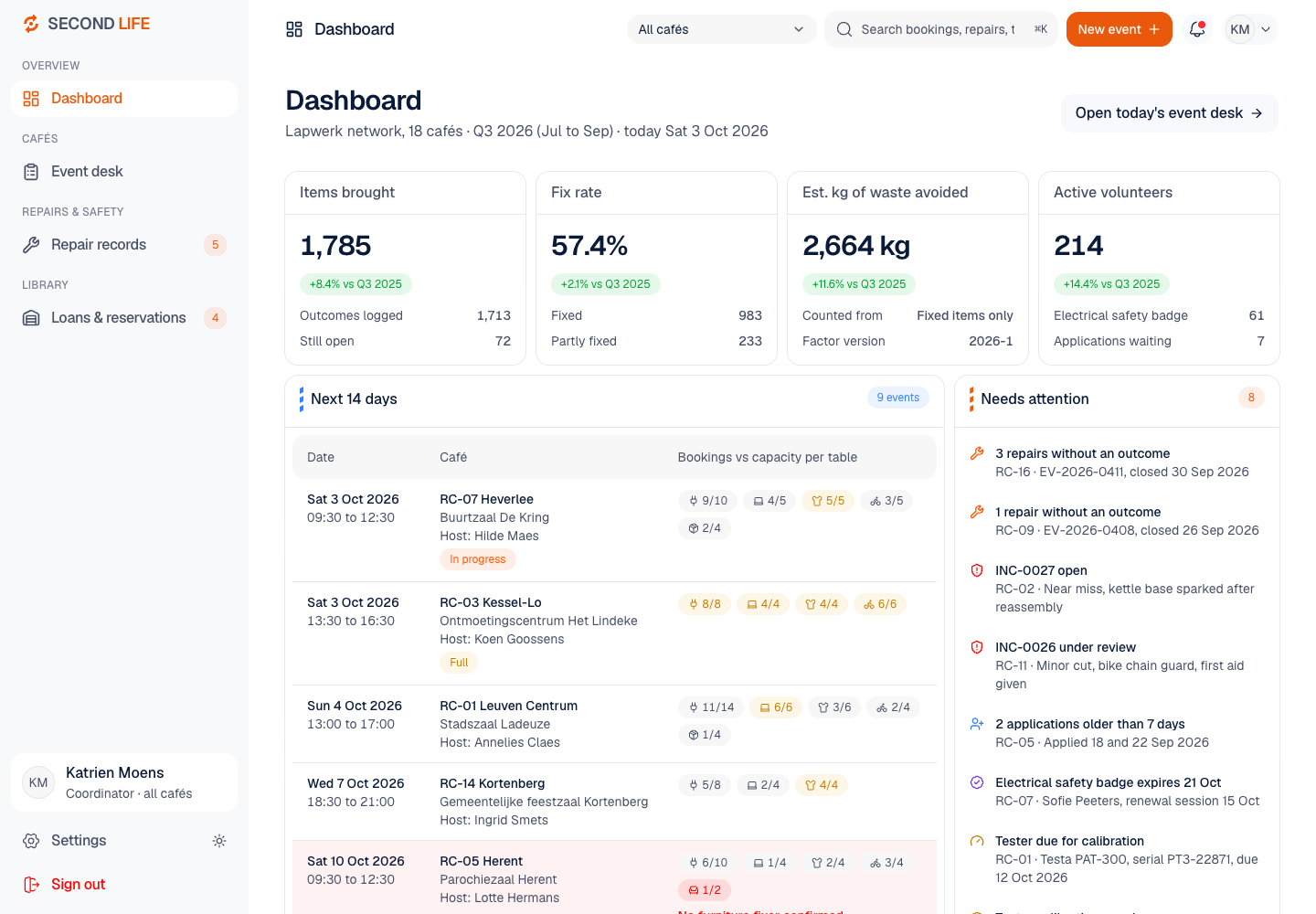
Second Life - Repair Café Platform with Safety Checks and Explainable Impact
Designed and built a clickable platform for a non-profit that runs 18 volunteer repair cafés in and around Leuven: a network dashboard, an event desk for hosts on the day, repair records with electrical safety tests, and a tool library loans desk - with waste avoided counted only from items that were fully fixed.
Enterprise Software Engineering - Human + AI
Contact Us
© 2026 - Copyright. All Rights reserved Oceanlab
Location
Global Headquarters
21 Merchant Road, 3rd Floor, Singapore 058267
Main corporate office and leadership operations
North America Office
548 Market Street, PMB 12345, San Francisco, CA 94104
Client operations and business development
India Office
402 Shivalik Shilp II, SG Highway, Ahmedabad 380015
Engineering and delivery center

Enterprise Software Engineering - Human + AI
Contact Us
Locations
Global Headquarters
21 Merchant Road, 3rd Floor, Singapore 058267
Main corporate office and leadership operations
North America Office
548 Market Street, PMB 12345, San Francisco, CA 94104
Client operations and business development
India Office
402 Shivalik Shilp II, SG Highway, Ahmedabad 380015
Engineering and delivery center
© 2026 - Copyright. All Rights reserved Oceanlab