Perungo - Produce Marketplace Linking Nepali Smallholder Farmers with Kathmandu Kitchens
Produce Marketplace for a Kathmandu Fresh Produce Trader
Designed and built a clickable operator console for a Kathmandu company that buys vegetables and fruit from hill farmers and sells them graded and delivered to restaurants, hotels and retailers: tomorrow's supply against demand, a matching board that turns order lines into collection lots, and hub intake that grades every lot and traces it back to the farmer.
Most of our work is under NDA. Per agreement, we can share the work but not the company details - all names and identifying information shown here have been changed.
Impact
Dashboard, orders, order detail with lot trace, matching board and intake & grading. Every one of the 25 demo orders opens its own detail page.
Grade factors of 1, 0.85 and 0.65 turn each day's imported Kalimati average into a farmer price band and a buyer sell price, labelled as client policy.
52 screens: 32 in the operator console, 11 in the farmer and aggregator app and 9 in the buyer web and app, plus 5 slide-over panels.
16 buyers across 5 segments, 19 farmers, aggregators and cooperatives, 14 produce items, 6 collection points, 51 listings and 16 lots on 4 collection runs.
The Problem
Bhanjyang Fresh ran its trade on phone calls, WhatsApp photos, a paper price list copied from the Kalimati wholesale board and a spreadsheet of who owed what. Farmers did not know the day's price until the truck had left, waited weeks to be paid and had no record of why a crate was downgraded. Buyers phoned every evening to repeat the same order and argued about quality with no photos, and about a fifth of what was collected spoiled at the hub because orders and collections were matched by memory.
Our Solution
Perungo gives Bhanjyang Fresh's staff one console to run the day from supply to cash. Prices come from the imported Kalimati list, tomorrow's orders are matched to farmer listings and grouped into collection lots, every lot is weighed and graded at the hub with photos, and each order line traces back to the farmer, listing, run and intake grade behind it.
The Challenge: Fresh Produce on a Tight Clock
Vegetables and fruit move from villages in Dhading, Kavre, Bhaktapur, Nuwakot and Makwanpur to Kathmandu kitchens within a day or two of harvest. The farmers, the buyers and the operator each need different information, and most of the produce cannot wait.
Prices Known After the Sale
A grower usually sold through two or three middlemen and learned the price after the truck left. The operator needed a fair, visible price per grade every morning, set from the Kalimati market average rather than a phone call.
Sellers Who Read Little
Many farmers use low-end Android phones on 3G and read little or not at all. Listing produce, accepting orders and checking payments has to work with pictures, large numbers and Nepali voice, or through a field agent in the village.
Matching by Memory
Orders close at 18:00 for next-morning delivery, and spinach and mustard greens have a best-before of 36 hours at the hub. Without one view of ordered against listed kg, short items were found too late and surplus spoiled in the cold room.
Quality, Money and Nepali Rules
Downgrades and buyer complaints had no photo trail, payouts and unpaid buyer balances were tracked in a spreadsheet, and invoices must show both PANs, VAT only on taxable charges and the Bikram Sambat fiscal year, with payments through Nepal Rastra Bank licensed providers.
Our Approach: From Produce Rules to a Clickable Console
Spec and Rules Research
Mapped 12 roles from farmer and field agent to hub staff, quality lead and finance, 52 screens across the operator console, farmer and aggregator app and buyer web and app, and the data model for sellers, KYC, consents, listings, price boards, orders, allocations, lots, runs, stock, disputes, invoices and payouts. Wrote down the rules the design follows: the Individual Privacy Act 2075 and its regulation, the E-Commerce Act 2081, the Payment and Settlement Act 2075, IRD PAN and VAT rules with the Shrawan to Ashadh fiscal year, DFTQC food quality oversight, and BS and AD dates. Fees, grades and credit terms are labelled client policy.
Clickable Demo on a Production UI Kit
Built 5 key operator console screens on a production dashboard kit: the dashboard with 5 KPIs, tomorrow's supply against demand, the order pipeline, price watch and a needs attention list; orders with bulk actions and a phone order sheet; order detail with lot trace, substitutions, charges and proof of delivery; the matching board with typed or drag-and-drop allocation and auto-match; and intake & grading with photo compare, the grading checklist, grade split and a farmer earnings preview. All actions run on local state.
What a Production Build Adds
Integration with the Kalimati daily price import, eSewa, Khalti and Fonepay, connectIPS bank transfers, Sparrow or Aakash SMS, Nepali speech to text, Galli Maps or Google Maps, photo storage, push notifications and a Tally export. Staff auth by role, an audit log of every grade change, price override, dispute decision, payout and credit limit change, the offline farmer app with voice and assisted mode, the buyer web and app, the remaining console screens, and review by a Nepali lawyer and tax adviser before launch.
Why It Works: One Lot, Traced From Village to Kitchen
A Price Before the Harvest
Each grade gets a farmer band and a sell price from the day's Kalimati average and the grade factor. The matching board shows the band for each item and grade, and price watch shows the change since yesterday and the margin per item.
Shortfalls Seen the Day Before
Tomorrow's supply against demand marks items short by more than 10% in red and over by more than 30% in amber. Auto-match fills demand from the nearest collection point first, then by rating, then by price, and short items offer a grade B split, aggregators or a buyer notice.
Every Line Traces to a Farmer
Each order line lists its source lots, and the lot trace opens the farmer, listing, collection run and intake grade. At the hub, listing, collection and intake photos sit side by side, the grade split must add up to the intake weight, and a rejection needs a reason.
Money Rules on Every Screen
Charges show produce as VAT exempt with VAT only on the service and delivery charges, and both PANs. Dates show BS first with AD alongside, and accepting a lot shows the farmer's earnings after the 3% commission and when they are payable.
Related case studies
View all: Agriculture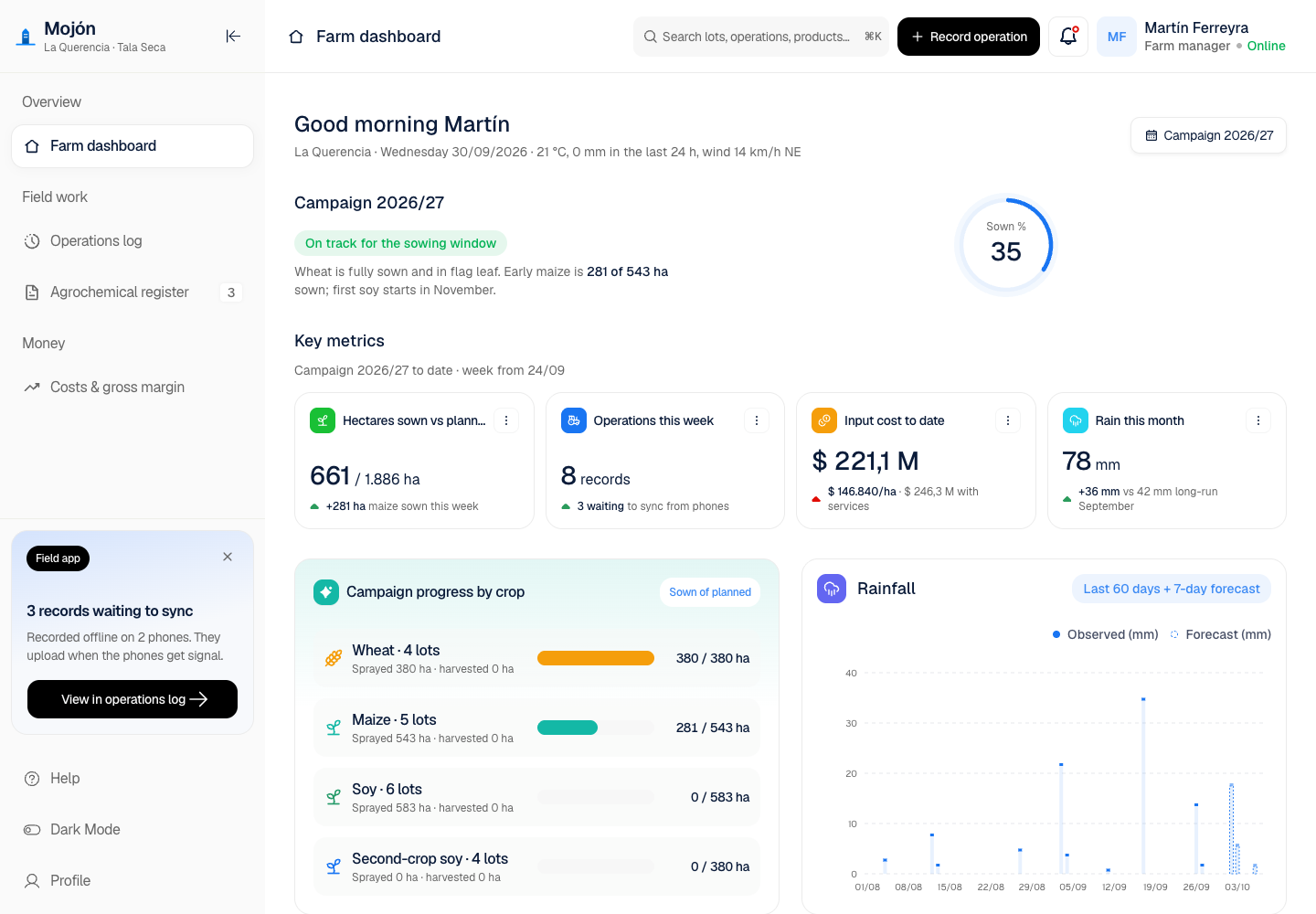
Mojón - Farm Management with Offline Field Records and a Cooperative Console
Designed and built a clickable farm management app for the member farms of a grain cooperative in Córdoba, Argentina: a field operations log, an agrochemical register that ties every spray to a signed agronomic prescription, application records ready for inspectors and grain buyers, and costs and gross margin per lot. The full design adds an offline mobile field app and a cooperative console.
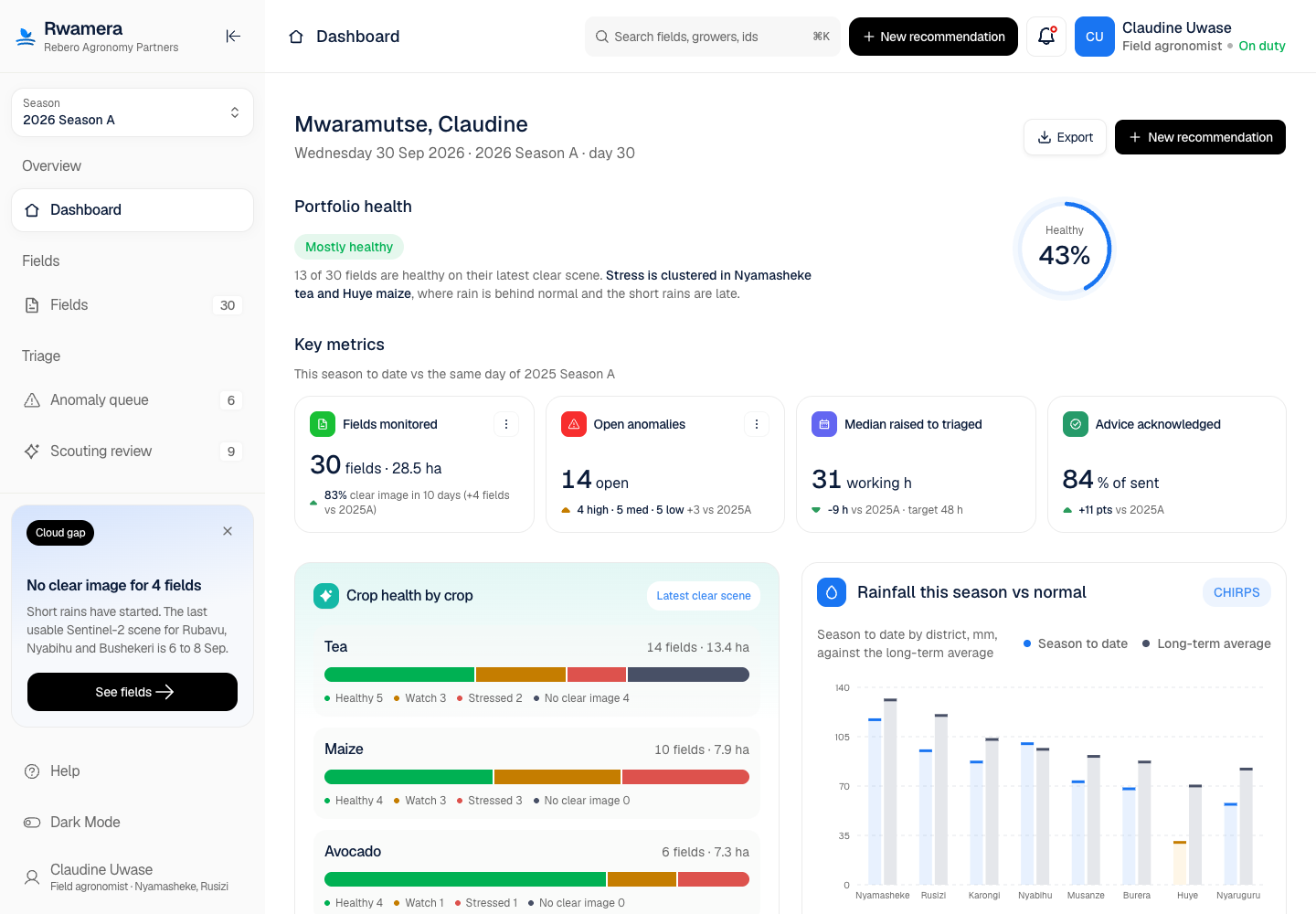
Rwamera - Satellite Crop Monitoring with Cloud-Aware Field Maps and Agronomist Triage
Designed and built a clickable crop monitoring console for a Kigali agronomy advisory firm serving tea, maize and avocado growers: satellite index maps per field with cloud masked out, a queue of stress anomalies to triage, scouting photos with an advisory-only AI suggestion, and advice that cannot name an unregistered pesticide or reach a grower without senior approval.
Enterprise Software Engineering - Human + AI
Contact Us
© 2026 - Copyright. All Rights reserved Oceanlab
Location
Global Headquarters
21 Merchant Road, 3rd Floor, Singapore 058267
Main corporate office and leadership operations
North America Office
548 Market Street, PMB 12345, San Francisco, CA 94104
Client operations and business development
India Office
402 Shivalik Shilp II, SG Highway, Ahmedabad 380015
Engineering and delivery center

Enterprise Software Engineering - Human + AI
Contact Us
Locations
Global Headquarters
21 Merchant Road, 3rd Floor, Singapore 058267
Main corporate office and leadership operations
North America Office
548 Market Street, PMB 12345, San Francisco, CA 94104
Client operations and business development
India Office
402 Shivalik Shilp II, SG Highway, Ahmedabad 380015
Engineering and delivery center
© 2026 - Copyright. All Rights reserved Oceanlab