Mukwa - AI Contract Review Checked Against the Playbook and Signed Off by a Lawyer
AI Contract Review for a Zambian Mining Company's Legal Team
Designed and built a clickable contract review tool for the in-house legal team of a Lusaka copper miner: the AI extracts each clause of a third-party contract, compares it with the company playbook, flags risks with a plain explanation and drafts redlines, while a lawyer decides every flag and only a lawyer with the right authority can sign off.
Most of our work is under NDA. Per agreement, we can share the work but not the company details - all names and identifying information shown here have been changed.
Impact
Dashboard, review queue, review workspace, issues list and sign-off, plus a New review modal. Each of the 24 demo reviews opens its own workspace, issues list and sign-off page.
Legal counsel up to ZMW 5,000,000 with no departures, senior counsel up to ZMW 25,000,000, and the Head of Legal above that and for every departure. Without authority, Sign off becomes Request sign-off from the right person.
The drilling services review carries 10 clause flags and 3 missing clauses (anti-bribery, data protection, local content), each with the quoted text, the playbook position, a suggested redline and the AI's confidence.
NDAs, supply, services, consultancy and equipment hire contracts across every status, with 21 counterparties, 15 users in 6 roles, 5 versioned playbooks and 3 matters.
The Problem
Kabwelume's legal team of five lawyers and two contracts officers handles roughly 900 third-party contracts a year. Contracts arrived by email and sat in personal inboxes, lawyers reviewed from memory and a 40-page Word playbook, and the same supplier clause was argued differently by different lawyers. A routine supply agreement took 8 to 12 working days, NDAs took 3, and the business had started signing low-value paper without legal at all.
Our Solution
Mukwa takes an uploaded contract, extracts and classifies its clauses, compares each one with Kabwelume's preferred, fallback and unacceptable positions, and flags what falls short with a plain explanation and a suggested redline. A lawyer accepts, edits or rejects every flag, builds the issues list for the counterparty and signs off within their authority. The AI never approves a contract.
The Challenge: AI Speed With a Lawyer Still Accountable
Contract review on the other side's paper is judgement work. The AI can read faster than a lawyer, but every decision, every word sent to a counterparty and every sign-off has to trace back to a named person and a known version of the playbook.
A Lawyer Decides, Not the Model
Under the Law Association of Zambia's rules of professional conduct, practitioners generally remain responsible for the advice they give, whatever tools they use. AI output can only be a first draft, and sign-off must record who decided, their authority and the playbook version used.
A Playbook Few People Had Read
The rules lived in a 40-page Word document. Each clause type needs a preferred position, fallbacks with the conditions for using them and who may agree them, and unacceptable positions that only the Head of Legal can depart from.
Privileged Advice Next to Counterparty Exports
Risk flags, lawyer notes and fallback positions are internal legal advice, while the issues list goes to the supplier. Internal analysis has to stay separate from anything exported, and be labelled privileged and confidential.
Personal Data and an Offshore Model
Contracts carry signatories' and key personnel's details, so Zambia's Data Protection Act No. 3 of 2021 generally applies. The model may run outside Zambia, so the transfer basis, no-training terms and retention have to be recorded and confirmed by the data protection officer.
Our Approach: From the Playbook to a Clickable Review Workspace
Spec and Rules Research
Mapped 6 roles from contracts officer to Head of Legal and business requester, 30 screens across the legal team app, a requester portal and a Word add-in, and the data model for reviews, extracted clauses, flags, redlines, versioned playbook positions, issues by round, departures, sign-offs and AI runs. Wrote down the rules the design follows: lawyer accountability, data protection, privilege, no training on client documents and licence flow-down clauses for the mine.
Clickable Demo on a Production UI Kit
Built 5 key screens on a production workspace kit: the dashboard with turnaround, queue by status and most negotiated clauses, the review queue with open flag counters and a quick view, the three-column review workspace with clause outline, inline tracked-change redlines and flag cards, the issues list with internal and counterparty views and round tracking, and sign-off with the readiness checklist and authority check. All actions run on local state.
What a Production Build Adds
An enterprise LLM such as Anthropic Claude or Azure OpenAI Service with no training on inputs, OCR for scanned contracts, a Word add-in writing real tracked changes through Office.js and Open XML, Microsoft Entra ID sign-in, email intake through Microsoft Graph, SharePoint or a legal DMS for storage and Teams notifications. Plus the playbook editor with approval, clause library, accuracy feedback, the requester portal and an append-only audit log of every AI run and human decision.
Why It Works: Every AI Suggestion Has an Owner
Flags Show Their Evidence
Each flag card quotes the contract text, shows the playbook position it was compared with, explains the gap in plain words and gives the AI's confidence. The lawyer accepts, edits or rejects it, with a reason required to reject, and Why? opens the model and prompt version behind it.
Redlines Stay Suggestions Until Accepted
Suggested changes appear inline as tracked changes marked AI suggestion, and the document toggles between original, with suggestions and accepted changes only. A persistent chip in the top bar reminds everyone that AI suggestions are drafts and a lawyer signs off.
Internal View and Counterparty View
The issues list holds playbook result, risk level, acceptable fallback and lawyer notes only in the privileged internal view. The counterparty view shows just the clause, their wording, our position and the reason given, and only that view is exported.
Sign-Off Checks Readiness and Authority
Sign-off lists every condition: flags decided, high-risk clauses reviewed, missing clauses added or waived, questions answered and a final version uploaded. It then checks the contract value and any unacceptable position against the signer's authority and routes departures to the Head of Legal.
Related case studies
View all: LegalTech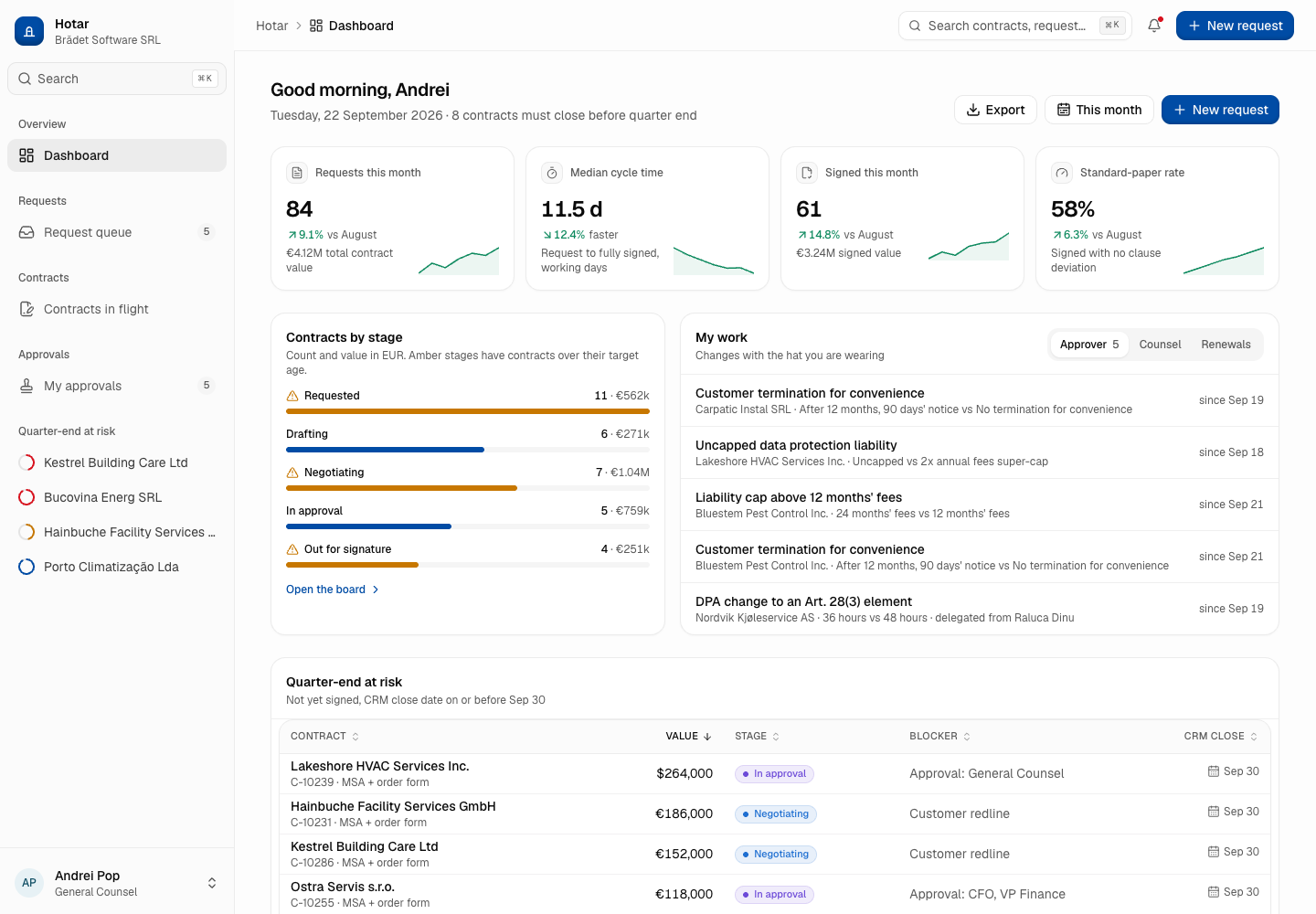
Hotar - Sell-Side Contract Lifecycle Management with an Approval Matrix
Designed and built a clickable contract lifecycle system for a Cluj-Napoca software company selling to EU and US customers: contract requests from CRM deals, a board of every contract in negotiation, a contract workspace with versions, clauses and signature level, and approvals routed by a fixed matrix of discount, liability, payment and data protection rules.
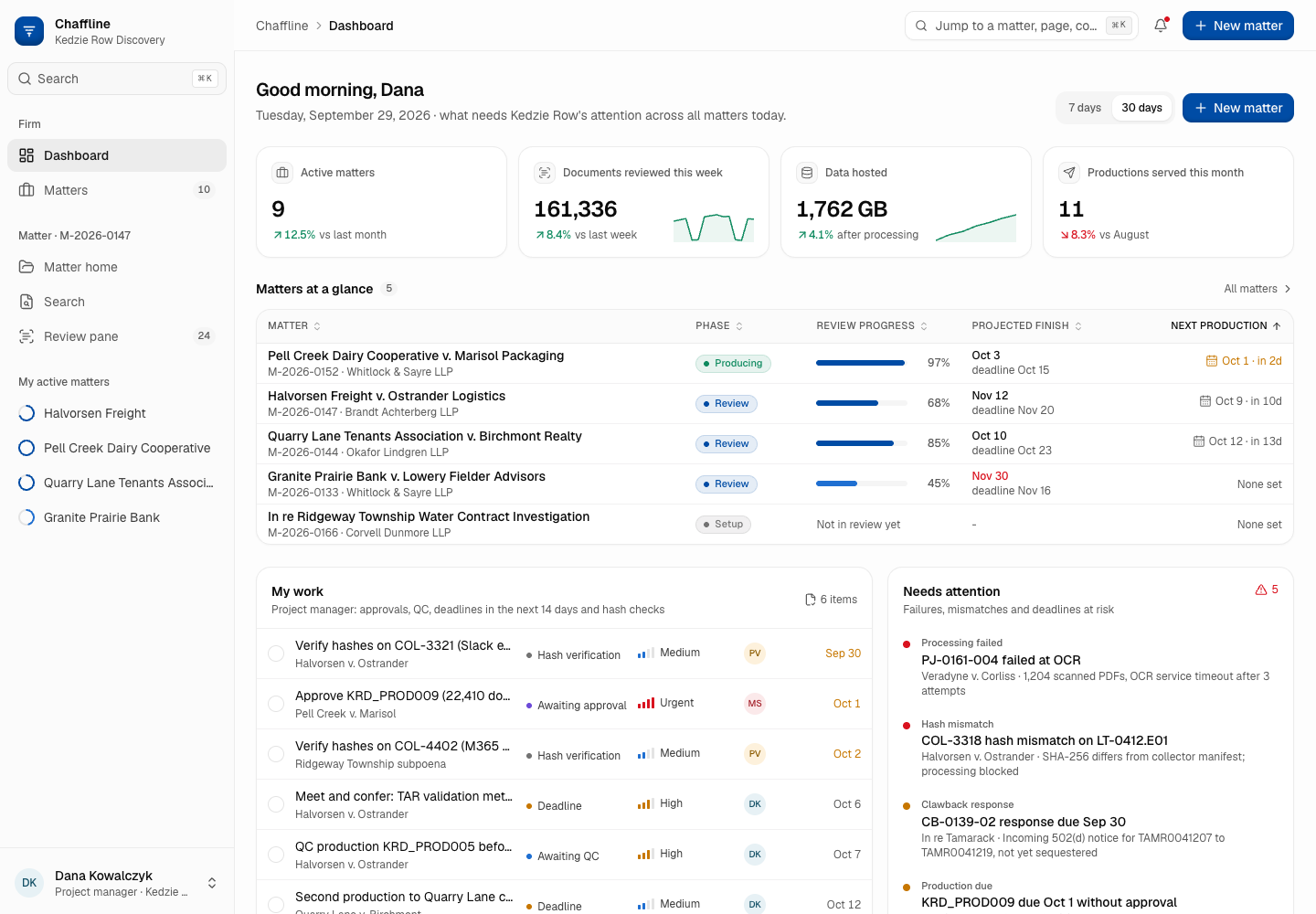
Chaffline - E-Discovery Search and Document Review Platform
Designed and built a clickable e-discovery platform for a Chicago litigation support firm that hosts and reviews data for US law firms: a dashboard across every matter, each matter's path from collection to production, Boolean, proximity and concept search, and a review pane where contract reviewers code documents with the privilege basis recorded at the moment of the call.
Enterprise Software Engineering - Human + AI
Contact Us
© 2026 - Copyright. All Rights reserved Oceanlab
Location
Global Headquarters
21 Merchant Road, 3rd Floor, Singapore 058267
Main corporate office and leadership operations
North America Office
548 Market Street, PMB 12345, San Francisco, CA 94104
Client operations and business development
India Office
402 Shivalik Shilp II, SG Highway, Ahmedabad 380015
Engineering and delivery center

Enterprise Software Engineering - Human + AI
Contact Us
Locations
Global Headquarters
21 Merchant Road, 3rd Floor, Singapore 058267
Main corporate office and leadership operations
North America Office
548 Market Street, PMB 12345, San Francisco, CA 94104
Client operations and business development
India Office
402 Shivalik Shilp II, SG Highway, Ahmedabad 380015
Engineering and delivery center
© 2026 - Copyright. All Rights reserved Oceanlab